

Market Review and Outlook
Rollovers and Required minimum Distributions: Today’s Slott Report Mailbag
By Andy Ives, CFP®, AIF®
IRA Analyst
QUESTION:
A 401(k) plan participant over age 73 wants to roll over his account to a new IRA. I understand that he must take a required minimum distribution (RMD) before the rollover. Is an additional RMD required in the same year from the IRA?
ANSWER:
If this person has no other IRAs besides the new one receiving the 401(k) funds, then no additional RMD needs to be taken from the IRA for this year. Reason being is that the IRA receiving the 401(k) rollover funds had a $0 balance on December 31, 2024. With no balance for the previous year’s end, there is no 2025 RMD on the IRA to calculate.
QUESTION:
I am turning age 73 this year and will need to take my RMD. I have three different investment firms for my IRAs, SEP IRA plan and a 457(b) plan. My question is: Do I have to take my required minimum distribution (RMD) from each plan/firm or can I take the full amount from any one of the accounts?
Thank you,
Dean
ANSWER:
Dean,
Your question is all about the RMD aggregation rules. Some accounts can be aggregated for RMD purposes, and some cannot. In your specific scenario, the IRAs and SEP IRA account RMDs can be aggregated. While the RMD must be calculated individually for each IRA and the SEP account, all or any portion of the aggregated total can be taken from any combination of the IRAs and SEP. The 457(b) RMD, on the other hand, cannot be aggregated with any other account. That RMD must be taken from the 457(b) plan.
If you have technical questions you would like to have answered, be sure to submit them to mailbag@irahelp.com, to be answered on an upcoming Slott Report Mailbag, published every Thursday.
https://irahelp.com/slottreport/rollovers-and-required-minimum-distributions-todays-slott-report-mailbag/

Is 2025 a Bad Year To Retire With the Stock Market in the Dumps?
2025 may seem like a bad year to retire if you’re looking at the stock market alone. But that’s not the only consideration.
It sure seems like a bad year to retire. The stock markets are falling, taking 401(k) balances along with it, tariffs are in place, federal government workers are losing jobs and egg prices are up about 59% year-over-year.
If you were planning to retire in 2025, recent economic developments may give you pause. After all, who wants to exit the workforce with less money to spend in retirement? Especially since it can easily last over twenty years.
Against that backdrop, 2025 may seem like a terrible year to retire, but whether that’s true for you comes down to how much you’ve saved, where you draw money from in retirement and how much you plan to spend during your golden years.
“For people who are planning to spend principal money during their retirement years, then this is a tougher year to start,” says Christopher R. Manske, a certified financial planner and president of Manske Wealth Management. “But if they do not need to spend money, then 2025 is a great year to retire.”
Why 2025 could be a bad year to retire given the stock markets
When retiring in a down market, you must be mindful of the sequence-of-returns risk. That occurs when poor investment returns early in retirement negatively impact your retirement savings over the long run. In that scenario, you may need to sell parts of your portfolio to meet your income needs, likely at a low point. As a result, you could end up selling more than originally planned to compensate for the shortfall.
“So far 2025 is shaping up to potentially be a future period in which withdrawal rates are lower because the markets are going down,” says David Blanchett, managing director, portfolio manager and head of retirement research for PGIM DC Solutions. “The markets have done really well for a long time and was [sic] due for at least some kind of correction.”
The question, says Blanchett, is what flexibility do you have in how and when you make withdrawals from your portfolio in retirement? Will you have enough money for it to last your lifetime? “If you have to withdraw from the portfolio and returns are down 20%, that ultimately is a double whipping,” he says.
Another risk of retiring in a weak market is becoming overly conservative to staunch a bleeding portfolio. That may prompt you to sell all your positions and move to cash, exacerbating your losses because you’re not giving the portfolio time to recover.
If history is any evidence, investors who stay the course in down markets tend to recoup their losses and then some. That was the case during the Great Recession of 2007-2009 and the early days of the COVID-19 pandemic.
“Often retirees get uber-conservative and move into cash and lock in their losses. Historically, the right play is to give the portfolio a chance to recover,” says Blanchett. He says retirees who do move to cash tend to commit the cardinal investing sin: they sell low and buy high. All of that could mean less money to live off in retirement.
Plus, if you do have to reenter the workforce because you are running out of money, you may have a difficult time getting a job comparable to your old one. You might even have to take anything to bring in cash. That’s a recipe for a miserable retirement.
“I think a great way to look at this is the simple question: do I have enough income coming in, without selling any holdings, to cover my expenses,” says Manske. “If you don’t see any need to sell a single holding for the next three years, then there’s no need to wait. If you do see the need to sell, then you might seriously consider waiting to retire.”
Why 2025 may be a good year to retire
Stocks rise and stocks fall. If you have been doing your job by saving for the long term, diversifying your portfolio and keeping your debt in check, then 2025 is a perfectly fine time to retire.
After all, inflation is stable, at least for now. The Consumer Price Index for February increased by 2.8% year over year, lower than economists expected — and it’s yet to be determined how tariffs will impact everyday goods and services.
But before you make the leap, Emily Irwin, head of Wells Fargo’s advice center, says to do a pulse check of where you’re at to ensure you can withstand potential losses in your portfolio in the first few years of your retirement.
Here are some key questions you should ask yourself.
- Have I been maxing out my 401(K) and making catch-up contributions?
- Have I worked with a professional adviser to ensure I’m taking advantage of tax structures?
- Is my living situation affordable and stable?
- Finally, can I emotionally handle a decline in my portfolio when I no longer collect a paycheck?
Irwin suggests reviewing your retirement plan and running scenarios. Will you have enough cash in retirement if the portfolio is down 10%? If you start taking 401(k) or IRA distributions and they are depleted, will you still be OK?
“The purpose of retirement is to move on to the next chapter, whether that’s to spend time with family, travel or whatever your next chapter is. If you don’t think you will enjoy it, punt until next year,” says Irwin. “If you can compartmentalize noise, you’ve done the right things, and you don’t need to make any trade-offs based on how you saved over the last few decades,” then full steam ahead with your retirement plan.
https://www.kiplinger.com/retirement/is-this-a-bad-year-to-retire
Will Market Volatility Mean RMD Waivers for 2025?
By Sarah Brenner, JD
Director of Retirement Education
Recent turmoil in the markets has hit many retirement savers hard as they see their IRA and 401(k) balances rapidly shrinking. For many, the age-old advice to stay the course for the long term and not cash out too soon applies, but for those who are age 73 or older, the rules requiring required minimum distributions (RMDs) present a hurdle.
2025 RMDs
Under current tax rules, IRA owners and many participants in employer plans must start taking RMDs once they reach the year in which they turn age 73. (The first RMD can be delayed until the following April 1, but then you would have two RMDs due in the next year.) Some plan participants can also delay RMDs if they are still working.
To calculate your 2025 RMD, you divide the December 31, 2024, balance of your account by the factor that corresponds with your age on the IRS Uniform Lifetime Table. Here is the issue: Due to recent market losses, many have seen their account balances decrease sharply from where they were at the end of 2024. This means taking an RMD calculated on a much bigger balance from a significantly smaller account.
RMD Waivers
Will retirement savings get any relief from this 2025 RMD hit?
In the past, when the markets have experienced very severe declines, Congress has stepped in and waived RMDs for the year. We saw this happen in 2009 during the Great Recession and then again in 2020 due to the global pandemic. As of right now, it is too early to tell if similar relief will be available in 2025, but the fact that this happened before is worth noting.
In these times of market volatility, retirement savers may want to delay 2025 RMDs until later in the year. Retirement account balances may have recovered by then, or Congress may act and grant some relief, as they have done before.
Stay Tuned
At the Slott Report, we have heard from many IRA owners and plan participants who are concerned about their 2025 RMDs in these times of market losses. We will be following any developments on this issue closely. Stay tuned for updates!
If you have technical questions you would like to have answered, be sure to submit them to mailbag@irahelp.com, to be answered on an upcoming Slott Report Mailbag, published every Thursday.
https://irahelp.com/slottreport/will-market-volatility-mean-rmd-waivers-for-2025/
Who Can Use a 10% Penalty Exception?
By Andy Ives, CFP®, AIF®
IRA Analyst
As a follow up to the March 26 Slott Report entry that included a full list of the 10% early withdrawal penalty exceptions (“10% Penalty Exceptions: IRAs and Plans”), here we get a little deeper into the weeds on some of the nuances of certain exceptions. As mentioned in the March 26 article, some exceptions apply to plans only, some to IRAs only, and some to both. Taking that concept a bit further, some exceptions apply to the account owner only, and some to certain extended family members of the account owner.
Not only must a person know which exceptions apply to which accounts, but they must also recognize who can leverage these exceptions. We have seen countless situations where a misunderstanding has led to the exception being denied. For example, in a recent court case, an IRA owner under the age of 59½ took a distribution from his account and claimed the disability exception. He used the dollars to cover expenses for his disabled wife. And therein lies the problem. The disability exception is applicable to the IRA owner only. Even though the distributed money was used to cover the legitimate costs for taking care of a disabled person (the wife), the IRA owner (husband) was not disabled. To qualify for the exception, the withdrawal needed to come from the disabled wife’s account. The 10% penalty exception was denied.
Like the disability exception, other exceptions available to the account owner ONLY include birth or adoption, terminal illness, active reservists, age 55, and the 72(t) substantially equal periodic payment exception. Meaning, the account owner himself must be the one who is terminally ill or adopting a child. Other exceptions are applicable to the account owner AND certain extended family members. These include the following:
- Higher Education (IRAs only). The 10% penalty on the IRA distribution can be avoided if the higher education costs are for the IRA account owner, his spouse, child, or grandchild of either the owner or spouse. Nephews, cousins and siblings of the IRA owner do not qualify.
- First-Time Homebuyer (IRAs only). For the purchase of a home belonging to the IRA owner, his spouse, any child, grandchild, or ancestor of the IRA owner or his spouse. Again, people like nephews, cousins and siblings of the IRA owner do not qualify.
- Medical Expenses over 7.5% of adjusted gross income (Plans and IRAs). This exception is used for expenses incurred by the account owner, spouse or dependent. Just be careful with timing. The medical expenses must be paid in the same year as the distribution.
- Domestic Abuse (Plans and IRAs). The IRA owner himself does not need to be the victim to qualify for this exception. The abuse could be inflicted on the account owner’s child or another family member living in the household.
- Financial Emergencies (Plans and IRAs). This exception is for distributions necessary to meet “unforeseeable or immediate financial needs relating to personal or family emergencies.” Hence, it is available for a family member’s emergency, not just those of the account owner.
If you have technical questions you would like to have answered, be sure to submit them to mailbag@irahelp.com, to be answered on an upcoming Slott Report Mailbag, published every Thursday.
https://irahelp.com/slottreport/who-can-use-a-10-penalty-exception/

Weekly Market Commentary
-Darren Leavitt, CFA
Global financial markets tumbled last week as investors moved out of risk assets, fearing that a worldwide trade war would ensue after Trump’s tariffs were higher than anticipated. Thursday and Friday’s market action resulted in a $5.4 trillion loss in US market capitalization. Q1-2025 ended on Monday, marking the worst quarter since 2022, and March was also the worst month since 2022. The first quarter was also the worst quarter for US stocks when compared to the rest of the world’s equity indices since 2009. Have we seen peak uncertainty in the markets? That is the question many on Wall Street are contemplating. Now that the US has announced its tariffs, will other countries retaliate with their own tariffs? China imposed a 34% tariff in response to the announcement that the US would levy an additional 34% on Chinese goods, resulting in an overall duty of 54% on Chinese goods. On the other hand, Vietnam and Cambodia announced that they would eliminate tariffs on US goods and sought to negotiate with the US to remove the announced tariffs. I am in the camp that negotiations will be ongoing, and in the end, overall global tariffs will be reduced. That said, the current narrative is that these announced tariffs will increase inflation, slow global growth, and perhaps tip several economies into recession. According to a survey from Bloomberg, economists have increased the probability of recession in the next year to 30% from 20% at the end of 2024. The idea of slower growth means that corporate earnings are likely to be revised lower in the coming months as first-quarter earnings are announced. This may lead to another leg lower for the market, although some of this has likely already been priced into the market. Investors should expect increased volatility in the coming weeks as retaliatory tariffs are announced and negotiations result in new levels of duties. The volatility index (VIX) spiked to 45, the highest level since the Covid-19 pandemic hit the markets in March 2020. I would expect some moderation in the VIX over the coming days and weeks, but I anticipate it will remain elevated for the next couple of months.

The S&P 500 lost 9.1%, the Dow shed 7.9%, the NASDAQ tumbled 10%, entering a bear market, falling more than 20% from its recent highs, while the Russell 2000 gave back 9.7%. It was just an ugly week on Wall Street. The Information Technology sector lost 11.4%, the Financials Sector shed 11.4%, and the Energy Sector fell by 15%. All 11 S&P 500 sectors fell on the week. US Treasuries did offer a safe-haven quality. The 2-year yield fell by twenty-four basis points to 3.67%, while the 10-year yield fell by twenty-seven basis points to 3.99%. Interestingly, the market now has priced in a 50% probability that the Federal Reserve will cut its policy rate by 100 basis points by the end of the year. Commodities offered no safe haven for investors. Gold prices dropped from their all-time highs by 2.5% or $78.50 to close at $3,034.60. Oil prices hit a four-year low after falling 10.6% or $7.32 to close at $62.02 a barrel. Copper prices fell by 14.5% to close at $4.39 per Lb. Bitcoin’s price increased by $200 to close at $82,962. The US Dollar index fell by 1.1% to close at 102.89. The Yen, Euro, and Swiss Franc were all bid higher on the week.

The Employment Situation report was the highlight of this week’s economic calendar. Non-farm payrolls came in much better than expected at 228,000 versus the consensus estimate of 130,000. Private Payrolls were also better, coming in at 209,000 versus the estimated 120,000. The Unemployment rate ticked higher to 4.2% from 4.1%. Average Hourly earnings were in line with expectations of 0.3%, as was the average workweek at 34.2 hours. In aggregate, this was a good report; however, revisions to the prior two months of data were lower and cast a slight shadow over the overall report. ISM Manufacturing fell into contraction with a reading of 49, down from the previous figure of 50.3, and concerns about prices paid were noted by several economists. ISM Services remained in expansion but just barely, coming in at 50.8, down from the prior reading of 53.5. Job openings fell to 7.568 million from 7.762 million. Initial Jobless claims fell by 6k to 219k, while Continuing Claims increased by 56K to 1.903 million- the highest level since November of 2021.

Investment advisory services offered through Foundations Investment Advisors, LLC (“FIA”), an SEC registered investment adviser. FIA’s Darren Leavitt authors this commentary which may include information and statistical data obtained from and/or prepared by third party sources that FIA deems reliable but in no way does FIA guarantee the accuracy or completeness. All such third party information and statistical data contained herein is subject to change without notice. Nothing herein constitutes legal, tax or investment advice or any recommendation that any security, portfolio of securities, or investment strategy is suitable for any specific person. Personal investment advice can only be rendered after the engagement of FIA for services, execution of required documentation, including receipt of required disclosures. All investments involve risk and past performance is no guarantee of future results. For registration information on FIA, please go to https://adviserinfo.sec.gov/ and search by our firm name or by our CRD #175083. Advisory services are only offered to clients or prospective clients where FIA and its representatives are properly licensed or exempted.
Weekly Market Commentary
-Darren Leavitt, CFA
Global financial markets tumbled last week as investors moved out of risk assets, fearing that a worldwide trade war would ensue after Trump’s tariffs were higher than anticipated. Thursday and Friday’s market action resulted in a $5.4 trillion loss in US market capitalization. Q1-2025 ended on Monday, marking the worst quarter since 2022, and March was also the worst month since 2022. The first quarter was also the worst quarter for US stocks when compared to the rest of the world’s equity indices since 2009. Have we seen peak uncertainty in the markets? That is the question many on Wall Street are contemplating. Now that the US has announced its tariffs, will other countries retaliate with their own tariffs? China imposed a 34% tariff in response to the announcement that the US would levy an additional 34% on Chinese goods, resulting in an overall duty of 54% on Chinese goods. On the other hand, Vietnam and Cambodia announced that they would eliminate tariffs on US goods and sought to negotiate with the US to remove the announced tariffs. I am in the camp that negotiations will be ongoing, and in the end, overall global tariffs will be reduced. That said, the current narrative is that these announced tariffs will increase inflation, slow global growth, and perhaps tip several economies into recession. According to a survey from Bloomberg, economists have increased the probability of recession in the next year to 30% from 20% at the end of 2024. The idea of slower growth means that corporate earnings are likely to be revised lower in the coming months as first-quarter earnings are announced. This may lead to another leg lower for the market, although some of this has likely already been priced into the market. Investors should expect increased volatility in the coming weeks as retaliatory tariffs are announced and negotiations result in new levels of duties. The volatility index (VIX) spiked to 45, the highest level since the Covid-19 pandemic hit the markets in March 2020. I would expect some moderation in the VIX over the coming days and weeks, but I anticipate it will remain elevated for the next couple of months.
The S&P 500 lost 9.1%, the Dow shed 7.9%, the NASDAQ tumbled 10%, entering a bear market, falling more than 20% from its recent highs, while the Russell 2000 gave back 9.7%. It was just an ugly week on Wall Street. The Information Technology sector lost 11.4%, the Financials Sector shed 11.4%, and the Energy Sector fell by 15%. All 11 S&P 500 sectors fell on the week. US Treasuries did offer a safe-haven quality. The 2-year yield fell by twenty-four basis points to 3.67%, while the 10-year yield fell by twenty-seven basis points to 3.99%. Interestingly, the market now has priced in a 50% probability that the Federal Reserve will cut its policy rate by 100 basis points by the end of the year. Commodities offered no safe haven for investors. Gold prices dropped from their all-time highs by 2.5% or $78.50 to close at $3,034.60. Oil prices hit a four-year low after falling 10.6% or $7.32 to close at $62.02 a barrel. Copper prices fell by 14.5% to close at $4.39 per Lb. Bitcoin’s price increased by $200 to close at $82,962. The US Dollar index fell by 1.1% to close at 102.89. The Yen, Euro, and Swiss Franc were all bid higher on the week.
The Employment Situation report was the highlight of this week’s economic calendar. Non-farm payrolls came in much better than expected at 228,000 versus the consensus estimate of 130,000. Private Payrolls were also better, coming in at 209,000 versus the estimated 120,000. The Unemployment rate ticked higher to 4.2% from 4.1%. Average Hourly earnings were in line with expectations of 0.3%, as was the average workweek at 34.2 hours. In aggregate, this was a good report; however, revisions to the prior two months of data were lower and cast a slight shadow over the overall report. ISM Manufacturing fell into contraction with a reading of 49, down from the previous figure of 50.3, and concerns about prices paid were noted by several economists. ISM Services remained in expansion but just barely, coming in at 50.8, down from the prior reading of 53.5. Job openings fell to 7.568 million from 7.762 million. Initial Jobless claims fell by 6k to 219k, while Continuing Claims increased by 56K to 1.903 million- the highest level since November of 2021.
Investment advisory services offered through Foundations Investment Advisors, LLC (“FIA”), an SEC registered investment adviser. FIA’s Darren Leavitt authors this commentary which may include information and statistical data obtained from and/or prepared by third party sources that FIA deems reliable but in no way does FIA guarantee the accuracy or completeness. All such third party information and statistical data contained herein is subject to change without notice. Nothing herein constitutes legal, tax or investment advice or any recommendation that any security, portfolio of securities, or investment strategy is suitable for any specific person. Personal investment advice can only be rendered after the engagement of FIA for services, execution of required documentation, including receipt of required disclosures. All investments involve risk and past performance is no guarantee of future results. For registration information on FIA, please go to https://adviserinfo.sec.gov/ and search by our firm name or by our CRD #175083. Advisory services are only offered to clients or prospective clients where FIA and its representatives are properly licensed or exempted.
Deferral of First RMD and RMDs for Roth IRAs: Today’s Slott Report Mailbag
Question:
My wife turns 73 years old in August 2025. My understanding is that she has until April 1, 2026, to take her first required minimum distribution (RMD), in which case she would wind up taking two RMDs in 2026.
The RMD for 2025 is approximately $24,000. My question is: Can she can take a partial RMD of, say, $20,000 in 2025 and the $4,000 balance in 2026? Or, if she takes anything out of the IRA in 2025, does it have to be the full amount?
Thank you.
Les
Answer:
Hi Les,
Your wife can split the 2025 RMD between 2025 and 2026, as long as the total RMD is taken by April 1, 2026.
Question:
I am turning age 73 in 2025. I am still working, so I know I don’t need to start taking RMDs on my 401(k) because my plan has the still-working provision. All of my IRAs have been converted to Roth IRAs. I do a backdoor Roth each year on January 1. My question is: Do I need to take an RMD on the $8,000 contribution before I convert it to a Roth IRA?
Clinton
Answer:
Hi Clinton,
No, an RMD does not need to be taken. The reason is that lifetime RMDs are only required for traditional IRAs – not Roth IRAs. So, the RMD is based on the prior-year 12/31 account balance of your traditional IRAs divided by your life expectancy under the IRS Uniform Lifetime Table. If all of your traditional IRAs have been converted, then, for RMD purposes, you will have a zero account balance as of 12/31 of the prior year.
If you have technical questions you would like to have answered, be sure to submit them to mailbag@irahelp.com, to be answered on an upcoming Slott Report Mailbag, published every Thursday.
https://irahelp.com/slottreport/deferral-of-first-rmd-and-rmds-for-roth-iras-todays-slott-report-mailbag/

5 Dos and Don’ts When Lending Money to Loved Ones
Helping friends or family shouldn’t mean hurting your finances
Let’s face it: Money is tight for many people. And if you have loved ones in your life who are struggling financially, you may feel inclined to help them.
If you do, proceed with caution. According to a 2022 CreditCards.com survey, 42 percent of people who lent money did not get repaid, and about half of Baby Boomers and Gen Xers said they got burned in such transactions.
“One of the most common mistakes people make when lending money to family and friends is expecting to get it back,” says Nate Towers, director at Five Pathways Financial, a retirement planning firm in Phoenix. “If you’re going to lend money, you should assume that you might not be repaid. If you’re OK with that, then go ahead, but if not, you need to take steps to protect both parties involved.”
Are you considering loaning money to a loved one? Heed these dos and don’ts to protect yourself.
Do understand how it could impact your relationship
Before you choose to loan money to a friend or family member, think about the potential repercussions it could have on your relationship with them. According to the CreditCards.com survey, more than a quarter of people who lent money said it damaged their relationship with the borrower.
“Ask yourself what will happen if the loan isn’t repaid,” says Matthew Argyle, a certified financial planner and principal at Encore Retirement Planning in South Jordan, Utah. “Can you sacrifice the funds without sacrificing the relationship? If they fail to repay, will you sue them? Will conflict and resentment ruin the relationship?” Bottom line: weigh the risks before opening up your wallet to a close friend or relative.
Don’t lend money you don’t have
You should also be careful how much cash you loan someone. While it might be nice to help your loved one cover the entire cost of whatever expense they’re facing, limiting the loan to what you can reasonably afford is important.
“This is one of those situations where you need to ask yourself, ‘If I don’t get paid back, will I be OK?’ ” Towers says. “Be honest with your answer. If you lost 100 percent of what you’re lending right now, could you handle it? Would it affect your financial stability in the long run?”
Moreover, you shouldn’t tap into your emergency fund to loan money; reserve those funds for a rainy day of your own. And if you decide to use some of your retirement savings to help out a loved one, make sure it won’t throw your long-term plans off track.
“You should always prioritize your own financial security before lending to family, no matter how much you want to help,” Towers says. “If lending will jeopardize your retirement, it’s simply not worth the risk. Think of it like being on an airplane: They always tell you to put your oxygen mask on first before helping others. It’s sound advice in this situation.”
Another thing to consider: If you have to pay any penalties for the funds you loan out — early withdrawal fees on a certificate of deposit (CD) or individual retirement account (IRA), for example — consider factoring those costs into the loan amount.
Do get it in writing
Before you give a loved one money, get the terms and conditions of the loan down on paper. While you might trust the person to keep their word, having an agreement in writing can ensure there’s a legal obligation to do so.
You could have an attorney craft a loan agreement, or create one using an online legal resource such as LawDepot, Nolo or Rocket Lawyer. A promissory note — a document in which the borrower promises to repay the other party a specified amount of money — will often suffice in these situations, Argyle says.
The contract “should include key details, like whether you’ll charge interest, the repayment schedule, due dates and any consequences if the loan isn’t repaid,” Towers says. “You might even consider having another family member sign as a witness. For an added layer of legitimacy, you can also have the contract notarized at your local bank.”
A signed agreement reduces the potential for disputes and “preserves goodwill,” Argyle says. It’s also important tax-wise if the borrower fails to repay the loan.
“If you aren’t repaid, you may be able to claim a bad debt deduction, but only if you can prove the loan was legitimate,” Towers says. The loan contract provides this evidence.
Don’t forget about the IRS
When planning your loan, make sure you take into account the potential tax implications. These will depend on where you source the money, financial and legal professionals say. “If you have to pull it from your IRA, you are incurring [income] taxes to get the money,” says Pat Simasko, an elder law and estate planning attorney at Simasko Law Offices in Mount Clemens, Michigan. (This is only true for traditional IRAs, withdrawals from which are taxable; with Roth IRAs, you pay income taxes on these before putting money in the account.)
Generally, money you withdraw from a 401(k) is also taxed at your ordinary income tax rate (unless you’re using a 401(k) loan). And “if you are selling stock, there might be capital gains taxes,” Simasko says. “It all adds up and should be included in the amount they have to repay you.”
If you loan out more than $10,000, you’ll need to charge interest on the loan, too, Argyle says. The IRS sets the applicable interest rates monthly. “That interest counts as taxable income, and you’ll need to report it on your tax return,” Towers says. “Depending on the size of the loan, this could push you into a higher tax bracket.”
Do consider consulting experts
Ultimately, the best way to protect yourself is to consult an attorney when setting up your loan. You could get guidance from a tax adviser and a retirement planner as well.
“Obtaining professional advice on the front end helps address any potential violations of the law,” says Troy A. Young, a certified financial planner and founder of Destiny Financial Group in Atlanta. “It is always easier to prepare than it is to repair.”
Can’t lend money? Offer other ways to help
If you determine you’re not in a position to loan a loved one money or the relationship just isn’t worth the risk, you may need to politely decline.
“You can soften the message by offering emotional support like, ‘I wish I could help, but I’m not able to lend you money right now. If there’s anything else I can do to support you, let me know,’ ” Argyle says. “You can also redirect them with a line like, ‘I’m not in a position to lend money, but I can help you look into other options.’ ” If your finances are tight, offering to help with childcare, for example, could be a way to provide meaningful assistance and help your loved one save money.
In some cases, you might consider cosigning a loan with your loved one if it would help them qualify for one. But be careful: If they fail to make payments, you would need to step in and take over. For this reason, make sure “you can shoulder the full payment without hardship” before co-signing, Argyle says.
https://www.aarp.org/money/personal-finance/lending-money-to-loved-ones/
Higher IRA Federal Bankruptcy IRA Protection Limit Became Effective on April 1
By Ian Berger, JD
IRA Analyst
When you file for bankruptcy, one thing you usually don’t have to worry about is protecting your IRA funds from your bankruptcy creditors.
That’s because, in just about every case, all of your IRA (and Roth IRA) monies are off limits. Under the federal bankruptcy law, IRA assets up to a certain dollar limit cannot be reached by creditors. That dollar limit is indexed every three years based on the cost-of-living. On April 1, the dollar limit increased from $1,512,350 to $1,711,975, effective through March 31, 2028.
That limit is especially generous because it doesn’t take into account rollovers from employer plans like 401(k) or SEP and SIMPLE IRA plans. (Those rolled-over dollars are always fully protected.) So, only IRA contributions themselves, and earnings on those contributions, are taken into account. Since IRAs did not become available until 1975, it would be a rare case for someone to have amassed over $1.7 million from IRA contributions and earnings alone.
Of course, the $5 billion Roth IRA owned by Peter Thiel, a cofounder of PayPal, is a notorious exception to that rule. If you’re also an IRA owner lucky enough to have contributory IRAs and earnings worth more than the federal dollar limit, you may have two other ways to shield your entire IRA portfolio in bankruptcy.
First, you may live in a state that has its own state bankruptcy law protecting all of your IRA funds in bankruptcy – no matter how large (in other words, without the $1.7 cap).
You may also have protection if you live in certain states with an anti-garnishment law. That’s a law that says your IRAs can’t be reached to pay off a non-bankruptcy legal judgment (for example, when you must pay lawsuit damages). In the 2022 case of Hoffman v. Signature Bank of Georgia, No. 20-12823 (11th Cir. 2022), January 24, 2022, a Georgia resident filed for bankruptcy. Georgia is a state that completely protects IRAs from garnishment. The Eleventh Circuit Court of Appeals ruled that the existence of the Georgia anti-garnishment law, a non-bankruptcy law, fully protects a resident’s IRA dollars in bankruptcy. (Don’t ask me to explain; it’s complicated.) That would be the case even if the IRA assets exceed the $1.7 million cap.
A couple of points about the Hoffman decision: First, it technically only affects you if you live in the Eleventh Circuit – Alabama, Florida and Georgia. Second, it would never apply if you live in a state that doesn’t have an anti-garnishment law like Georgia’s law.
But, remember, even if your state doesn’t have its own laws to protect your IRAs, you can always rely on the federal protection up to $1,711,975. For most people, that should be more than enough.
If you have technical questions you would like to have answered, be sure to submit them to mailbag@irahelp.com, to be answered on an upcoming Slott Report Mailbag, published every Thursday.
https://irahelp.com/slottreport/higher-ira-federal-bankruptcy-ira-protection-limit-became-effective-on-april-1/
Make Your 2024 IRA Contribution by April 15
By Sarah Brenner, JD
Director of Retirement Education
There is still time! You can still make a prior-year (2024) IRA or Roth IRA contribution up to the tax filing due date, April 15, 2025. For most people, there is no extension beyond that date, regardless of whether a tax return extension is filed.
While April 15 is the deadline to contribute to an IRA for most individuals for the prior year, if you live in a federally declared disaster area you may be given additional time by the IRS to complete certain tax-related acts, such as making an IRA contribution. This year, those taxpayers impacted by the California wildfires have until October 15, 2025, to make a 2024 prior-year IRA contribution. An up-to-date list of disaster victims entitled to tax relief can be found on the IRS’s website: irs.gov/newsroom/tax-relief-in-disaster-situations.
Contribution Limit
The maximum contribution is $7,000. However, if you are age 50 or older by December 31, 2024, you can contribute an additional $1,000. This total amount is applied in aggregate across all of your traditional and Roth IRAs. Note that IRA contributions have no bearing on how much you can contribute to a workplace plan such as a SEP IRA, SIMPLE IRA or a 401(k).
Compensation
IRA and Roth IRA contributions are only permitted when you have compensation. Typically, whether or not a person has “compensation” is a relatively straightforward determination. For most individuals, compensation comes from employment, either as an employee or from self-employment income. Confirmation of “compensation” can be found in Box 1 of your W-2 form. Any amount listed here (minus any amount listed in box 11) qualifies as “compensation.”
As is often the case with IRAs, special rules exist for spouses when it comes to compensation. A spouse with little or no compensation can make an IRA contribution based on the other spouse’s compensation. If the higher-compensated spouse had enough eligible income, both spouses can make the maximum IRA contribution. Note that you must file a joint tax return for the year to qualify for a spousal contribution.
Deductibility
A traditional IRA contribution is not always deductible. (Roth IRA contributions are never deductible.) One factor for determining IRA deductibility is if you are an “active participant” (i.e., “covered”) in a retirement plan at work. This can be confirmed by checking Box 13 on your W-2. If neither you or your spouse have a retirement plan through an employer, then neither of you is an “active participant” and you each can deduct a traditional IRA contribution. It does not matter what your income is. Single filers not participating in an employer plan also qualify for a deductible IRA contribution without regard to their income.
If you are an active participant in an employer plan, you must consider the phase-out ranges for traditional IRA deductibility. As mentioned, while you can always make a traditional IRA contribution, you may not be able to deduct it. For 2024 IRA contributions, the income phase-out ranges for deductibility were $123,000 – $143,000 of modified adjusted gross income (MAGI) for those married/filing joint, and $77,000 – $87,000 for single filers. (In 2025, those numbers move to $126,000 – $146,000 and $79,000 – $89,000, respectively.)
There is another IRA deductibility phase-out range when one spouse participates in an employer plan and the other spouse does not. The participating spouse uses the married/filing joint phase-out ranges just listed. The non-participating spouse is permitted a higher phase-out range of $230,000 – $240,000 for 2024 ($236,000 – $246,000 for 2025).
If you have technical questions you would like to have answered, be sure to submit them to mailbag@irahelp.com, to be answered on an upcoming Slott Report Mailbag, published every Thursday.
https://irahelp.com/slottreport/make-your-2024-ira-contribution-by-april-15/
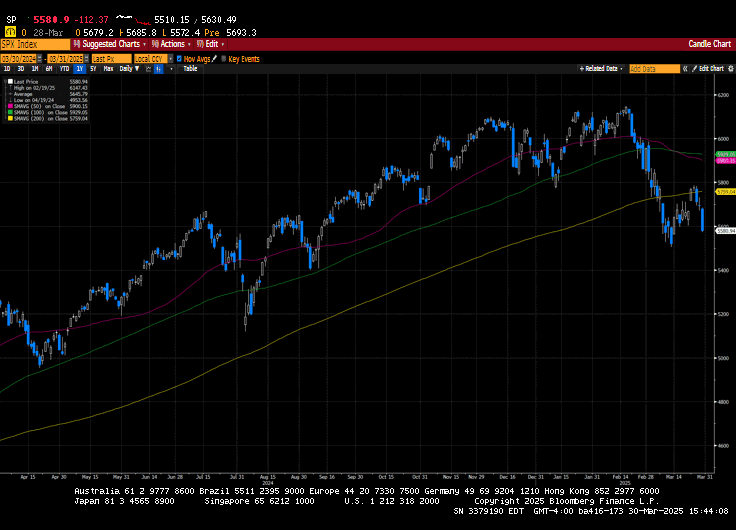
Weekly Market Commentary
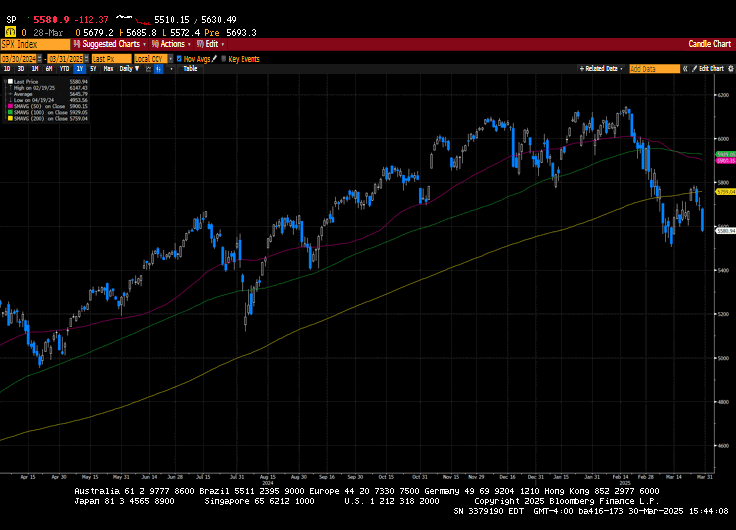
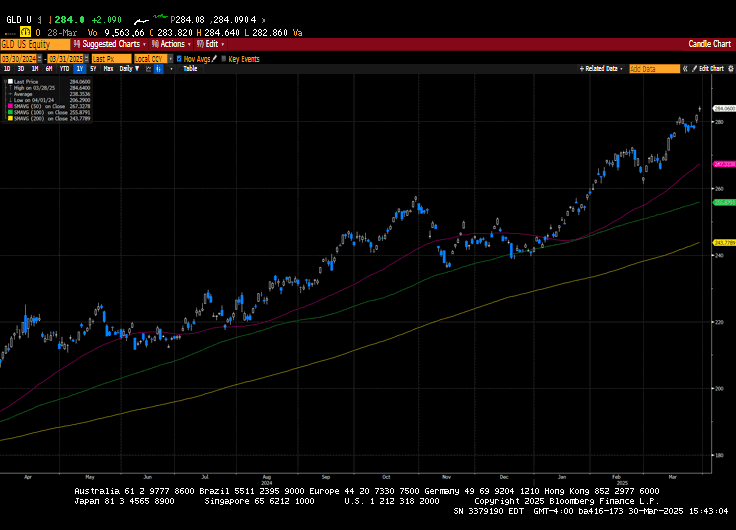
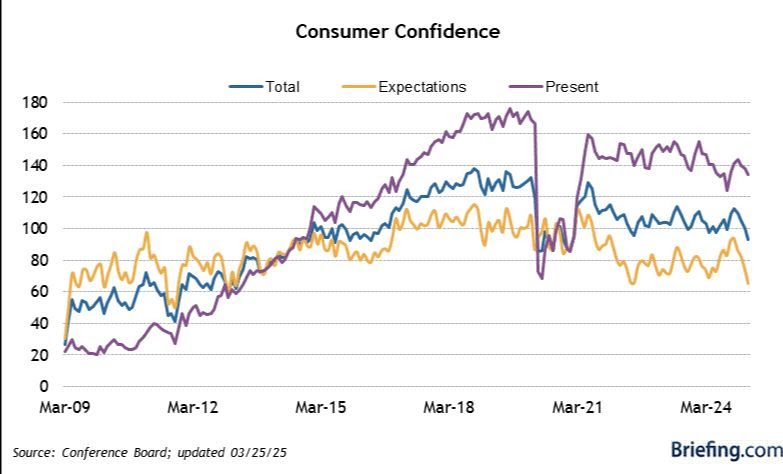
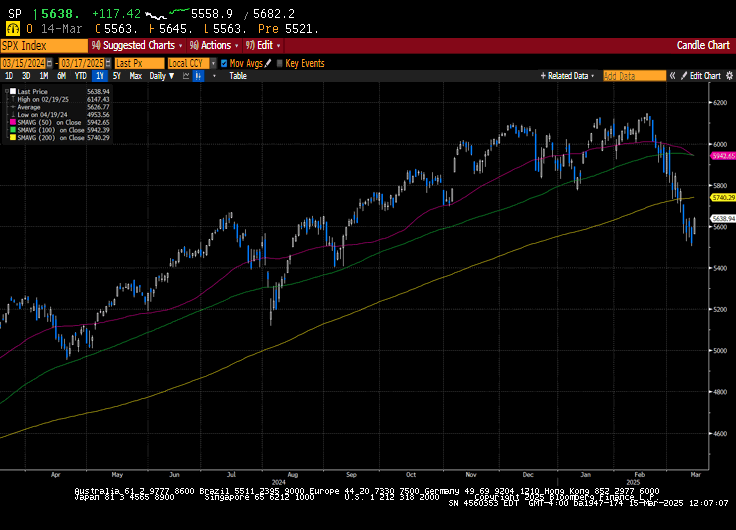
It’s been a difficult month for investors, and sentiment indicators tell that story. Wall Street appeared poised to build on the prior week’s gains, but regressed again as mixed signals on tariffs and a loss of sentiment gave reason to sell. Early in the week, rhetoric on a more targeted approach to tariffs was met with optimism. However, a 25% levy on all imported autos, scheduled to take effect on April 3rd, rattled the auto sector and contradicted early thoughts that the auto sector would avoid blanket tariffs. Trump’s “Liberation” Day is also set for April 2nd, at which time it is widely expected that the administration will impose reciprocal tariffs on all nations. Inflation fears related to tariffs were top of mind in the sentiment data released this week, and concerns regarding future employment were also conveyed in the surveys. These concerns may lead to a pullback in discretionary spending, which will, in turn, ultimately affect corporate earnings. More curbs on technology exports hurt the Semiconductor and Information Technology sectors. Disappointing news from KB Homes and Lennar also cast a shadow on the home builders.

11 Mistakes Retirees Make at the Supermarket
It’s not just inflation. Your bad habits may explain why you’re paying too much for groceries.
Retirees living on fixed incomes have been feeling the pinch of rising grocery costs.
Grocery prices in February rose 2.6 percent year-over-year, according to the U.S. Bureau of Labor Statistics’ Consumer Price Index. For some items, such as eggs, price hikes have been much steeper.
But don’t blame a big grocery bill entirely on inflation (or bird flu, in the case of egg prices). Your shopping habits could be a contributing factor.
“There are many ways retirees can reduce their grocery costs and help avoid overspending,” says Laura Adams, author of Money Girl’s Smart Moves to Grow Rich and an analyst at financial products and services comparison website Finder.com.
1. Missing out on senior discounts
A number of grocery stores across the country offer discounts to people over a specific age, typically worth 5 percent to 10 percent off your grocery bill (select items may be exempted).
Senior discounts are generally offered on a specific day of the week. Some big chains, such as Giant and Safeway, don’t offer them at every location, but their individual stores may, so it’s best to check with your local store.
2. Shopping without a plan
Create a meal plan for the week before you head to the grocery store to ensure you only buy what you need and avoid food waste. When crafting your weekly menu, look for recipes with overlapping ingredients so you can use everything you buy in its entirety.
“You can take this one step further by reviewing local store ads to see what’s on sale then picking recipes that use these discounted foods to save more,” says Andrea Woroch, a money consultant.
Also, check your refrigerator, freezer and pantry before you shop. “When making the meal plan for the week, it’s important to take inventory of what you already have on hand and build out your recipes and shopping list from there,” says Jill Sirianni, co-host of the Frugal Friends podcast and co-author of Buy What You Love Without Going Broke.
3. Buying out-of-season produce
You typically can buy your favorite fresh fruits and vegetables regardless of whether they’re in season, but it’s often not cost-effective. “In-season fruit and veggies are always less expensive and should be incorporated into your meal plan and shopping list week to week,” Sirianni says. If you’re not sure what’s in season in your area, check the website Seasonal Food Guide.
4. Overlooking frozen fruits and vegetables
You don’t have to bypass out-of-season fruit and vegetables entirely. In fact, you can save money on most produce purchases without compromising freshness by shopping in the frozen foods section.
“Because produce is frozen at peak ripeness, you are still getting all the nutritional content but for less money and stored in a way that reduces the chances of the food spoiling too soon,” Sirianni says.
Stocking up on frozen produce can also help you eat your recommended daily vegetable intake (2-3 cups), which only 12.5 percent of adults 51 or older reach, according to the Centers for Disease Control and Prevention.
5. Overbuying foods in bulk
Buying in bulk might have made sense when you had a house full of kids. But it could be a source of overspending if you’re now an empty nester and can’t consume a 3-pound barrel of pretzels before they go stale.
“This is especially true for fresh food, but even oversized bags of frozen fruit, veggies and other foods can go bad over time in the freezer thanks to freezer burn,” Woroch says.
6. Sticking to the center aisles
The center aisles of the supermarket are filled with often-pricey packaged goods, whereas the perimeter of the store is typically where you’ll find meat, fish, dairy and produce, Sirianni says.
“Not only is it more beneficial to our diets for these categories to make up the majority of our meals, but it’s also beneficial to our wallets,” she says. “When you’re buying a lot from the center aisles, you are paying more for convenience and packaging.”
7. Buying nonfood items at the supermarket
Purchasing household and personal items at the grocery store can be convenient but costly. “If you’re not shopping separately for nonperishable items like soaps and paper products you can buy in bulk at a discount, you’re likely overpaying for them,” Adams says.
You can also save money by signing up for subscriptions for certain items. For example, Amazon offers discounts on recurring purchases of many household items through its Subscribe & Save option; when you set up auto-delivery for five or more items, you can save an additional 15 percent. In addition, Chewy.com offers discounts if you set up auto-shipment for certain dog foods.
8. Not using grocery store apps
“Overlooking store apps could mean overpaying,” Woroch says. By signing up for your store’s loyalty program and using its mobile app, it’s easy to see what’s on sale before you shop and clip digital coupons that can be applied automatically when you scan your loyalty card or enter your phone number at checkout.
Some apps, such as the Target Circle app, even have a barcode scanner that lets you scan items as you shop to see if there are any deals available for them, Woroch says.
9. Being too loyal to major brands
Over the years, you may have developed an attachment to certain food brands, but that loyalty comes with a cost.
“Store brands have come a long way over the last decade, offering higher quality ingredients and even healthier options such as gluten-free and organic,” Woroch says. “It’s worth exploring and testing new options that can save you 30 to 50 percent on grocery items.” If you’re not happy with the product, your grocery store might refund the purchase, she says.
Sticking to just one grocery store also could be costing you. Other supermarkets might have lower prices or better deals on items you regularly buy. Woroch recommends using the Flipp app to see local grocery store circulars and compare prices without having to drive from store to store.
10. Using the wrong credit card
Using a rewards credit card to make grocery purchases can pay off — if you use the right card.
“If you’re not using a credit card to maximize rewards based on where you shop, that’s costing you,” Adams says. “For instance, warehouse stores typically offer branded cards with discounts, rewards and extra benefits. Or you can use a rewards card that pays competitive cash back for grocery purchases.”
If you have a cash-back credit card, review the reward terms to make sure you’re aligning your cash back with your shopping habits. You can compare credit cards at sites such as Nerdwallet, Bankrate or WalletHub to find one that offers the most cash back for groceries and items you regularly purchase.
“Just keep in mind that if you don’t pay monthly card balances in full, you can accrue interest that offsets a card’s net financial benefits,” Adams warns.
11. Throwing away receipts
Don’t toss your grocery receipts without checking them for deals first. “Some receipts may offer coupons to local businesses or even coupons for money off future grocery purchases,” Woroch says. “I recently got a deal from Sprouts for $10 off $75.” She recommends wrapping the receipt around your credit card so you don’t forget to use it the next time you shop.
Woroch also advises using the Fetch app to take photos of receipts and earn points that can be redeemed for gift cards for a variety of retailers and restaurants “so you can enjoy a meal out without derailing your limited retirement budget.” Other mobile apps that let you earn cash back for scanning receipts include Ibotta, CoinOut and Receipt Hog.
https://www.aarp.org/money/personal-finance/overspending-on-groceries/
Qualified Charitable Distributions and inherited IRAs: TOday’s Slott Report Mailbag
By Andy Ives, CFP®, AIF®
IRA Analyst
Question:
In the article “Why You Should Take Your 2025 RMD Now,” the following caught my eye …
“Or, maybe you are charitably inclined and looking to satisfy your RMD by doing a qualified charitable distribution (QCD). This will require the custodian to send funds directly to charity and the charity must cash the check.”
I wonder if you can clarify what the phrase, “send funds directly to charity” means? The reason I ask is because doing a QCD on my IRA custodian’s web site produces a check payable to:
Name of the charity
FBO my name
My address
The custodian mails the check to me, and I need to mail it to the charity. The IRA custodian apparently thinks that qualifies as “directly to the charity.” I’m not sure. What do you think?
Sincerely,
– Jim
Answer:
Hi Jim,
That will work! Sending a check to you will still qualify as a QCD, as long as the check is made payable to the charity and not to you personally. Just be sure that you deliver it to the charity, so it can be processed by them before the December 31 QCD deadline to avoid tax issues.
Question:
I have a question about an inherited Roth IRA. If a person inherits a Roth IRA in 2023, do they have to take required minimum distributions (RMDs) during the 10-year payout period? My spouse’s mother died in 2023 at the age of 95. In 2024 my spouse decided to take an RMD because it was unclear if he needed to. We would prefer to allow the money to compound as long as possible, before taking any distributions.
Thanks,
Mitch
Answer:
Hi Mitch,
Good news! RMDs are not required during the ten-year period for Roth IRA beneficiaries using the 10-year rule. Your spouse does not need to take any distributions from the Roth IRA he inherited from his mother until the end of 2033. He can let the tax-free earnings continue to accumulate in the inherited account until then.
If you have technical questions you would like to have answered, be sure to submit them to mailbag@irahelp.com, to be answered on an upcoming Slott Report Mailbag, published every Thursday.
https://irahelp.com/slottreport/qualified-charitable-distributions-and-inherited-iras-todays-slott-report-mailbag-2/
10% Penalty Exceptions: IRAs and Plans
By Andy Ives, CFP®, AIF®
IRA Analyst
If a person under age 59½ takes a withdrawal from his IRA or workplace plan, there is a 10% early withdrawal penalty…unless an exception applies. There are currently 20 exceptions, with a 21st on the way. Here are those exceptions, with some brief commentary.
Exceptions Applicable to BOTH Plans and IRAs (Note: Check to make sure your plan allows in-service withdrawals for any plan-specific exceptions.):
- Death. Withdrawals from inherited accounts are always penalty free.
- Disability. High hurdle. Being “retired on disability” may not qualify.
- 72(t). The program must run for 5 years or until age 59½, whichever is longer. Tread carefully with this exception!
- Medical Expenses (Over 7.5% Adjusted Gross Income). You will need to do some math with this one.
- IRS Levy. If the IRS takes your money, there is no 10% penalty. Awesome.
- Active Reservists. A function of active duty and when the distribution is taken.
- Birth or Adoption. Up to $5,000 per child. Must be the parent of that child to qualify. (Aunts and uncles of the new family member cannot leverage this exception.)
- Terminal Illness. Death is reasonably expected within 7 years. No limit on the amount.
- Federally Declared Disasters. Capped at $22,000. The IRS provides a list of current disaster areas here: Tax relief in disaster situations | Internal Revenue Service.
- Domestic Abuse. An unfortunate reason for the need of a spouse or domestic partner to access retirement funds, up to the lesser of $10,000 or 50% of account
- Emergency Expenses. $1,000 cap, but it might get a person to their next paycheck.
Exceptions Applicable to IRAs Only (Including SEPs and SIMPLEs):
- Higher Education Expenses. Available to the IRA owner and certain family members.
- First Time Homebuyer. Lifetime cap of only $10,000.
- Health Insurance If You Are Unemployed. Pretty straightforward.
Exceptions Applicable to Plans Only (Not Including SEPs or SIMPLEs):
- Age 55. You must separate from service in the year you turn age 55 or older.
- Age 50 or 25 Years of Service for Public Safety Employees. Same as above, except the earlier of age 50 or 25 years of service, and only applicable to certain groups of workers.
- Section 457(b) (Governmental) Plans. Withdrawals are always penalty-free from these plans.
- Divorce (QDRO “Qualified Domestic Relations Order”). A QDRO allows the receiving ex-spouse to have penalty-free access to the funds while they are in the plan.
- Phased Retirement Distributions from Federal Plans. Very complex. Allows full-time employees to work part-time schedules while beginning to draw retirement benefits.
- Pension-Linked Savings Accounts. Limited to $2,500. This is an optional add-on feature for plans like a 401(k).
Exception #21, effective December 29, 2025, is for plans only and applies to premium payments for certain long-term care policies. But we will cross that bridge when we get to it.
If you have technical questions you would like to have answered, be sure to submit them to mailbag@irahelp.com, to be answered on an upcoming Slott Report Mailbag, published every Thursday.
12 Super Catch-Up Contribution Questions Answered
By Ian Berger, JD
IRA Analyst
We continue to get lots of questions about the new “super catch-up” contribution for retirement plan and SIMPLE IRA participants who are ages 60-63. Here are answers to your top 12 questions:
1. When does the super catch-up contribution rule become effective?
It became effective for the 2025 calendar year.
2. Is the super catch-up only available for 2025?
No, it will continue for years after 2025.
3. To which plans does it apply?
The super catch-up applies to 401(k), 403(b) and governmental 457(b) plans. It also applies to SIMPLE IRA plans. However, it does not apply to traditional or Roth IRAs.
4. Are those plans required to offer it?
No, the super catch-up is optional for plans to offer.
5. Who is eligible for the super catch-up?
Participants in covered plans who turn age 60, 61, 62 or 63 during the year are eligible for that year.
6. If I turn age 60 during the year, can I contribute the full super catch-up?
Yes, the limit is not pro-rated in the year you turn age 60. So, for example, if you turn age 60 on July 1, 2025, and your plan offers the super catch-up, you can contribute up to the full limit for 2025 – not just ½ of the full limit.
7. If I turn age 64 during the year, am I eligible for the period when I was age 63?
No, you are not eligible. That’s the case even if you don’t turn age 64 until December 31.
8. Why ages 60, 61, 62 and 63?
That’s one question we can’t answer. No one seems to know why Congress settled on those ages.
9. Is the super catch-up in addition to, or instead of, the “regular catch-up” for ages 50 and older?
It’s instead of the age-50 catch-up.
10. What is the 2025 super catch-up limit?
For 401(k), 403(b) and governmental 457(b) plans, the 2025 limit is $11,250. That figure results from multiplying $7,500 (the 2024 regular catch-up limit) by 150%. So, an age 60-63 employee in a plan that allows catch-ups can defer up to a total of $34,750 ($23,500 + $11,250) for 2025.
11. What about SIMPLE IRAs?
You’ll be sorry you asked. The super catch-up contribution is available for SIMPLE IRA employees. The 2025 limit is $5,250. SIMPLE IRA participants age 50 or older (but not ages 60, 61, 62 or 63) are also eligible for the “regular” catch-up. That catch-up is either $3,850 or $3,500 for 2025. It’s $3,850 for plans with 25 fewer employees or plans with more than 25 employees where the company has agreed to make a larger-than-normal employer contribution. (That’s because of a 10% bump-up to the SIMPLE IRA contributions that became effective in 2024.) The 2025 age 50-or-older catch-up is $3,500 for larger plans where the employer hasn’t agreed to make the higher contribution. So, for 2025, there are three SIMPLE IRA catch-up contribution limits.
12. Why are the SIMPLE IRA catch-up rules so un-SIMPLE?
Ask your congressperson.
If you have technical questions you would like to have answered, be sure to submit them to mailbag@irahelp.com, to be answered on an upcoming Slott Report Mailbag, published every Thursday.
https://irahelp.com/slottreport/12-super-catch-up-contribution-questions-answered/

Weekly Market Commentary
-Darren Leavitt, CFA
The S&P 500 avoided a fifth straight week of losses as investors continued to assess the impact of Trump’s policies. A late rally on Friday afternoon, fueled on heavy volume from quarterly options’ expiration, helped propel the S&P 500 higher and avoid another weekly loss. As expected, the Federal Reserve kept its monetary policy unchanged at 4.25%-4.50% but at the same time announced that it would reduce the amount of assets running off its balance sheet from $25 billion to $5 billion, a form of quantitative easing. Fed Chairman Powell endorsed the idea that tariffs could have a “transitory” effect on inflation and acknowledged that inflation continues to be elevated and that it was likely that economic growth would slow. However, the Chairman remained constructive on the US economy, which helped to send markets higher after his post-meeting Q&A. The Summary of Economic Projections showed that the committee had reduced its forecast on 2025 GDP growth to 1.7% from 2.1% and increased its Core PCE forecast to 2.8% from 2.5%. The Committee also forecasts the Fed Funds rate to be 3.9% by the end of 2025, translating to two twenty-five basis point cuts this year.
President Trump’s call with Russian President Putin appeared to yield a framework for a ceasefire centered on energy and infrastructure while opening the door to a maritime ceasefire in the Black Sea. Further technical negotiations are scheduled in the coming weeks, but the timeline remains vague.
NVidia’s GTC event showcased its newest chip and applications in AI and robotics, but the developers’ conference received a sell-the-news response on Wall Street. FedEx earnings results were disappointing, as were earnings from Nike, Lennar Homes, and Micron Technology.
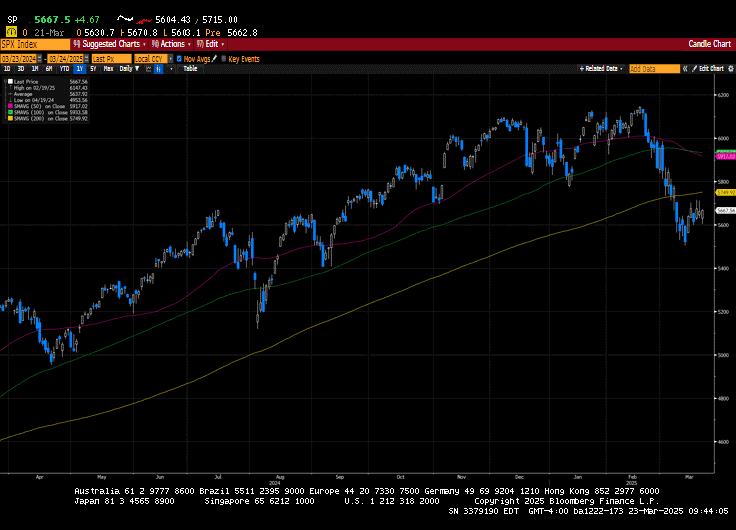
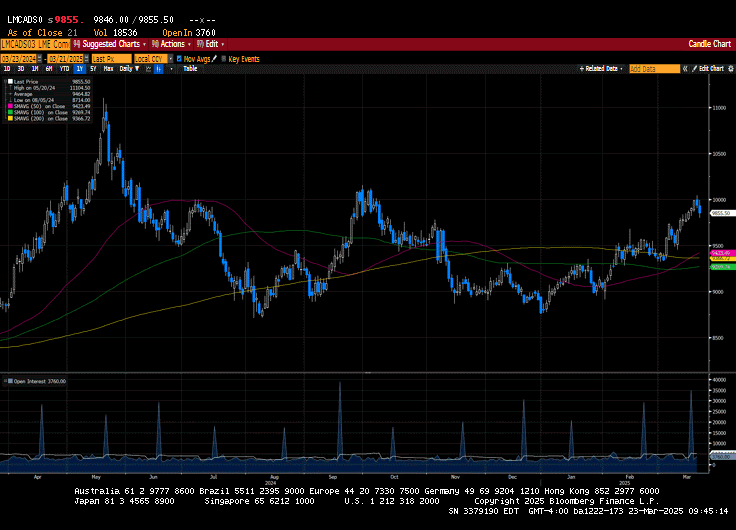
The S&P 500 gained 0.5%, the Dow rose by 1.2%, the NASDAQ added 0.2%, and the Russell 2000 increased by 0.6%. US Treasuries rallied across the curve but favored the front end and the belly. The 2-year yield fell by seven basis points to 3.95%, while the 10-year yield fell by six basis points to 4.25%. Oil prices increased by $1.07 or 1.6%, closing at $68.27 a barrel. Gold prices rose by $21.10 to close at $3,022.10 an Oz. Copper prices continued to trade higher, adding $0.21 to close at $5.11 per Lb. Bitcoin prices increased by ~$1,800, closing at $84,390 on Friday. The US Dollar index added 0.3% to 104.6.
Economic data for the week was mixed. Retail sales increased by 0.2%, less than the estimated increase of 0.7%. The Ex-auto print was up 0.3% versus the consensus estimate of 0.4%. The control group figure came in up 1%, which was materially better than the 1% decline in January and gave investors solace that the consumer is still spending, albeit at a more measured pace. Housing data for the week was better than expected, with Housing Starts and Permits coming in above estimates. Existing Home sales also topped estimates at 4.26M versus 3.95M. Industrial production came in at 0.7%, above the estimated 0.2%, while capacity utilization rose to 78.2% compared to the estimated 77.7%. Initial Claims increased by 2k to 223K, while Continuing Claims jumped by 33k to 1.892M.
Investment advisory services offered through Foundations Investment Advisors, LLC (“FIA”), an SEC registered investment adviser. FIA’s Darren Leavitt authors this commentary which may include information and statistical data obtained from and/or prepared by third party sources that FIA deems reliable but in no way does FIA guarantee the accuracy or completeness. All such third party information and statistical data contained herein is subject to change without notice. Nothing herein constitutes legal, tax or investment advice or any recommendation that any security, portfolio of securities, or investment strategy is suitable for any specific person. Personal investment advice can only be rendered after the engagement of FIA for services, execution of required documentation, including receipt of required disclosures. All investments involve risk and past performance is no guarantee of future results. For registration information on FIA, please go to https://adviserinfo.sec.gov/ and search by our firm name or by our CRD #175083. Advisory services are only offered to clients or prospective clients where FIA and its representatives are properly licensed or exempted.

Retire with confidence: Master your finances and lifestyle
Discover steps to help you prepare for retirement
Imagine this: After decades of hard work and dedication, you’re just 12 months away from the retirement of your dreams. Exciting, right? But hold on, this final stretch is crucial. Let’s make sure you’re fully prepared to enjoy a rewarding and stress-free retirement.
The last thing you want is to approach this pivotal moment without a solid plan. Here’s why taking this one-year runway seriously can set the stage for a fulfilling and secure retirement.
The importance of strategic retirement planning
Navigating retirement without a solid plan can turn this exciting new phase into a source of stress and financial uncertainty. The lack of preparation might even lead to rejoining the workforce. However, by taking proactive steps, you can ensure your retirement is as enjoyable and secure as you’ve always envisioned.
Practical steps to prepare for retirement
1. Assess your financial resources
Evaluate your current financial situation. Start by calculating your net worth by listing all your assets and liabilities. Then, evaluate future income streams like Social Security, pensions and investment withdrawals. This provides an understanding of your financial resources, allowing you to plan based on real numbers rather than assumptions.
2. Define clear retirement goals
Envision your retirement lifestyle. Do you see yourself in a fun part-time job? Traveling the world? Pursuing new hobbies? Perhaps relocating? By clarifying what you want, you can better estimate your annual expenses and set a realistic budget. This reflection not only helps you plan financially but also ensures that your spending aligns with your personal values and goals.
3. Redesign your investment portfolio
Check regularly on how your investments are doing. Take a good look at your portfolio’s asset allocation and investment choices. But remember, a one-time review isn’t enough. Set up a regular process to monitor and adjust your investments. This proactive approach helps ensure your assets properly address market ups and downs and inflation in order to meet your financial needs.
4. Create a comprehensive health care plan
Your health care plan should be robust enough to cover both regular check-ups and unexpected medical situations. Health care is a significant concern in retirement, often accounting for a large portion of expenses. Start by exploring your health insurance options, including Medicare and any supplemental plans. Additionally, consider long-term care insurance to cover potential future needs.
5. Reduce and manage debt
Enter retirement with minimal debt to provide a comforting sense of financial freedom. Aim to pay off high-interest debts like credit cards and car loans first. Tackling debt while you still have a steady paycheck makes the process easier and can significantly free up your monthly budget, paving the way for more enjoyable retirement activities.
6. Update legal and financial documents
Make sure all your legal and financial documents are up to date and organized. This includes wills, trusts and beneficiary designations on retirement accounts and insurance policies. Consider services such as Trustworthy.com to manage and store these documents securely. Having clear, accessible documents reduces stress for both you and your family, ensuring your wishes are honored.
Complement your legal will with a practical and thoughtful step by documenting your final wishes that make your intentions clear. That will help to ease the burden on your loved ones and preventing unanswered questions during their time of grief.
7. Establish an income strategy
There are several key considerations in planning your retirement income strategy. One key decision is when to take Social Security and pension benefits. The right timing can greatly influence your overall income. Equally important is developing a withdrawal plan for your investment portfolio, which includes determining a safe annual withdrawal rate and identifying which accounts to draw from to minimize tax impacts. By thoughtfully addressing these income sources, you can enhance the longevity of your retirement savings.
8. Understand tax implications
Strategically navigate the tax code to significantly increase the portion of your retirement income that stays in your pocket. Engaging the advice of a tax professional can be invaluable in this process. Smart tax planning involves choosing the right accounts to draw from, utilizing available deductions, avoiding traps that unintentionally prohibit you from receiving certain tax benefit, and coordinating withdrawals to minimize your tax burden.
Emotional and lifestyle considerations
While financial planning is essential, don’t overlook the emotional and lifestyle aspects of retirement. Transitioning from a structured work life to retirement can be challenging. Here are a few tips to ease this transition:
- Engage in hobbies and learning: Jump into hobbies you love and explore classes or workshops to discover new interests. This not only keeps you engaged with exciting activities but also boosts your skills and knowledge, keeping your mind sharp.
- Cultivate social connections: Strengthen and expand your social network by joining clubs or groups that match your interests. This helps prevent feelings of isolation and fosters meaningful relationships, essential for emotional well-being.
- Volunteer, stay active and consider part-time work: Find fulfillment by volunteering for causes you care about and/or consider part-time work in a job you enjoy. This can provide a sense of purpose and social interaction. Additionally, keep active with exercise that interests you, such as walking, swimming, golf or pickleball. Lots of options!
- Travel and explore: Embrace travel opportunities to enrich your retirement with new experiences. Whether exploring locally or venturing internationally, travel can broaden your horizons and add a sense of adventure and excitement to your life. You might even explore the world virtually, experiencing dream destinations without the physical and financial strain, thanks to immersive AI-enhanced virtual reality technology.
Final thoughts
As you countdown to retirement, taking the time to plan thoroughly can lead to a more rewarding and stress-free experience. The key is not to wing it but rather approach this phase with the same diligence and foresight you’ve applied throughout your career.
By following these strategies, you can enter retirement with confidence, ready to embrace the adventures and possibilities that lie ahead.
https://www.voya.com/blog/retire-confidence-master-your-finances-lifestyle
Bankruptcy Protection and Inherited IRAs: Today’s Slott Report Mailbag
By Andy Ives, CFP®, AIF®
IRA Analyst
QUESTION:
I cannot find the indexed number for IRA bankruptcy protection for 2025-2028. It is $1,512,350 currently, but it is scheduled to increase on April 1, 2025. Do you know what it will be?
Mike
ANSWER:
The updated IRA bankruptcy protection number is $1,711,975, effective April 1, 2025. As you mentioned, this level of bankruptcy protection for IRAs will be in effect for the next three years. Note that the $1,711,975 does NOT include former plan dollars rolled into the IRA – like from a 401(k). Former plan dollars remain 100% protected from bankruptcy within the IRA and do not eat into the $1,711,975 cap.
QUESTION:
I inherited my brother’s Roth IRA in 2018 and take required minimum distributions (RMDs).
Under the SECURE Act, does the beneficiary I name on this account continue taking RMDs based on my schedule? If so, do they do so for 10 years and then empty the account in year 10?
Or, do they not have to take any distributions until year 10?
Thank you.
Donna
ANSWER:
Donna,
The beneficiary of your inherited Roth IRA is a successor beneficiary. Since you are already taking RMDs, those annual payments cannot be stopped by the successor. The IRS rules dictate that the successor will “step into your shoes” and continue with your exact same RMD schedule, using your same single life expectancy factor, minus one each year. Additionally, the successor beneficiary must also abide by the added layer of the 10-year rule. So, RMDs must continue in years 1 – 9 for the successor, and the account must be emptied by the end of year 10.
If you have technical questions you would like to have answered, be sure to submit them to mailbag@irahelp.com, to be answered on an upcoming Slott Report Mailbag, published every Thursday.
https://irahelp.com/slottreport/bankruptcy-protection-and-inherited-iras-todays-slott-report-mailbag/
Surprise! You May Still Be Eligible for the Stretch IRA
By Sarah Brenner, JD
Director of Retirement Education
The arrival of the SECURE Act means the end of the stretch IRA for many beneficiaries. Instead, a 10-year payout rule applies for most IRAs inherited by non-spouse beneficiaries. However, the SECURE Act does allow the stretch to continue for certain select groups of beneficiaries. These beneficiaries are called “eligible designated beneficiaries” (EDBs). EDBs include spouse beneficiaries, minor children of the account owner, as well as disabled and chronically ill individuals.
Not More Than 10-Years Younger
Beyond the above listed groups of EDBs, there is another group of EDBs that may surprise you. This group is often overlooked, and many people are unaware of just how common it can be. A beneficiary who is not more than 10 years younger than the deceased IRA owner (based on their actual birthdates) also qualifies as an EDB. Under this definition, any beneficiary older the account owner would also be an EBD. This group of beneficiaries can include an unexpectedly large number of people. For example, siblings, friends, and unmarried partners, who are often named as beneficiaries, are all frequently close in age.
Example: Eli, age 65, dies in 2025. He has two IRAs. The beneficiary of one IRA is his older brother, Ben, age 77, and the beneficiary of the other IRA is his good friend, Thomas, age 60. Both Ben and Thomas qualify as EDBs because they were not more than 10 years younger than Eli. Therefore, they can both use the stretch IRA. They can take distributions from the IRAs they inherited from Ben using their single life expectancy. They are not required to use the 10-year rule.
Are You An EDB?
If you have inherited an IRA, you should not assume that the 10-year rule applies, even if you are a non-spouse beneficiary. Are you older than the IRA owner was? Or, were you close in age? That can make you an EDB, which changes your options for inherited IRA funds. If you are not more than 10 years younger than the account owner was, you are part of a surprisingly large group of beneficiaries who are still eligible for the stretch, even after the SECURE Act.
If you have technical questions you would like to have answered, be sure to submit them to mailbag@irahelp.com, to be answered on an upcoming Slott Report Mailbag, published every Thursday.
https://irahelp.com/slottreport/surprise-you-may-still-be-eligible-for-the-stretch-ira/
IRA Trivia: Missed RMD or Excess Contribution?
By Andy Ives, CFP®, AIF®
IRA Analyst
Here is an all-too-common situation that seems counterintuitive: A participant in a 401(k) retires and must take his required minimum distribution (RMD). This person requests that his entire 401(k) plan balance be directly rolled over to an IRA. The plan follows the participant’s direction, and the entire amount is sent to the IRA.
PROBLEM: No RMD is distributed from the plan prior to the movement of money to the IRA.
QUESTION: Do we have a missed RMD situation?
ANSWER: We do NOT…but all is not well.
The RMD from the plan must be taken prior to the rollover to the IRA. RMDs are not eligible to be rolled over, so it should have been distributed. Oftentimes people think they can roll a 401(k) RMD to their IRA and simply take that plan RMD from the IRA later in the year. Incorrect. This is not permitted.
So, if an RMD cannot be rolled over, then how do we NOT have a missed RMD in the scenario outlined above?
Technically, a direct rollover from a plan to an IRA is just that: a rollover. It is NOT a direct transfer like we see with IRA-to-IRA transactions. Direct transfers between IRAs do not generate any tax reporting. There is no 1099-R or Form 5498 with direct transfers. As such, RMDs can be directly transferred from IRA to IRA. But they cannot be ROLLED over from IRA to IRA.
Plan balances, like in a 401(k), cannot be directly “transferred” to an IRA. The movement of money from plan to IRA is a direct rollover, and rollovers generate tax forms. A 1099-R reports the distribution from the plan, and a 5498 shows the offsetting rollover/redeposit into the IRA.
And therein lies the sneaky answer as to why we don’t have a missed RMD in the scenario above. Technically, the plan paid out the entire balance, including the RMD. The 1099-R will report a full distribution. As such, the RMD was TECHNICALLY paid out by the plan. The problem now is not that the RMD was missed. The problem is that the RMD was rolled over. And what is the result when an RMD is rolled over? We have an excess contribution for the RMD amount in the receiving IRA.
The corrective measure here is NOT to follow the missed RMD correction process. Instead, we follow the excess contribution rules. If timely corrected by the October 15 deadline, the erroneously rolled-over RMD is removed from the IRA along with any earnings (“NIA” – net income attributable) as an excess contribution withdrawal. The earnings are taxable, but there is no penalty and no special tax forms to file. Oh…and no missed RMD.
If you have technical questions you would like to have answered, be sure to submit them to mailbag@irahelp.com, to be answered on an upcoming Slott Report Mailbag, published every Thursday.
https://irahelp.com/slottreport/ira-trivia-missed-rmd-or-excess-contribution/
Weekly Market Commentary


7 Strategies for More Income in Retirement
“Old age is always fifteen years older than I am.”
—Bernard Baruch, American financier, investor, statesman and philanthropist
One of the biggest fears people have is running out of money in retirement. And for many Americans, this is a very real risk, not an irrational phobia.
If you are a reasonably healthy 65-year-old non-smoker, actuarial tables estimate you’re likely to live to age 86, as a man, and 89, as a woman. And the longer you live, the longer you can expect to live. A 90-year old non-smoker has a good chance of living to age 95, as a man, and a 97, as a woman.
However, there’s no need to worry your way through retirement in a state of self-enforced poverty and extreme frugality. Follow these strategies to have more spendable income in retirement, and never run out of money!
#1: Stay healthy and active.
According to Fidelity Investments, a couple who retired in 2017 will spend an average of $275,000 for health care costs throughout retirement. Poor health is expensive in every way imaginable, taking a heavy mental, emotional, and financial toll.
Although it’s no guarantee, good health habits can help slash medical costs:
Move more. Inactivity costs individuals, employers and the governments as much as $28 billion annually in medical costs and lost productivity, according to a study cited by The New York Times. Exercising for 30 minutes 3-5 times per week can make a measurable difference in health and vitality.
Eat from the bottom of the food pyramid. To reduce your risk of cancer and heart disease, eat more fruits and vegetables. Avoid the “SAD” Standard American Diet, which fuels disease, and learn what “Blue Zone” researchers are discovering about the world’s healthiest and longest-living people.
Quit or moderate negative habits. Eliminate bad habits such as cigarettes or over-indulging in sugar, junk food or alcohol.
Think positively. A recent Harvard study found that “optimistic women” had nearly a 40% lower chance of dying of heart disease or stroke and a 16% lower risk of dying from cancer. Multiple other studies show that optimistic people of both sexes live longer and have less heart-related illnesses.
Exercising regularly, eating well and maintaining a positive attitude will save you money and—even more importantly—help you enjoy your life!
#2: Save more.
The average American saves less than 5% of their income. Some Americans have no savings at all, or they have debt instead. Some people invest but neglect to save and have to raid their retirement accounts—paying penalties and taxes—for every emergency.
We recommended saving 20% of your income. That might sound intimidating or even impossible, but it’s not. It starts with a decision and it requires a mindset committed to living below your means.
Start saving—even if it’s 5 or 10% to start, and work your way up as you can. The key is to increase your saving—not your spending—as your income and financial capability increases.
Save more money, and you’ll have liquidity for opportunities as well as emergencies. You’ll end up with more money to invest, without compromising your savings. Saving more also makes people less compelled to subject their dollars to unreasonable risks in pursuit of unrealistic rates of return.
#3: Keep working, contributing, and earning.
According to the Social Security Administration, approximately one out of every ten people turning 65 today will live past age 95. Nearly half—43%—of retirees underestimate how long they will live by 5 or more years, reports the Society of Actuaries. And yet, Census Bureau figures show that the average age of retirement is only 63. How many people have saved enough to live another 30 or more years without earned income?
The impact of longevity and low savings rates combined with too-early retirement can be devastating. Many people are retiring without the financial capability to remain independent—one reason why we don’t recommend a traditional retirement. Work can also provide people with purpose and with their primary social interaction.
Another tremendous benefit of working longer is that you can maximize your Social Security income! Too many people take Social Security too soon and regret having a lower income.
If you don’t enjoy your work, the thought of delaying retirement may lead to despair. But when we say “don’t retire,” we mean, “Find work you LOVE and do it for as long as long as you want.” If you love what you do, it won’t feel like “work.”
It doesn’t have to be full-time work. Perhaps you’ll work part-time or seasonally. Maybe you’ll freelance and volunteer on the side. Perhaps you’ll consult, become a travel blogger, or work virtually. Just keep your mind active, keep contributing your wisdom and skills, and keep earning!
81-year old Earnestine Shepherd is the world’s oldest female bodybuilder. She no longer competes in bodybuilding, but she has found her calling in inspiring and training others to be healthy and strong at any age. In this BBC video profile, she declares she’ll do the work she loves “until her last breath”:
Want to envision a future you’ll love? You’ll find inspiring stories and “case studies” in Busting the Retirement Lies, along with some serious number-crunching that may have you re-thinking your 401(k).
#4: Reduce risk with asset allocation
You may know the joke about how 401(k)s “became 201(k)s” in the Financial Crisis. People who planned on retiring saw their investments plummet as much as 50%.
“Easy come, easy go” should not be a phrase that applies to your investments! But the problem is this: most people’s portfolios are comprised of nearly all stocks, and stocks are subject to systemic risk.
For investors with truly diversified portfolios, “Great Recession” was more of a speed bump than a roadblock to retirement. Reduce your risk by following Prosperity Economics™ strategies and investing in diverse asset classes and financial instruments, such as:
- private lending instruments such as bridge loans
- cash-flowing real estate
- business investments
- alternative investments such as oil and gas
- life settlement funds
- and high cash value life insurance.
#5: Raise financially independent children.
From childcare (whether that means staying home with your children or hiring childcare), clothes and food to college expenses, it’s expensive to be a parent. (But worth it!) After a couple of decades, more or less, your financial support should no longer required on an ongoing basis, and you’ll have more to save, invest, or spend.
Unfortunately, some parents keep spending resources on adult children who remain dependent. Increasingly, kids are moving back in with parents after college, where some overstay their welcome.
The trend of many young adults to become self-supporting has become so widespread it now has a name: the “Failure to Launch” syndrome. Unfortunately, parents can contribute to the problem when they keep subsidizing kids and shielding them from the natural consequences of their actions. To avoid this, help kids learn responsibility and independence from a young age. Encourage them to earn (even if it’s through chores or babysitting), save (even if it’s from gifts and allowance), and make wise choices with money.
#6: Focus on cash flow, not net worth.
Typical financial advice helps you accumulate assets in a brokerage account, but too often, financial plans neglect how to turn this into cash flow later. Such strategies may be a better retirement plan for advisors with “assets under management” than for YOU!
When interest rates dropped recently to historic lows, retirees faced hard choices. Should they scrimp and save to live off of “interest only”? Consume equity and risk outliving their savings? Keep the bulk of their investments in equities and pray that stocks will somehow keep going up?
It’s best to “practice” creating cash flow with assets before you must rely on the income from investments. It’s good to accumulate assets, but you must also have reliable strategies to turn assets into income.
#7: Consume assets strategically.
The amount of money accumulated in assets isn’t as important as the amount of spendable income produced by those assets! By accumulating the right assets and spending them in the right order, you might end up with hundreds of thousands of dollars extra in your pocket!
By strategically consuming assets in the most efficient way, you can:
- dramatically reduce taxes
- increase your cash flow and
- protect yourself from market swings and low interest rates
- while increasing your net worth and (likely) leaving more to heirs.
For instance, replacing bonds in your portfolio with high cash whole value life insurance can make a multiple six-figure difference in future spendable income! (This is why we don’t recommend bonds. And we’ll show you a case study in a future post that demonstrates how this move can give you more income—while raising the value of your estate!)
https://prosperityeconomics.org/more-income-in-retirement/?gad_source=1&gclid=Cj0KCQjw4cS-BhDGARIsABg4_J0l2KAriRkuGIow7ClUk7qcp7S0KCZq5NnkEW5v_wHf6W7MuXC89rkaAnfFEALw_wcB
Inherited Roth IRAs and Qualified Charitable Distributions from SEP IRAs: Today’s Slott Report Mailbag
By Ian Berger, JD
IRA Analyst
Question:
Hi,
In a recent blog post, you addressed the complicated rules for a 401(k) to Roth IRA rollover. I have a similar question as it relates to a pre-tax IRA conversion to a Roth IRA.
My client is a 95 year-old woman who has a large pre-tax IRA. She has converted some of the pre-tax IRA to a Roth IRA. This is her first Roth IRA ever.
Suppose she dies three years later, prior to the 5-year holding period being met. The Roth IRA passes to her beneficiaries, who fall under the 10-year payout rule. But what is taxable and what is not?
Thank you in advance,
Bob
Answer:
Hi Bob,
The converted amounts themselves will be tax-free whenever paid out to the beneficiaries. Earnings on the converted amounts will be tax-free only if taken after the 5-year holding period has been satisfied. That period began on January 1 of the year of the first Roth conversion and is carried forward to the beneficiaries. It does not restart for the beneficiaries. So, for example, if your client did her first Roth conversion anytime in 2024, her 5-year period began on January 1, 2024, and even if she dies in 2027, it will end on December 31, 2028. After 2028, the entire inherited Roth IRA will be available tax-free.
Question:
I have three SEP IRAs with three different custodians. I still contribute to one of the SEPs on an annual basis. I am over age 70½. Can I take a qualified charitable distribution (QCD) out of one of the SEP IRAs I am not contributing to?
Answer:
Yes. A QCD can be made from any “inactive” SEP or SIMPLE IRA. A SEP or SIMPLE IRA is considered inactive for a year if an employer contribution isn’t made to it for that year.
If you have technical questions you would like to have answered, be sure to submit them to mailbag@irahelp.com, to be answered on an upcoming Slott Report Mailbag, published every Thursday.
https://irahelp.com/slottreport/inherited-roth-iras-and-qualified-charitable-distributions-from-sep-iras-todays-slott-report-mailbag/
Avoid Double Trouble by Fixing 2024 Excess 401(k) Deferrals by April 15
By Ian Berger, JD
IRA Analyst
Everyone knows that April 15, 2025, is the deadline for filing 2024 income tax returns. But April 15 is also a crucial deadline if you made too many 401(k) deferrals in 2024. If you don’t fix the error by that date, the tax consequences are serious. Having a tax filing extension for 2024 does NOT give you more time.
The maximum amount of pre-tax and Roth contributions you could make for 2024 was $23,000 (plus another $7,500 more if you were least age 50). Many people are unaware that contributions you make to ALL plans during the year are usually combined when applying that limit. (That aggregation rule doesn’t apply if one of your plans is a 457(b) plan.)
If you were in only one plan during 2024, your plan should have had internal controls to block you from exceeding the deferral limit. If the plan mistakenly allowed you to overcontribute, it’s up to the plan to fix the problem.
But that’s not the case if you were in two different plans during the year (because you had two jobs at the same time or changed jobs). That makes sense because one plan could not be expected to know how much you contributed to the other plan. So, the burden is on you to keep track. Your Form W-2 from each employer indicates the amount of pre-tax and Roth contributions in Box 12. Or, you can check your plan account statements.
If you’ve overcontributed, you must contact the administrator of one of the plans immediately and make them aware of the problem. To avoid double taxation (see below), the error must be corrected by April 15, 2025.
The plan you contact should fix the error by making a “corrective distribution” to you. A corrective distribution is the excess over the $23,000/$30,500 limit, adjusted for earnings or losses attributable to the excess. You’ll receive a corrected W-2 that adds back the excess deferrals to your 2024 taxable income. (If you’ve already filed your 2024 tax return, you’ll need to amend it.) Earnings on the excess are taxable to you in 2025.
Example: Liang, age 48, made $18,000 of 2024 pre-tax contributions to Company A’s 401(k) plan before leaving to work for Company B. Liang didn’t keep track of his total 2024 contributions and made another $12,500 of pre-tax contributions to Company B’s 401(k) – for a total 2024 contribution of $30,500. He exceeded the 2024 deferral limit by $7,500 ($30,500 – $23,000). The excess deferrals earned $700. Liang became aware of this problem in early 2025 and contacted Company B. On March 31, 2025, Company B’s 401(k) makes a corrective distribution of $8,200 ($7,500 + $700) to him. Company B also sends Liang a corrected 2024 W-2 showing an additional $7,500 of 2024 taxable income. He must include the $700 of earnings as taxable income for 2025.
Why is it so important to have this fixed by April 15? Because if the error isn’t corrected by that date, you’ll be hit with double taxation. The excess deferrals won’t be paid to you, but they’ll still count as 2024 taxable income. And the excess, along with related earnings, will be taxable to you a second time in the year they are eventually distributed to you.
If you have technical questions you would like to have answered, be sure to submit them to mailbag@irahelp.com, to be answered on an upcoming Slott Report Mailbag, published every Thursday.
https://irahelp.com/slottreport/avoid-double-trouble-by-fixing-2024-excess-401k-deferrals-by-april-15/
How Roth IRA Distributions Are Taxed
By Sarah Brenner, JD
Director of Retirement Education
Do you have a Roth IRA? If you do, there will very likely come a time when you want to take a distribution from that account. The distribution rules for taxation of Roth IRA distributions can be complicated, but if they are followed, the reward is tax-free withdrawals in retirement.
Here is what you need to know:
Aggregation
Things can get a little confusing if you have more than one Roth IRA. When determining the taxation of a Roth IRA distribution, all of your Roth IRAs are aggregated. What does “aggregated” mean? Well, simply put, this means your Roth IRAs are considered one account for tax purposes. Your IRA custodian reports the distribution on Form 1099-R to you and to the IRS. You will be responsible for determining the taxation of your distribution. You will use Form 8606 to report the Roth IRA distribution on your federal tax return.
Tax-Year Contributions
Amounts up to the total of your Roth IRA contributions are considered to be distributed first. These amounts are not taxable or subject to the early distribution penalty, even if you take them out before five years or before age 59½. In other words, you always have access to amounts equal to your contributions tax and penalty-free. Maybe, for example, you contributed to your Roth IRA in 2018, and you are now 32 years old and need that money. You will not be taxed or subject to penalty when the amount of that contribution is distributed. It doesn’t matter that you are not yet age 59½ and it doesn’t matter how you use your money.
Converted Amounts
Amounts up to the total of your Roth conversions are considered to be distributed next on a first-in, first-out basis. If you converted both pre- and after-tax amounts, the amount of your pre-tax amounts is distributed first. Distributions of amounts equal to your conversions are not taxable. Remember, you already paid taxes on those funds when you did the conversion. Pre-tax amounts are subject to the 10% early distribution penalty if you are under age 59½ at the time of the distribution and the conversion was less than five years ago. There are exceptions to the penalty such as disability or death. If you are over age 59½, you can immediately access the amount of your converted funds without worrying about the penalty. There is no five-year waiting period for you.
Earnings
The remaining portion of your Roth IRAs are considered earnings and are the last thing distributed from your account. Those amounts are tax-free and penalty-free if the distribution is a qualified distribution. A qualified distribution is made after you have had any Roth IRA account for five years AND you are over the age of 59½, you are disabled, you are taking the funds for a first-time home purchase, or the distribution is to your beneficiary after your death. If your distribution of amounts equal to earnings is not a qualified distribution, it will be taxable and subject to the 10% early distribution penalty, unless an exception applies.
Tax-Free Distributions in Retirement
You are not required to take any distributions from your Roth IRA during your lifetime. Unlike traditional IRAs, Roth IRAs are not subject to the lifetime required minimum distribution rules. However, if you do decide to withdraw funds, a qualified distribution will be completely tax-free and not included in adjusted gross income. By taking a qualified Roth IRA distribution, you can therefore avoid the stealth taxes that hit many retirees hard, such as taxation of Social Security benefits or Medicare surcharges when income rises in retirement.
https://irahelp.com/slottreport/how-roth-ira-distributions-are-taxed/

Weekly Market Commentary
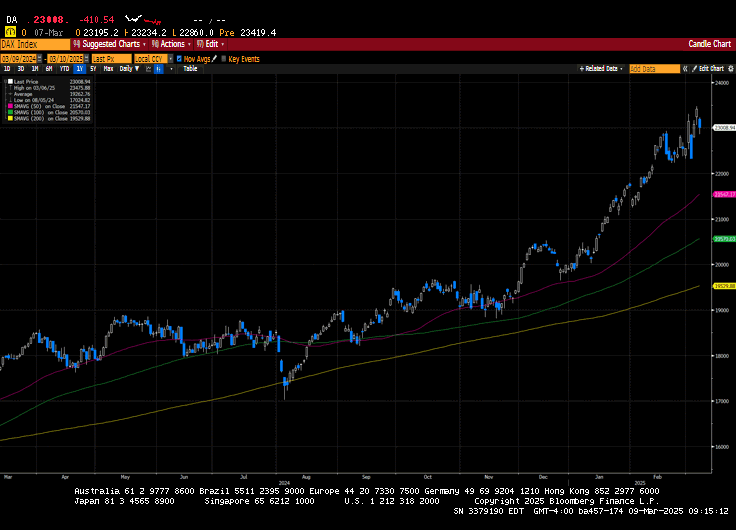
The S&P 500 fell by 3.1% and breached its 200-day moving average before bouncing back in Friday’s session. The Dow lost 2.4%, the NASDAQ tumbled 3.5%, and the Russell 2000 shed 4%. Fourth-quarter earnings results from Target and Best Buy offered a warning about the consumer and the impact of higher prices on their respective bottom lines. Broadcom announced a great quarter and provided a positive outlook for AI infrastructure cap-ex that helped propel the beaten-down Semiconductor sector to a 3.2% gain on Friday.
Longer-tenured US Treasuries sold off during the week. The 2-year yield closed the week unchanged at 4%, while the 10-year yield increased by nine basis points to 4.32%. Significant changes in the outlook for Fed Monetary policy due to US growth concerns hammered the US Dollar index, which fell by 3.5% this week. Notably, the Euro strengthened to 1.0842, relative to the dollar.
Oil Prices continued to fall. WTI lost 3.7% or $2.60 to close at $67.11 a barrel. Gold prices increased by $66.30 to close at $2916 an Oz. Copper prices rallied 3.7% on tariff talk, closing the week at $4.71 per Lb. Bitcoin closed a volatile week at $86,600.
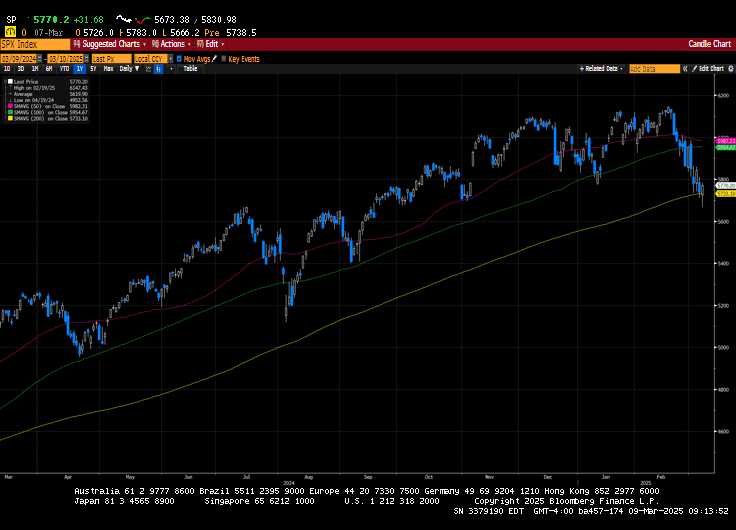
Weekly Market Commentary
The S&P 500 fell by 3.1% and breached its 200-day moving average before bouncing back in Friday’s session. The Dow lost 2.4%, the NASDAQ tumbled 3.5%, and the Russell 2000 shed 4%. Fourth-quarter earnings results from Target and Best Buy offered a warning about the consumer and the impact of higher prices on their respective bottom lines. Broadcom announced a great quarter and provided a positive outlook for AI infrastructure cap-ex that helped propel the beaten-down Semiconductor sector to a 3.2% gain on Friday.
Longer-tenured US Treasuries sold off during the week. The 2-year yield closed the week unchanged at 4%, while the 10-year yield increased by nine basis points to 4.32%. Significant changes in the outlook for Fed Monetary policy due to US growth concerns hammered the US Dollar index, which fell by 3.5% this week. Notably, the Euro strengthened to 1.0842, relative to the dollar.
Oil Prices continued to fall. WTI lost 3.7% or $2.60 to close at $67.11 a barrel. Gold prices increased by $66.30 to close at $2916 an Oz. Copper prices rallied 3.7% on tariff talk, closing the week at $4.71 per Lb. Bitcoin closed a volatile week at $86,600.
Roth Conversions: Today’s Slott Report Mailbag
By Andy Ives, CFP®, AIF®
IRA Analyst
Question:
Hello,
If a person is turning 73 years old in March, s/he would be required to take required minimum distributions for the year. Can a person do Roth Conversion prior to turning age 73 (say in February)? Does the first money out rule still apply?
Regards,
Ravi
Answer:
If you reach age 73 in 2025, then you have a required minimum distribution (RMD) for 2025, and the first money out of your IRA this year will be considered your RMD. If you convert prior to your 73rd birthday in March, you will still need to take your 2025 RMD prior to the conversion.
Question:
Is it possible to reverse part of the Roth conversion that I did from my traditional IRA?
Thanks
Answer:
No, it is not possible to undo a conversion. In the past, an unwanted conversion from a traditional IRA to a Roth could be recharacterized back to a traditional IRA. However, the Tax Cuts and Jobs Act eliminated recharacterization of Roth IRA conversions back in 2018.
If you have technical questions you would like to have answered, be sure to submit them to mailbag@irahelp.com, to be answered on an upcoming Slott Report Mailbag, published every Thursday.
https://irahelp.com/slottreport/roth-conversions-todays-slott-report-mailbag/

How an annuity can help as you plan for retirement
As you approach retirement, you may be wondering what are the next steps for your investments. An annuity may be an effective tool for you in retirement planning by providing a steady and reliable income stream.
With 2024 being the year with the greatest number of retirees hitting 65,1 there is a significant demographic of people reaching retirement age who have questions on what are the next steps for their investments. This aging population, often referred to as the “silver tsunami” has several key financial challenges they will need to face in short order.
In light of these challenges, an annuity can be a potential option for this population as they seek to grow their wealth in retirement. Here we list several reasons why an annuity can be an appealing investment for retirement:
An annuity – which is a contract with an insurance company that can provide a steady income stream or serve as protection from loss of principal – can be an effective tool in retirement planning by providing a steady and reliable source of capital. Here’s how an annuity can be used in retirement:
- Asset preservation: Depending on the annuity type, annuities can provide a guaranteed rate of return or level of protection that gives investors comfort when they no longer have their employment wages in retirement. Fixed annuities, for example, provide a guaranteed rate of return, which can help reduce investment risk compared to more volatile investment options. This can be a particularly attractive to retirees who prioritize stability and protecting their capital.
- Guaranteed income stream. An annuity can provide a consistent and predictable source of income, which can be practically valuable in ensuring that retirees have enough money to cover their essential living expenses. With an annuity, clients can build a personal pension for themselves in retirement.
- Longevity protection: By converting a portion of their retirement savings into an annuity, retirees can protect against the risk of outliving their assets. Lifetime annuities guarantee payments for as long as the retiree lives, offering peace of mind and financial security.
- Tax-deferred growth: Funds within a deferred annuity grow tax deferred, meaning that the interest earned is generally not taxed until withdrawals begin. This can be advantageous for retirees looking to maximize their investment growth.
- Supplementing other retirement income: An annuity can complement other sources of retirement income such as Social Security, pensions and withdrawals from retirement accounts. This type of diversification can enhance the overall financial stability of an investor in retirement.
- Simplified financial management: By providing a regular income stream or a fixed rate of return, annuities can simplify financial management in retirement, reducing the need for complex budgeting or investment decision.
When considering an annuity, it is essential for retirees to evaluate their overall financial situation, retirement goals and other income sources. Consulting with a financial advisor can help determine the most appropriate type of annuity or income structure to ensure a secure and comfortable retirement.
https://www.jpmorgan.com/insights/retirement/how-an-annuity-can-help-as-you-plan-for-retirement
RMD Avoidance: Red Flags and Dead Ends
By Andy Ives, CFP®, AIF®
IRA Analyst
I appreciate it when reputable financial advisors fight for their clients. It is a pleasure to see a well-educated, experienced professional leave no stone unturned when it comes to helping someone through a problematic situation. Such conversations can be inspiring. “What if we try this? What if we tried that?” If a creative path to a desired outcome exists within the rules, I will diligently help the advisor map out a route while simultaneously pointing out the tripping hazards. In my February 24, 2025, Slott Report entry, I wrote about IRA detours and alternate routes. Today, we run into road closures.
Sometimes, there is no path forward. On occasion, all roads lead to dead ends. Recently, I traded emails with a respected advisor. Previous communications demonstrated this individual to be someone who understands some of the more complex IRA rules and strategies. In this situation, he was searching for any possible angle to help his client with an $8 million 401(k) avoid taking required minimum distributions (RMDs).
Our first email exchange centered on the still-working exception. For those who have a 401(k) or other employee retirement plan, the required beginning date (RBD) for RMDs is the same April 1 as for IRA owners, unless they are still working for the company where they have the plan. If the person does NOT own more than 5% of the company (and the plan allows), he can delay his RBD to April 1 of the year following the year he retires. The client in question was still working, but he was a more-than-5% owner. Therefore, he could not use the still-working exception on his current plan. Dead end.
The next stone the advisor flipped was an idea to transfer the 401(k) into another retirement plan that accepted rollovers. The client was not a 5% owner of the company sponsoring the other plan. Success! The client could delay RMDs on any dollars he moved into this plan! Not so fast. The client explicitly wanted to do Roth conversions over the next few years. The other plan did not allow in-plan Roth conversions. Also, the client wanted his entire $8 million in the hands of a specific money manager only available within the current 401(k). Dead end. (Yes, he could do partial rollovers back to the 401(k) or to an IRA for conversion, but that was not what the client wanted.)
Now things began to get interesting. Our conversation turned back to the still-working exception and the “more that 5% ownership test.” The still-working exception does not apply to an individual who owns more than 5% of the company in the year the individual turns age 73. This is a one-time determination. If the individual is a more-than-5% owner in that year, he will never be able to use the still-working exception on that plan. Such is the case even if he no longer owns more than 5% of the company at some point in the future. (Family aggregation rules apply in determining the percentage.)
The advisor considered terminating the 401(k) in the year the client turned age 73 and then opening a new plan in the future. No deal. The same business entity still existed, and it was already determined that the client was a more-than-5% owner. Dead end.
Next, the advisor shared an article he found which suggested the possibility of closing the actual business and then establishing an entirely new business entity to skirt the age 73 ownership test year. Within that article, the author used phrases like “would appear to work” but “the IRS has never formally blessed this planning technique.” Red flags. Best not to pursue this angle. Dead end.
Ultimately, when I get an uneasy feeling in my gut, I know it’s the end of the road. I told the advisor that I could not bless these latest strategies. I told him I respected his efforts on behalf of his client. I asked if he also felt that knot in his belly. (Based on his stellar record, I knew he did.) Yes, we hit a dead end, but at least we exhausted all possibilities. His client can rest easy knowing this advisor did everything in his power to find a legal workaround. But based on client needs, there were none. RMDs apply.
If you have technical questions you would like to have answered, be sure to submit them to mailbag@irahelp.com, to be answered on an upcoming Slott Report Mailbag, published every Thursday.
https://irahelp.com/slottreport/rmd-avoidance-red-flags-and-dead-ends/
Deciphering the Rules for Roth 401(k)-to-Roth IRA Rollovers
By Ian Berger, JD
IRA Analyst
More and more 401(k) plans are making Roth employee contributions available, and employees leaving their jobs often want to roll over Roth 401(k) funds to a Roth IRA. What tax rules apply to distributions of amounts rolled over? Warning: The rules are complicated because they involve two five-year holding periods, one for the Roth 401(k) distribution and the other for the Roth IRA distribution.
If Your Roth 401(k) Distribution Is Qualified
Step one is to figure out if your Roth 401(k) distribution is qualified; that is, if you are age 59½ or older (or disabled) and have satisfied a five-year holding period. The holding period begins on January 1 of the year you made your first Roth contribution to the current plan (or did a rollover of Roth funds into the plan or an in-plan Roth conversion). Roth contributions made to other plans (or IRAs) don’t count.
If your Roth 401(k) distribution is qualified, you can immediately withdraw tax-free the entire rolled-over amount (both the Roth 401(k) contributions themselves and associated earnings) from your Roth IRA. What about earnings generated after the rollover? You can’t withdraw those earnings tax-free until the five-year holding period for your Roth IRA has been satisfied. The Roth IRA clock begins on January 1 of the year you made your first contribution (or conversion) to any Roth IRA. (That’s why it’s so important to make a Roth IRA contribution – no matter how small – as early as possible to get the clock ticking.) Importantly, you cannot carry over the Roth 401(k) holding period and use itto satisfy the Roth IRA holding period. But if your Roth IRA is distributed after the Roth IRA holding period has been met, then you’re all set: Everything comes out tax-free and penalty-free.
If the Roth IRA holding period hasn’t been met (because, for example, the rollover is your first Roth IRA), then you have to wait out five years before withdrawing your post-rollover earnings free of taxes. But, again, the original amount rolled over can always be withdrawn without tax or penalty.
If Your Roth 401(k) Distribution Is Not Qualified
What if your Roth 401(k) distribution is not qualified? In that case, you can immediately withdraw tax-free only the rolled-over Roth 401(k) contributions from your Roth IRA. Both the rolled-over Roth 401(k) earnings and any post-rollover earnings come out tax-free only if the Roth IRA distribution is qualified; that is, you’re age 59½ or older (or disabled or using the funds for first-time homebuyer expenses) and you’ve satisfied the Roth IRA five-year holding period (discussed above).
If the Roth IRA distribution is not qualified, then you’ll pay taxes (and possibly the 10% early distribution penalty) on both the rolled-over earnings and post-rollover earnings out of the Roth IRA. But the rolled-over Roth 401(k) contributions can always be distributed free of taxes and penalty.
I said it was complicated! Consulting with a knowledgeable financial advisor prior to any rollover is highly recommended.
If you have technical questions you would like to have answered, be sure to submit them to mailbag@irahelp.com, to be answered on an upcoming Slott Report Mailbag, published every Thursday.
https://irahelp.com/slottreport/deciphering-the-rules-for-roth-401k-to-roth-ira-rollovers/

Weekly Market Commentary
-Darren Leavitt, CFA
Growth concerns entered the market narrative as investors continued to look at policy uncertainties on tariffs and the strains on geopolitical relations. The Trump administration confirmed that 25% tariffs on Canada and Mexico would be effective on March 4th and announced an additional 10% levy on Chinese imports. Trump also said a 25% tariff would soon be placed on European imports. That said, there is still a sense that these tariffs may be avoided, and late in the week, Mexico announced that they may propose to match the US tariffs on Chinese imports.
Valuations of companies that led the markets higher last year have been scrutinized as the ROI from AI initiatives has underwhelmed. Microsoft’s announcement that they would curtail their plans to build out data centers, coupled with a “good but not great” 4th quarter earnings result from Nvidia, induced more selling in the more speculative parts of the market. However, there are mixed signals here. Microsoft said that it still planned to spend the $80 billion in capital expenditures detailed in its most recent earnings call; Apple announced a $500 billion plan that would create 20,000 jobs in the US to create AI-focused servers, and Meta and Apollo are working on a $35 billion financing plan to finance a new Meta data center. Despite the continued spending on AI mega-caps are off more than 10% from their highs and have now entered correction territory.
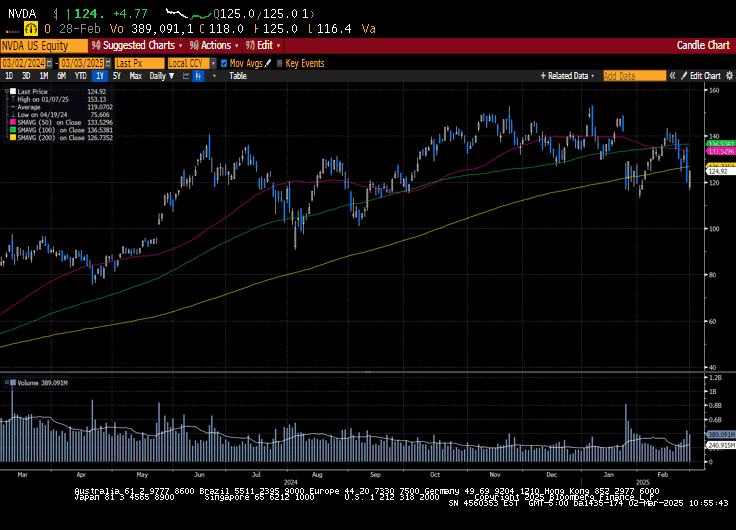
The S&P 500 shed 1%, the Dow gained 1%, the NASDAQ tumbled 3.5%, and the Russell 2000 gave back 1.5%. Notably, the S&P 500 could not hold on to its most recent highs, and selling brought the index below its 50-day moving average, which will now act as resistance for the index to move higher. The NASDAQ joined the Russell 2000 with negative year-to-date returns. Investor concerns about growth were manifested in US Treasuries. The 2-year yield declined by nineteen basis points to 4%, while the 10-year yield went to 2025 lows with a nineteen basis point decline to 4.23%. Interestingly, the market is now pricing just over two rate cuts in 2025: two weeks ago, it was a jump ball on one rate cut.
Oil prices continued to slump, losing $0.65 to close at $69.71. Gold prices had a meaningful retreat off their most recent highs, losing 3.5% or $103.70 to close at $2849.70 an Oz. Copper prices were unchanged on the week at 4.54 per Lb. Bitcoin prices plunged and nearly broke through $80,000 before bouncing to close, down 9.5% to $85,900. The Dollar index advanced 0.9% to 107.62.
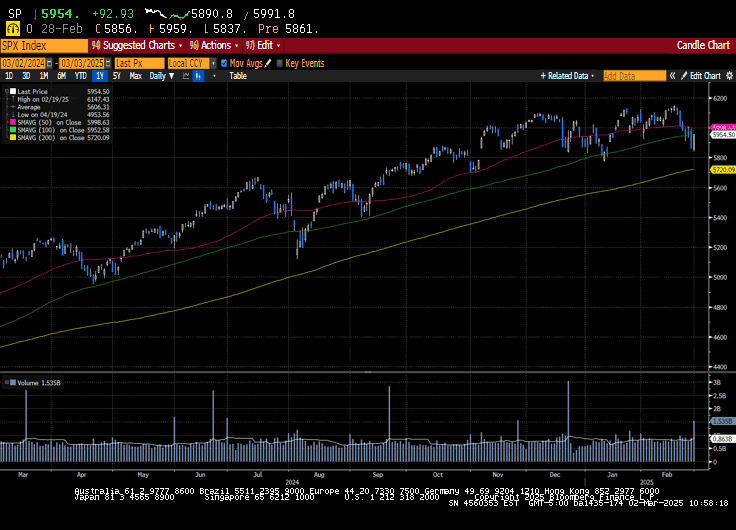
The economic calendar fostered the weak growth narrative as well. Pending Home Sales fell by 4.6%, a percentage fall not seen since 2001. The 2nd estimate of Q2 GDP was in line with the 1st estimate of 2.3%, but the GDP inflator increased to 2.4% from 2.2%, showcasing the elevated inflationary environment. Consumer Confidence fell to 98.3 from the prior print of 105.3 and was the lowest print in the data series since August 2021. The survey showed a material increase in one-year inflation expectations from 5.2% to 6%, the highest level since 1995. Tariffs were cited as the reason for the rise in inflation expectations. The Fed’s preferred measure of inflation, the PCE, showed a month-over-month increase of 0.3%, as did the Core reading; both were in line with expectations. The year-over-year figures came in at 2.5% and 2.6%, lower than the December figures of 2.6% and 2.9%. Personal spending came in at -0.2%, down from the prior print of 0.7%, and validated the weak retail sales print earlier in the month. The weaker print also may translate into a weaker Q1 2025 GPD estimate. The weaker print caused investors to reevaluate the health of the consumer. Personal Income increased to 0.9% from the prior reading of 0.4%.
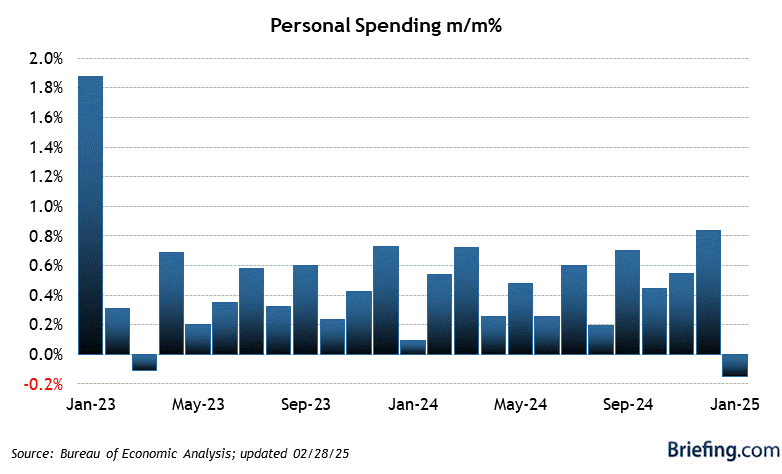
Investment advisory services offered through Foundations Investment Advisors, LLC (“FIA”), an SEC registered investment adviser. FIA’s Darren Leavitt authors this commentary which may include information and statistical data obtained from and/or prepared by third party sources that FIA deems reliable but in no way does FIA guarantee the accuracy or completeness. All such third party information and statistical data contained herein is subject to change without notice. Nothing herein constitutes legal, tax or investment advice or any recommendation that any security, portfolio of securities, or investment strategy is suitable for any specific person. Personal investment advice can only be rendered after the engagement of FIA for services, execution of required documentation, including receipt of required disclosures. All investments involve risk and past performance is no guarantee of future results. For registration information on FIA, please go to https://adviserinfo.sec.gov/ and search by our firm name or by our CRD #175083. Advisory services are only offered to clients or prospective clients where FIA and its representatives are properly licensed or exempted.

9 Ways Retirement Will Be Different in 2025
How changes in Social Security, Medicare, 401(k) contributions and more will affect your finances
Retirement is not static. Even when the kids are gone and the career is done, your lifestyle and expectations are constantly evolving. So are your finances. Areas key to retirees’ economic life, from Social Security payments and Medicare costs to the way we contribute to and withdraw from savings plans, will see changes in 2025.
Here are nine things to know about your retirement money in the year to come.
1. Social Security payments
Social Security’s cost-of-living adjustment (COLA) boosts benefits in 2025 by 2.5 percent. The average retiree will see a $49 increase in their monthly payments, from $1,927 to $1,976, according to the Social Security Administration (SSA). For the surviving spouse of a late beneficiary, the estimated average survivor benefit will increase by $44, from $1,788 to $1,832 a month.
People drawing retirement, survivor or Social Security Disability Insurance (SSDI) benefits will see the increase in their January payments. Those getting Supplemental Security Income (SSI), a benefit administered by the SSA for people who are 65 and older, blind or have a disability and have very limited income and assets, will receive their first COLA-boosted payment Dec. 31.
The coming year’s COLA reflects changes in prices for a set of consumer goods and services in the third quarter of 2024 compared to the same period the year before. Inflation cooled slightly over that time, resulting in a dip from 2024’s 3.2 percent adjustment.
How the COLA affects beneficiaries’ buying power will depend largely on inflation trends in the year ahead. If the rate continues declining, the 2.5 percent benefit bump could provide retirees with a measure of protection, but if the rate rises, the increase in consumer prices could swallow up the COLA gain.
2. Medicare costs
Another potential drag on the COLA’s effectiveness is rising Medicare premiums. For the second straight year, the base rate for Medicare Part B, which covers doctor visits and other outpatient treatment, is going up by 6 percent, from $174.70 a month to $185.
Most Medicare enrollees pay this standard rate directly from their Social Security payments. For this group, the premium increase effectively trims the COLA benefit boost by $10.30 a month. Premiums are higher for what Medicare considers high earners — in 2025, incomes above $106,000 for individual taxpayers and above $212,000 for couples filing jointly.
The annual deductible for Part B is also increasing, from $240 in 2024 to $257 in 2025.
Medicare enrollees who have Medicare Advantage (MA) coverage or Medicare Part D prescription drug plans can see widely varying costs, as these plans are provided by private insurers. Medicare officials estimate the average monthly premium for an MA plan will decrease by $1.23 a month, from $18.23 to $17, and that more than 4 in 5 people with MA plans will not see any increase.
Average Part D premiums are also projected to drop, from $41.63 a month for a stand-alone drug plan in 2024 to $40 in 2025. And starting in 2025, there’s a $2,000 cap on annual out-of-pocket costs on prescriptions for both Part D policies and drug coverage in MA plans. Some 3.2 million people with Part D plans will save money on covered prescriptions due to the cap, an August 2024 AARP study found.
3. Retirement plan contributions
The IRS sets limits on how much you can contribute each year to a retirement savings plan, and there are multiple tiers (including a new one for 2025 — see below).
For an individual retirement account (IRA), the standard cap for the 2025 tax year is $7,000. But if you are 50 or older, you can make a catch-up contribution of up to $1,000, for a total of $8,000. The limits are the same as in 2024 — and if you haven’t yet maxed out your contribution for 2024, you still can; the deadline is April 15, 2025.
Contribution limits are going up for people with workplace retirement plans. In 2025, those ages 50-plus can put up to $31,000 into a 401(k), 403(b) or Thrift Savings Plan (and most 457 plans). That’s $500 above the 2024 cap. The limit for workers 49 and younger ticks up from $23,000 to $23,500 in 2025.
4. ‘Super catch-up’ contributions
Starting in 2025, workers near retirement age can put even more into employer-sponsored retirement plans. The so-called “super catch-up” contribution enabled by the SECURE 2.0 Act, a 2022 federal law designed to help U.S. workers save more, goes into effect Jan. 1.
Under this provision, savers ages 60 through 63 can make bigger catch-up contributions than other 50-plus workers: up to $11,250 over the standard limit, for a total of $34,750.
Early-60s workers can make super catch-up contributions to a 401(k), 403(b), governmental 457 or Thrift Savings Plan. The super catch-up is indexed to inflation and may increase year to year.
5. RMDs
People ages 73 and older must make annual minimum withdrawals from traditional IRAs and workplace retirement plans. Roth IRAs and workplace accounts are exempt from these required minimum distributions, or RMDs, as long as the original account owner is alive.
The IRS calculates your RMD based on the account balance and your life expectancy. You’ll owe federal income taxes on the withdrawal, at your regular tax rate. If you turned 73 in 2024, you have until April 1, 2025, to take your RMD; otherwise, the deadline is Dec. 31, 2024.
New RMD rules taking effect in 2025 will affect some heirs who inherit an IRA. These beneficiaries typically must make minimum annual withdrawals but until 2025 have been able to spread them out over their lifetime. Starting Jan. 1, IRA inheritors other than a spouse — such as a child, sibling or a close friend — have 10 years to deplete the account.
This 10-year rule was part of a 2019 federal law on retirement savings but the IRS delayed implementation for several years. It applies to beneficiaries of accounts whose original owner died on or after Jan. 1, 2020. (Surviving spouses, in most cases, still have their full lifetime to empty an inherited account.)
6. Standard tax deduction
Most taxpayers take the standard deduction rather than itemizing their tax returns, and taxpayers ages 65 and up get to take a little bit more out of their taxable income. The IRS annually adjusts the amounts for inflation.
Here are the regular standard deductions for 2024 tax returns (the ones you must file by April 15, 2025):
- Married couple filing jointly: $29,200 (up from $27,700 in the 2023 tax year)
- Single or married filing separately: $14,600 (up from $13,850)
- Head of household: $21,600 (up from $20,500)
And here are the standard deductions for taxpayers ages 65 and older:
- Married filing jointly (if one or both spouses is 65-plus): $32,300 (up from $30,700 in 2023)
- Single or married filing separately: $16,550 (up from $15,700)
- Head of household: $23,850 (up from $22,650)
7. Full retirement age
Congress voted in 1983 to gradually raise the Social Security full retirement age (FRA) — the age when you become eligible to claim 100 percent of the retirement benefit calculated from your lifetime earnings — from 65 to 67. In recent years, it has been going up two months at a time, based on year of birth.
For people born in 1958, FRA is 66 years and 8 months, and for those born in 1959, it’s 66 years and 10 months. You’ll reach full retirement age in 2025 if you were born between May 2, 1958, and Feb. 28, 1959. Under current law, FRA will be 67 for people born in 1960 or later.
You can start collecting retirement benefits before FRA — the minimum age is 62 — but you’ll take a benefit hit and lock it in. People who turn 62 in 2025 will collect up to 30 percent less per month, for life, than if they wait to claim at 67. For every month you delay, your prospective benefit increases a little, up to age 70, when you can claim your maximum retirement benefit.
8. Social Security earnings test
If you claim Social Security retirement benefits before reaching FRA and continue to do paying work, your benefits may be temporarily reduced if your annual work income exceeds a certain limit. This is called the “earnings test.” Here’s how it will work in 2025:
- If you will reach FRA in a future year, the 2025 earnings limit is $23,400 (up from $22,320 in 2024). Social Security withholds $1 in benefits for every $2 in earnings above the cap.
- If you will reach FRA in 2025, the income threshold is $62,160 (up from $59,250). The withholding in this case is less: $1 in benefits for every $3 in earnings above the limit.
Once you attain full retirement age, the earnings test goes away. You get the monthly benefit you qualify for, with no deduction for work income, and the SSA recalculates your benefit amount to make up for the past withholding.
9. Qualified charitable donations
The IRS allows people age 70½ and older to make a qualified charitable donation (QCD) directly from an IRA and exclude it from their taxable income. The ceiling for an eligible donation is going up, from $105,000 in the 2024 tax year to $108,000 in 2025.
Along with reducing your tax bill, qualified charitable distributions count toward your RMD. If you take your mandatory withdrawal in the form of a QCD, it’s tax-free, provided you make the donation directly from your retirement account to the charity. And you don’t have to itemize, as is the case if you’re taking charitable donations as regular tax deductions.
https://www.aarp.org/money/retirement/changes-2025/
Roth IRA Distributions and Eligible Designated Beneficiaries: Today’s Slott Report Mailbag
By Andy Ives, CFP®, AIF®
IRA Analyst
QUESTION:
I opened my first Roth IRA in 2017 and a second Roth IRA in December 2021. My current age is 71. I withdrew some funds from these accounts last year. For tax year 2024, I received a 2024 Form 1099-R for the 2017 Roth IRA account with a distribution code of Q and a 1099-R for the 2021 Roth IRA with a distribution code of T. That’s where the confusion is – different distribution codes. Having the 2021 Roth IRA for less than 5 years, and having received the Form 1099-R with a distribution code of T, I wanted to make sure I did not have to pay taxes on this distribution. Having the first Roth IRA for more than 5 years, is not the second Roth IRA also covered within that 5-year requirement period for withdrawals?
Thanks,
Ken
ANSWER:
Ken,
I didn’t need to read much beyond your first two sentences. You are over age 59½ and have had a Roth IRA (any Roth IRA) for over 5 years. End of story. Every distribution you take will be tax free. If you do any Roth conversions in the future, the converted dollars and earnings will be immediately available tax free. As far as Roth IRAs go, you never have to worry about taxes again for the rest of your life. Regarding the 1099-R codes, Code Q is used for a distribution from a Roth IRA when the custodian knows the Roth IRA owner meets the 5-year holding period and has reached age 59½. Such is the case with your 2017 Roth IRA. Code T is used for a distribution from a Roth IRA when the custodian knows you are over 59½, but is unsure if you have met the 5-year period. That is the case with your 2021 Roth IRA. All is in order. Based on the details you shared, nothing is taxable.
QUESTION:
I am 77 years old and take required minimum distributions (RMDs) from my IRA. Can I name my grandchildren who are seven and five years old as beneficiaries for my IRA accounts? If something happens to me, can they stretch RMDs over their life expectancies if they are still minors at the time of my death?
ANSWER:
You can name your grandchildren as your IRA beneficiaries. However, even though they are minors, they do not qualify as “eligible designated beneficiaries” (EDBs) for your IRA. Only EDBs are allowed to take stretch RMD payments over their full life expectancy, and only minor children of the IRA owner qualify for this EDB category. Since the grandchildren are not your children, they would be subject to the 10-year payout rule.
If you have technical questions you would like to have answered, be sure to submit them to mailbag@irahelp.com, to be answered on an upcoming Slott Report Mailbag, published every Thursday.
https://irahelp.com/slottreport/roth-ira-distributions-and-eligible-designated-beneficiaries-todays-slott-report-mailbag/
Watch Out for the Once-Per-Year Rollover Rule
By Sarah Brenner, JD
Director of Retirement Education
Why is it so important to know how the “once-per-year rollover rule” works? Well, that’s because trouble with the once-per year rule is the kind of trouble no one wants! If you violate this rule, you are looking at some serious tax consequences. Here is what you need to know about this rule that can cause big problems for those who do not know all its details and pitfalls.
One Rollover a Year for An IRA Owner
If an IRA owner for whatever reason elects not to do a direct transfer but instead chooses to move her money by 60-day rollover, there will usually be no escaping the once-per-year rollover rule. The rule says that an IRA owner cannot roll over an IRA distribution that is received within a 365-day period of a prior distribution that was rolled over.
Traditional and Roth IRAs are combined for purposes of the once-per-year rule. So, for example, a distribution and subsequent rollover between your Roth IRAs will prevent another rollover of a distribution from your traditional IRA received within one year of the Roth IRA distribution. The bottom line is that an IRA-to-IRA (or Roth IRA-to-Roth IRA) 60-day rollover may not be done if you received a prior distribution within the last year (365 days) that you also rolled over.
The once-per-year rollover rule does NOT apply to rollovers between plans and IRAs or Roth IRA conversions.
Fatal Error
A mistake with the once-per-year rollover rule can result in the loss of your retirement savings. It is a fatal error with no remedy.
If you take a distribution with the intent of rolling over and discover that you are ineligible to roll over the funds due to the rule, that distribution will be taxable to you. You will no longer have an IRA and will likely have a tax bill instead. The distribution will also be subject to the 10% early distribution penalty if you are under age 59½. If you go ahead and deposit the funds anyway, you will have an excess IRA contribution complete with all the penalties and headaches that go with it.
What about the IRS? Well, the IRS will not be able to grant relief. This is because by law the IRS has no authority to waive this rule. The self-certification procedures allowing for relief when the 60-day deadline is missed do not apply to violations of the once-per-year rollover rule. A private letter ruling (PLR) request won’t work either.
Do Direct Transfers Between Your IRAs.
Why chance it? A good place to start is by avoiding 60-day day rollovers whenever possible. If there is no 60-day rollover, then there is no once-per year rollover rule to worry about. How then can you move your retirement funds? The best advice is to directly transfer the funds from one retirement account to another rather than taking a distribution payable to yourself and then rolling it over to another retirement account. You can do as many transfers between IRAs annually as you want. There are no limits for you to worry about here.
If you have technical questions you would like to have answered, be sure to submit them to mailbag@irahelp.com, to be answered on an upcoming Slott Report Mailbag, published every Thursday.
https://irahelp.com/slottreport/watch-out-for-the-once-per-year-rollover-rule/
IRA Transactions: Detours and Alternate Routes
By Andy Ives, CFP®, AIF®
IRA Analyst
Sometimes we get stuck in traffic, or a highway is closed, and we are forced to find an alternate route. I’m not talking about driving across someone’s front yard or going the wrong way on a one-way street. Think side roads and legal detours. While a main road may be blocked, that might not be the only way to reach your destination. The same holds true with certain IRA transactions. Here are a handful of creative “detours” that retirement account owners may be forced to take in order to reach their intended goal.
Backdoor Roth IRA. This is the classic workaround for anyone who makes too much money to contribute to a Roth IRA. Yes, there are contribution income limits which prohibit high earners from contributing directly to a Roth IRA. But these limitations can easily be overcome. High earners can make non-deductible contributions to a traditional IRA and then convert those dollars to a Roth IRA immediately thereafter. (There is no mandatory holding period before the conversion can be done.) Just be aware that the pro-rata rule will apply.
No Liquidity/RMD Aggregation. If an IRA owner holds an illiquid investment in his IRA, that is no excuse to avoid taking the required minimum distribution (RMD). The easiest “alternate route” is to take a distribution from another IRA. Assuming the IRA owner has another IRA, SEP or SIMPLE IRA that contains liquid assets, aggregation rules allow the RMD from the illiquid account to be taken from another IRA. Recognize that not all retirement accounts can be aggregated for RMD purposes. For example, an RMD for a 401(k) cannot be satisfied by taking a distribution from an IRA.
No Liquidity/RMD Conversion. Recently an advisor called and said his client was short by $24 with his IRA RMD. An illiquid investment prevented him from generating the cash to cover the shortfall. Additionally, he had no other IRA from which he could take the shortage from. The first idea was to make a contribution to the IRA, and then turn around and withdraw $24. But the retired IRA owner had no earned income, so a contribution was not allowed. The advisor mentioned that the client wanted to convert the entire IRA to his existing Roth. Ah-ha! A legal detour. Solution: The advisor converted the entire illiquid investment to a Roth. This resulted in a conversion of the remaining RMD of $24. But RMDs are not supposed to be converted. Oops. The $24 was now an excess contribution in the Roth. The existing Roth IRA had plenty of liquid investments. The $24 was then promptly removed from the Roth IRA as an excess contribution withdrawal. RMD satisfied, no penalties, legal workaround.
Estimated Taxes Underpayment. If it is late in the year and you find yourself behind in your estimated tax payments, take a distribution from your IRA and have 100% withheld. Taxes withheld are deemed to be paid in equally over all four quarters.
Taxes Withheld on Plan-to-IRA Rollover. Speaking of having taxes withheld, sometimes plan participants erroneously request a distribution (as opposed to a direct rollover) from their work plan with the intent of rolling over the dollars within 60 days. When the plan processes the distribution, there is a requirement to withhold 20%. In a situation like this, the account owner can make up the “missing” 20% with dollars from his own savings to complete a full 100% rollover. The 20% withheld will be a credit to the IRS that the taxpayer may be able to recoup at tax time.
Just because the sign says “Dead End” or “Road Closed” does not mean the journey is necessarily over. Legal workarounds exist for many retirement account transactions.
If you have technical questions you would like to have answered, be sure to submit them to mailbag@irahelp.com, to be answered on an upcoming Slott Report Mailbag, published every Thursday.
https://irahelp.com/slottreport/ira-transactions-detours-and-alternate-routes/

Important Tasks & Decisions for Each Phase of Retirement Planning
Important Tasks & Decisions for Each Phase of Retirement Planning
Retirement. It tends to be a catch-all word that generally refers to the light at the end of the tunnel after years of hard work. It’s a time to enjoy the things in life that matter the most, like family, travel, and leisure activities. After all, you’ve put in your time and earned it!
But “retirement” is much more than just a time for seniors to kick back and relax; it is a period of life for which many people have been planning and saving literally for decades.
When helping people diligently save and prepare for retirement, financial planners sometimes find it helpful to break retirement planning down into phases, with each one having distinct characteristics and action items. There are choices about your retirement lifestyle and housing that should be considered and decided during each of the following five phases.
- Accumulation
What is it? This first phase of retirement planning may be the longest for many people. The Accumulation phase starts when you begin your time in the workforce and commence saving for retirement. It’s sometimes tough to save a lot during the early years of this phase because you are just starting out in your career and are at the lower end of the pay scale. Additionally, many people are paying off student loans, buying a first home, and/or starting a family. However, every little bit that can be saved is important because people in this phase have something no one else has – time. Small contributions early on can grow to substantial levels over time due to the power of compound interest. The Accumulation phase is typically thought to end at retirement. However, retirement today is often a moving target, so there may not be a hard and fast end date for this phase.
What are my to-dos? For those who have a 401(k) or other retirement savings account offered by their employer, sign up and start contributing whatever you are able. Make this a priority and start with a goal of contributing at least up to the amount that is matched by the employer, if applicable. After all, a company match is free money! Set a goal of trying to reach the point where you can put away close to 10 percent of your income. As a rule of thumb, if you can do this and invest the money appropriately, you should be well on your way to a secure retirement.
For those who are self-employed or work for companies that lack a 401(k) option, talk with a qualified financial planner about opening a Roth and/or traditional individual retirement account (IRA) for your retirement savings. If you are self-employed, you may consider other options such as SEP or SIMPLE IRAs, or even a solo 401(k). When you’re just getting started, there are a growing number of useful online resources and tools for basic financial education and investing. Remember, it is never too early to envision what you want for your retirement and saving to achieve those goals.
- Pre-Retirement
What is it? This phase typically begins around 50 years old or about 15 years from retirement (whichever comes first). This is still part of the Accumulation phase, so you want to be sure your savings rate is sufficient, and there are also other aspects of retirement planning to begin considering at this stage.
What are my to-dos? This is a critical time for talking with an experienced and qualified financial planner who can prepare retirement projections for you. These projections can help you determine if you are on track or lagging with your retirement savings. No one has a crystal ball but having some idea of where you stand at this point is better than not having any idea at all.
This is also the time to begin educating yourself on how Social Security and Medicare benefits work, as well as long-term care insurance (LTCi). Long-term care covers the type of assistance you may need in the future, but which is not covered by Medicare. This type of coverage could become prohibitively expensive if you wait until the next retirement phase. Although the LTCi industry has had its challenges over the past few years, new forms of coverage are already emerging that should be more sustainable and affordable for consumers in the long run. Finally, if you haven’t already started discussing where you would like to live during retirement, start those conversations with your spouse or partner and loved ones now. Think about what will be most important to you during retirement. If you’ve saved appropriately, retirement may be the first time that you will have the opportunity to live wherever you want, without other obligations dictating this decision for you.
- Early Retirement
What is it? The time from your last day in the workforce until you reach your early 70s may be considered Early Retirement. Of course, a growing number of retirees are now embarking on encore careers during retirement, which is an exception to this rule. An encore career keeps retirees active and engaged and perhaps means starting that business that you’ve dreamed about for years.
What are my to-dos? There will likely be adjustments to your budget during this phase, based on your decisions about where to live or whether to embark on an encore career, etc. It’s also the first time you’ll probably begin drawing income from your retirement accounts to help pay the bills. This is a big adjustment. For many people, the thought of reversing the process from putting money into savings to taking money back out can be downright frightening. You’ll probably need some guidance from a qualified financial advisor to help make sure your distributions are well within a reasonable level without jeopardizing your long-term financial security and that you are taxing distributions in the most tax-efficient way as possible. This often means knowing which assets to draw from first.
Early in this phase you’ll also need to make decisions about health insurance, such as Medicare and Med Sup, or determining whether insurance from your employer will carry over into retirement.
- Mid-Retirement
What is it? Mid-Retirement starts at 70 years old and extends whatever length of time you are still able to safely live independently. This period can vary greatly from one person to another based largely on health, genes, and lifestyle. At this stage, tax and estate planning become increasingly important. If you have built up substantial savings in tax-deferred retirement accounts, such as IRAs and 401(k)s, then you’ll need to be sure you are properly withdrawing required minimum distributions (RMDs), which must begin at age 70 ½. Since you’ll have to begin taking these distributions and paying ordinary income taxes, then this might dictate changes to other parts of your income and investment management plans. An experienced and reputable financial advisor, in conjunction with a CPA, can help make sure you are doing this efficiently.
This is also the most important time to begin thinking about where you would like to live as you get older—In your current home? In a different home? In a retirement community? You should research all your options in order to make the most informed decision. This is also a good time to begin having honest conversations with your family members about what is most important to you, particularly if your health declines.
What are my to-dos? This is a time when many people choose to downsize, move closer to family, or begin considering the low-maintenance lifestyle offered by a retirement community. If you plan to stay in your home, begin to earnestly explore and specify the choices you want your loved ones to make when your health declines. Since it is not possible to know exactly what healthcare needs or challenges will arise in the future, it is important to consider and plan for a range of scenarios.
If you are considering a retirement community, make sure you know what distinguishes one type from another. It’s also important to know what types of supportive services and healthcare are available to you if needed in the future. For instance, a continuing care retirement community (CCRC or “life plan community”) usually provides residents an onsite “continuum of care,” the increasing levels of healthcare services that a person may need as they age, from independent living to skilled nursing care. Having access to this type of progressive care means a senior and their family don’t have to worry about the “what if” scenarios of the aging process. However, choosing a CCRC can be complex so it’s important to do the appropriate research and comparisons.
- Late Retirement
What is it? If a senior’s health declines to the point that they need extensive help to care for themselves on a daily basis, and it is unlikely that their health status will improve, they have entered the Late Retirement phase.
What are my to-dos? In theory, if a senior has followed the planning steps above, including having discussions with family and making wise housing choices, the challenges of this phase will be more manageable than without planning—focused on implementing previously determined choices.
Are you on track?
Longer lifespans, which can result in extended long-term care needs, means that people must be more proactive when it comes to planning for the later phases of retirement. Unfortunately, this is often a part of retirement planning that is overlooked by families and financial advisors, the result being a reactive approach to addressing seniors’ lifestyle and healthcare needs when a crisis arises.
If you are nearing or in the “Mid-Retirement” phase—still active and able-bodied—it is a great time to plan for your Late Retirement years. Putting off such important decisions about your future needs may mean you and your loved ones will have to deal with difficult, stressful, and frequently costly situations down the road.
https://rw-c.org/retirement-planning/?gad_source=1&gclid=Cj0KCQiAwtu9BhC8ARIsAI9JHan3tcKeB0JTYBDDs8RkKz2NdEQH0mGWzdEO0f31dhxgpHTFI1dfPG8aAieyEALw_wcB

Weekly Market Commentary
The holiday-shortened week saw the S&P 500 hit all-time highs, but late in the week, the move abruptly succumbed to consolidation pressure. Investors are worried about valuations, trade tensions, inflation, and declining consumer sentiment.
A call for European nations to spend more on defense hit European bond markets but catalyzed their equity markets—the German DAX has forged 17 new all-time highs this year while the Euro STOXX 50 continues to set new all-time highs as well. European markets were also likely bolstered by the beginning of negotiations that may end the war in Ukraine. Fund flows have continued to pour into international developed and emerging markets. China’s President Xi Jinping met with private sector leaders and endorsed several initiatives taken by several Chinese Technology companies, including Alibaba and Baidu. The meeting signaled to global investors that the crackdown on the Chinese private sector could be ending. Alibaba’s recent rally continued on the back of the fastest revenue growth in over a year. Japan’s market rallied on better-than-expected economic growth and fostered a further rally in the Japanese Yen.
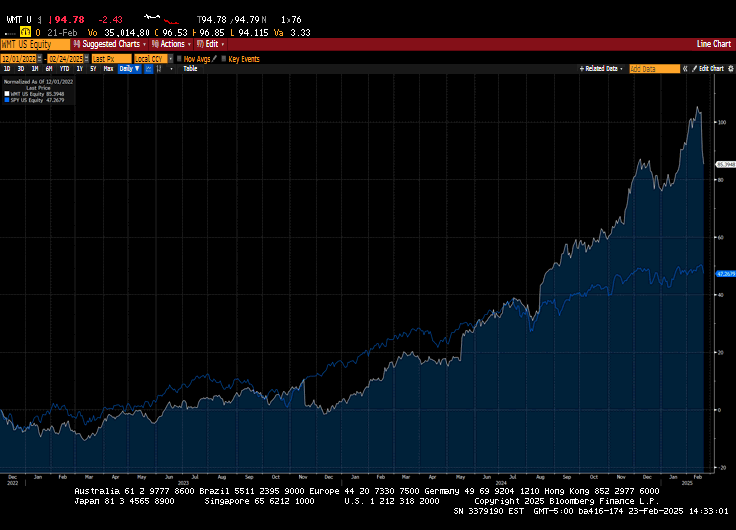
Fourth quarter earnings continued to roll in, with the quarter’s results showing EPS growth north of 14%. That said, many management teams have taken the opportunity to dampen their guidance due to the uncertainties around tariffs and what they could mean for the cost of goods and, in turn, margins. Over 8% of S&P 500 companies have lowered guidance, another factor weighing on US markets. Walmart shares fell 6.5% in the aftermath of their disappointing earnings. Worries over consumer spending behaviors, a weak global economic backdrop, and last week’s weak retail sales print moved investors to the sidelines. However, for context, Walmart’s share price had doubled since the beginning of December 2002, and shares were arguably due for some consolidation. Super Micro Computer’s shares soared on better-than-expected earnings. Intel shares rallied on the idea of selling parts of the company and/or forming new partnerships with Taiwan Semiconductor and Qualcomm. On Friday, United Healthcare shares were hammered on the news that the Department of Justice is investigating their Advantage Medicare billing practices.
The S&P 500 shed 1.7%, the Dow and NASDAQ fell by 2.5%, and the Russell 2000 lost 3.7%. US Treasuries rallied across the curve as safe-haven assets were sought on the back of weaker economic data. The 2-year yield fell by seven basis points to 4.19%, while the yield on the 10-year fell by five basis points to 4.42%. Oil prices trended to the lowest levels seen this year. WTI prices fell by $0.32 to close the week at $70.36 a barrel. Gold prices advanced for the seventh consecutive week, gaining $53.50 to close at $2953.40 an Oz. Copper prices fell by twelve cents to $4.54 per Lb. Bitcoin’s price fell by $2,500 to close at $94,900. The US Dollar index fell by 0.1% to 106.59.
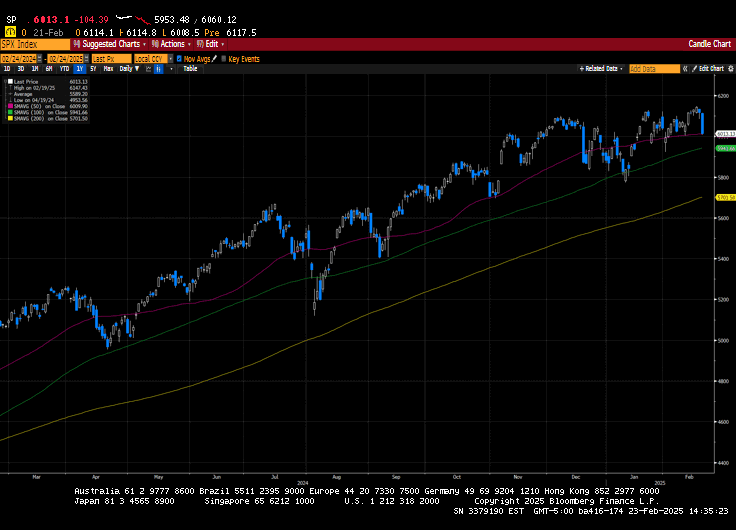
SPOUSAL ROLLOVERS AND THE ONCE-PER-YEAR ROLLOVER RULE: TODAY’S SLOTT REPORT MAILBAG
By Ian Berger, JD
IRA Analyst
Question:
Dear Ed Slott and America’s IRA Experts,
I have a rollover traditional IRA that was set up when I left my last job. I am no longer employed, so I don’t have any earned income. My husband works full time, and our filing status is married filing jointly.
I would like to know if I am able to contribute to a newly established traditional IRA account with no balance and then convert it to a Roth IRA. Also, when I convert the new traditional IRA to a Roth IRA, do I have to consider the assets in the rollover traditional IRA and calculate the taxes on a pro-rata basis? Or do I calculate taxes owed on the converted Roth dollars using only the contribution from the new traditional IRA? Lastly, is this conversion strategy limited by income levels?
Sincerely,
Anna
Answer:
Hi Anna,
As a spouse, you are allowed to use your husband’s compensation to open up a traditional IRA for yourself. (This assumes his compensation is high enough to cover your IRA and any IRA he opens for himself.) When you convert your traditional IRA to a Roth IRA, the pro-rata rule does require you to take into account your rollover IRA (and any other IRAs or SEP or SIMPLE IRAs you may have) to determine the taxation of the conversion. The good news is that there are no income limits on converting to a Roth IRA.
Question:
Can a person do 60-day rollovers from both their traditional and Roth IRAs in the same 365-day period?
Answer:
Traditional and Roth IRAs are combined for purposes of the once-per-year rollover rule. So, a distribution and subsequent rollover between your Roth IRAs will prevent another rollover of a distribution and rollover between your traditional IRAs if the distribution of the traditional IRA occurs within 365 days of the distribution of the Roth IRA. The same would be true if the traditional IRA distribution and rollover comes first.
IRS Issues Proposed Regulations on Automatic Enrollment Requirement
By Ian Berger, JD
IRA Analyst
One important provision of the 2022 SECURE 2.0 law is the requirement that most new 401(k) and 403(b) plans must institute automatic enrollment. This rule is effective for plan years beginning after December 31, 2024. A “plan year” is the plan’s 12-month fiscal year and is usually January 1 – December 31. So, many new plans became subject to automatic enrollment on January 1, 2025. On January 9, 2025, the IRS issued proposed regulations on this rule.
What is automatic enrollment? It’s a plan feature that requires covered employees to make elective deferrals to the plan unless they opt out. Automatic enrollment is not new. Over the last 15 years, many plans have voluntarily adopted this plan design as a way of boosting plan participation. But now it will be mandatory for most newly-established plans. A number of studies have shown that automatic enrollment is indeed an effective way of getting employees to start making 401(k) deferrals. However, some critics have argued that automatic enrollment effectively dupes many employees into contributing when they can’t afford it and that employees don’t understand that they can opt out.
The IRS proposed regulations say that several categories of plans are exempt from mandatory automatic enrollment (although employers of these plans are free to voluntarily adopt it):
- Grandfathered plans: When SECURE 2.0 was enacted, some news outlets reported that the new automatic enrollment rule applied to existing plans. That’s clearly not what the law says, and the IRS confirms this in the regulations. Any 401(k) or 403(b) plan adopted by the employer before December 29, 2022 (the effective date of SECURE 2.0) is grandfathered. That’s the case even if the plan did not start operating until after that date.
- Governmental and church plans: The IRS confirms that plans sponsored by governments or churches are exempt.
- Small employer plans: Companies that “normally” employ 10 or fewer employees do not have to comply. The regulations set out a complicated method for determining whether a small company meets that standard. In essence, a company is not exempt if it employs more than 10 employees during 50% of the company’s fiscal year. There are special rules for counting part-time employees.
- Plans of new businesses: Any business that, as of the beginning of the plan’s “plan year” has been in existence for less than three years is exempt.
Employers with plans subject to mandatory automatic enrollment can set the deferral rate for employees who don’t opt out or who elect a deferral rate higher than the one set by the employer. That rate must be at least 3% of pay and no more than 10% of pay. Each year after that, the employer must increase the required deferral rate by 1% until it reaches a rate of at least 10% and no more than 15% of pay. Any employee subject to automatic enrollment must be allowed to withdraw his deferrals within 90 days of the date of the first automatic contribution to the plan.
The proposed regulations aren’t technically effective until after the IRS issues final regulations. In the interim, plans should be able to rely on the proposed regulations.
https://irahelp.com/slottreport/irs-issues-proposed-regulations-on-automatic-enrollment-requirement/
Thinking About Making an IRA Contribution? Here Are 10 Things You Need to Know
By Sarah Brenner, JD
Director of Retirement Education
Tax season is upon us! This is the time of year when many people consider making a contribution to an IRA. If you are thinking about doing so, here are 10 things you need to know.
- You can still make an IRA contribution for 2024. This is called a prior year contribution. If you do, be sure you let your IRA custodian know so they can code it properly. If you don’t, they may code it for the current year instead and that will cause tax problems for you.
- The deadline for making a 2024 IRA is April 15, 2025. Having an extension of time to file your return does NOT give you more time to make a 2024 IRA contribution.
- The maximum dollar amount that is allowed to be contributed by an individual to a traditional or Roth IRA for both 2024 and 2025 is $7,000 for those under age 50 and $8,000 for those age 50 and older.
- You cannot contribute $7,000 (or $8,000) to both a traditional IRA and a Roth IRA for 2024 or 2025. You are limited to $7,000 (or $8,000) combined to both types of IRAs. For example, you could contribute $2,000 to a traditional IRA and $5,000 to a Roth IRA for 2024 but you cannot contribute $7,000 to both your traditional IRA and your Roth IRA.
- IRA contributions must be based on taxable compensation. Taxable income for IRA purposes can include a salary from a job or earnings from self-employment. It does not include investment income, Social Security, or pension income.
- If you do not work but your spouse does, you can make an IRA contribution based on your spouse’s taxable compensation. A contribution to your IRA based on your spouse’s compensation cannot exceed the amount of the spouse’s compensation, adjusted by any IRA contribution the spouse makes for himself.
- Roth IRA contributions are subject to income limits, but there are no income limits for traditional IRA contributions.
- Many individuals can deduct their traditional IRA contributions. However, for active participants in employer plans and their spouses, the ability to deduct an IRA contribution will phase out for those with higher incomes.
- There are no age restrictions on making contributions to either traditional or Roth IRAs.
- IRA custodians will report your IRA contributions to the IRS (and to you). This is done on Form 5498.
If you have technical questions you would like to have answered, be sure to submit them to mailbag@irahelp.com, to be answered on an upcoming Slott Report Mailbag, published every Thursday.
https://irahelp.com/slottreport/thinking-about-making-an-ira-contribution-here-are-10-things-you-need-to-know/

Weekly Market Commentary
-Darren Leavitt, CFA
Despite all of the uncertainties within the investment landscape, global markets were able to post nice gains last week. Fourth-quarter earnings continued to roll in with notable results from Coca-Cola, McDonald’s, Roku, Cisco Systems, Draft Kings, Coinbase, DuPont, Shopify, Reddit, Deer, and Palo Alto Networks. News that Apple will work with Chinese technology companies Baidu and Alibaba to put their AI technology onto the iPhone helped push Apple’s shares higher. Mega Cap names stood out as market leaders throughout the week as Meta posted its 20th consecutive day of gains on Friday. NVidia was able to break above its 50-day moving average, which is seen as a key technical resistance area, portending perhaps more upside for the stock. This comes as the S&P 500 looks to break out to new all-time highs after nearly three months of consolidation.
Tariff talk, fears of global trade wars, and concerns about what tariffs could mean for an already elevated inflation environment continue to dominate market rhetoric. The Trump Administration announced 25% tariffs on imported steel and aluminum at the beginning of the week and announced that reciprocal tariffs would be applied to countries that impose levies on US goods. Trump asked his Commerce Secretary, Howard Lutnick, to formulate these reciprocal tariffs, expected to be announced by April 1st. In the latter half of the week, India’s President Modi visited the White House, where he and President Trump discussed multiple trade initiatives and immigration. European leaders were caught off guard by the announcement that President Trump had started negotiating with Russian President Putin to end the Russian-Ukrainian war. There are several reports that the two leaders will meet in Saudi Arabia to discuss the war’s end.
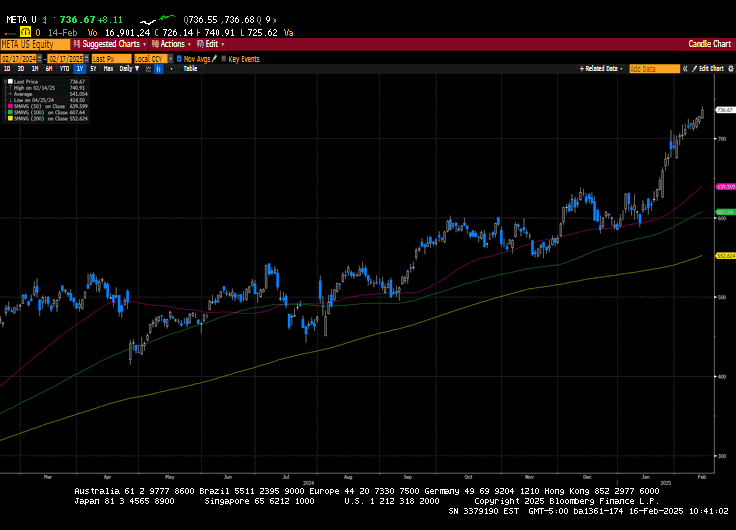
The S&P 500 gained 1.5%, the Dow advanced 0.5%, the NASDAQ rose 2.6%, and the Russell 2000 closed flat on the week. It’s worth pointing out that international markets have been performing exceptionally well this year, in fact, better than the US market, which has dominated performance for the last several years. The Euro STOXX 50, an index of Europe’s 50 largest companies, is up 13.9% for the year and has moved to the highest level seen in 25 years. We are seeing international markets do well for several potential reasons- maybe they are just playing catch up, a revision to the mean trade, valuations are more attractive. A weaker currency profile has probably helped; a more accommodative monetary policy relative to the US is also a likely tailwind; a more stable political backdrop, including the potential for the end of the Russian-Ukraine war, may also be helping.
The US bond market posted its fifth consecutive week of gains in a very volatile week of trade. US CPI data hit Treasuries hard on Wednesday, sending the 10-year yield higher by nine basis points to 4.62%, but the Treasury market was able to bounce back nicely after the PPI print showed that certain key component prices were moderating. The 2-year yield fell by three basis points to close the week at 4.26%, while the 10-year yield fell one basis point to close at 4.48%. Fed Chairman Powell’s semi-annual testimony to the Financial Services Panel and Senate Banking Committee had minimal market impact. Powell said there was no rush to cut rates. The market expects one twenty-five basis point cut in 2025 in late summer. However, the timing of the cut has been all over the map, moving from December to June/July within a week.
Oil prices fell by $0.22 to $70.68 a barrel, partly due to the news that the war in Ukraine may be ending. Gold prices gained $12.80 to close at $2,899.90 an Oz. Copper prices rose by $0.06 to $4.66 per Lb. Bitcoin prices increased by $1,550 to close at $97,400. The US Dollar index tumbled 1.2% to close the week at 106.73.
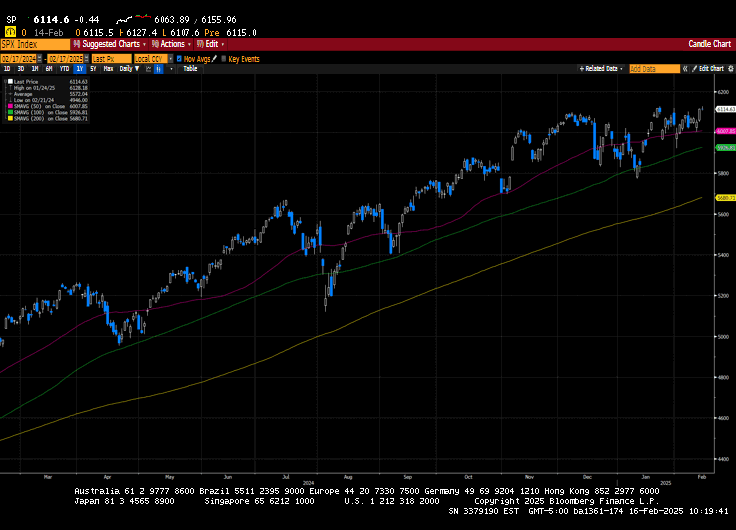
This week’s economic calendar was highlighted by the Consumer Price Index (CPI) and the Producer Price Index. Both readings came in hotter than expected. Headline CPI rose by 0.5% versus the expected 0.3% and was up 3% on a year-over-year basis in January, up from 2.9% in December. The Core reading, which excludes food and energy, rose by 0.4% versus the estimated 0.3%. The Core rose 3.3% annually, up from the 3.2% reported in December. The elevated prints were troublesome for the markets as investors worry about inflation and its potential to accelerate off Trump’s tariff policy. Headline PPI rose by 0.4%, above the consensus estimate of 0.2%, and annually by 3.5%, in line with December’s reading. The Core reading came in at 0.3%, in line with estimates, and was up 3.6% annually, slightly less than the 3.7% print in December. The PPI data helped to stabilize the bond market as key components within the data set that are also used in the Fed’s preferred measure of inflation showed modest declines and suggested that the upcoming PCE print would show continued progress on inflation. PCE will be reported on February 28th. Retail Sales in January showed a significant drop and had investors questioning the consumer’s health. The headline reading was -0.9% versus the consensus estimate of 0%. The Ex-Autos reading was -0.4 versus the estimated 0.3%. Initial jobless claims fell by 7k to 213k, while Continuing Claims fell by 36k to 1.850m.

Investment advisory services offered through Foundations Investment Advisors, LLC (“FIA”), an SEC registered investment adviser. FIA’s Darren Leavitt authors this commentary which may include information and statistical data obtained from and/or prepared by third party sources that FIA deems reliable but in no way does FIA guarantee the accuracy or completeness. All such third party information and statistical data contained herein is subject to change without notice. Nothing herein constitutes legal, tax or investment advice or any recommendation that any security, portfolio of securities, or investment strategy is suitable for any specific person. Personal investment advice can only be rendered after the engagement of FIA for services, execution of required documentation, including receipt of required disclosures. All investments involve risk and past performance is no guarantee of future results. For registration information on FIA, please go to https://adviserinfo.sec.gov/ and search by our firm name or by our CRD #175083. Advisory services are only offered to clients or prospective clients where FIA and its representatives are properly licensed or exempted.

Retirement Challenges in 2025: Market Volatility, Inflation and Social Security
Inflation, uncertain markets and a limited Social Security COLA are among the financial hurdles for retirees in 2025.
Key Takeaways
- High interest rates may complicate investment decisions for retirees.
- Social Security recipients are getting a 2.5% raise, which may lag inflationary pressures.
- On the bright side, S&P 500 earnings growth is projected at 14.8% for 2025.
Retirees face some financial hurdles this year. Inflation has lasted longer than many experts had predicted, and the bond market is signaling that investors believe inflation may tick higher again this year. High interest rates are also throwing a wrench into investment decisions.
As if that weren’t enough, an uncertain stock market adds another layer of unpredictability, making it harder to plan long-term. Despite these challenges, there’s not much relief from Social Security, where the cost of living adjustment for 2025 is relatively modest.
Here’s a look at the challenges ahead and what retirees can do to successfully navigate them.
Stubborn Inflation
In a December report, Bank of America analysts expect high prices to stick around for a while, with the outlook for Federal Reserve rate cuts now murky.
“Progress on inflation has stalled of late, and there are upside risks to inflation on the horizon,” analysts wrote. “We, therefore, expect the Fed to slow the cadence of cuts in 2025 to once per quarter from every meeting and maintain our terminal rate forecast of 3.75% to 4.0%.”
Inflation cuts into everyone’s buying power, but it brings unique concerns for retirees, who typically have limited ability to generate income from new sources.
“Rising prices in 2025 are making it harder for retirees to cover everyday costs like groceries and health care,” said George McFarlane, president in an email.
This can cause people to withdraw more money from their savings, which could make their money run out faster, he said.
However, McFarlane also noted that retirees have some ways of mitigating inflation’s effects.
“Since people are living longer, it’s really important to plan carefully. Adjusting how much money you take out of your savings each year, finding new ways to earn income or investing in tools like Treasury inflation-protected securities can help protect your savings from inflation,” he said.
Uncertain Markets
Bond markets are signaling that they anticipate rate cuts this year, but only to a level near 4%, as Bank of America analysts also expect.
Rate cuts, and interest rates in general, have a significant effect on portfolio returns, something retirees should consider carefully.
“For the past year or two, we’ve gotten used to high interest rates. That means many people may have too much cash sitting on the sidelines,” said Jay Zigmont, founder and CEO of Childfree Wealth in Mount Juliet, Tennessee, in an email.
“The challenge is that while you get interest on your cash, it rarely will keep up with inflation,” he said.
That means now is the time for investors to figure out exactly how much cash they need to keep on hand and invest the rest, he added.
For fixed-income investors, there may be a silver lining if rate cuts fall short of expectations.
“Higher interest rates present opportunities to secure attractive yields across short- and long-term instruments,” said Anthony Saccaro, president at Providence Financial & Insurance Services in Woodland Hills, California.
Retirees can capitalize on this by locking in these higher yields now, he said. That would allow predictable and reliable income streams.
“Additionally, the extended period of elevated rates provides more flexibility to diversify fixed-income strategies, ensuring portfolios remain resilient against potential rate fluctuations,” Saccaro added.
Balancing Risk and Return
In addition to Fed actions and fixed-income yields, retired investors must monitor the equity market, which ran red-hot in 2023 and 2024, driven by technology stocks and enthusiasm about artificial intelligence-related companies.
Stocks, which add growth, as well as risk, to portfolios while helping investors stay ahead of inflation, may continue to perform well, analysts say.
According to data compiled by investment researcher FactSet, analysts expect the S&P 500 to report double-digit earnings growth in 2025, with an estimated earnings growth rate of 14.8%. That would be higher than the trailing 10-year average of 8% earnings growth.
“It is interesting to note that analysts believe earnings growth for companies outside the Magnificent 7 will improve significantly in 2025,” wrote John Butters, vice president and senior earnings analyst at FactSet, in a January report.
Strong company performance may carry more weight than Fed projections for interest rates, and rate cuts and offer some optimism for retirees.
“While we anticipate 2025 is likely to be more volatile than the remarkably low volatility environment of 2024, the fundamentals remain supportive for both equities and fixed-income assets,” said Garrett Melson, portfolio strategist at Natixis Investment Managers in Boston, in an email.
“And it’s those fundamentals that matter more for the outlook than the exact number of cuts,” he said
Social Security’s Modest Raise
Social Security recipients will receive a 2.5% cost-of-living adjustment this year, down from 3.2% in 2024. The COLA is based on the Consumer Price Index’s inflation data.
Despite the increase, retirees may still see a decrease in their spending power.
The Social Security COLAs often fail to keep pace with real inflation, especially after factoring in rising Medicare Part B premiums, Saccaro said.
“For this reason, retirees should avoid relying on COLAs from Social Security to offset inflationary pressures,” he said.
Instead, Saccaro said clients or their advisors should turn to investment strategies that provide cost-of-living adjustments, such as interest and dividend-producing assets along with dividend-paying equities.
“This proactive approach ensures retirees maintain their purchasing power and financial independence, regardless of Social Security adjustments,” Saccaro said.
https://money.usnews.com/money/retirement/articles/outlook-for-retirement
Inherited IRAs and Roth Conversions: Today’s Slott Report Mailbag
By Sarah Brenner, JD
Director of Retirement Education
Question:
I just inherited an IRA from my sister. She died at age 74 and I am age 78. Am I required to use the 10-year rule, or can I stretch distributions from the inherited account over my life expectancy? I am hearing conflicting information as to what my options are.
Answer:
You are considered an eligible designated beneficiary (EDB) under the SECURE Act because you are older than your sister. EDBs include any beneficiary who is “not more than 10 years younger than the IRA owner.” Being older qualifies. Because you are an EDB, you are not subject to the 10-year rule. Instead, you have the ability to stretch distributions from the inherited account over your single life expectancy.
Question:
I just started participating in a SIMPLE IRA plan at my job. I would like to convert my SIMPLE IRA funds to a Roth IRA. Can I do this?
Answer: There is a two-year waiting period before SIMPLE IRA funds can be converted to a Roth IRA. This waiting period begins with the first contribution to the SIMPLE IRA.
If you have technical questions you would like to have answered, be sure to submit them to mailbag@irahelp.com, to be answered on an upcoming Slott Report Mailbag, published every Thursday.
https://irahelp.com/slottreport/inherited-iras-and-roth-conversions-todays-slott-report-mailbag-2/
99%: Good Enough for the Hall of Fame, but Not for Certain IRA Transactions
By Andy Ives, CFP®, AIF®
IRA Analyst
On January 21, Ichiro Suzuki was elected to Major League Baseball’s Hall of Fame by the Baseball Writers Association of America. It takes 75% of the writer’s support to gain entry, and Ichiro was chosen on 393 out of 394 ballots. Ichiro joined Derek Jeter (396/397) and Ken Griffey Jr. (337/440) as players to garner 99+% of the votes. (Yankees great Mariano Rivera was the only player elected unanimously, back in 2019.) While a person can reach Cooperstown without 100% of the votes, such is not the case with many IRA transactions. A single misstep, a lone “missed vote,” and the outcome could be completely different. Here are a handful of transactions where a 1% shortfall can cause the entire house of baseball cards to come tumblingdown.
Missing the 60-Day Rollover Window by 1 Day. IRA owners have 60 days to complete a rollover. There is no wiggle room. Try to do the rollover on Day 61 and it will be rejected.
One Rollover Per Year. Speaking of rollovers, IRA owners can only do one 60-day rollover in any 12-month period. You did a little $3,000 rollover 10 months ago, and now you take a $3 million distribution with the intent to roll that over as well? Sorry, the one-rollover-per-year rule dictates that the $3 million distribution is taxable and can’t go back to a traditional IRA.
Super Catch-Up Birthdate. There is a new “super catch-up” option for workplace plans like a 401(k) or SIMPLE IRA. Participants who turn ages 60, 61, 62 or 63 during the calendar year can contribute additional dollars to their plan. You turned age 64 on December 31? That means you are ineligible for the extra catch-up for that entire year.
Death on December 31, 2019. Continuing with last-day-of-the-year deadlines…this is somewhat morbid: If an IRA owner died on December 31, 2019, then all of his living beneficiaries would get the full lifetime stretch. If he hung on for a few more hours and passed away on January 1, then we must consider the 10-year rule. (Thank you, SECURE Act for compressing the payout window.) This could shave decades off the payout structure ofan inherited IRA.
Still-Working Exception. On the flip side, retiring on December 31 is a bad thing when it comes to the still-working exception and delaying required minimum distributions (RMDs)from employer plans. The RMD will be due for that same year if you retire on December 31. In the case of the still-working exception, it behooves a worker to hang on for one more day and retire on January 1.
Prohibited Transactions. Do you have an investment property in your self-directed IRA? Better keep an arm’s length. You can’t do anything to improve the property yourself. If you stop by and change a lightbulb, that’s a prohibited transaction, and the entire IRA is deemed distributed.
QCDs and Early Distributions. Want to do a qualified charitable distribution (QCD)? Very generous! Just don’t try to do it when you are age 70 and 180 days. You must be age 70½. Same deal with avoiding the 10% early IRA distribution penalty. You must be 59 AND a full six months.
Roth Conversions and IRMAA. You did a Roth conversion that pushed your modified adjusted gross income just $1 into an Income-Related Monthly Adjustment (IRMAA) bracket? These are cliff brackets. One dollar over and you just bought yourself a year of elevated Medicare surcharges.
Ichiro will soon have his bust in the Baseball Hall of Fame. Get sideways with the IRA rules, if only by a single day or dollar, and you’ll be busted.
If you have technical questions you would like to have answered, be sure to submit them to mailbag@irahelp.com, to be answered on an upcoming Slott Report Mailbag, published every Thursday.
https://irahelp.com/slottreport/99-good-enough-for-the-hall-of-fame-but-not-for-certain-ira-transactions/
Do I Have to Take an RMD Before Rolling Over My 401(k) Distribution?
By Ian Berger, JD
IRA Analyst
Here’s one question that keeps coming up: If I retire in the year when I turn 73 (or older) and want to directly roll over my 401(k) funds to an IRA, do I have to first take a required minimum distribution (RMD) from my 401(k)?
Well, RMDs normally don’t need to start until April 1 following the year you turn age 73 (or April 1 following the year you retire if you’re using the “still-working exception”). That April 1 is considered your required beginning date (RBD) for RMDs. So, it would SEEM THAT you shouldn’t have to take an RMD from your 401(k) if you do a rollover BEFORE that date.
But, as with many retirement account tax issues, what seems like a correct assumption turns out not to be. Your ability to defer your first RMD into the next year is trumped by three tax rules. First, a direct rollover from a plan is considered a distribution and then a rollover. Second, the first funds distributed to you in a year for which an RMD is required are considered part of the RMD (the “first-dollars-out rule”). Third, RMDs can never be rolled over. Putting all these rules together means that the first dollars distributed to you as part of a direct rollover in the year you retire on or after age 73 are part of the RMD and aren’t eligible for rollover.
What if the 401(k) RMD is rolled over? Then, you have an excess IRA contribution. But that’s not as bad as it sounds. As long as the rolled-over amount, along with earnings or losses attributable to the excess amount (net income attributable, or “NIA”), are withdrawn from the IRA by October 15 of the year after the year of the rollover, you won’t have a penalty.
Example: Caitlin works for Fourth Fifth National Bank and participates in its 401(k) plan. Caitlin uses the still-working exception to delay plan RMDs beyond age 73. In 2025 at age 74, Caitlin retires and elects to roll over her entire 401(k) balance (worth $400,000 as of December 31, 2024) to an IRA. She knows that her 401(k) RBD is not until April 1, 2026. For that reason, she rolls over the entire 401(k) balance (including her 2025 401(k) RMD of $15,686) to the IRA. On February 1, 2026, Caitlin discovers that she now has a $15,686 excess IRA contribution. The IRA custodian tells her that the $15,686 excess has earned $1,000. She can fix the error without penalty by withdrawing $16,686 from her IRA by October 15, 2026. (The $1,000 in earnings will be taxable.)
Can Caitlin avoid taking the 2025 RMD from her 401(k) in 2025? Yes, by delaying her 401(k) distribution/rollover until 2026. But then she would have to take two RMDs – the 2025 RMD and the 2026 RMD – before rolling over the rest of her funds to her IRA.
If you have technical questions you would like to have answered, be sure to submit them to mailbag@irahelp.com, to be answered on an upcoming Slott Report Mailbag, published every Thursday.
https://irahelp.com/slottreport/do-i-have-to-take-an-rmd-before-rolling-over-my-401k-distribution/

Weekly Market Commentary
Uncertainty about global trade continued to be at the top of investors’ minds as Trump announced 25% tariffs on Mexico and Canada while levying 10% on Chinese goods. Mexico and Canada’s immediate reaction was to place tariffs on US goods. But an about-face mid-morning on Monday saw Mexico’s President Sheinbaum and Canada’s Prime Minister Trudeau turn instead to negotiation, which led to Trump’s tariffs being delayed until March. China’s response was much more muted but did induce a 15% tariff on US LNG and coal and a 10% tax on US crude oil, agriculture equipment, and automobiles. China also announced it would put export bans on some rare earth metals and probe both Google and Apple for anti-trust violations. Trump also announced that levies on European and Japanese goods were in the works and that reciprocal tariffs would be imposed on other countries. All of this has Wall Street wondering what the ultimate ramifications will be. Will this be inflationary and inhibit growth, causing stagnation, or is all the rhetoric just noise to bring trade to the negotiating table? Nobody knows, and Wall Street does not particularly like uncertainty. That said, with all the changes announced by the new Trump administration and its potential disruption, the S&P 500 is just a sneeze away from all-time highs. It feels like there is some complacency in this market, and perhaps we are due for some constructive consolidation. Volatility will continue to be prevalent.
One hundred thirty-one companies of the S&P 500 announced earnings over the week, and results continued to be mixed but positively skewed. So far, 75% of the companies that have reported beat estimates on earnings per share, and 66% have beat revenue estimates. The aforementioned uncertainty has tempered some guidance, with 8% of the companies that have reported lowering forward guidance. 5% of companies have raised forward guidance. Google and Amazon shares were hit hard after investors raised questions about the return on investment on Capex spending related to AI. Google announced that it would spend $75 billion on AI infrastructure. Palantir and Phillip Morris International had blowout quarters that saw shares rise after their results were announced. Qualcomm, Pepsi, and Merck had disappointing results.

The S&P 500 fell by 0.2%, the Dow lost 0.5%, the NASDAQ shed 0.5%, and the Russell 2000 was lower by 0.3%. Market action across the yield curve saw short-tenured paper underperform longer-duration Treasuries. The 2-year yield rose by four basis points to 4.28%, while the 10-year yield declined by eight basis points to 4.49%. The Bank of England lowered its policy rate by twenty-five basis points with a more dovish posture from the Monetary Policy Committee.
Oil prices continued to slide, losing 2% or $1.51 to close at $70.95 a barrel. Gold prices extended gains with an increase of 1.8% to close at $2887.10 an Oz. Copper prices increased by 7.7% to close at $4.60 per Lb. Bitcoin prices tumbled 6.1% to close the week at $95,846. The US Dollar index declined by 0.4% to 108.05.

Non-Spouse Beneficiaries and Inherited IRAs: Today’s Slott Report Mailbag
By Andy Ives, CFP®, AIF®
IRA Analyst
QUESTION:
Am I correct that a non-spouse Roth IRA beneficiary does NOT have a yearly required minimum distribution (RMD) over the 10-year period?
Ken
ANSWER:
Ken,
You are correct. Non-spouse beneficiaries of Roth IRAs that are subject to the 10-year rule do not have to take RMDs in years 1 – 9. The only requirement is that the inherited Roth IRA be emptied by the end of the tenth year. The reason for no RMDs within the 10-year period is that, since Roth IRA owners never have to take RMDs during their lifetime, all Roth IRA owners are deemed to die prior to the required beginning date (“RBD,” when RMDs are “turned on”). This is true no matter how old the Roth IRA owner is at death. As such, death before the RBD means no RMDs within the 10-year period.
QUESTION:
Can inherited IRAs be converted to Roth IRAs?
Michael
ANSWER:
Michael,
No, inherited IRAs cannot be converted to an inherited Roth IRA or to a person’s own Roth IRA. Inherited Roth IRAs must stay as inherited accounts. There is an anomaly in the rules for inherited 401(k) plans to be converted to inherited Roth IRAs, but again, that is only applicable to some inherited plan accounts.
https://irahelp.com/slottreport/non-spouse-beneficiaries-and-inherited-iras-todays-slott-report-mailbag/

3 Social Security Changes Retirees Need to Know About in 2025
Key Points
- A modest cost-of-living adjustment (COLA) will make benefit checks bigger.
- Note that higher earners will pay a bit more in Social Security taxes.
- Retirees still earning income may have some of their benefits temporarily withheld.
- The $22,924 Social Security bonus most retirees completely overlook
Without Social Security, millions of Americans would be living below the poverty line. With it, many don’t — even though the average monthly retirement benefit of $1,975 (as of December) is not all that huge. It works out to about $23,700 annually.
Fortunately, Social Security does undergo some changes from year to year, including nearly annual increases in benefits. There are also some things you can do to make your future benefits bigger. Let’s dive in.
1. The COLA for 2025 is making benefit checks bigger
The cost-of-living adjustment (COLA) for 2025 is indeed a most notable change in Social Security for 2025, but it’s not an Earth-shattering one. The COLA, effective in December 2024, is just 2.5%. So if you were collecting, say, $2,000 per month, you’d now be getting $2,050.
But remember that the nearly annual COLAs are meant to help retirees keep up with inflation, so a low increase reflects relatively low inflation. Here are some recent years’ COLAs, some of which arrived after much higher inflationary periods:
Year COLA 2020 1.6% 2021 1.3% 2022 5.9% 2023 8.7% 2024 3.2% 2025 2.5% Still, a 2.5% increase will certainly disappoint a lot of people. In fact, a recent Motley Fool survey found 54% of retirees view the COLA as inadequate.
2. Higher earners will have to fork over more to Social Security
Here’s something many people don’t realize. You’re probably taxed on all your wages for Social Security — there’s a 6.2% deduction on your paystub and it’s matched by another 6.2% coming from your employer. (Self-employed people have to pay the full 12.4%.) But high earners are only taxed on part of their wages. The threshold was $168,600 last year and for 2025 it’s $176,100.
So someone earning, say, $3,176,100 will only be taxed on $176,100 of earnings for Social Security and not at all on the other $3 million in earnings. If you think this is unfair, you’re not alone. With Social Security due to face a funding shortfall within a decade or so, it’s been suggested that this earnings cap be raised a lot — or just eliminated. That’s one effective way to strengthen Social Security.
3. The retirement earnings test has higher thresholds
Here’s a quick refresher: You can claim your benefits as early as age 62, or at your “full retirement age” (FRA), which is 66 or 67 for most people today. Claiming early results in more, but smaller checks. Those delaying starting to collect checks will see them increase by about 8% for each year beyond their full retirement, until age 70. For most people, waiting until age 70 will be the best move — if you can swing it. Many people simply can’t, as they need that income as soon as possible.
If you claim your benefits early and you keep working to some degree, you’ll want to know about the retirement earnings test. Earn more than a certain threshold, and your benefits will be reduced. It’s not as bad as it seems, though, because any money withheld is factored into your benefits once you reach your FRA and your future benefits will increase accordingly. So you don’t really lose out on any Social Security benefits — you just receive some later.
Here are the details:
FRA Status Income Limit 2024 Income Limit 2025 Benefit Reductions If you’re below your FRA $22,320
$23,400
$1 for every $2 over the limit
If you’ll reach your FRA this year $59,520
$62,160
$1 for every $3 over the limit
Data source: Social Security Administration.
These are three of the most important Social Security changes for 2025. It’s smart to keep up with Social Security developments, as it may help you in your retirement planning. Also, the new administration in Washington hasn’t committed to not touching or changing Social Security. So do keep an eye on things and let your representatives know your feelings, too.
The $22,924 Social Security bonus most retirees completely overlook
If you’re like most Americans, you’re a few years (or more) behind on your retirement savings. But a handful of little-known “Social Security secrets” could help ensure a boost in your retirement income. For example: one easy trick could pay you as much as $22,924 more… each year! Once you learn how to maximize your Social Security benefits, we think you could retire confidently with the peace of mind we’re all after.
https://www.fool.com/retirement/2025/02/05/3-social-security-changes-retirees-need-to-know/
Why You Should Take Your 2025 RMD Now
By Sarah Brenner, JD
Director of Retirement Education
The deadline for most retirement account owners to take their 2025 required minimum distribution (RMD) is December 31, 2025. However, there are good reasons why you should take your RMD now instead of waiting.
You are doing a rollover. Maybe you are retiring this year, and you are now moving your employer plan funds to an IRA, or maybe you are tapping your IRA with the intent of doing a 60-day rollover after receiving the funds. In both of these situations, the first-money-out rule says that the first money that is distributed from your retirement account is your 2025 RMD. There is no choice in the matter. The rules also say that your RMD is not rollover eligible. You must take it prior to the rollover.
If you are in either of these situations, you must take your 2025 RMD now, before doing the rollover. You cannot wait to take your RMD later in the year.
You are doing a conversion. A Roth conversion can be a smart move. However, if you are age 73 or older this year and doing a conversion now, you will need to take your 2025 RMD from your IRA prior to the conversion. Why? The IRS says the first money out of your IRA is your RMD. A conversion is subject to the rollover rules, so your RMD cannot be converted.
Your IRAs are all seen as one IRA by the IRS. To make things even more complicated, the final RMD regulations confirm that when it comes to RMDs, your IRAs are aggregated. That means that if you have multiple IRAs (including SEP and SIMPLE IRAs), you must take your 2025 RMDs from all of them before doing any rollovers or conversions.
Avoid Last Minute Mistakes. Even if you aren’t required to take your 2025 RMD now, there are still good reasons why you should go ahead and do so. Waiting until late in the year is a recipe for trouble. The holiday season is busy and your RMD can get lost in the shuffle. Or, maybe you are charitably inclined and looking to satisfy your RMD by doing a qualified charitable distribution (QCD). This will require the custodian to send funds directly to charity and the charity must cash the check. These steps require some time and coordination. Taking care of these transactions now is a good move because you have plenty of time to check and be sure that everything is done properly.
Now Instead of Later
For many, taking an RMD is a year-end ritual. Maybe it’s time to change that mind set. The rules may require you to address your RMD sooner. Even if you can wait, it can be smart planning to take your 2025 RMD now instead of later.
https://irahelp.com/slottreport/why-you-should-take-your-2025-rmd-now/
Inherited IRAs – Bankruptcy Protection?
By Andy Ives, CFP®, AIF®
IRA Analyst
Just over 10 years ago, in June 2014, the U.S. Supreme Court ruled unanimously, 9-0, that inherited IRAs are NOT protected in bankruptcy under federal law. The primary issue before the Court was whether an inherited IRA is a “retirement account.” Considering the fact that “inherited IRA” is short for “inherited individual retirement arrangement,” this would seem like an odd question to debate. The word “retirement” is right there in the name. Nevertheless, the Supreme Court felt that three primary characteristics of inherited IRAs were not features of a “retirement” account. Those three characteristics were:
Beneficiaries cannot add money to inherited IRAs like IRA owners can to their own accounts. This is true. If a person inherits an IRA from any other person, that beneficiary cannot make any contributions to the inherited IRA. The beneficiary cannot roll over any of their own IRA dollars into that inherited IRA, and they cannot do any Roth conversions with the inherited IRA. Of course, a spouse beneficiary has the option of doing a spousal rollover of the inherited account into her own IRA. The surviving spouse can then make contributions to the account, but this account is no longer considered “inherited.” After a spousal rollover, the account is deemed to have been owned by the surviving spouse since Day 1 and is hers to do with as she pleases.
Beneficiaries of inherited IRAs must generally begin to take required minimum distributions (RMDs) in the year after they inherit the account, regardless of how far away they are from retirement. Remember, this Supreme Court ruling came down in 2014, well before the SECURE Act. Back in the day, under the old rules, any living, breathing beneficiary could set up an inherited IRA and start taking annual RMDs in the year after the year of death. (Now we have the 10-year rule for certain beneficiaries, and annual RMDs do not always apply within the 10-year period.) These annual “stretch” RMDs are based on the beneficiary’s single life expectancy. Annual RMDs do not apply to the original IRA owner until he reaches RMD age (currently age 73). Since annual RMDs applied to beneficiaries at any age (again, under the old rules), then inherited IRAs are NOT retirement accounts.
Beneficiaries can take a total distribution of their inherited IRA at any time and use the funds for any purpose without a penalty. IRA owners under age 59½ cannot take lifetime, penalty-free distributions from their own IRA unless an exception to the 10% early withdrawal penalty applies. The 10% penalty does not apply to distributions from an inherited IRA. A beneficiary at any age can completely drain the inherited account without penalty (although taxes may apply). Therefore, inherited IRAs are NOT retirement accounts in the eyes of the Supreme Court.
A handful of states disagree. For example, Idaho does offer bankruptcy protection to inherited IRAs. But for most inherited IRA owners, it is important to recognize that the favorable bankruptcy protection afforded to such funds under the Federal Bankruptcy Code does NOT extend to them. Based on the Supreme Court’s reasoning on the three items above, this seems like a sensible conclusion.
https://irahelp.com/slottreport/inherited-iras-bankruptcy-protection/

Weekly Market Commentary
Darren Leavitt, CFA
US financial markets were extremely busy last week as a rush to download a Chinese AI platform called Deep Seek from Apple’s App Store seemingly changed the narrative around artificial intelligence in a heartbeat and on multiple fronts. Capital expenditures and the return on investment questions were front and center on Wall Street and tested current earnings estimates and valuations for these AI-related companies. NVidia, an AI darling, saw its shares tumble 17%, the largest one-day loss of market capitalization in history. Investors also digested 4th quarter earnings from almost 40% of the S&P 500, including Tesla, Microsoft, Apple, and Meta. Earnings results were met with mixed responses. For instance, Microsoft’s quarter appeared solid, but inline cloud results induced a steep sell-off in shares. The Federal Reserve’s Open Market Committee meeting yielded no change to its policy rate. Fed Chairman Powell acknowledged that inflation continues to be elevated, and the labor market appears solid. The Fed is in wait-and-see mode, and at this point, it’s possible the markets will not get a rate cut in 2025. Tariff policy also came into play toward the end of the week, agitating markets as Trump levied 25% tariffs on Canada and Mexico while putting an additional 10% tariff on China. The President also said tariffs would be imposed on Europe.
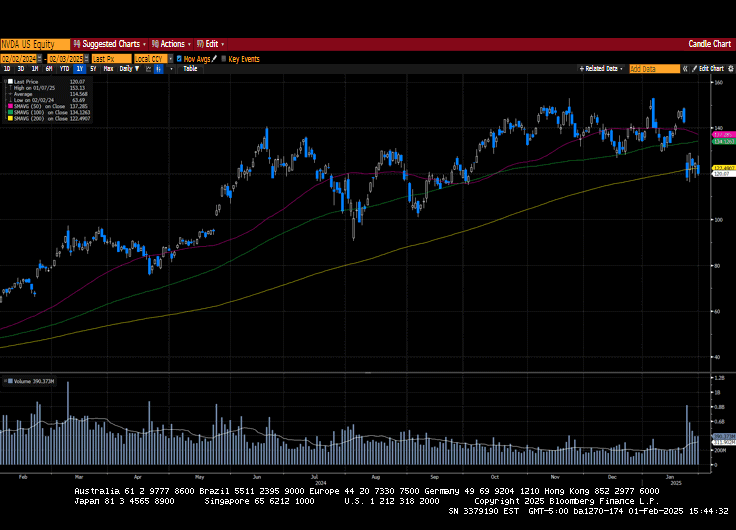
The S&P 500 shed 1% but closed the month higher by 2.7%. The Dow managed a gain of 0.3% and closed the month up 4.7%. The NASDAQ fell by 1.6% and posted a 1.6% gain for January. The Russell 2000 lost 0.9% and added 2.6% for the month. US Treasuries advanced this week in volatile trade and ended the month flat. The 2-year yield fell by three basis points to 4.24%, while the 10-year yield declined by six to 4.57%. Oil prices fell by 2.8% or $2.14 to close the week at $72.46. Oil prices rallied late in the week on the idea that Trump would impose tariffs on energy. Gold prices traded to new all-time highs in a safe-haven bid. Prices rose by $55.60 to close the week at 2834.10 an Oz. Copper prices fell by five cents to $4.27 per Lb. Bitcoin prices fell by 2.36%, closing the week at $102,240. The US Dollar index rallied on the idea of tariffs and closed the week higher by 0.80 to close the week at 108.38. Notably, the Mexican Peso and Canadian Dollar sold off hard on Trump’s tariff announcement but ended the month flat relative to the US Dollar. It’s also worth mentioning that Trump’s strong rhetoric on the US Dollar maintaining its reserve currency status was aimed directly at the BRICS nations (Brazil, Russia, India, China, and South Africa). For some time, these countries have floated the notion of moving away from utilizing the US Dollar.
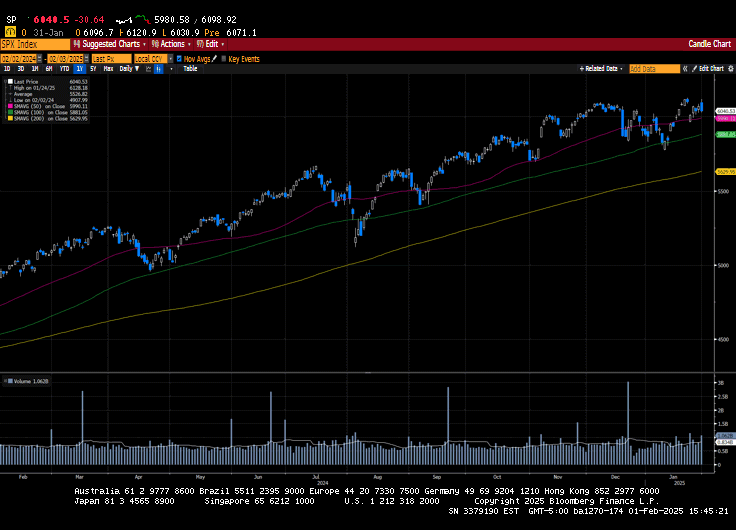
The economic calendar was also quite busy. The Fed’s preferred measure of inflation, the PCE, showed an increase of 0.3% on the headline number and an increase of 0.2% on the Core reading. These results were in line with the street’s expectations. On a year-over-year basis, the headline number rose by 2.6%, up from 2.4% in November, while the Core measure rose for the third consecutive month by 2.8%. Personal income rose by 0.4%, in line with the consensus estimate, while personal spending increased by 0.7%, above the estimated 0.5%. 4th Quarter GDP showed growth of 2.3%, down from 3.1% in the 3rd quarter. The Atlanta Fed GDPNOW 1st quarter 2025 estimates growth of 2.9%. Initial Jobless Claims fell by 16k to 207k, while Continuing Claims fell by 42k to 1.858M, showing the labor market continues to be solid.
Investment advisory services offered through Foundations Investment Advisors, LLC (“FIA”), an SEC registered investment adviser. FIA’s Darren Leavitt authors this commentary which may include information and statistical data obtained from and/or prepared by third party sources that FIA deems reliable but in no way does FIA guarantee the accuracy or completeness. All such third party information and statistical data contained herein is subject to change without notice. Nothing herein constitutes legal, tax or investment advice or any recommendation that any security, portfolio of securities, or investment strategy is suitable for any specific person. Personal investment advice can only be rendered after the engagement of FIA for services, execution of required documentation, including receipt of required disclosures. All investments involve risk and past performance is no guarantee of future results. For registration information on FIA, please go to https://adviserinfo.sec.gov/ and search by our firm name or by our CRD #175083. Advisory services are only offered to clients or prospective clients where FIA and its representatives are properly licensed or exempted.
RMDS FOR ANNUITIES AND SPOUSAL BENEFICIARY RULES: TODAY’S SLOTT REPORT MAILBAG
By Ian Berger, JD
IRA Analyst
Question:
I have an IRA holding an immediate annuity as well as other IRAs. With the passage of the SECURE 2.0 Act, l understand that I may be able to apply my monthly annuity payments against my RMD requirement for all of my IRAs. The only valuation I can get on my annuity is the year-end fair market value. Can you provide any update to any IRS ruling on this?
Tom
Answer:
Hi Tom,
Your understanding of the SECURE 2.0 provision is correct. The IRS confirmed this in regulations issued last July. Since you have a year-end valuation of the annuity from the insurance company, you can take advantage of this rule. For 2025, first calculate the total RMD of all of your IRAs (using 12/31/24 values divided by your life expectancy under the IRS Uniform Lifetime Table). Then, you will only need to take RMDs from your non-annuity IRAs equal to that total RMD minus the sum of your monthly annuity payments.
Question:
In a previous answer to a question submitted to the Slott Report Mailbag, you said section 327 of the SECURE 2.0 Act applies to an IRA inherited by a spouse beneficiary. I thought that these new rules for spouse beneficiaries only apply to spouse beneficiaries of employer plans and not IRAs. Is this true?
Answer:
No, the IRS has made clear that the section 327 rules apply to spouse beneficiaries of both employer plans and IRAs.
https://irahelp.com/slottreport/rmds-for-annuities-and-spousal-beneficiary-rules-todays-slott-report-mailbag/

If you’re nearing retirement, these 2025 changes could affect your finances. Here’s what to know
- If you’re nearing retirement, key changes for 2025 could affect your finances, according to advisors.
- Starting in 2025, there’s a higher 401(k) plan catch-up contribution for workers ages 60 to 63.
- Plus, there are new rules for inherited individual retirement accounts and boosted Social Security benefits for certain public workers.
As President Donald Trump kicks off a second term, many older investors are focused on how shifting policy could affect their wallets.
But some key changes for near-retirees were already enacted for 2025. These updates could have a big impact on your finances — and may easily be missed, financial experts say.
Nearly half of Americans ages 55 to 64 don’t feel prepared to retire by their target date, according to a survey from the American Savings Education Council, which polled more than 2,000 U.S. adults in early 2024.
More from Personal Finance:
Vanguard’s $106 million target-date fund settlement offers tax lesson
There’s a ‘big change’ for inherited IRAs in 2025, advisor says
Investors may be able to file taxes for free this season. Here’s who qualifies
But planning around these 2025 changes could boost retirement security, experts say. Here’s what older workers need to know.
Leverage the 401(k) ‘super catch-up’
For 2025, investors can save more with higher 401(k) plan limits. Employees can defer $23,500 into 401(k) plans, up from $23,000 in 2024. The catch-up contribution limit is $7,500 for workers ages 50 and older.
But thanks to Secure 2.0, there’s a “super catch-up” for investors ages 60 to 63, said certified financial planner Michael Espinosa, president of TrueNorth Retirement Services in Salt Lake City.
The catch-up contribution for employees ages 60 to 63 jumps to $11,250 for 2025. That brings the total deferral limit to $34,750 for these workers.
“This could be huge” for deferring taxes in 2025, Espinosa said.
Some 15% of eligible participants made catch-up contributions in 2023, according to Vanguard’s 2024 How America Saves report, based on data from 1,500 qualified plans and nearly 5 million participants.
Avoid a penalty for inherited IRAs
An inherited individual retirement account could boost your nest egg. However, some heirs may face an IRS penalty for missed required withdrawals in 2025, experts say.
With more focus on shifting economic policy, “it’s easy to see how this one could get buried,” said CFP Edward Jastrem, chief planning officer at Heritage Financial Services in Westwood, Massachusetts.
Since 2020, certain inherited accounts must follow the “10-year rule,” meaning heirs must empty inherited IRAs by the 10th year after the original owner’s death. This applies to heirs who are not a spouse, minor child, disabled, or chronically ill, and certain trusts.
Starting in 2025, the IRS will enforce the penalty on heirs for missed required minimum distributions, or RMDs. The penalty is 25% of the amount that should have been withdrawn. But it’s possible to reduce that penalty if your RMD is “timely corrected” within two years, according to the IRS.
Heirs must take yearly withdrawals if the original IRA owner had reached their RMD age before death.
Social Security benefit change is ‘significant’
If you or your spouse work in public service and expect to receive a pension, new legislation could mean higher Social Security benefits in retirement.
Enacted by former President Joe Biden in January, the Social Security Fairness Act ended two provisions — the Windfall Elimination Provision and Government Pension Offset — that lowered benefits for certain government employees and their spouses.
“This change is significant for many retirees who had their benefits eliminated or reduced,” said CFP Scott Bishop, partner and managing director of Presidio Wealth Partners, based in Houston.
The Social Security Administration is working on the timeline for the new legislation and will update its website when more details are available.
https://www.cnbc.com/2025/01/25/retirement-changes-for-2025.html
What Are My Contribution Limits If I Participate in Two Company Savings Plans?
By Ian Berger, JD
IRA Analyst
You probably know there’s a limit on the amount of pre-tax and Roth contributions you can make to your company savings plan each year. The 2025 elective deferral limit is $23,500 for 401(k), 403(b) and 457(b) plans and is either $16,500 or $17,600 for SIMPLE plans (depending on the size of your employer). If you’re age 50 or older, you can make additional catch-up contributions beyond these limits, and if you’re age 60, 61, 62 or 63, you may qualify for even higher catch-ups.
But what if you’re in two different plans at the same time or in two different plans during the same year after changing jobs? Do you get a separate elective deferral limit for your pre-tax and Roth contributions to each plan? The answer is generally no. The cap for pre-tax and Roth employee contributions is usually a “per-person” limit – not a “per-plan” limit. So, your contributions to all plans are normally aggregated when the limit is applied. It doesn’t matter if the plans are sponsored by companies that are totally unrelated under the tax rules.
Example 1: Samar, age 49, has a 401(k) through his regular job with Crypto Solutions and a solo 401(k) through a computer repair side gig. The most that Samar can defer between the two plans for 2025 is $23,500. It doesn’t matter that Crypto and his computer repair company are unrelated businesses.
Why do we say “generally,” “usually,” and “normally?” Well, like most tax rules, it’s just not that simple. There are two exceptions to the rule that requires aggregation of contributions to multiple plans. First, traditional (non-Roth) after-tax contributions, if allowed by the plan, don’t count towards the $23,500 elective deferral limit (although they do count towards the overall contribution limit, discussed in the next paragraph). Second, 457(b) plans have their own separate limit.
Besides the elective deferral limit, there’s another annual cap to worry about – the overall contribution limit (sometimes referred to as the “415 limit”). This limit is the maximum amount of ALL contributions that can be made to a plan in any year. Both your own contributions – pre-tax, Roth or after-tax (non-Roth) – and your employer’s contributions (matching or profit sharing) are counted. For 2025, the overall contribution limit is $70,000 (higher if catch-up contributions are made).
Generally, contributions made to two plans sponsored by businesses considered related under IRS rules are combined for the overall limit. But if you’re in two plans maintained by separate unrelated companies, contributions generally aren’t combined, and you get the benefit of a separate overall cap for each plan.
Example 2: Crypto Solutions and Samar’s computer business (from Example 1) are considered unrelated businesses. So, for 2025, Samar has a separate overall limit for each 401(k) plan and could theoretically have a total of $140,000 ($70,000 x 2) in combined contributions. However, to achieve that result, he would have to make a large amount of after-tax employee contributions and/or receive a large amount of employer contributions. In any case, Samar’s combined pre-tax and Roth contributions between the two plans would still be limited to $23,500.
https://irahelp.com/slottreport/what-are-my-contribution-limits-if-i-participate-in-two-company-savings-plans/
Are HSAs Going Roth?
By Sarah Brenner, JD
Director of Retirement Education
Many of the provisions of the Tax Cuts and Jobs Act are scheduled to expire at the end of 2025. There are currently a number of proposals in the works in Congress to extend these tax cuts. A serious hurdle is how to pay for them. One interesting legislative proposal that has surfaced to cover the cost is the possibility of requiring Health Savings Accounts (HSAs) to be made on a Roth basis.
How HSAs Work
Under current law, an HSA is a tax-free account that is used to pay for qualified medical expenses that aren’t covered by insurance. It is similar to an IRA in that it’s a custodial or trust account set up with a financial institution that is owned and controlled by the individual, not by the employer.
In order to contribute to an HSA, an individual must be:
1. Covered by a high deductible health plan (HDHP),
2. Not enrolled in Medicare, and
3. Not eligible to be claimed as a dependent on someone else’s tax return
Everyone gets a full federal income tax deduction for the HSA contributions they make. There is no income limit or phase-out. It is an above-the-line deduction rather than an itemized deduction, so it’s available even if the standard deduction is taken on the tax return.
HSA withdrawals are tax-free when used to pay for qualified medical expenses of the account owner, his spouse, or dependents. Also, the HSA can be used to reimburse the account owner for qualified medical expenses he already paid for. Generally, qualified medical expenses are those that would be eligible for the medical expense tax deduction if someone was itemizing expenses on their tax return. They usually include all medical and dental expenses and prescription drugs (but not over-the counter medicines). IRS Publication 502, Medical and Dental Expenses, has comprehensive lists of what expenses are, and are not, qualified medical expenses.
If the HSA is not used for qualified medical expenses, then the distribution is not tax-free but instead is taxed as ordinary income and is also subject to a 20% penalty. If the individual is age 65 or older or has died or become disabled, then the 20% penalty won’t apply, but the distribution is still taxable if it wasn’t used for qualified expenses.
HSAs are an extremely tax-efficient way to pay for medical expenses. HSAs can be used to pay for current medical expenses on a tax-free basis – just like qualified Roth IRA distributions. Plus, regular HSA contributions made by a client are tax-deductible – just like most traditional IRA contributions. It’s like getting the best of both worlds, at least when it comes to medical expenses.
Roth HSAs – A Bad Bargain for Savers
Any Roth account is funded with after-tax revenue. Requiring a contribution to an HSA to be made as a Roth contribution would be a win for Congress because they would generate immediate revenue. However, for taxpayers that would be a loss. While savers could still enjoy the benefit of tax-free distributions if HSAs become Roth accounts, they would lose the ability to deduct their contributions. That seems like a bad bargain for savers. At The Slott Report, we will be following this potentially detrimental legislative proposal closely as we watch Congress debate tax code changes.
Stay tuned!
https://irahelp.com/slottreport/are-hsas-going-roth/

Weekly Market Commentary
Darren Leavitt, CFA
Wow, what a week! US markets were closed on Monday for Martin Luther King Jr. Day, and Donald Trump was inaugurated as the 47th President of the United States. It was a historic day indeed. The global markets were poised for a barrage of executive orders on Trump’s first day back in office, and he did, in fact, execute 26 orders on his first day back. The President declared a national emergency at the southern border and said the government should take all appropriate action to stop and remove illegal immigrants. Trump also issued an order to restrict birthright citizenship. Trump announced a national energy emergency while also calling out OPEC and Saudi Arabia to lower oil prices. Tariff policy has been top of mind for Wall Street, and Trump surprised with the announcement of 25% tariffs on Mexico and Canada that may be levied as soon as February 1st. The President did not announce additional tariff policies on China and Europe. The announcement of a $500 billion AI infrastructure project called Stargate fueled optimism in AI. Later in the week, Meta announced it would likely spend $60-$65 billion in Capex aimed at their AI initiatives. According to the Economist, The World Economic Forum in Davos, Switzerland, had three distinct narratives: trade policy, Artificial intelligence, and European competitiveness. Interestingly, climate change discussions were on the back burner as Trump announced several moves away from subsidized clean energy. Trump announced that the US would no longer participate in the Paris Accord on climate change and that it would depart the World Health Organization. At Davos, Trump also called on European NATO members to earmark 5% of their GDP to NATO. President Trump saw his nominees, Marco Rubio (Secretary of State) and Pete Hegseth (Secretary of Defense), confirmed by Congress.
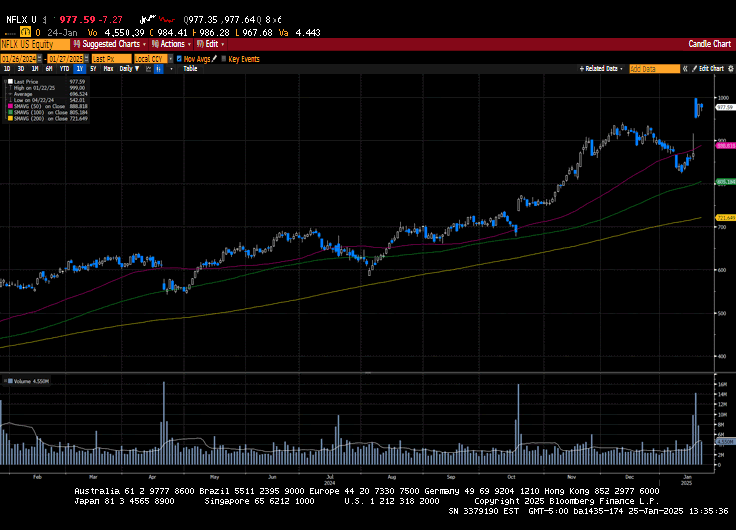
Fourth-quarter earnings results also encouraged markets. Netflix, MMM, Proctor and Gamble, Travelers, and United Healthcare stood out as winners. Texas Instruments and Boeing shares fell after their results. Apple shares were also under pressure after a Bloomberg report suggested that iPhone sales in China have fallen by 18%. In the coming week, we will get a look at Q4 earnings from Apple, Meta, Microsoft, Amazon, and Tesla.
The S&P 500 gained 1.7% and forged an all-time high Thursday. The Dow rose 2.2%, the NASDAQ climbed 1.7%, and the Russell 2000 notched a 1.4% gain. The US Treasuries markets were quiet, which also allied the move in equities. The 2-year yield was unchanged on the week, closing at 4.27%. The 10-year yield increased by two basis points to 4.63%. The Federal Reserve meets in the coming week, and they are widely expected to keep rates at the current level. That said, Trump’s demand that all Global Central Banks cut rates will add an interesting twist to the Q&A session for Fed Chairman J. Powell post-meeting.
Oil prices fell 3.5% following Trump’s call for lower oil prices. Last week, the energy sector was the lone loser among the S&P 500’s 11 sectors. Gold prices increased by $30 to $2778.50 an Oz. Copper prices fell by four cents to $4.32 per Lb. Bitcoin’s price fell by 1.25% over the week to $104,740. The Dollar index tumbled 1.8% to 107.58. Notably, the Japanese Yen rallied on the Bank of Japan’s decision to raise its policy rate by 25 basis points to 0.50% while indicating the bias for another hike in the future.
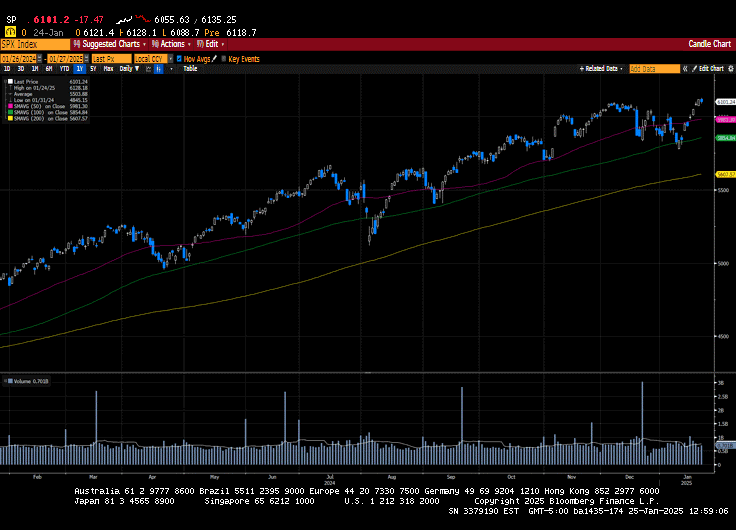
The economic calendar was pretty quiet. Initial Jobless Claims ticked higher by 5k to 223k, while Continuing Claims increased by 46k to 1.899M. S&P Global Manufacturing came in better than expected at 50.1, but the Services figure surprised to the downside, coming in at 52.8, down from 56.8 in the prior reading. The final look at the University of Michigan’s January Consumer sentiment index showed a decline to 71.1 from 74 in December. Concerns regarding employment and inflation were evident in the report.
Investment advisory services offered through Foundations Investment Advisors, LLC (“FIA”), an SEC registered investment adviser. FIA’s Darren Leavitt authors this commentary which may include information and statistical data obtained from and/or prepared by third party sources that FIA deems reliable but in no way does FIA guarantee the accuracy or completeness. All such third party information and statistical data contained herein is subject to change without notice. Nothing herein constitutes legal, tax or investment advice or any recommendation that any security, portfolio of securities, or investment strategy is suitable for any specific person. Personal investment advice can only be rendered after the engagement of FIA for services, execution of required documentation, including receipt of required disclosures. All investments involve risk and past performance is no guarantee of future results. For registration information on FIA, please go to https://adviserinfo.sec.gov/ and search by our firm name or by our CRD #175083. Advisory services are only offered to clients or prospective clients where FIA and its representatives are properly licensed or exempted.

A Checklist for Retiring in 2025
Our checklist for retiring next year includes everything you need to do before the retirement party.
Only you can know if you’re ready for a checklist for retiring in 2025. If you’re 60 or getting there, retirement is no longer a hazy concept in the distance. It’s a real deadline. In five or six years, or maybe just a year. Or six months. Or even six weeks. You are going to leave your full-time job, not for a new phase in a working career, but for a largely unknown future.
Ideally, you’ve prepared financially and otherwise ahead of this looming date to ensure a calm, rather than chaotic, transition. If you’re hyper-organized, you may have already ticked off most of the 10-year checklist for retirement planning tasks. But the lead-up to the last day requires a sharpened focus. What do you need to know about your finances? Your health insurance? When do you tell your boss and colleagues? And how do you leave your job looking forward to a new phase, rather than looking back and longing?
Money and health
Line ’em up. Presumably, you’ve been accruing money in some combination of retirement accounts, pensions, money markets and brokerage accounts to fund a fairly comfortable retirement. It’s time to decide the best way to use those accounts before the last paycheck stops.
account is just as much of a safety net as your IRA. Decide what’s going to be the most tax-efficient way to pull it out so your money lasts as long as possible. Never let low tax brackets go to waste in creating your income in early retirement.”
Pay those debts. It’s a great idea to go into retirement debt-free — if you can manage it and still have some liquidity. It’s critical to have a healthy savings account that can be drawn on in an emergency, McClanhan says. And you don’t want to pay off the mortgage and then be living on your IRA, with the taxes that will accrue.
“If you are one of those lucky people that has an old mortgage at 2.5% interest, it’s crazy to pay off the mortgage,” she adds. “But if your mortgage interest rate is higher than what you can earn in a savings account, you probably should pay it off.”
Unused vacation? If your company has a policy of paying for unused vacation days, consider delaying any vacations until after retirement and collecting the money.
Health insurance maze. Retirement at 65 years or older makes things much easier in the health insurance arena since Medicare will be available.
If you retire before 65, that’s another matter. The federal law known as COBRA allows someone leaving a company to stay on the company’s health care plan for up to 18 months — but it is expensive, McClanhan warns
Other options are joining a spouse or partner’s health insurance if available or buying it through the Affordable Care Act on the open market; there’s a limited sign-up period after retirement, so there’s no need to wait until the special enrollment period.
Life, disability insurance? If your employer offers life insurance and disability insurance, decide whether it makes sense to replace it out of your own pocket. Life insurance often isn’t necessary if both you and a partner are retired with enough savings and don’t have dependents, experts say. And since disability insurance only covers lost income, it’s unnecessary once retired.
Visit your doctors. Don’t delay doctors’ appointments until after retirement, even if it seems to make sense because you’ll have more time. Rather, catch up on all your doctors’ visits and routine screenings before leaving your job.
That’s what Carolyn Bodkin, 61, of Branford, Conn., decided to do when she retired in August after working at a major publishing house for 39 years — because she wasn’t sure exactly what her health insurance would look like after leaving work.
That’s especially true with vision and dental care because traditional Medicare and many plans offered under the ACA don’t offer such coverage. However, most Medicare Advantage plans include them as extras. If your plan doesn’t have dental and vision coverage, you might want to buy it separately, but McClanahan says
this coverage is generally “not worth it because it’s expensive and barely covers anything.”
Another reason to make sure you’re up-to-date with all your health needs: the administrative work related to COBRA can take a while to kick in, and during that period, you will have to pay for everything out of pocket, although COBRA does retroactively cover medical costs from the day your company insurance expires, she adds. Also, make sure you have extra medication on hand in case it takes longer than expected to move to a new plan.
Social and emotional preparation
Anticipate the future. If there’s a universal piece of advice from retirement experts, it’s this: don’t put off thinking about what your retirement will look like until the day you’ve left work. That can be a recipe for some unhappy months or years.
There’s a reason that a TED Talk by Riley Moynes, a former financial adviser, has been viewed more than 3 million times online. It’s about struggling with retirement.
“I thought I had a pretty good idea of what success looked like in a working career, but when it came to retirement, it was fuzzier for me,” he says in his presentation. After interviewing dozens of retirees, he says he discovered that most people move through in retirement in four phases — a concept he turned into a book, The Four Phases of Retirement: What to Expect When You’re Retiring.
The first is the vacation phase — sleeping in, lounging, taking those long-delayed trips. This, he says, lasts for about a year.
Then, in phase two, boredom can set in, and people can feel “loss and lost,” Moynes says in his talk. They might face fear, anxiety and depression.
Many people struggle in phase two, but find a way out by entering phase three, he says: Figuring out what you like to do and what you do well by trial and error.
Moynes speaks about how he investigated becoming a paralegal, which didn’t go anywhere. He also started a program on writing memoirs that he says “met with limited success.”
Not everyone gets to phase four, which is finding a meaningful purpose in life, perhaps by volunteering, starting a nonprofit or caring for family or friends. Those who do, however, “are some of the happiest people I’ve met,” he says.
Game plan. One way to minimize phase two can be to think seriously about how you will replace some of the more intangible benefits of the workplace before you’re out the door.
Once you know you’ve got the money you need to retire, “instead of rehashing the numbers, focus on the non-financial benefits that you’re getting at work, which a lot of people don’t even recognize,” said Fritz Gilbert, founder of the website The Retirement Manifesto.
Gilbert has identified five benefits that many people get from their jobs and may miss deeply when they retire:
- A sense of identity. “No one cares if you’re vice-president of operations now,” Gilbert says. “Now you’re just another retired person.”
- A sense of accomplishment by starting and finishing projects, for example.
- A structured day.
- Social interactions. Even if you didn’t hang out with colleagues outside of work hours, there’s usually ongoing interactions during the day that help you avoid loneliness. That can feel like a real loss when it disappears, Gilbert adds.
- A sense of purpose. That is bigger than simply finishing a project and is more about contributing to something larger than yourself.
“In the work I do, I see a big difference between people who go all in the last year of work versus those who say, ‘Well, I’m going to really take maybe 10% to 20% of my time and shift it toward things I can do to get a head start on,’” says Joe Casey, an executive and retirement coach and host of the podcast Retirement Wisdom.
Use the last year to develop a game plan, he says; one way to start thinking about it is like managing a portfolio. But instead of it being financial, it’s a time portfolio with the same principles of diversification and rebalancing.
That could involve participating in a new activity or with groups that might broaden social connections, he says. “I see people who look back and regret they didn’t do that” before retirement.
Change the narrative. How we think about retirement is often connected to how we think about age, says Mary Jo Saavedra, a gerontologist who helps people plan for retirement.
“What the broader culture has trained us to think about retirement is decline,” she says. “It’s really important that we change the narrative that the media, movies and that culture would have us believe — that you become invisible as you age.” Saavedra is the author of Eldercare 101: A Practical Guide to Later Life Planning, Care and Wellbeing.
A research study of 14,000 adults over 50 found that feeling better about one’s own aging is associated with fewer physical and mental health problems.
You do you
Be yourself. With all that said, the most important thing is to know there are many variations of retirement.
Howard Mizrachi, 68, of Larchmont, N.Y., who worked as a surgical pathologist for almost 35 years, prepared intensively for retiring and understood that the social and emotional part was as important as the financial side.
But he decided he didn’t have to figure it all out at once. “I gave myself permission not to know what I was going to do.”
His two years of retirement so far have been wonderful. Gardening, running, taking walks with his wife, playing bridge, helping take care of his grandchild, reading and doing projects around the house have been very fulfilling. He hasn’t felt the need to create more of a schedule or line up activities.
“I’m very fortunate,” he says. “I had a real sense of purpose and fulfillment with my career. I’m thankful to have been able to do that and in this part of retirement I’m not focused so much on that. I spent my whole life being structured.”
Alicia Munnell, who founded the Center for Retirement Research at Boston College in 1998, may know more than just about anyone about retirement. So, when the college recently announced her retirement at age 82, she was more than ready.
“People look at me very earnestly and ask, ‘What are you going to do?’” she says. “I plan to take goofing off very seriously. I’m not worried about being bored at all. If I am, maybe I’ll become a ballerina.”
The last few months and weeks
Tell the boss. You’ve got everything lined up and now you need to tell the boss. How much notice should you give? Teresa Amabile, a professor emerita at Harvard Business School, and her co-authors interviewed 120 people — 83 of them 55 years and older — for their book, Retiring: Creating a Life That Works for You. They were all knowledge workers relatively high up on the career ladder, leaving successful companies.
One employee gave five years’ notice. Another, a weekend.
Those were the extremes, Amabile says, and many had contracts that specified how much notice one had to give. But the average, she says, seemed to be about two months.
Much depends on the type of job and expectations. The rule of thumb tends to be the more senior position, the more notice is given; in all jobs, at least two-weeks’ notice is considered common courtesy even if not mandated, writes Jamie Birt, a career counselor.
Those who have been at their jobs for many years often want to give more than the required minimum. That was the case with Mizrachi.
“My contract said I had to give three months, but I thought I had better give six months to give them more time to replace me,” he says.
‘Please stay.’ Also, be prepared to respond to common questions, such as whether you’re willing to stay longer or work part-time. Bodkin, who worked in publishing, agreed to stay a few more months past her chosen retirement date. Mizrachi, who was asked if he’d continue part-time, declined. He was ready to move on.
Goodbye, office mates. When should you tell your colleagues and clients? People often worry co-workers will treat them differently once they say they’re leaving; Amabile says that one person interviewed for her book waited until the last minute “because he didn’t want to be yesterday’s news.”
There is no set time frame for letting coworkers know. It depends, she says, “on whether a person has sufficient trust that their colleagues will not ignore them or completely sideline them once they know about retirement.” If you have faith that particularly close colleagues can keep it to themselves, experts say, you might want to tell them earlier than others so they don’t feel blindsided.
Also, be sure to let your professional network know of your retirement and, if you want, include a personal email where you can be reached.
Transfer the personal stuff. While there’s the big picture in disentangling from work life, there are also the little details. You may not have access to your work computer and files once you walk out the door, so be sure to take anything you (legally) can and want. Don’t forget your list of professional contacts you may want to reach out to in the future.
If you use a work email for your personal contacts, set up a separate email at least several weeks before leaving and move your non-work contacts into it. This part proved particularly important for Bodkin, who solely used her work email and cell phone for her personal life. “I had to contact everyone I know and change the email and phone numbers — our doctors, stockbroker, the local club where I play tennis. It was very time-consuming.”
Just chill. Tell your family and friends what your plans are in the immediate weeks before retiring — before they make them for you.
“I made it really clear to my husband that I was going to decompress for the first couple of months,” says Bodkin, who worked full-time while raising four children. “And I didn’t want him to ask, ‘What did you do today?’ I play a lot of tennis, read and love going to the library. I’m meeting new people and getting to know old friends better. “
There are bound to be a number of issues that come up as you’re winding down a major portion of your life. But with the proper preparation, by the time the last day at work arrives, the only remaining question is what type of wine to serve for your retirement toast.
https://www.kiplinger.com/retirement/retirement-planning/a-checklist-for-retiring-in-2025
Rollovers and Inherited IRAs: Today’s Slott Report Mailbag
By Sarah Brenner, JD
Director of Retirement Education
Question:
I have a large non-qualified 457 deferred compensation plan and I am required to take distributions. I am looking to minimize taxes. Can I roll over these funds to an IRA?
Answer:
Unfortunately, this will not work. A non-qualified deferred compensation plan is not eligible for rollover to an IRA.
Question:
Hello,
I had a question concerning inherited Roth IRAs. I know that in the past you have said that no required minimum distribution (RMD) is required for these accounts. Does this include inherited Roth IRAs that were created prior to the SECURE ACT changes? There is so much confusion on Roth IRA RMDs, so I wanted to be sure.
Thank you!
Kade
Answer:
Hi Kade,
This is an area of great confusion! Non-eligible designated Roth IRA beneficiaries (NEDBs) are not required to take annual RMDs during the 10-year period. However, there are other situations where annual RMDs are required for Roth beneficiaries. Roth IRA beneficiaries who inherited prior to 2020 (when the SECURE Act became effective) must still take these annual RMDs. Eligible designated beneficiaries (EDBs) who inherited after SECURE and are using the “stretch” must also take annual RMDs from an inherited Roth IRA.
https://irahelp.com/slottreport/rollovers-and-inherited-iras-todays-slott-report-mailbag-2/
529-to-Roth IRA: False Alarm
By Andy Ives, CFP®, AIF®
IRA Analyst
When the “check engine” light comes on in a vehicle, most people are rightfully concerned that something is wrong. When a fire alarm blares through a building, it is wise to take stock of your surroundings. And when a member of Ed Slott’s Elite IRA Advisor Group℠ calls and says a red alert popped up on his monitor as he attempted to do a 529-to-Roth rollover, we must assess the situation. In the end, it is our opinion that the warning notification on the advisor’s computer was incorrect. A false alarm. What was the computer worried about?
Yes, there are a number of restrictions when it comes to moving money from a 529 plan to a Roth IRA. For example:
- The Roth IRA must be in the name of the 529 beneficiary.
- The maximum amount that can be rolled over in a lifetime is $35,000.
- The 529 plan must have been open for more than 15 years.
- Rollovers are subject to the annual Roth IRA contribution limit.
- Etc., etc.
In this case, it appeared that all the proper boxes were checked, and the coast was clear for the advisor to proceed. He completed a successful 529-to-Roth transaction in December 2024, and was now trying to execute another 529-to-Roth rollover for the same client in January 2025. Yet the computer was flashing a red alert. The message said that, when processing a 529-to-Roth rollover, the one-rollover-per-year rule must be considered. It is our interpretation that this is UNTRUE (although definitive guidance is needed). The SECURE Act explicitly states that, to qualify as a 529-to-Roth rollover, the transaction must be “paid in a direct trustee-to-trustee transfer to a Roth IRA maintained for the benefit of such designated beneficiary.”
So, if the transaction must be completed as a direct trustee-to-trustee transfer, then the rollover rules are irrelevant. You cannot do a 529-to-Roth transaction as a 60-day rollover. As such, the one-rollover-per-year rule does not apply to 529-to-Roth IRA transfers. In hindsight, it’s easy to see where the confusion comes from. It’s all about terminology, and when a transaction is broadly referred to as a 529-to-Roth “rollover,” it is no surprise red flags go up.
Further proof (in our opinion) that the rollover rules do not apply to these transactions is that 529-to-Roth IRA transfers are considered Roth IRA contributions. The normal contribution limits apply. Any amount transferred from a 529 plan to a Roth IRA reduces the amount of a “regular” Roth IRA contribution the 529 beneficiary can make for that same year. Therefore, since these dollars are contributions, the rollover rules appear to be again rendered moot.
Alarms exist to keep people safe, and they should be heeded. However, sometimes a check engine light goes on for no ascertainable reason. Sometimes a jerk pulls a fire alarm as a bad joke, and sometimes computer software is incorrect. In this case, the advisor played his cards well. Assess the situation, contact the Ed Slott team, and proceed with confidence.
https://irahelp.com/slottreport/529-to-roth-ira-false-alarm/
One Roth IRA Rule Congress Should Do Away with Now
By Sarah Brenner, JD
Director of Retirement Education
Today is Inauguration Day. A new administration has arrived. We also have a new Congress. With the arrival of newly elected officials, many will have hopes of legislative change. When it comes to retirement accounts, one rule that the new Congress should consider changing immediately is the income limit rule that applies to Roth IRA contributions. This pointless rule should be eliminated.
The Roth IRA Income Limits
The Roth IRA tax year contribution limit for 2024 and 2025 is $7,000. Those who are age 50 or older by the end of the year can contribute $8,000. However, not everyone is eligible to contribute to a Roth IRA. Congress has placed income restrictions on Roth contributions. Here are the limits on modified adjusted gross income for Roth tax year contributions:
| Single or Head |
| Year Married/Joint of Household |
| 2023 $218,000 – $228,000 $138,000 – $153,000 |
| 2024 $230,000 – $240,000 $146,000 – $161,000 |
| 2025 $236,000 – $246,000 $150,000 – $165,000 |
Why Congress Should Do Away with Roth IRA Income Limits
There are several reasons why the new Congress should make the Roth IRA contribution income limits history.
The backdoor is wide open. The Roth IRA contribution limits are not stopping high income savers. There is an easy workaround. You can simply make a nondeductible traditional IRA contribution (no income limits apply) and then convert it to a Roth IRA (no income limits apply).
While there may have been concerns about this strategy years ago, there has been no evidence that either Congress or the IRS is doing anything to prevent these transactions. In fact, Congress indirectly “blessed” the backdoor Roth IRA conversion in the committee report to the Tax Cuts and Jobs Act.
The only people not rushing through the backdoor are those individuals with existing taxable traditional, SEP or SIMPLE funds. They will get stuck with a tax bill on the conversion due to the complicated pro-rata formula rules that apply to conversions. Even these unlucky individuals can still do a backdoor Roth IRA as long as they are willing to pay the taxes on the conversion.
Unnecessary complications. While the backdoor may be a way to fund a Roth IRA, it does complicate things unnecessarily. You must make a contribution to a traditional IRA. If you do not have one, it must be established. Then, when the contribution is made, it must be reported as nondeductible on Form 8606. Then, a conversion must be done and reported by both you and your IRA custodian. This must happen each year a backdoor Roth IRA conversion is done. That’s a lot of work and potential for mistakes. If the new Congress is serious about doing away with red tape and simplifying unnecessary rules, getting rid of the income limits on Roth contributions would certainly seem to be a good place to start. Imagine how much easier it would be to just contribute directly to a Roth IRA.
No other Roth saving strategies have income limits. Over the years since the Roth IRA became a reality back in 1998, we have seen Congress establish a long list of other Roth options. None of them have income limits like tax-year Roth IRA contributions do. Congress did away with the income limits for Roth IRA conversions in 2010. Roth 401(k) and Roth SEP and SIMPLE IRA contributions are available to all regardless of income level. In fact, next year some high earners will be forced to make their catch-up plan contributions on a Roth basis instead of as a pre-tax salary deferral. With all these Roth options available to high income savers, it makes no sense to keep the Roth IRA contribution limits.
Roth accounts raise revenue. Congress loves Roth accounts because they bring in immediate revenue since they are funded with after-tax dollars. So, why not allow high income individuals to save for retirement by making direct Roth IRA contributions? This will generate more current revenue and allow more savers to work more easily towards a secure retirement.
The income limits don’t work. If the goal of the income limits on Roth contributions is to keep high income individuals from taking advantage of the Roth IRA strategy, it has not worked. A few years ago, the story of one tech billionaire’s large Roth IRA made headlines. According to reports, his Roth IRA was started with a tax year contribution. Twenty-two years later, it was worth five billion dollars. The income limits did not prevent one of the richest men in the world from amassing a fortune in a Roth IRA. They serve no purpose and Congress should do away with them now!
https://irahelp.com/slottreport/one-roth-ira-rule-congress-should-do-away-with-now/

Weekly Market Commentary
-Darren Leavitt, CFA
Financial markets advanced this week as a solid start to the fourth-quarter earnings season, and some better-than-feared inflation data gave investors a reason to buy the most recent dip. The financial sector gained 6.1% on the week as bank earnings rolled in with solid results. JP Morgan, Goldman Sachs, Morgan Stanley, Blackrock, and Citibank were some of the top performers in the group. The Producer Price Index (PPI) and the Consumer Price Index (CPI) showed sticky inflation. Still, the numbers were not as robust as some expected, which gave investors some relief on the inflation front. US Treasuries advanced significantly across the curve on the benign data. However, this sense of relief may be short-lived as the world awaits Trump 2.0 and the agenda that is poised to unfold next week after Trump is inaugurated on Monday as the 47th President of the United States. We expect Trump to announce tariffs shortly after taking office, although we did expect these tariffs to be titrated higher over time, as several reports have suggested. We also expect that the current immigration policy will materially change in the first days in office. A cease-fire has been agreed upon by Israel and Hamas, which is a situation that is also likely to be addressed by the President on his first day in office.
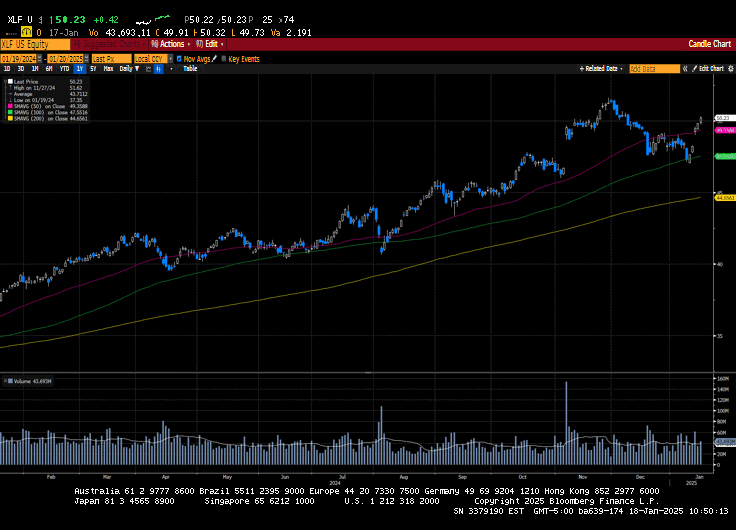
The S&P 500 gained 2.9% and retook its 50-day moving average. The Dow rose 3.7%, the NASDAQ climbed by 2.4%, and the Russell 2000 advanced 4%. US Treasuries rallied across the curve, with the 2-year yield decreasing by thirteen basis points to 4.27% and the 10-year yield falling by seventeen basis points to 4.61%. As yields fall, bond prices increase. Oil prices continued to trend higher, adding $0.69 to close at $77.52 a barrel. Gold price rose by 1.2% or $34.80 to $2748.50 an Oz. Copper prices increased by six cents to $4.36 per Lb. Bitcoin soared by nearly $10,000 to close above $105,000. The US Dollar index gave up 0.3% to 109.34.
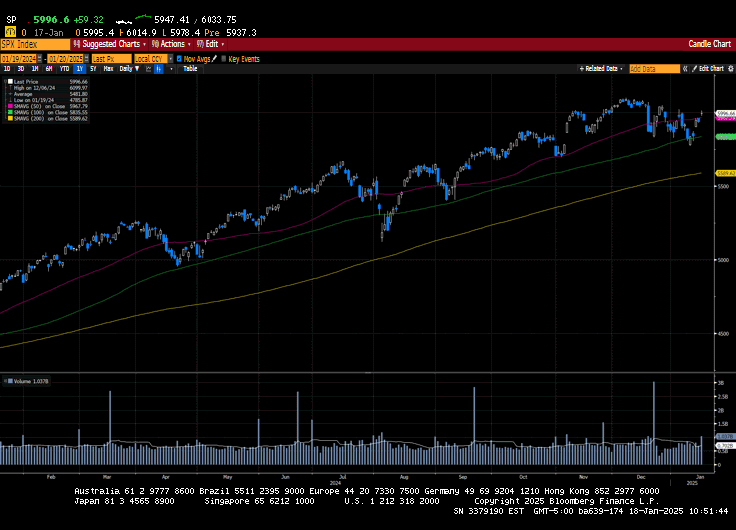
The PPI and CPI headlined the Economic calendar. The Producer Price Index (PPI) increased by 0.2% in December, lower than the consensus estimate of 0.3%. The reading was up 3.3% on a year-over-year basis, up from 3% in November. The core reading that excludes food and energy was flat in December versus an expected uptick of 0.3%. The core reading rose 3.5% annually, which was in line with the November figure. The Consumer Price Index (CPI) increased by 0.4%, slightly higher than the anticipated 0.3%. On a year-over-year basis, the figure increased by 2.9%, above the 2.7% reported in November. Core CPI was flat versus an expected increase of 0.3%. The Core reading on an annual basis came in at 3.2% in December, down from 3.3% in November. December Retail Sales increased by 0.4% versus the consensus estimate of 0.6%. The Ex-Auto metric also came in at 0.4%. Initial Jobless Claims increased by 14k to 217k, while Continuing Claims fell by 18k to 1.859M.
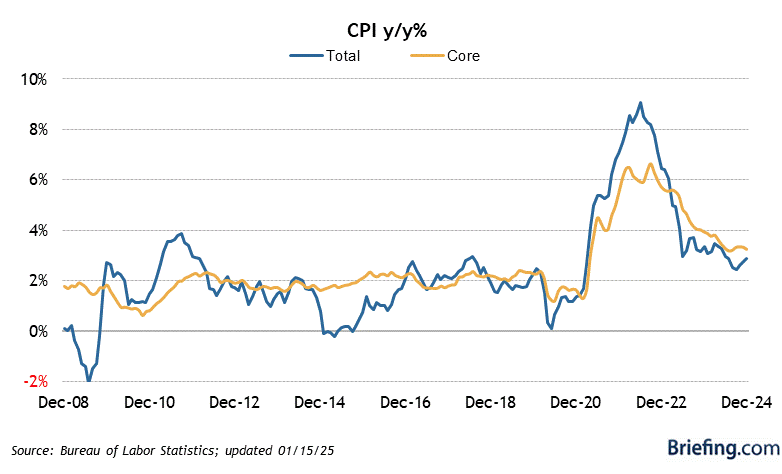
Investment advisory services offered through Foundations Investment Advisors, LLC (“FIA”), an SEC registered investment adviser. FIA’s Darren Leavitt authors this commentary which may include information and statistical data obtained from and/or prepared by third party sources that FIA deems reliable but in no way does FIA guarantee the accuracy or completeness. All such third party information and statistical data contained herein is subject to change without notice. Nothing herein constitutes legal, tax or investment advice or any recommendation that any security, portfolio of securities, or investment strategy is suitable for any specific person. Personal investment advice can only be rendered after the engagement of FIA for services, execution of required documentation, including receipt of required disclosures. All investments involve risk and past performance is no guarantee of future results. For registration information on FIA, please go to https://adviserinfo.sec.gov/ and search by our firm name or by our CRD #175083. Advisory services are only offered to clients or prospective clients where FIA and its representatives are properly licensed or exempted.

Social Security’s full retirement age is increasing in 2025. Here’s what to know.
Most Americans may consider the standard retirement age to be 65, but the so-called “full retirement age” for Social Security is already older than that — and it’s about to hit an even higher age in 2025.
Social Security’s full retirement age (FRA) refers to when workers can start claiming their full benefits, which is based on the number of years they’ve worked as well as their income during their working years. The longer someone works and the higher their income, the more they can receive from Social Security when they finally claim their benefits.
While the FRA used to be 65 years old, Congress overhauled the program in 1983 to raise the retirement age threshold in order to account for longer life expectancies.
As part of that revamp, the FRA has been inching higher by two months at a time, based on a person’s birth year. For instance, people who were born in 1957 reached their FRA when they turned 66 years and 6 months old, or starting in 2023; but people born in 1958 must turn 66 years and 8 months old to qualify for their full benefits, or starting in September 2024.
The full retirement age is set to increase again by two months, to 66 years and 10 months old, for people born in 1959. That means the higher FRA for that cohort will go into effect in 2025, with people born in 1959 starting to qualify for their full benefits in November 2025. (You can calculate when you could get your full benefits on this Social Security Administration page.)
To be sure, there is flexibility about when to claim Social Security benefits. People can claim as soon as they turn 62 years old, but the trade-off is a reduced benefit that’s locked in for the rest of their retirement.
For instance, claiming at 62 will result in a benefit that’s about 30% less than your full benefit — a sacrifice that many older Americans opt for, given that many are forced into retirement earlier than they expected or because they believe it makes more sense to claim more years of guaranteed retirement income, even if it’s at a lower amount.
While the increase in the retirement age isn’t new, it might catch some older workers by surprise, because even claiming a month earlier than your FRA will reduce your benefits, although at a lower rate than at age 62. And the difference in waiting until FRA versus 62 years old can be financially significant, with the Social Security Administration noting that someone retiring at FRA in 2024 could get a maximum monthly benefit of $3,822, while someone claiming at 62 would receive a max of $2,710.
Each year, Social Security benefits are adjusted to account for inflation so beneficiaries’ purchasing power doesn’t erode over time. In 2025, the annual cost-of-living adjustment will be 2.5%, the smallest annual COLA hike since 2021 due to cooling inflation.
For most Social Security beneficiaries, the new COLA goes into effect with their January payment.
Young boomers and Gen Xers
The increase in the FRA for people born in 1959 marks the penultimate age change, with the final jump occurring for workers born in or after 1960. Those Americans won’t be able to claim their FRA until they hit 67 years old, which means that someone born in January 1960 must hold off until January 2027 to get their full retirement benefits.
That will mostly impact the youngest baby boomers and Gen Xers, with the latter generation spanning 1965 to 1980.
These workers, however, are among the least prepared for retirement, according to recent research. The youngest boomers — those born between 1959 and 1965 — started to hit 65 this year, but many of them lack adequate savings to support themselves in old age, the ALI Retirement Income Institute found earlier this year.
About 1 in 3 of these younger boomers will rely on Social Security benefits for at least 90% of their retirement income when they are 70, the study found. But Social Security benefits are designed to replace about 40% of a person’s working income.
Gen X, meanwhile, is also shaping up to hit retirement without enough saved for their golden years. The average retirement savings of Gen X households is about $150,000 — far below the roughly $1.5 million that Americans say they need to retire comfortably. Another study found that about 40% of Gen Xers don’t have a penny saved for retirement.
Meanwhile, older Americans can also maximize their Social Security benefits by delaying claiming until they turn 70 years old. At that point, one’s benefits are boosted about 25% higher than their full benefits. But only about 4% of Americans wait until they’re 70 to claim the maximum Social Security benefit, according to a recent study from the Transamerica Center for Retirement Studies.
https://www.cbsnews.com/news/social-security-full-retirement-age-2025-what-to-know/
The Pro-Rata Rule and Roth Conversions: Today’s Slott Report Mailbag
By Andy Ives, CFP®, AIF®
IRA Analyst
QUESTION:
My wife has two after-tax traditional IRAs at two separate institutions. We are hoping to consolidate them, then convert to a Roth in the next 18 months. She is already retired. She also has an inherited IRA (from her father). Does the calculation for taxation on the conversion to Roth need to include the assets in the inherited IRA? Do assets in my IRA have any impact on the calculation?
ANSWER:
The calculation you are speaking of is the pro-rata rule. When an IRA containing after-tax (non-deductible) dollars is totally or partially converted, we must determine the ratio of how much of the conversion is taxable and how much is tax-free. (You cannot target just the after-tax dollars and only convert those.) There is no problem with your wife consolidating her “after-tax IRAs.” Subsequently, when she does a conversion, her inherited IRA is disregarded for the pro-rata calculation as are any IRAs you (as her spouse) have.
QUESTION:
There seems to be some confusion about a 5-year rule as it applies to Roth IRA conversions. I am under the strong impression that if you are over age 59½ and you convert $100,000 and pay the taxes due on that conversion, then that money is now available for use or withdrawal from the Roth IRA with no taxes. For example, if I am age 65 and find that I need $25,000 next summer after doing a $100,000 conversion less than 5 years ago, do I have to pay taxes on this withdrawal? I already paid the taxes on the converted amount, I don’t think so, but I can’t find anything on the IRS website, or even any articles online, that prove I am correct.
Robert
ANSWER:
Robert,
You are correct. In the scenario you outlined, there would be no taxes due on that $25,000 withdrawal from your Roth IRA. Roth IRA distributions follow strict ordering rules. Contributions come out first, then converted dollars, then earnings. Assuming there were no contributions in your Roth IRA, if you did a $100,000 Roth conversion and then took a $25,000 distribution, that distribution would be comprised entirely of converted dollars. Converted dollars are always available TAX-free, regardless of age, because as you said, you already paid the taxes due on those dollars when you did the conversion. (And, since you are over age 59½, the converted amounts come out PENALTY-free as well.)
https://irahelp.com/slottreport/the-pro-rata-rule-and-roth-conversions-todays-slott-report-mailbag/
IRS Issues Mandatory Roth Catch-Up Regulations
By Ian Berger, JD
IRA Analyst
One of the more controversial rules in the 2022 SECURE 2.0 Act is the requirement that plan catch-up contributions by certain highly-paid employees be made on a Roth basis. Last Friday, (January 10, 2025) the IRS issued proposed regulations on the new rule.
Congress intended for the Roth catch-up mandate to be effective on January 1, 2024. However, in response to a flood of complaints, the IRS in Notice 2023-62 delayed the effective date until January 1, 2026. The delay means that until next year, plans can continue to accept pre-tax catch-up contributions from all employees (including high-paid).
The proposed regulations are not technically effective until after the IRS issues final regulations. But plans are allowed to follow them in the interim. Since the regulations are mostly taxpayer-friendly, most plans will want to do that.
The regulations confirm several unanswered questions about the new mandatory Roth catch-up contribution, most of which were originally addressed in Notice 2023-62:
- The Roth mandate applies to 401(k), 403(b) and governmental 457(b) plans – but not to SIMPLE IRA plans.
- The requirement only applies to employees with “wages” from the employer in the preceding year that exceeds a dollar threshold. The IRS confirmed that “wages” means wages subject to FICA; that is, amounts reported on Box 3 (not Box 1) of W-2. The dollar threshold would have been $145,000 in 2023 wages for 2024 and would have remained $145,000 in 2024 wages for 2025. But it will go up in future years based on inflation. The threshold on 2025 wages for determining required Roth catch-up contributions for 2026 (when the rule becomes effective) will not be available until the end of this year.
- Self-employed individuals have self-employment income, not wages. If a self-employed person’s income exceeds the dollar limit in the prior year, is she required to make catch-ups on a Roth basis? The IRS says no. Only high-paid workers with actual “wages” are subject to the Roth rule.
- The look-back wage rule means that new employees — no matter how well paid — will get a free pass in their first year of employment (because they have no wages the previous year from the new company). And, because the IRS says the dollar threshold is not pro-rated for the first year of employment, some highly-paid employees also will not be affected in their second year of employment.
- One important issue the IRS punted on in 2023 was addressed in the new regulations: What if a plan doesn’t already offer Roth contributions (since they are optional)? The IRS says it will not force an employer to put in a Roth option. But if a plan does not have a Roth option, pre-tax catch-ups could only be made available to lower-paid employees (i.e., those who would not have been subject to the mandatory Roth rule). Higher-paid employees could not make any catch-ups – pre-tax or Roth. Of course, most employers would be uncomfortable with this arrangement because it would alienate its highest-earning employees. So, the practical impact is that plans without a Roth contribution option will likely have to introduce one for 2026.
This is the only mandatory Roth rule in SECURE 2.0. Many affected employees may be better off making catch-up contributions on a Roth basis anyhow, but starting next year they will have no choice.
Beneficiary Form Resolutions
We are two weeks into 2025. Have you been following through on your New Year’s resolutions? As our readers already know, for an IRA owner not to follow through on his or her annual check up of beneficiary forms could have dire consequences.
Repeat after me: In 2025, I will…
- Obtain a copy of the beneficiary form for each IRA I own.
- Ensure I have named a primary beneficiary and a secondary (contingent) beneficiary for each IRA I own.
- If there are multiple beneficiaries, make sure that each beneficiary’s share is clearly identified with a fraction, a percentage or the word “equally” if applicable.
- Ensure that the financial institution has my beneficiary selections on file and that their records agree with my choices.
- Keep a copy of all my IRA beneficiary forms and give copies to my financial advisor and attorney.
- Let my beneficiaries know where to locate my beneficiary forms.
- Review my beneficiary forms at least once per year to make sure they are correct and reflect any changes during the year due to new tax laws or major life events, such as death, birth, adoption, marriage, re-marriage or divorce.
- Check the IRA custodial document for every financial institution that holds my IRA funds. I will make sure that the financial institution allows the provisions that are important to me and my IRA beneficiaries.
- Do all of the above for any company retirement plan accounts I have, like 401(k)s, 403(b)s, or 457 plans.
https://irahelp.com/slottreport/beneficiary-form-resolutions/

Weekly Market Commentary
-Darren Leavitt, CFA
US equity markets fell in the first full week of 2025 as investors recalibrated their Federal Reserve monetary policy expectations. Stronger labor data, a robust ISM Services print, and a weaker Consumer Sentiment report showing increased inflation expectations fueled losses across the US yield curve, where the 30-year yield eclipsed 5%. Swaps markets now have only one twenty-five basis point cut priced in for 2025. Trump’s suggestion that he would utilize an Economic Emergency declaration to impose tariffs stoked the inflation narrative. Trump also suggested strong sanction enforcement on Russian oil and those entities that ship the crude oil, which sent oil prices higher by 3%. The Fed’s December meeting minutes reinforced the idea that the Fed was in wait-and-see mode, with the next cut now expected to come in the second half of the year. The yield on the US 10-year has increased by over 100 basis points since the Federal Reserve started cutting rates in September, which is unusual in a rate-cutting cycle and has brought in concerns about where equity markets are headed.
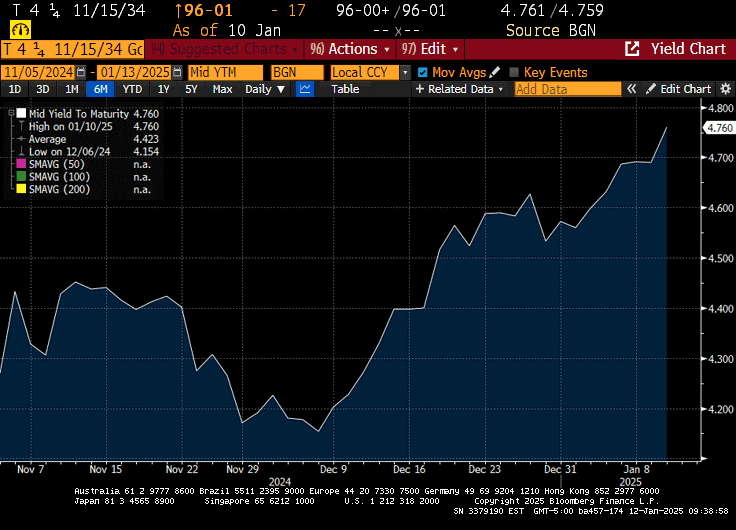
The S&P 500 and Dow fell by 1.9%, the NASDAQ lost 2.3%, and the Russell 2000 sank 3,5%. Notably, the S&P 500 could not hold above its 50-day moving average, which has now become a level of technical resistance. The yield on the 2-year climbed twelve basis points to 4.40%, while the 10-year yield increased by eighteen basis points to close at 4.78%. West Texas Intermediate Crude prices increased by $2.48, closing at $76.63 a barrel. Gold prices rose by 2.2% or $58.60 to $2713.70 an Oz. Copper prices increased by $0.23 to $4.30 per Lb. Bitcoin’s price fell by 3.54% to close at $94,287. The US dollar index gained 0.7% to close the week at 109.65.
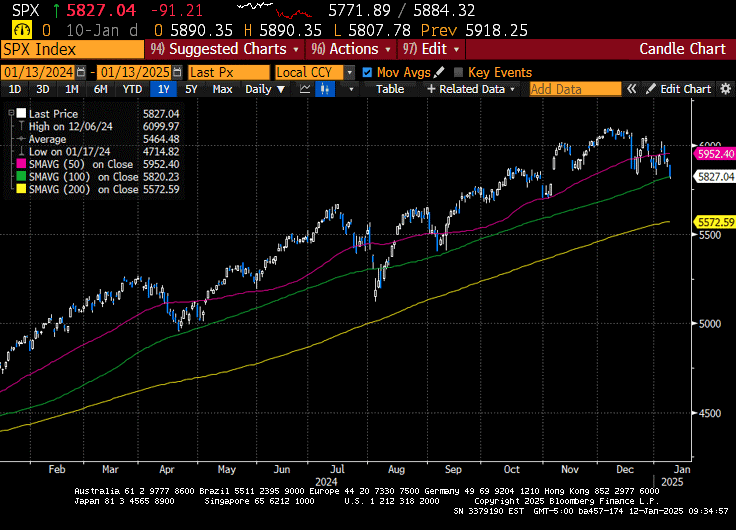
The Employment Situation report headlined the economic calendar. Non-farm payrolls increased by 256k, well above the consensus estimate of 154k. Private payrolls came in at 223k versus an estimated 140k. The unemployment rate fell from 4.1% to 4.2%. Average hourly earnings came in as expected at 0.3%, as did the Average work week at 34.3 hours. Earlier in the week, JOLTS data showed that job openings increased to 8.098m from the prior reading of 7.839m. ADP payrolls increased by 122k versus the consensus estimate of 134k. Initial Jobless Claims fell by 10k to 201k, while Continuing Claims increased by 23k to 1.867m. ISM Services showed the service sector expanding by 54.1%, up from the prior reading of 52.1%. The Prices Paid Index within the data increased to 64.4% from 58.2% and again catalyzed concerns on the inflation front. A preliminary look at the University of Michigan’s Consumer Sentiment fell from 74 in December to 73.2, attributed to increased inflation expectations.
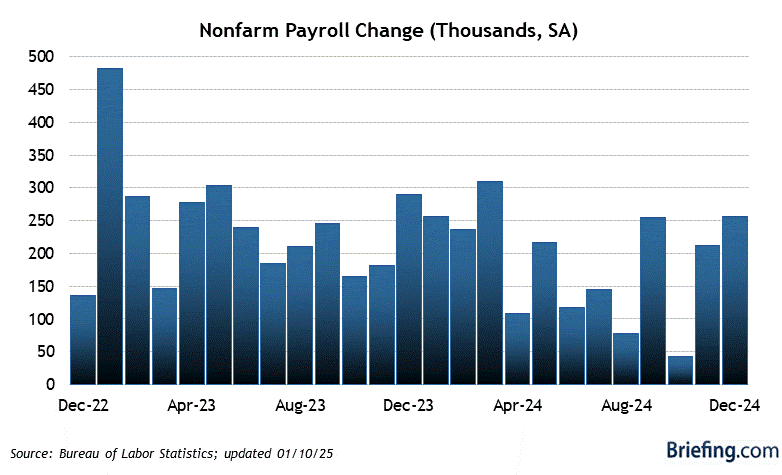
Investment advisory services offered through Foundations Investment Advisors, LLC (“FIA”), an SEC registered investment adviser. FIA’s Darren Leavitt authors this commentary which may include information and statistical data obtained from and/or prepared by third party sources that FIA deems reliable but in no way does FIA guarantee the accuracy or completeness. All such third party information and statistical data contained herein is subject to change without notice. Nothing herein constitutes legal, tax or investment advice or any recommendation that any security, portfolio of securities, or investment strategy is suitable for any specific person. Personal investment advice can only be rendered after the engagement of FIA for services, execution of required documentation, including receipt of required disclosures. All investments involve risk and past performance is no guarantee of future results. For registration information on FIA, please go to https://adviserinfo.sec.gov/ and search by our firm name or by our CRD #175083. Advisory services are only offered to clients or prospective clients where FIA and its representatives are properly licensed or exempted.
By Ian Berger, JD
IRA Analyst
Question:
I am planning for a required minimum distribution (RMD) from both my IRA and 403(b) plan for 2026, my first RMD year. I am in the third year of a 10-year period in which I am rolling over 10% of my 403(b) funds each year to my IRA as a way to consolidate. This is per my 403(b) contract. The funds get rolled over in September each year.
In 2026, do I need to take my RMD before the 10% rollover on the balance of my 403(b)? Are there regulations or just preference as to when I should take the RMD?
Claudia
Answer:
Hi Claudia,
Yes, starting in 2026, you will need to take your RMD from the 403(b) plan before doing the rollover to the IRA. That’s because the first dollars paid out of the 403(b) in any RMD year are considered the RMD, and RMDs cannot be rolled over. There is no rule requiring you to take the RMD at any particular time during the year, as long as it is taken before your rollover in September.
Question:
I believe that my RMD can be taken from any account to satisfy the total RMD, but does that apply to different types as accounts such as an IRA and a 401(k)? A related question: Can I use a qualified charitable distribution (QCD) from an IRA to satisfy the RMD for both my IRA and 401(k)?
Thanks for any insights you can provide.
John
Answer:
Hi John,
You can satisfy the total RMDs of all of your IRAs (and any SEP or SIMPLE IRA) from any IRA (or SEP or SIMPLE). But RMDs from IRAs and retirement plans, like 401(k)s, must be taken separately. Meanwhile, a QCD can only be used to satisfy an IRA RMD.
https://irahelp.com/slottreport/rmd-rollover-and-aggregation-rules-todays-slott-report-mailbag/

5 Key Changes to 401(k)s in 2025 and What They Mean for You
These new rules could make it easier for you to save more money for retirement
Participating in a 401(k) plan where you work is a smart way to invest for retirement. Plus, your employer may match some or all of the money you contribute. In 2025 the rules for 401(k)s will undergo several significant changes as a result of the federal SECURE 2.0 Act of 2022.1
Here’s the lowdown on five big changes to 401(k) plans in 2025 and how you can take full advantage of them.
Key Takeaways
- Maximum contribution limits for 401(k) plans are rising by $500 for many workers in 2025.2
- Workers age 50 and older can make additional catch-up contributions, with those in the 60 to 63 age group eligible for even higher limits.12
- Many employers will now be required to enroll their workers automatically in their 401(k) plan, although workers can still opt out.1
- More part-time workers will be eligible for 401(k)s, with the work requirement as either one year with at least 1000 hours of service or two consecutive years with at least 500 hours of service. (The latter requirement dropped from three years to two years.)1
- The government has also clarified the 10-year rule for non-spouse beneficiaries who inherit a 401(k).3
1. Higher Contribution Limits
The maximum amount that workers can contribute to their 401(k) plans tends to rise each year, as it’s adjusted for inflation. (For 2025, however, the contribution limit for IRAs didn’t increase. It’s still $7,000, or $8,000 if you’re 50 or older.2) For 2025, the most you can contribute to a 401(k) if you’re under 50 is $23,500. That’s up from $23,000 in 2024.2
Workers must earn at least that much to contribute that much money, because contributions each year are limited to 100% of employee compensation.4
Workers can have both a traditional 401(k) account and a designated Roth 401(k) account if their employer offers a Roth option. However, the limit applies to both accounts combined.5
2. Higher Catch-Up Contributions for Some Older Workers
Workers age 50 and older can make additional catch-up contributions. For both 2024 and 2025, the maximum catch-up contribution is $7,500 for most workers age 50 and older. In other words, a worker who is age 50 or older who earns at least $31,000 in 2025 is eligible to contribute that much to their 401(k) plan ($23,500 + $7,500).2
Internal Revenue Service. “401(k) Limit Increases to $23,500 for 2025, IRA Limit Remains $7,000.”
n addition, as a result of the SECURE 2.0 Act, workers age 60, 61, 62, and 63 will now be eligible to make catch-up contributions of up to $11,250. For 2025, that would mean a maximum of $34,750 ($23,500 + $11,250). Again, they must earn at least that much to contribute that much.2
Internal Revenue Service. “401(k) Limit Increases to $23,500 for 2025, IRA Limit Remains $7,000.”
3. Automatic 401(k) Enrollment
Since 1998, the government has allowed employers to automatically enroll new employees in their 401(k) plans. Workers who didn’t want to participate could opt-out by taking no action to enroll.16
Because of a provision in the SECURE 2.0 Act, starting in 2025, most 401(k) plans established after December 28, 2022, will be required to automatically enroll new employees unless they proactively opt out of the program.
If you don’t take steps to opt-out, the contribution percentage must be at least 3% of your salary but not more than 10% in the first year. After that, it must increase by one percentage point per year until it gets to at least 10% but not more than 15%.1 If you were an existing employee, you are legacied in at your current contribution levels.
There are various exceptions, including one for companies that have been in business for less than three years or have 10 or fewer employees.1
As a result of the law, anyone who begins work with an employer that doesn’t qualify fo
4. Quicker Eligibility for Part-Time Workers
The SECURE 2.0 Act also shortened the service requirement for some part-time workers to become eligible to participate in their employer’s 401(k) plan.
The rule applies to part-time employees who work at least 500 (but less than 1000) hours for an employer in a given year. As of 2025, they are eligible for enrollment after two consecutive years of service, rather than three years (as it was before the rule changed). The rule for part-time employees who work 1000 or more hours per year is the same: they are eligible for enrollment after one year.1
United States Senate Committee on Finance. “SECURE 2.0 Act of 2022.”
5. New 10-Year Rule
Another change for 2025 will affect many people who inherit someone else’s 401(k).
Since the passage of the SECURE Act, non-spouses who inherit a 401(k) after 2019 typically must withdraw the money within 10 years (the 10-year rule). This was previously interpreted to mean that the beneficiary didn’t have to take money out every year but could delay withdrawals until the end of the 10 years if they wanted to.7 In that way, they could postpone the tax hit and enjoy tax-sheltered growth for all that time.
In 2024, however, the Internal Revenue Service (IRS) clarified that, in addition to following the 10-year rule, such accounts are now subject to annual required minimum distributions (RMDs) if the person dies after their required beginning date—that is, the date on which they would have had to start taking RMDs. Under the clarified rules, the beneficiary must take RMDs based on their life expectancy.7
Beneficiaries subject to this newly clarified rule must begin taking RMDs in 2025 or face penalties. Fortunately, the IRS is waiving penalties for the years 2021 through 2024.7
What Are the 401(k) Contribution Limits for 2025?
Contribution limits differ by age. Older workers are eligible for additional catch-up contributions. For 2025, the annual limits are:2
- Workers under 50: $23,500
- Workers age 50 or older but not 60, 61, 62, or 63: $31,000
- Workers aged 60, 61, 62, or 63: $34,750
How Many People Are Enrolled in 401(k) Plans?
The Investment Company Institute, a financial services industry trade group, estimates that there were about 70 million active 401(k) plan participants, plus at the end of 2023. There were also millions more former employees and retirees with accounts,8
What Is the Average 401(k) Balance by Age?
Fidelity Investments, which manages the 401(k) plans of some 24 million workers, found that the average 401(k) balance overall as of Q3 2024 was $132,300.
Broken down by generation, the average balances were:9
- Baby boomers (born 1946-1964): $250,900
- Gen X (born 1965-1980): $191,100
- Millennials (born 1981-1996): $66,500
- Gen Z (born 1997-2012): $13,000
The Bottom Line
The rules for 401(k) plans can change each year, so if you want to get the most from your plan, it’s a good idea to review it periodically. The year 2025, in particular, is bringing some important changes to maximum contributions, catch-up contributions, and inherited retirement accounts, among others. If you have any questions about what to do this year, consulting a financial planner or other knowledgeable advisor could be worth the investment.
https://www.investopedia.com/important-changes-401k-8743513
What’s New for 2025
By Ian Berger, JD
IRA Analyst
When the ball dropped in Times Square on New Year’s Eve, a number of new retirement account provisions became effective. We’ve previously written about each of these new rules in The Slott Report. This article will serve as a checklist, with links to the prior articles.
- As happens frequently, many retirement account dollar amounts increased in 2025 as a result of indexing for inflation. For example, the 2025 regular (non-catch-up) elective deferral limit for 401(k), 403(b) and 457(b) plans went up from $23,000 to $23,500. In addition, the SEP contribution limit increased to 25% of up to $350,000 in pay, but no more than $70,000. Here’s a link to our November 6, 2024, Slott Report article with more details: irahelp.com/slottreport/401k-contribution-limits-increase-for-2025/.
- A big change to the required minimum distribution (RMD) rules made by the 2019 SECURE Act requires most non-spouse retirement account beneficiaries to empty the inherited account by the end of the 10th year following the year of death. IRS regulations also mandate that any beneficiary subject to the 10-year rule who inherited from someone who had started RMDs must continue them during years 1-9 of the 10-year period. However, because of confusion over this rule, the IRS did not require annual RMDs for beneficiaries in this category for years 2021-2024. Starting this year, yearly RMDs become due. See the following Slott Report post from November 11, 2024, for more information: irahelp.com/slottreport/annual-rmds-for-certain-beneficiaries-kick-in-soon/.
- Several new rules for retirement plans have kicked in. Many new 401(k) and 403(b) plans will be required to include an automatic enrollment feature. This means that eligible employees will be required to make elective deferrals unless they opt out. In addition, it’s now harder for plans to keep out part-time employees. Any employee who has worked at least 500 hours in two consecutive 12-month periods (but excluding periods before 2023), and who is age 21 or older, must be allowed to participate. Both of those provisions are discussed in more detail in the December 2, 2024, post on the Slott Report: irahelp.com/slottreport/new-401k-provisions-that-become-effective-in-2025/.
- Last but not least, Congress has increased catch-up contribution opportunities for certain older employees in 401(k), 403(b) and governmental 457(b) plans starting this year. This “super catch-up” is higher than the current age-50-or-older catch-up — for 2025, it is $11,250. The super catch-up is available only to those who are age 60, 61, 62 or 63 on the last day of the year.
A super catch-up ($5,250 for 2025) also applies to age 60-63 SIMPLE IRA participants. This means that employees in SIMPLE plans will be subject to one of three different catch-up limits, depending on their age and the size of their employer. These two Slott Report articles from October 21, 2024, and November 20, 2024, attempt to clear up this confusing topic: https://irahelp.com/slottreport/nothing-simple-about-it-3-different-catch-up-limits-for-2025/.
5 Things We Are Talking About at the Slott Report in 2025
By Sarah Brenner, JD
Director of Retirement Education
The year 2025 is upon us! There is no doubt that this will be an eventful time for retirement accounts. As the new year kicks off, here is what we are talking about now at the Slott Report.
1. Increased contribution opportunities. New catch-up contribution options for certain older individuals are here!
For 2025, those who are age 50 or older can contribute an additional $7,500 as salary deferrals to their employer plan. However, those who are aged 60, 61, 62 or 63 at year’s end can contribute even more. They can contribute an additional $11,250 — instead of $7,500.
For SIMPLE IRA plans, those who are age 50 or older can contribute an additional $3,500. The SECURE 2.0 Act also increased the SIMPLE IRA catch-up contribution limit for certain individuals. For 2024 and 2025, the catch-up contribution limit for a business with 25 or fewer employees is automatically increased to $3,850. Businesses with 26 – 100 employees can allow this higher contribution limit, but only if they provide a 4% (instead of 3%) matching contribution, or a 3% (instead of 2%) across-the-board contribution.
Additionally, for 2025, those SIMPLE IRA plan participants who are aged 60, 61, 62 or 63 at year’s end can contribute an additional $5,250 — instead of $3,500 or $3,850.
At the Slott Report, we are getting many questions on how these new complicated rules work, so expect to see some deep dives into the all the details in upcoming posts.
2. Potential tax law changes. Whenever a new administration takes over, the chances for big legislative changes go up.This year, the odds increase even more with one-party control of both the Presidency and Congress. When you add to the mix the fact that the individual tax provisions from the Tax Cuts and Jobs Act (TCJA) are set to expire at the end of 2025, the possibility of significant tax law changes is real.
There is no doubt that retirement savings will be impacted as Congress takes on the tax code. We will be following it all here at the Slott Report.
3. More Roth opportunities. With new tax legislation and breaks, inevitably comes discussion of how to pay for it all. Roth accounts often are part of the answer. Congress loves Roth accounts because they bring in immediate revenue. Roth accounts have proliferated. We now have Roth SEP and SIMPLE IRAs, and mandatory Roth catch-up contributions are scheduled to begin in 2026 for some high-income earners. The lead-up to TCJA back in 2017 even brought discussions of all 401(k) contributions being required to be Roth.
We at the Slott Report expect to see many more Roth opportunities in 2025 and future years.
4. Recent and upcoming regulations. The year 2024 brought us both long-awaited final SECURE Act regulations and proposed SECURE 2.0 regulations.In 2025, we know that annual required minimum distributions (RMDs) will be mandatory during the 10-year rule for many beneficiaries, and we know how the new rules for spouse beneficiaries will work.
At the Slott Report, we will be watching how these new rules are put into practice as well as monitoring any new guidance from the IRS. We are still eagerly awaiting guidance on more issues such as rollovers from 529 plans to Roth IRAs. Stay tuned for future updates.
5. Distribution planning. There has always been a focus on the importance of accumulating retirement savings. However, as the baby boomer generation reaches retirement age, it has become increasingly apparent that, as important as saving for retirement is, when it comes to tax advantage retirement accounts, it is equally important to focus on distribution planning. Doing so allows savers to keep more of their hard-earned money, instead of giving it over to Uncle Sam.
Here at the Slott Report, we expect to focus more on this part of the retirement savings process in 2025.
Stay tuned! The year ahead promises to be an exciting one. We hope you continue to follow the Slott Report for all the latest retirement account news, analysis and discussion!
https://irahelp.com/slottreport/5-things-we-are-talking-about-at-the-slott-report-in-2025/
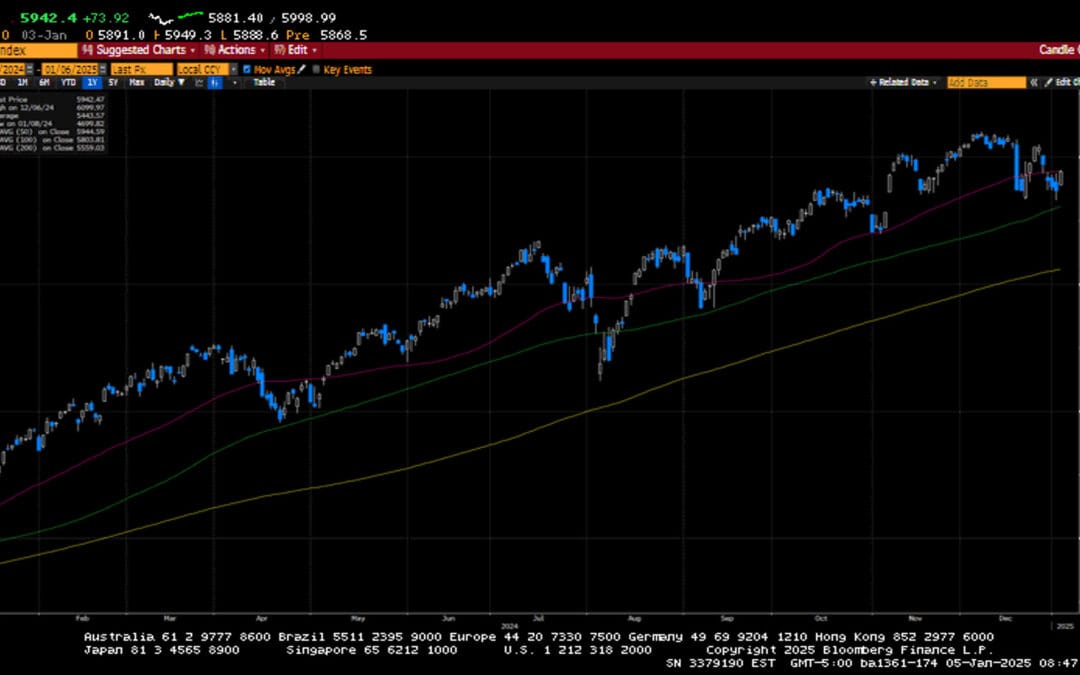
Weekly Market Commentary
-Darren Leavitt, CFA
The final trading sessions for 2024 extended losses from the prior week, but the S&P 500 and NASDAQ still posted impressive gains for the year, 23.3% and 28.6%, respectively. The so-called Santa Clause Rally did not appear for the second year, as the final seven trading sessions produced a 1.6% loss in the S&P 500. The holiday-shortened week saw increased volatility as trading volume skewed to the light side. Friday’s session saw investors come in and buy the dip, with mega-cap issues outperforming. As we move into 2025, there are several variables Wall Street is considering. What exactly will the Trump 2.0 policy look like ( think taxes, tariffs, deregulation, geopolitical relations), and will these policies foster inflation? What will global central bank policy look like, and where will the most significant policy divergences materialize? Will the US consumer continue to show up, providing a tailwind to corporate earnings and the economy? What will corporate earnings be, and will they broaden out from the mega-cap technology names? Will artificial intelligence capital expenditures continue, and will past expenditures start to show a return on investment? Will US exceptionalism continue, or will other global economies begin to outperform? There will be a lot to unpack over the next several months, and we expect increased volatility as the answers to these questions are found out.
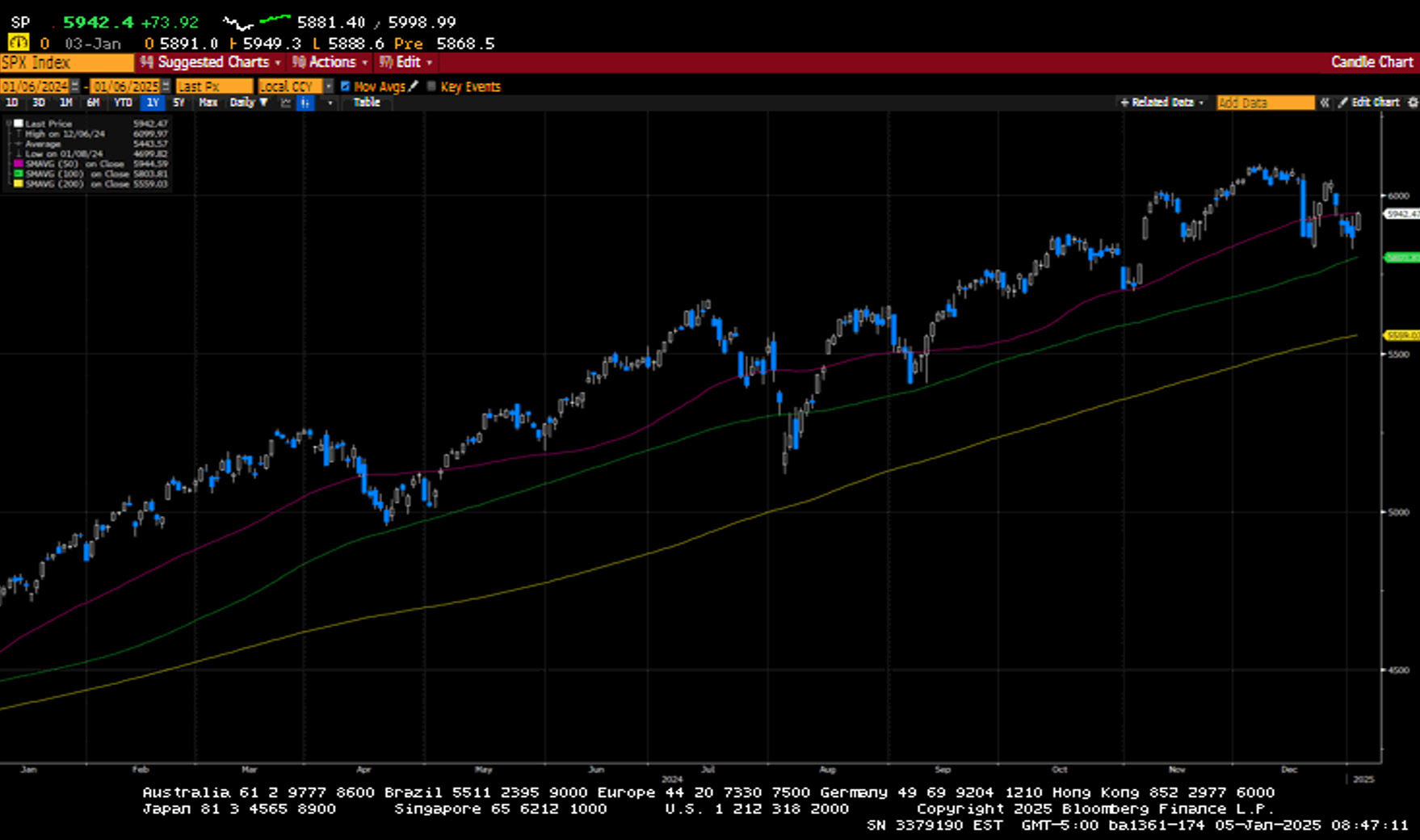
2024 was an excellent year for the equity markets, with the S&P 500 gaining 23.3%, the Dow added 12.9%, the NASDAQ rose 28.6%, and the Russell 2000 increased 10%. It was a more challenging market for US Treasuries as the 2-year yield decreased by just one basis point over the year to 4.24%, while the 10-year yield increased by sixty-nine basis points to 4.57%. However, the absolute moves across the curve really does not tell the whole story, as investors witnessed extreme volatility in the rates market with several material movers throughout the year.
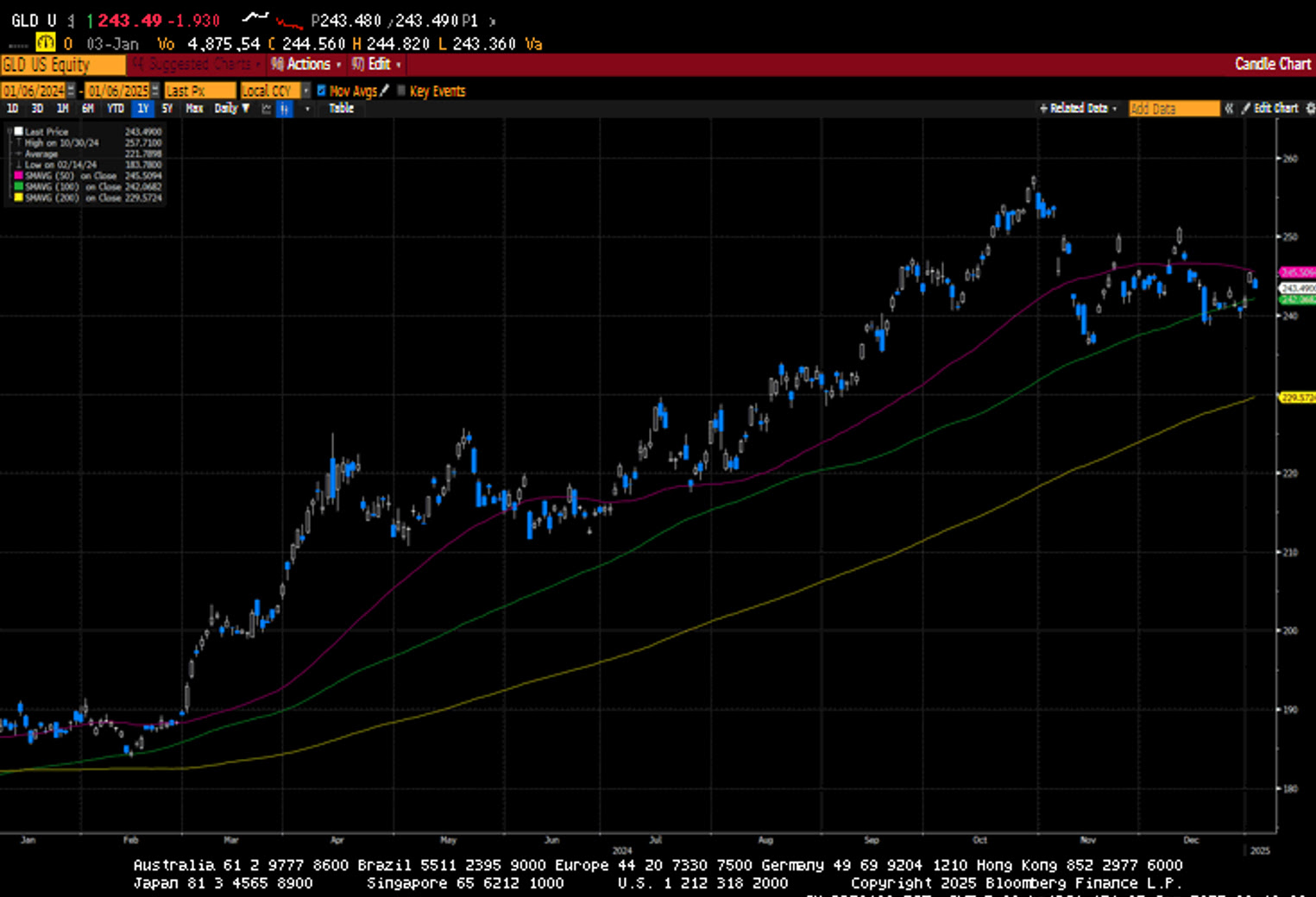
Internationally, I was a bit surprised to see some of the year end numbers. The German DAX was up 18.8% despite a very weak economic backdrop. The China Shanghai Composite was up 12.6% despite lackluster economic policy. Weakness in South Korea was evident given the recent political fallout- the Kospi fell 9.6% for the year. Similarly, political uncertainty in France weighed on the CAC 40, which shed 2.4%.
Gold prices rallied 27.4% or $568.80 to close 2024 at $2641.10 an Oz. The price of Oil closed the year where it started, gaining $0.01 to close at $71.85 per barrel. Copper prices increased by $0.13 to $4.02 per Lb. The price of Bitcoin over the last year has surged by ~121%, rising by $54,700 to $97,944. The US Dollar index increased by 7.1% to 108.49. The currency markets were also riddled with volatility as the Yen carry trade unwound in early July. The Euro closed the year on its lows trading at 103.53 to the US Dollar, and looks poised to break parity in the coming weeks.
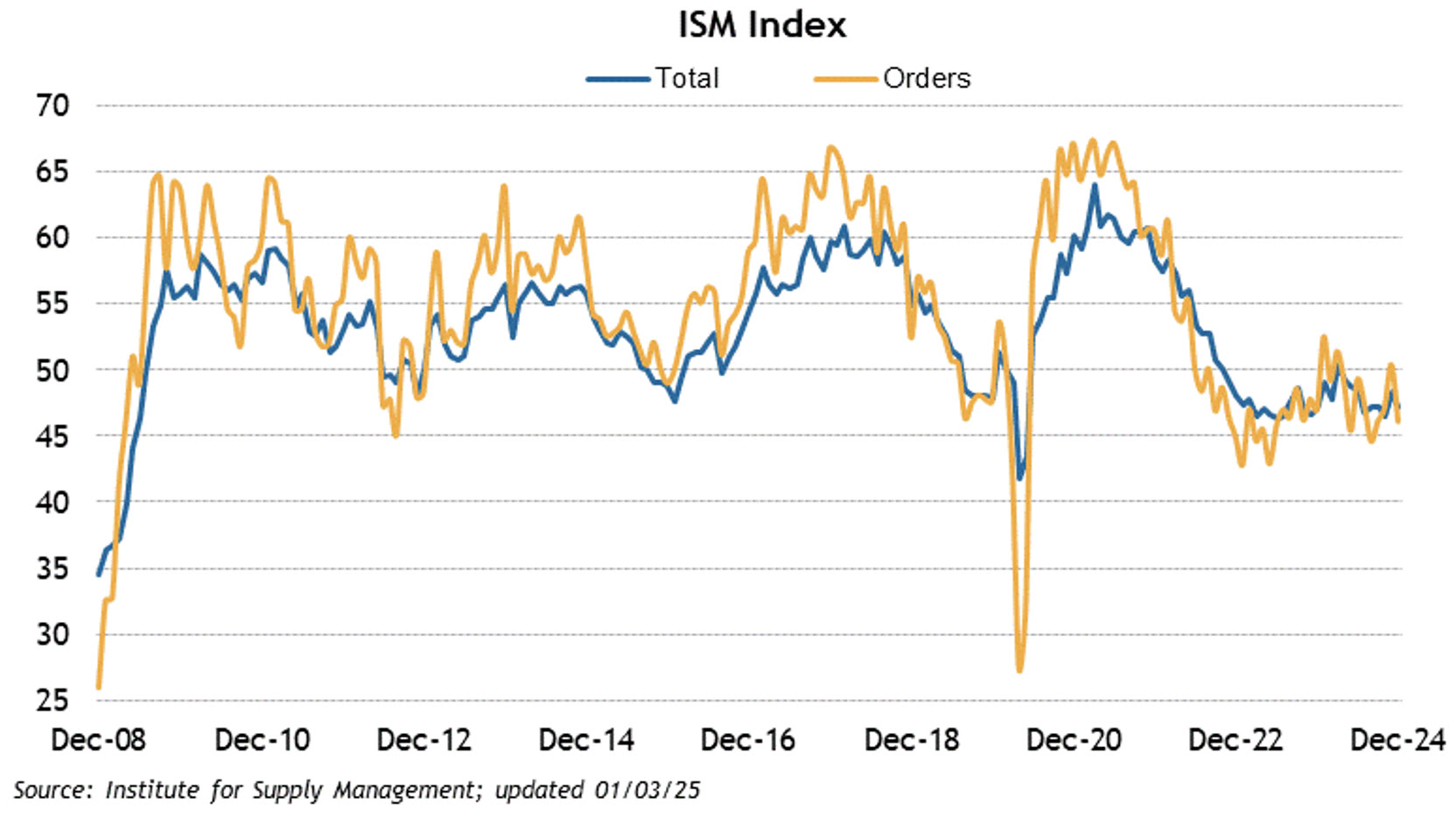
The Economic calendar featured some better-than-expected manufacturing data. The ISM Manufacturing Index increased to 49.3% versus the prior reading of 48.4% and topped the consensus estimate of 48.7%. The S&P Global Manufacturing PMI came in at 49.4%. Initial Jobless Claims fell by 9k to 211k, while Continuing Claims fell by 52k to 1844k.
Investment advisory services offered through Foundations Investment Advisors, LLC (“FIA”), an SEC registered investment adviser. FIA’s Darren Leavitt authors this commentary which may include information and statistical data obtained from and/or prepared by third party sources that FIA deems reliable but in no way does FIA guarantee the accuracy or completeness. All such third party information and statistical data contained herein is subject to change without notice. Nothing herein constitutes legal, tax or investment advice or any recommendation that any security, portfolio of securities, or investment strategy is suitable for any specific person. Personal investment advice can only be rendered after the engagement of FIA for services, execution of required documentation, including receipt of required disclosures. All investments involve risk and past performance is no guarantee of future results. For registration information on FIA, please go to https://adviserinfo.sec.gov/ and search by our firm name or by our CRD #175083. Advisory services are only offered to clients or prospective clients where FIA and its representatives are properly licensed or exempted.

What’s Changing for Retirement in 2025?
How Secure 2.0 and inflation adjustments will affect retirement savers and spenders.
For retirement savers, the ringing in of the new year will bring more than the usual inflation adjustments to retirement contributions. The retirement legislation known as Secure 2.0 will also continue to phase in, bringing implications for retirement savers and retirees alike.
Here’s a roundup of some of the key retirement-related changes to watch out for in 2025, as well as any planning-related moves to consider.
Higher Tax Brackets
Thanks to higher inflation, the income limits for tax brackets will be increasing next year. These changes affect the income thresholds for both income and capital gains taxes. The top marginal income tax rate is 37%, for example, but it applies to single filers with incomes of $626,350 or more and married couples filing jointly with $751,600 or more in income. (In 2024, those thresholds were $609,350 and $731,200, respectively.)
Potential Action Items
Realizing capital gains in the 0% range: Higher-income thresholds may enhance the opportunity to sell appreciated securities without any capital gains taxes. For 2025, the 0% capital gains tax rate applies to single filers earning less than $48,350 and married couples filing jointly with incomes less than $96,700.
Assessing the appropriateness of Roth conversions: You’ll owe ordinary income tax when you convert traditional IRA and 401(k) balances to Roth, but higher-income thresholds provide additional headroom to convert without pushing yourself into a higher tax bracket. A series of smaller conversions can often make sense, especially in the postretirement, prerequired minimum distribution phase.
Higher Contribution Limits for Savers
Here’s another set of changes that relate to inflation: Contribution limits to retirement accounts are increasing slightly for 2025. Company retirement plan contributions—whether 401(k), 403(b), or 457—are going up to $23,500 for people under age 50 and $31,000 for savers who are 50-plus. People who will be between the ages of 60 and 63 in 2025 can contribute up to $34,750, thanks to new “super catch-up contributions” that are going to be effected as part of Secure 2.0. The total 401(k) contribution limit—of particular interest to people contributing to aftertax 401(k)s—is $70,000, plus an additional $7,500 for savers over 50.
Meanwhile, IRA contribution limits will stay the same as in 2024: $7,000 for people under 50 and $8,000 for people who are 50-plus. Contributions to health savings accounts, or HSAs, which can be employed as stealth retirement accounts, are increasing as well, to $4,300 for people covered by an individual high-deductible health plan, or HDHP, and $8,550 for people with family HDHP coverage. HSA savers who are 55 and older can contribute an additional $1,000. Note that the income limits that determine eligibility to make Roth IRA or deductible traditional IRA contributions have also increased to account for inflation.
Potential Action Item
If you haven’t revisited your company retirement plan and/or HSA contributions for a while, now is a good time to do so, especially if you’re in a position to make the maximum allowable contributions to your account(s). While you’re at it, make sure you’re maximizing any employer-matching contributions that you’re eligible to receive. And if you’ll turn 50 in 2025, remember that you don’t need to wait until your birthday to make catch-up contributions. I’m a big fan of putting IRA contributions on autopilot with your investment provider, making automatic monthly contributions, just as you do with your 401(k). To make the maximum allowable IRA contribution in 2025, you’d need to contribute $583 monthly if you’re under 50 and $666 a month if you’re 50 and over.
Higher Qualified Charitable Distribution Limit
People over age 70.5 can contribute $108,000 to charity via the qualified charitable distribution, or QCD, in 2025. That’s up from $105,000 in 2024.
Potential Action Item
Given that nearly 90% of taxpayers aren’t itemizing their deductions, the QCD is a gimme for charitably inclined people 70.5 and older who have IRAs. Contributed amounts skirt income taxes and also satisfy required minimum distributions for those who are age 73 or above. The QCD will tend to be a better deal, from a tax standpoint, than writing a check to charity and deducting it on your tax return.
Higher Estate, Gift Tax Thresholds
The amount of an estate that’s exempt from estate tax will increase to $13.99 million per person in 2025. This means that married couples can effectively shield nearly $28 million from the federal estate tax. Meanwhile, the gift tax exclusion is increasing to $19,000 ($38,000 for couples) in 2025. This means individuals can gift up to $19,000 to each recipient next year without having that amount count toward their gift-tax exclusion.
Potential Action Item
The estate tax exclusion is at its highest level ever, but key provisions of the Tax Cuts and Jobs Act, including the currently high levels of assets that are exempt from federal estate tax, are set to expire at the end of this year. A Republican presidential administration and Congress may well extend them, but a qualified estate planner can help you determine the best strategies to reduce taxation on your estate (not to mention help with other crucial matters such as drafting powers of attorney).
Prescription Drug Costs
Mark Miller outlined some of the key changes to prescription drug costs for seniors who are covered by Medicare. Specifically, people who are covered by a Medicare Part D plan will now have their out-of-pocket drug costs capped at $2,000 per year starting next year. Moreover, seniors who are enrolled in Part D can opt into a new payment program that enables them to spread their prescription-related costs throughout the year.
Long-Term-Care Premium Deductibility
Long-term-care insurance has declined in popularity, but there are still millions of policies in force. The amount of long-term-care insurance premiums that one can deduct is going up a bit in 2025. People who are age 40 or under can deduct $480 in long-term-care premiums in 2024; those aged 41 to 50 can deduct $900; people aged 51 to 60 can deduct $1,800; those aged 61 to 70 can deduct $4,810; and those 71 and older can deduct $6,020.
https://www.morningstar.com/retirement/whats-changing-retirement-2025
Spousal Beneficiaries and the 10-Year Rule: Today’s Slott Report Mailbag
By Sarah Brenner, JD
Director of Retirement Education
Question:
Hello,
Our daughter (age 50) is the sole beneficiary of her husband’s (age 52) IRA due to his death in April 2024. Is there a time limit for when she must either take ownership or roll it over into her own IRA or other qualified plan?
Thank you,
Marylou Pagano
Answer:
Hi MaryLou,
Our condolences on the death of your son-in-law.
Your daughter as a spouse beneficiary has some options. She may consider keeping the IRA as an inherited IRA. If she does a spousal rollover into her own IRA and then needs to take a distribution, she will be subject to the 10% early distribution penalty because she is under age 59½. By delaying a spousal rollover and keeping the account as an inherited IRA, she would avoid this penalty because it does not apply to inherited accounts.
No distributions would be required from the inherited IRA until the year that the deceased IRA owner would have been age 73. She can still do a spousal rollover into her own IRA at any time. There is no time limit or deadline for this.
Question:
I have an 87-year-old mother who passed away after her required beginning date with three children as beneficiaries. They are each subject to the 10-year rule. Are the annual required minimum distributions (RMDs) based on the beneficiaries’ life expectancies or are they based on the original owner (87-year-old mother’s) life expectancy?
Thank you,
Janine
Answer:
Hi Janine,
You are correct that the beneficiaries in this case would be subject to the 10-year rule and would have to take annual RMDs during the 10-year period. Those annual RMDs would be based on the beneficiaries’ single life expectancies.
https://irahelp.com/slottreport/spousal-beneficiaries-and-the-10-year-rule-todays-slott-report-mailbag/
Jelly-of-the-Month Club
By Andy Ives, CFP®, AIF®
IRA Analyst
I counted them. This year the Slott Report published 101 blog articles. While other sites add “pay-for-content” firewalls, we continue to pump out incredibly valuable and important information, week after week, totally free of charge. One would be hard-pressed to find an IRA or retirement plan topic we did not touch in 2024. Yes, the Slott Report is the gift that keeps on giving: the IRA version of the Jelly-of-the-Month Club.
In the Q&A Mailbag, we answered 200 retirement-related questions. Hopefully our responses pointed readers in the right direction. This is a crazy, mixed-up industry we work in, and we understand the rules are complex. If our answers helped anyone avoid the IRS Grinch, then it was well worth the effort.
From Ed, Sarah, Ian and me: Thank you for reading! We wish you a wonderful holiday season and Happy New Year! (See you in 2025 for another 100+ new jelly flavors.)
https://irahelp.com/slottreport/jelly-of-the-month-club/
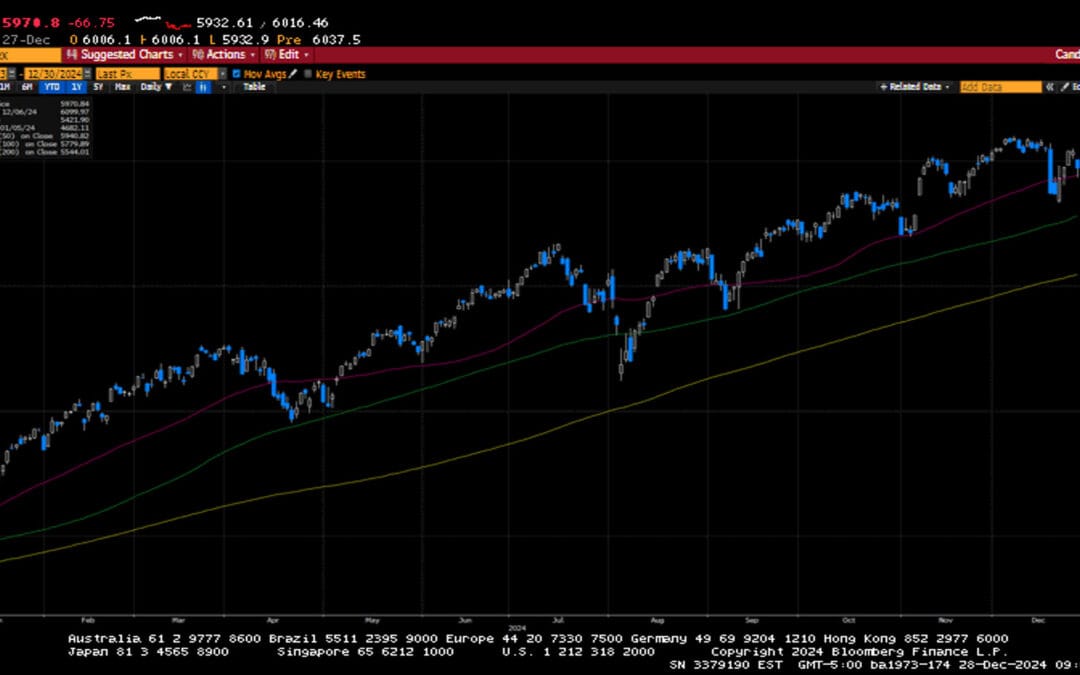
Weekly Market Commentary
-Darren Leavitt, CFA
Market action was mixed in a holiday-shortened week of trade. The Santa Clause rally, which runs for the last five trading sessions of the year through the first two trading sessions of the New Year, kicked off with gains from mega-cap technology. Light trading volumes can exaggerate moves, and one should not take too much from a thinly traded market. Tuesday’s abbreviated session and Thursday’s session ended flat, while Friday’s session saw a decent pullback in those same mega-cap technology issues.

The S&P 500 gained 0.7%, the Dow added 0.4%, the NASDAQ increased by 0.8%, and the Russell tacked on 0.1%. US Treasuries sold off across the curve, with longer-tenured issues taking the brunt of the sell-off. The 2-year yield increased by one basis point to 4.33%, while the 10-year yield increased by nine basis points to 4.62%. Oil prices increased by 1.5% or $1.10 to close at $70.53 a barrel. Gold prices fell by $11.20 to $2,633.20. Copper prices inched higher by two cents to $4.13 per Lb. Bitcoin traded lower by ~$2,800 to $94,400. The US Dollar index advanced by 0.42 to close at 108.04.

The economic calendar was quiet. Consumer Confidence missed the mark, coming in at 104.7 versus the street’s estimate of 113.5. The report raised concerns about the outlook for business conditions and income. Initial Claims fell by 1k to 219k; however, Continuing Claims increased by 46k to 1.910M, a three-year high. New Home sales in November came in at 664k versus the consensus estimate of 670k.
Investment advisory services offered through Foundations Investment Advisors, LLC (“FIA”), an SEC registered investment adviser. FIA’s Darren Leavitt authors this commentary which may include information and statistical data obtained from and/or prepared by third party sources that FIA deems reliable but in no way does FIA guarantee the accuracy or completeness. All such third party information and statistical data contained herein is subject to change without notice. Nothing herein constitutes legal, tax or investment advice or any recommendation that any security, portfolio of securities, or investment strategy is suitable for any specific person. Personal investment advice can only be rendered after the engagement of FIA for services, execution of required documentation, including receipt of required disclosures. All investments involve risk and past performance is no guarantee of future results. For registration information on FIA, please go to https://adviserinfo.sec.gov/ and search by our firm name or by our CRD #175083. Advisory services are only offered to clients or prospective clients where FIA and its representatives are properly licensed or exempted.

Most Americans Feel They’re Worse Off Now Than In 2020—Here’s What The Data Says
Key Takeaways
- A recent Gallup poll showed most Americans feel they are worse off today than four years ago.
- Data on household finances show that things have changed dramatically since September 2020, when the COVID-19 pandemic was affecting the economy.
- Americans have a better job market and higher wages than they did four years ago, and rely less on government aid. However, they also face a higher cost of living, are saving less, and are falling behind on credit card payments.
Most Americans say they and their families are financially worse off today than four years ago. Economic data paint a mixed picture on whether it’s easier or harder to get by than it was back then.
Gallup recently released the results of a poll conducted in September, in which they asked U.S. adults, “Would you say you and your family are better off now than you were four years ago, or are you worse off now?” Only 39% said they were better off, while 52% said they were worse off. It was the most pessimistic result ever during a presidential election year for that question, which Gallup has asked regularly since 1984.1
Gallup. “Majority of Americans Feel Worse Off Than Four Years Ago.”
The question is designed to gauge public opinion about how household finances have fared during presidential administrations and signal how likely they might be to vote for an incumbent candidate or party. But this year, the question is especially loaded since “four years ago” was the fall of 2020, a dark time for the country and an extremely weird phase of the economy.
In the fall of 2020, the U.S. was reeling from the onslaught of COVID-19. No vaccine was widely available to the public, and thousands of people were dying from the virus each week.2 Public health authorities were imposing restrictions on gatherings, and requiring masks in many public places. Many businesses had still not reopened, and shoppers sometimes found empty shelves when looking for common household supplies.
Here’s how key measures of Americans’ financial health and the overall economy have changed over the four years since.
More Americans Are At Work
In September 2020, the economy had recovered many of the more than 20 million jobs lost when the pandemic shutdown businesses, but still hadn’t dug itself out of the hole. The unemployment rate stood at 7.8%, nearly double its September 2024 rate of 4.1%.
Unemployment Four Years Ago
Workers are less likely to be unemployed in September 2024 than in September 2020 when the economy was still reeling from COVID-19 and the unemployment rate was nearly double its current level.
The resilient job market is one of the economy’s biggest bright spots despite a recent slowdown. It has defied the expectations of economists, many of whom expected a recession in 2023 because of the Federal Reserve’s rate hike campaign to stifle inflation.
Bigger Paychecks, But Even Bigger Price Increases
The standard of living is ruled by the constant tug-of-war between income and inflation. The surge of inflation that took hold as the economy reopened from the pandemic had a seismic impact on many households’ finances. Since then, price increases have slowed considerably while wages have continued rising steadily.
In September 2020, that storm of inflation was still in the future. Between September 2020 and 2024, consumer prices rose 21.1%, according to the Consumer Price Index, while average hourly pay rose 19.8%, leaving workers worse off on average.
Prices Have Just Barely Outpaced Wages Over Four Years
Since September 2020, typical workers have lost buying power because consumer prices have gone up more than wages. However, the gap has narrowed in recent months as inflation has slowed while wages continued to rise.
Homebuying Has Gotten Less Affordable
The pandemic spurred a surge in home prices as buyers scrambled for more space for the new work-from-home lifestyle. As the pandemic faded, mortgage rates rose as the Federal Reserve raised its benchmark interest rate to combat inflation. High prices and interest rates have pushed monthly mortgage payments high enough that far fewer people can afford a home.
The median monthly payment on a newly bought house, including taxes and insurance, was $2,997, or 42% of the median monthly income in August, according to the latest data from the Federal Reserve Bank of Atlanta. In September 2020, it was $1,656, or 29% of income. Home payments are generally considered “affordable” if they’re less than 30% of income.3
Federal Reserve Bank of Atlanta. “Home Ownership Affordability Monitor.”
The Pandemic-Era Social Safety Net Is Gone
In September 2020, unemployed workers could rely on an unprecedented social safety net that has mostly evaporated.
Early on in the pandemic, a federal program boosted state unemployment benefits by $600 a week, which was later reduced to $300 before going away in 2021.
Food stamp benefits were raised, and free lunches were made available to all school students in the country. The extra SNAP benefits ended in 2023, and the free school lunches ended in 2022, although several states have made free school lunches permanent.4
The federal government banned evictions from apartments, and homeowners could stop paying their mortgages without incurring any penalties. The eviction ban expired in 2021 after the Supreme Court ruled it was unconstitutional.5 Enrollment for pandemic mortgage forbearance ended in 2023 when the COVID national emergency officially ended.
In addition to that relief, the government had sent out checks directly to households of $1,200 per adult and $500 per child.
Medicaid, the government’s health insurance program for people with low incomes, stopped disenrolling ineligible beneficiaries, leading to a sharp decrease in the number of Americans going without health insurance. That began to reverse in 2023 when disenrollment resumed.
Payments on federal student loans were paused, taking a major expense off the monthly budgets for many of the nation’s 43 million borrowers. Payments resumed in 2023, a financial shock to some of those borrowers.
Overall, researchers credit the pandemic-era social safety net programs—especially the child tax credit expansion, which didn’t take effect until 2021—with reducing child poverty and helping the economy recover far faster than it would have otherwise.6
People Are Saving Less Money
Ironically, the economy’s distress in 2020 improved the bottom line of many households. Business closures meant there were fewer opportunities to spend money, and cash was still coming in, partly because of government relief programs. That caused the saving rate—how much after-tax income is left over after spending—to surge.
More Spending, Less Saving
U.S. households only saved 4.8% of their after-tax income in August, down from 13.1% in September 2020. People had more money because of government relief programs, and couldn’t spend as much because many businesses were still closed.
Since then, the saving rate has fallen as the economy has returned to normal. The same trend can be seen in the nation’s overall credit card debt, which plunged in 2020 and resumed its usual steady uptick in 2021.
Stocks Are Way Up
The stock market has boomed over the last four years, with the popular S&P 500 stock index up about 70% between September 2020 and September 2024. The surge in stock value has helped boost household wealth, though it mostly affects the richer households who own the majority of stocks, according to data from the Federal Reserve.7
Credit Card Delinquency Has Surged
How have all these crosscurrents affected household finances? There are signs that people have weathered the storm and some that stress is building. For example, more people are falling behind on credit card payments, suggesting more people are under pressure.8
Federal Reserve via Federal Reserve Economic Data. “Revolving Consumer Credit Owned and Securitized.”
Credit Card Crunch
The rate of people falling a month or more behind on their credit card bills has jumped to 9.1% in the second quarter of 2024, compared to 6.2% the same quarter in 2020, rising above pre-pandemic levels.
However, there’s no sign that people are cutting back on spending. U.S. consumers continue to spend freely on restaurants and other retailers.
Then there’s also a long-running trend of people being generally pessimistic about their own finances and the economy as a whole, regardless of what the data might say. People’s feelings about the economy can be partisan, viewing it as better when their preferred party is in power, and those feelings can run hot during a presidential election year.
https://www.investopedia.com/most-americans-feel-they-are-financially-worse-off-now-than-in-2020-what-the-data-says-election-economy-8734610
Holiday Cheers and Wishes
By Ian Berger, JD
IRA Analyst
This is the time of year for good cheer and holiday wishes. In keeping with those traditions, here are some cheers and wishes for the IRS and Congress:
Cheers to the IRS: Yes, it did take the IRS 4½ years to issue final required minimum distribution (RMD) SECURE Act regulations in July 2024. But the IRS does deserve credit for addressing most of the unanswered questions raised by the SECURE Act and the 2022 proposed regulations. And, aside from the IRS’s stubborn interpretation of the at-least-as-rapidly rule, the final regulations were taxpayer-friendly. The same is true for the proposed SECURE 2.0 regulations issued at the same time.
Wish for the IRS: We cannot let theIRS off the hook completely. In SECURE Act 2.0, Congress added a much-appreciated provision that started in 2024; it allows owners of unused 529 accounts to transfer up to $35,000 of surplus funds tax-free to a Roth IRA for the benefit of the 529 beneficiary. The new law requires that the 529 account must have been held for at least 15 years but fails to address one basic question: If the 529 beneficiary changes, does the 15-year clock start over again or can you get credit for the period with the prior 529 beneficiary? The new law has now been in effect for a full year, but we still have zero guidance from the IRS on this crucial issue.
Cheers to Congress: This year, unlike in December 2019 and 2022, Congress did not hit us with a last-minute piece of legislation that would make massive changes to the IRA and employer plan tax rules. However, there is already talk that Congress may include provisions in the next tax bill that will require more mandatory Roth contributions. (SECURE 2.0 already requires that, starting in 2026, highly-paid employees who want to make 401(k) catch-up contributions must make them on a Roth basis.) The additional revenue from more “Rothification” would help pay for the renewal of the tax cuts in the 2017 Tax Cuts and Jobs Act, which are due to expire on December 31, 2025. So, next year we may not be so lucky!
Wish for Congress: It may be too big of an ask, but it is long overdue for Congress to start simplifying the retirement account tax rules instead of just piling new complicated rules on top of existing complicated rules. Need some examples? There are now 20 different exceptions to the 10% early distribution penalty (3 of which apply only to IRAs, 6 of which only apply to employer plans, and 11 of which apply to both); 8 different beneficiary RMD rules, depending on when the account owner died and into what category the beneficiary fits; 4 different ages for when RMDs are first due: ages 70½, 72, 73 (and eventually) 75; and 3 different catch-up contribution limits for SIMPLE (!!) plan participants. (And a partridge in a pear tree.)
Cheers and Wishes to You: We would be remiss if we did not give cheers to you, our loyal Slott Report readers, for checking in with us every Monday, Wednesday and Thursday, and for sending us such great questions. Best wishes for a Happy Holiday season!
https://irahelp.com/slottreport/holiday-cheers-and-wishes/
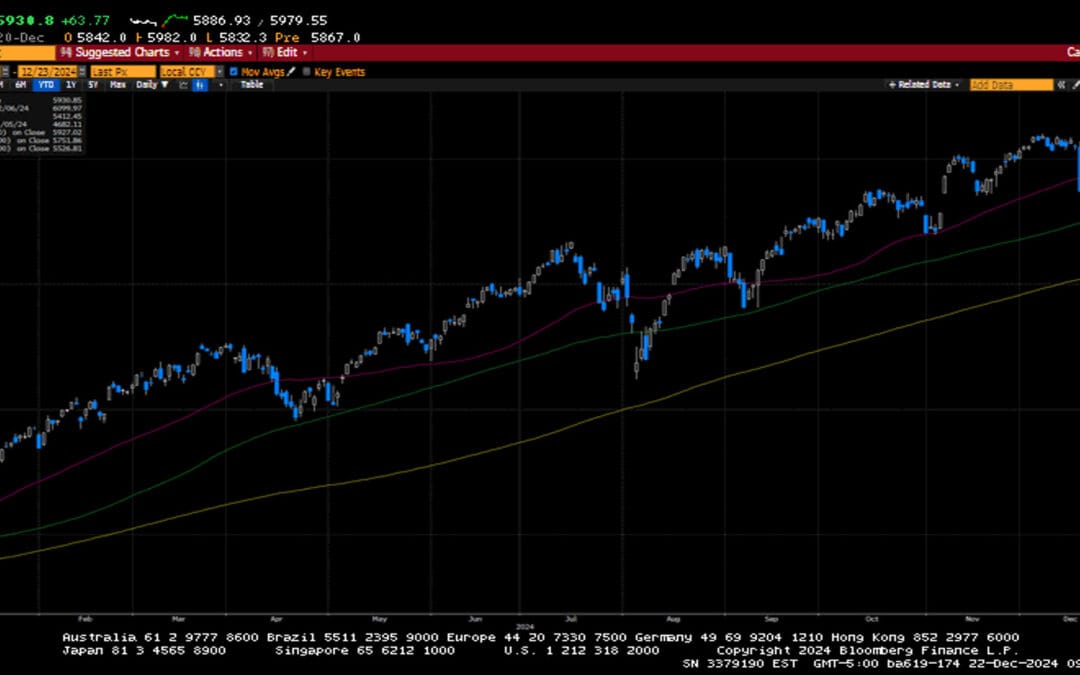
Weekly Market Commentary
-Darren Leavitt, CFA
Equity and fixed-income markets sold off for the second consecutive week as the Federal Reserve delivered an expected twenty-five basis-point rate cut but pivoted to a much more hawkish stance for 2025, where the committee now expects only two quarter-point rate cuts. Several committee members cited concerns regarding the new administration’s policies on tariffs and immigration and the policy ramifications on inflation. The pivot moved the Fed away from concerns about the labor market to worry more about their inflation mandate. The summary of economic projections showed an uptick in inflation expectations from 2024 to 2025 and, as I mentioned, the SEP also reduced 2025 rate cuts from four to two quarter-point cuts. Central bank policy elsewhere was pretty benign, with the Bank of England, Bank of Japan, and the Chinese Central Bank (PBOC) all keeping rates unchanged. The Norges Bank and the Bank of Mexico did cut their policy rates.
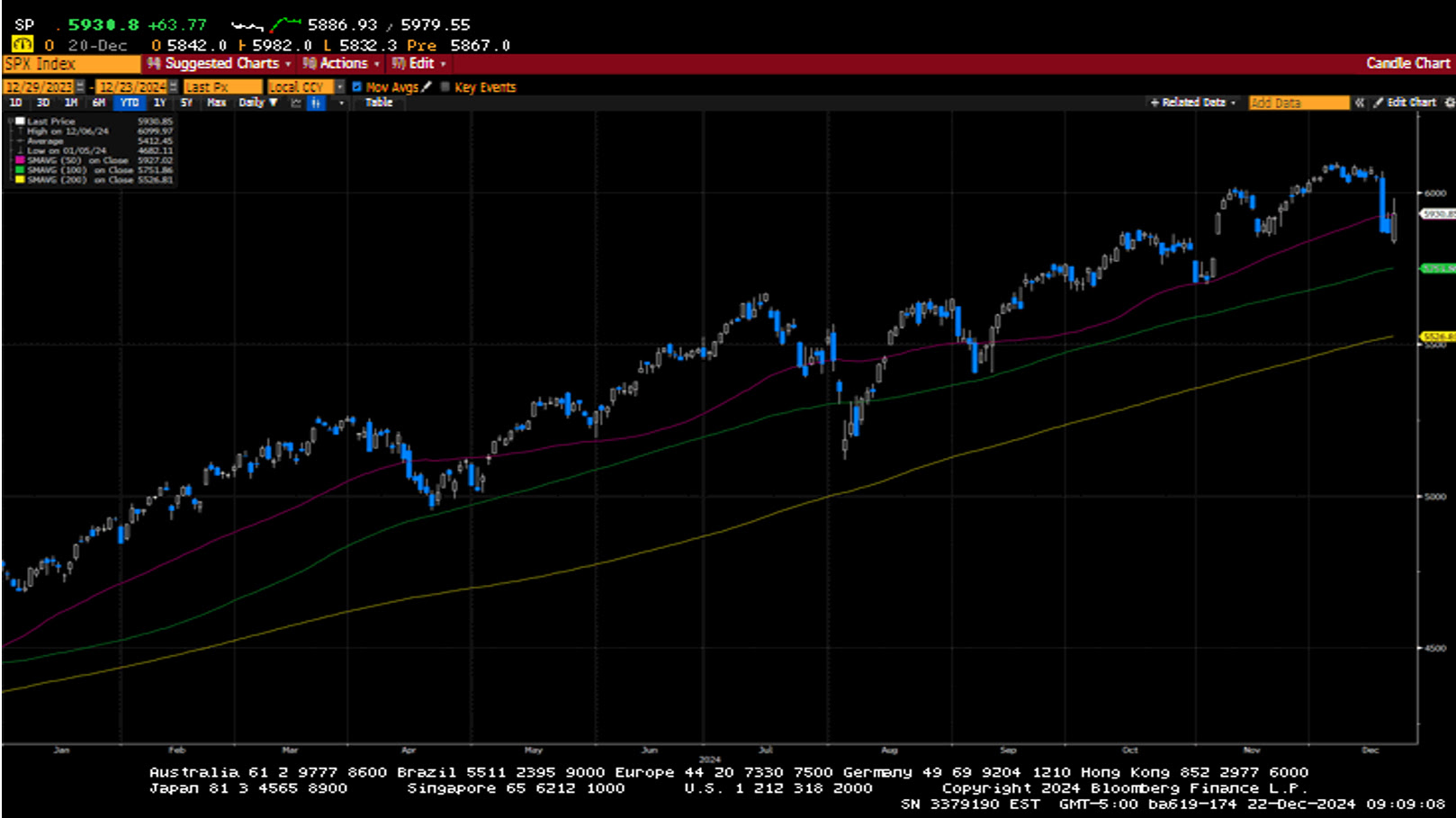
The S&P 500 lost 2%, the Dow was down 2.3%, the NASDAQ fell 1.8%, and the Russell 2000 was slammed, falling 4.5%. I should note that some of the market action witnessed this week was 100% related to a more hawkish Federal Reserve; however, some of this move is likely a natural consolidation of the tremendous move we have seen since the election. This consolidation can be seen as constructive and likely sets up the market for another move higher. Expect more market volatility as the Trump administration outlines its policies, but the backdrop for the US markets still appears constructive. US Treasuries suffered a second week of losses. The 2-year yield increased by seven basis points to 4.31%, while the 10-year yield increased by twelve basis points to 4.52%- the highest level since May.
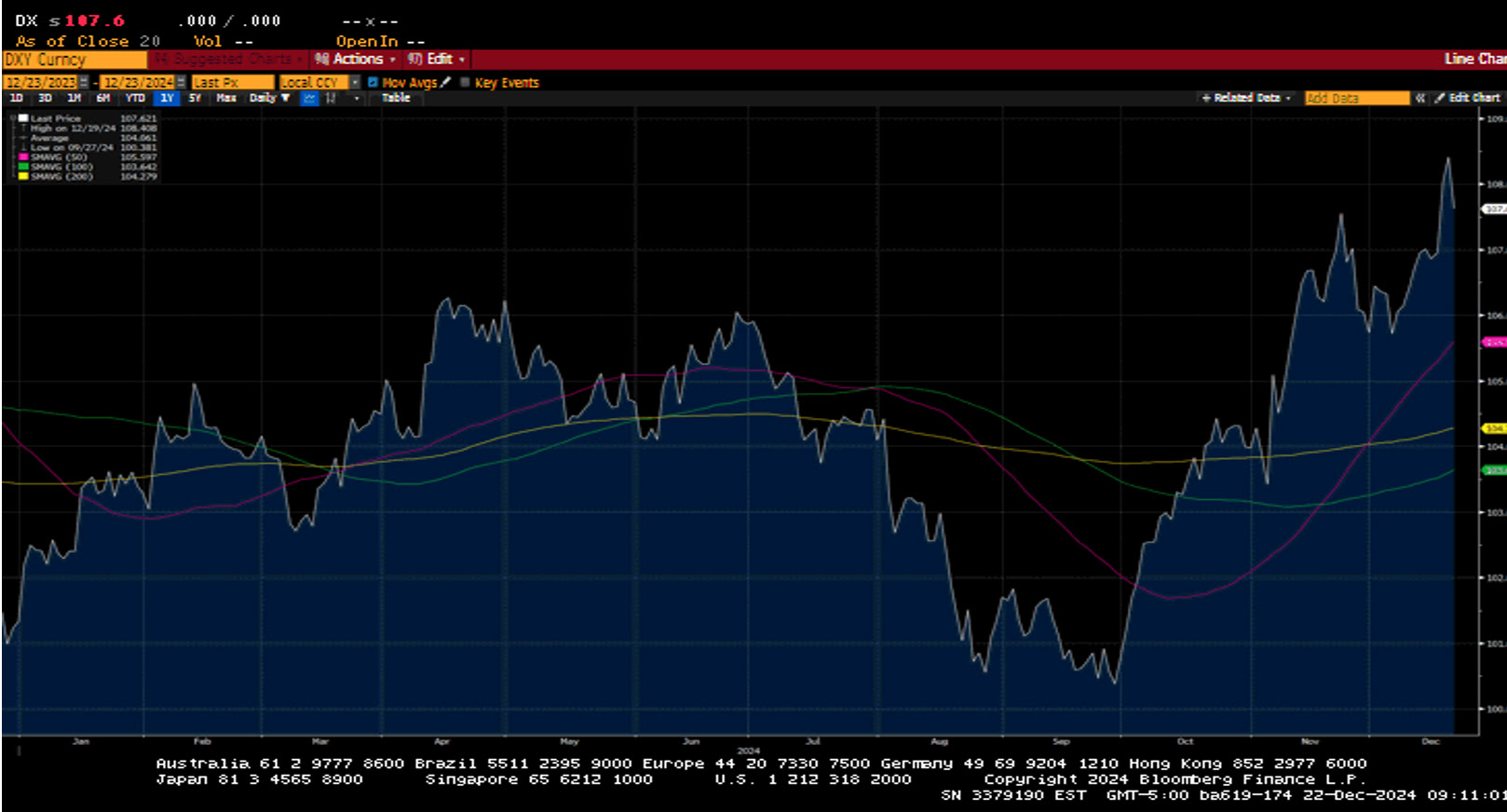
Commodity prices were generally lower while the US Dollar continued to post gains. Oil prices fell 2.6% or $1.86 on weak economic data out of China and the likelihood of weaker demand for crude from that region. Gold prices fell by $32.30 to $2644.40. Copper prices closed at $4.11 per Lb., down nine cents from the prior week. Bitcoin touched $108,000 per coin before selling off to close at $97,200. The Dollar index increased by 0.6% to 107.62.
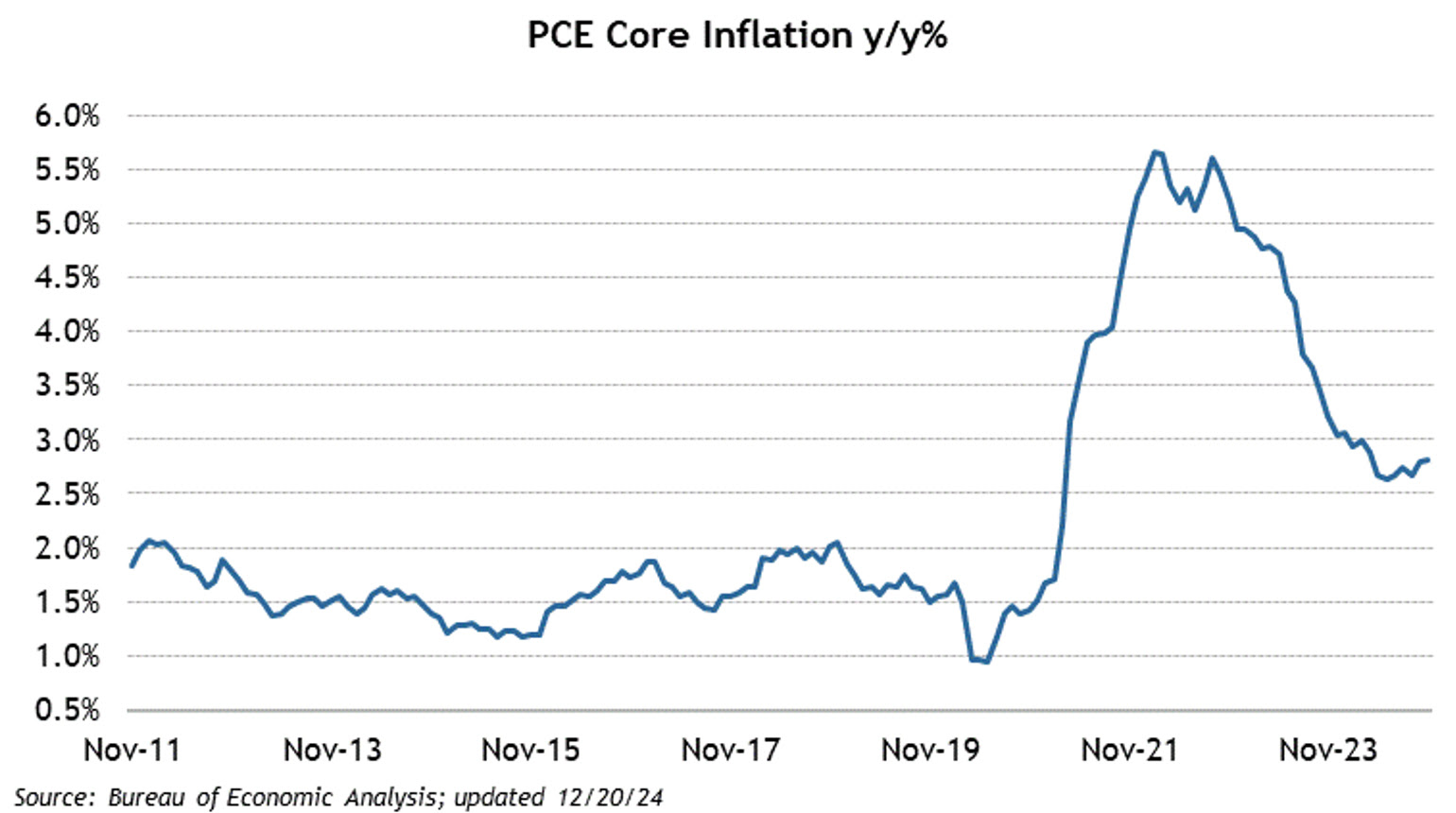
The economic calendar was headlined by the Fed’s preferred measure of inflation, the PCE. The PCE showed an increase of 0.1%, slightly lower than the expected 0.2%. On a year-over-year basis, the PCE increased by 2.4% versus the prior reading of 2.3%. The Core reading also came in at 0.1% month over month and was lower than the anticipated 0.2%. The year-over-year figure came in line with the prior month’s reading of 2.8%. The numbers showed no real improvement in inflation and provided some weight for the concerns articulated by the Fed earlier in the week. Personal Income came in at 0.3% versus the expected 0.4%, while Personal Spending increased by 0.4%, just below the consensus estimate of 0.5%. Retail Sales showed a robust market for autos. The headline number increased by 0.7%, while the ex-auto figure was up just .02%. Housing Starts increased by 1289k while building permits came in at 1505k- a mixed picture for the housing market. The 3rd estimate of Q3 GDP increased to 3.1% from 2.8%, while the GDP Deflator remained at 1.9%. Initial Claims fell by 22k to 220k, as Continuing Claims decreased by 5k to 1874k.
Investment advisory services offered through Foundations Investment Advisors, LLC (“FIA”), an SEC registered investment adviser. FIA’s Darren Leavitt authors this commentary which may include information and statistical data obtained from and/or prepared by third party sources that FIA deems reliable but in no way does FIA guarantee the accuracy or completeness. All such third party information and statistical data contained herein is subject to change without notice. Nothing herein constitutes legal, tax or investment advice or any recommendation that any security, portfolio of securities, or investment strategy is suitable for any specific person. Personal investment advice can only be rendered after the engagement of FIA for services, execution of required documentation, including receipt of required disclosures. All investments involve risk and past performance is no guarantee of future results. For registration information on FIA, please go to https://adviserinfo.sec.gov/ and search by our firm name or by our CRD #175083. Advisory services are only offered to clients or prospective clients where FIA and its representatives are properly licensed or exempted.

Retirees’ Credit Card Debt Levels Are Climbing
Key Takeaways
- An Employee Benefit Research Institute survey found that more than two-thirds of retirees had outstanding credit card debt in 2024, up from 40% in 2022.
- Even though inflation has cooled, high prices weigh on retirees. Almost a third of retirees said they spent more than they could afford in 2024.
- Most retirees said they retired earlier than they planned, and half said they didn’t have enough saved when they ultimately did retire.
Retirees are struggling with credit card debt as they deal with high prices.
A recent Employee Benefit Research Institute (EBRI) survey of over 3,600 retirees found that more than two-thirds had outstanding credit card debt in 2024.1 That’s up from 40% in 2022.
Although inflation has fallen from its peak two years ago, prices remain elevated, and inflation is still above the Federal Reserve’s 2% target. This year, almost one-third (31%) of retirees reported spending more than they could afford. By contrast, in 2022 only 17% of retirees said they were spending more than they could afford.
People Are Retiring Earlier Than Anticipated—Which Could Be Hurting Their Finances
In the survey, almost 60% of retirees said they retired earlier than expected. The most common reasons were a health problem or disability (38%) or their employer undergoing a change such as downsizing (23%). When respondents did retire, nearly half said they hadn’t saved enough for retirement.
Meanwhile, many retirees didn’t have access to or fully benefit from workplace plans like a 401(k) or investment accounts like individual retirement accounts (IRAs) and Roth IRAs. Responses to the EBRI survey indicated that few were relying on such savings to fund their retirements: Only 17% of retirees used 401(k) plans as a retirement income source while 20% used funds from their IRAs.
Many respondents said they relied on Social Security (80%) or a guaranteed income source (39%), like a pension or annuity.
tips@investopedia.com
When incredibly valuable assets go for sale, it’s typically the wealthy who end up taking home an amazing investment. But now, Masterworks enables anyone to invest in shares of multimillion dollar works by artists like Banksy and Picasso. When Masterworks sells a painting–like the 23 it’s already sold–investors reap their portion of any profits. Offerings can sell quickly, but you can skip the waitlist here. Important disclosures at masterworks.com/cd.
Required Minimum Distributions and IRAs: Today’s Slott Report Mailbag
By Andy Ives, CFP®, AIF®
IRA Analyst
QUESTION:
If a client opens an IRA at age 75 and makes a contribution this year, this account would not have a required minimum distribution (RMD) for 2024, correct? Since the IRA did not exist last year, there is no 12/31/23 balance.
ANSWER:
You are correct, there would be no RMD in the scenario you outlined. RMDs are calculated using the prior year-end balance. With no 2023 year-end balance, there is no RMD to calculate. Just be sure the person has earned income and is eligible to make an IRA contribution.
QUESTION:
Can you distribute stock in-kind from an IRA account to a non-IRA brokerage account to satisfy an RMD?
Thank you,
Jessica
ANSWER:
Jessica,
Yes, an in-kind distribution of stock can be used to satisfy an RMD. The value of the shares on the date of distribution is used when determining the amount of the withdrawal, so be sure to distribute enough shares to cover the RMD.
4 Things to Know About Rollovers Between Calendar Years
By Sarah Brenner, JD
Director of Retirement Education
The IRA rollover rules are always tricky. However, if you are rolling over an IRA distribution when the calendar year changes, the rules can become especially challenging. Here are four things you need to know about rollovers as the year 2024 ends and the year 2025 arrives.
1. A distribution taken in one year can be rolled over in the next year.
Surprisingly, sometimes IRA owners have doubts as to whether a distribution taken in one calendar year can even be rolled over in the next. There is no problem with this! Nothing prevents you from taking an IRA distribution in December of 2024 and rolling it over in January of 2025. Just be sure that you follow all the rollover rules that always apply, such as the 60-day rollover deadline.
2. Report the rollover on your 2024 tax return.
Another concern you may have is how to handle a distribution from your IRA in 2024 that you roll over in 2025 on your tax return. Do you report this transaction on your 2024 tax return or wait for 2025? Here is how it works. The IRA custodian will report the distribution from your IRA on a 2024 Form 1099-R. The rollover will be reported by the IRA custodian on a 2025 Form 5498. You will report the distribution and the rollover on your 2024 federal income tax return.
3. Watch out for the once-per-year rollover rule.
Do not fall for a common misunderstanding of the one-rollover-per-year rule. The rule says that you may only roll over one distribution from all of your IRAs in a one-year period. The one rollover per year does not apply on a calendar year basis. It begins with the date you receive the distribution you later roll over. A new calendar year does not mean you have a clean slate. If you take an IRA distribution on December 15, 2024, and roll it over in January of 2025, you may not roll over another IRA distribution until December 16, 2025.
4. Be sure to calculate your 2025 RMD correctly.
A rollover that is outstanding at the end of the year can affect your 2025 RMD. If you take a distribution in 2024 and complete a rollover of those funds in 2025, you must include the amount rolled over in your December 31, 2024, fair market value when calculating your 2025 RMD. This rule prevents IRA owners from avoiding RMDs by having an IRA balance of zero on December 31. You cannot escape your RMD by emptying out your IRA in December and then rolling over the funds in January.
https://irahelp.com/slottreport/4-things-to-know-about-rollovers-between-calendar-years/
The QCD Dance
By Andy Ives, CFP®, AIF®
IRA Analyst
Tis the season for giving, and qualified charitable distributions (QCDs) are a popular way to donate to a favorite charity. However, rules must be followed. In a recent Slott Report entry (“QCD Timing,” December 4), I included the following closing line: “Some IRA accounts allow check-writing privileges. Checks written to a charity from a ‘checkbook IRA’ qualify as a valid QCD. However, the custodian may not recognize the distribution until the check is cashed! That could be in early 2025…and then we have problems.”
What are these “problems” alluded to? If a QCD check is not cashed by the charity until early 2025, it will not count for a 2024 QCD. It does not matter that the check was written or dated in late 2024. The distribution must leave the IRA (i.e., the check must be cashed) by December 31. The custodian cannot and will not police when the check was delivered to the charity. The custodian can only monitor and report when the check is cashed, thereby initiating the actual distribution from the account.
If the QCD check written in late 2024 results in a distribution not officially being executed until early 2025, there are additional potential pitfalls to dance around. For example, if the intent was to use the QCD to offset all or a portion of a 2024 required minimum distribution (RMD), then we have a missed RMD situation. A penalty of 25% could apply if proper corrective action is not taken, and that is a scenario no one wants to tango with.
Additionally, with the QCD intended for 2024 being pushed into 2025, that QCD amount eats into the 2025 QCD cap of $108,000. If the IRA owner wants to donate the full amount to charity in 2025, the late-cashed check (intended for 2024) will have the unintended consequence of cutting into the 2025 QCD cap.
Note that QCDs still cannot be done from work plans like a 401(k). The QCD must come from an IRA. This rule leaves some donors scrambling to find a partner, and makes wallflowers out of others with no options. For any retirees turning 73 in 2025 who still have dollars in their 401(k), those plan assets must be moved to an IRA before the end of 2024 if the goal is to offset future RMDs with a QCD. Why the urgency? For anyone (not still working) who turns 73 in 2025, the first RMD year will be 2025. Rolling the 401(k) to an IRA next year and THEN offsetting the plan RMD with a QCD from the IRA will not work. RMDs cannot be rolled over. If you wait until 2025, the 2025 plan RMD must be withdrawn prior to the rollover, thereby eliminating the ability to offset that RMD with a QCD.
For those retired 401(k) participants who are already age 73 or older, the 2024 music has already stopped. You must take your 2024 plan RMD before doing any rollovers to an IRA. As such, the 2024 RMD must be withdrawn from the plan and cannot be offset with a QCD.
Of course, going forward, all will be well. With all plan dollars rolled over to an IRA, future IRA RMDs can be sent to whatever qualifying charity you wish via QCD. But until the plan dollars are in that IRA, we must do this plan RMD/rollover timing/QCD dance.
https://irahelp.com/slottreport/the-qcd-dance/
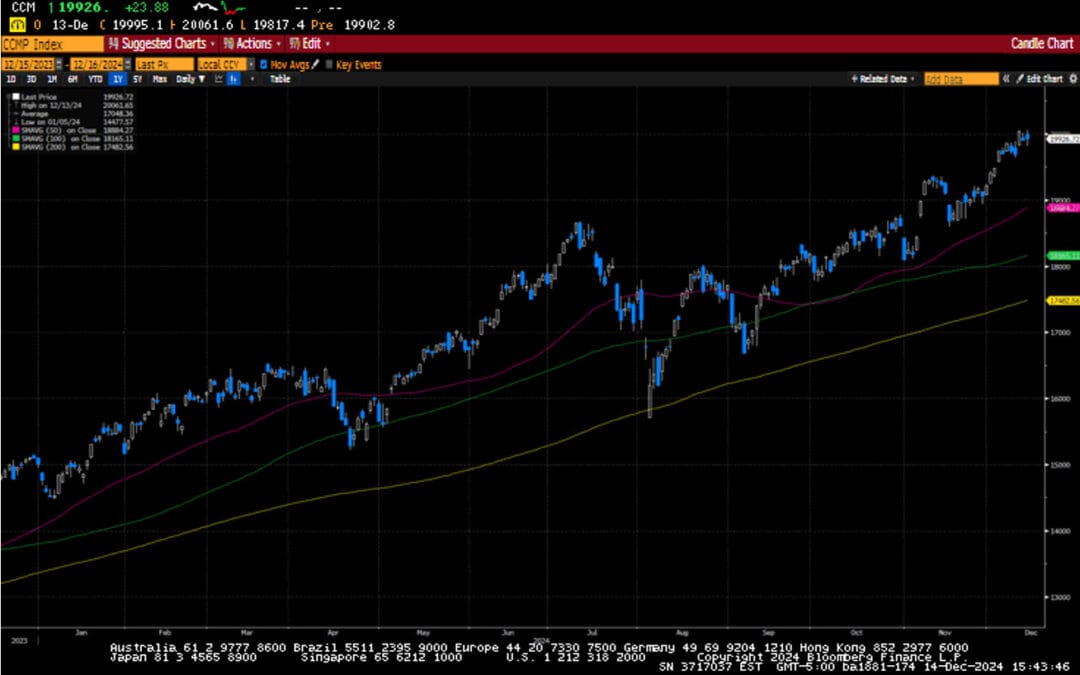
Weekly Market Commentary
-Darren Leavitt, CFA
The Nasdaq eclipsed the 20,000 level for the first time this week as investors reengaged in buying the mega-cap technology names. Amazon, Google, Tesla, and Meta hit new highs for the year as investors heard about more advances in AI and quantum computing. Google showcased advances in its quantum computing chip, Willow, while Broadcom reported stellar 3rd quarter results and announced it would work on a new AI chip for Apple. Market action was somewhat tempered by lackluster 3rd quarter results from Oracle and Adobe and by the announcement that Chinese authorities were investigating Nvidia for anti-competitive practices.
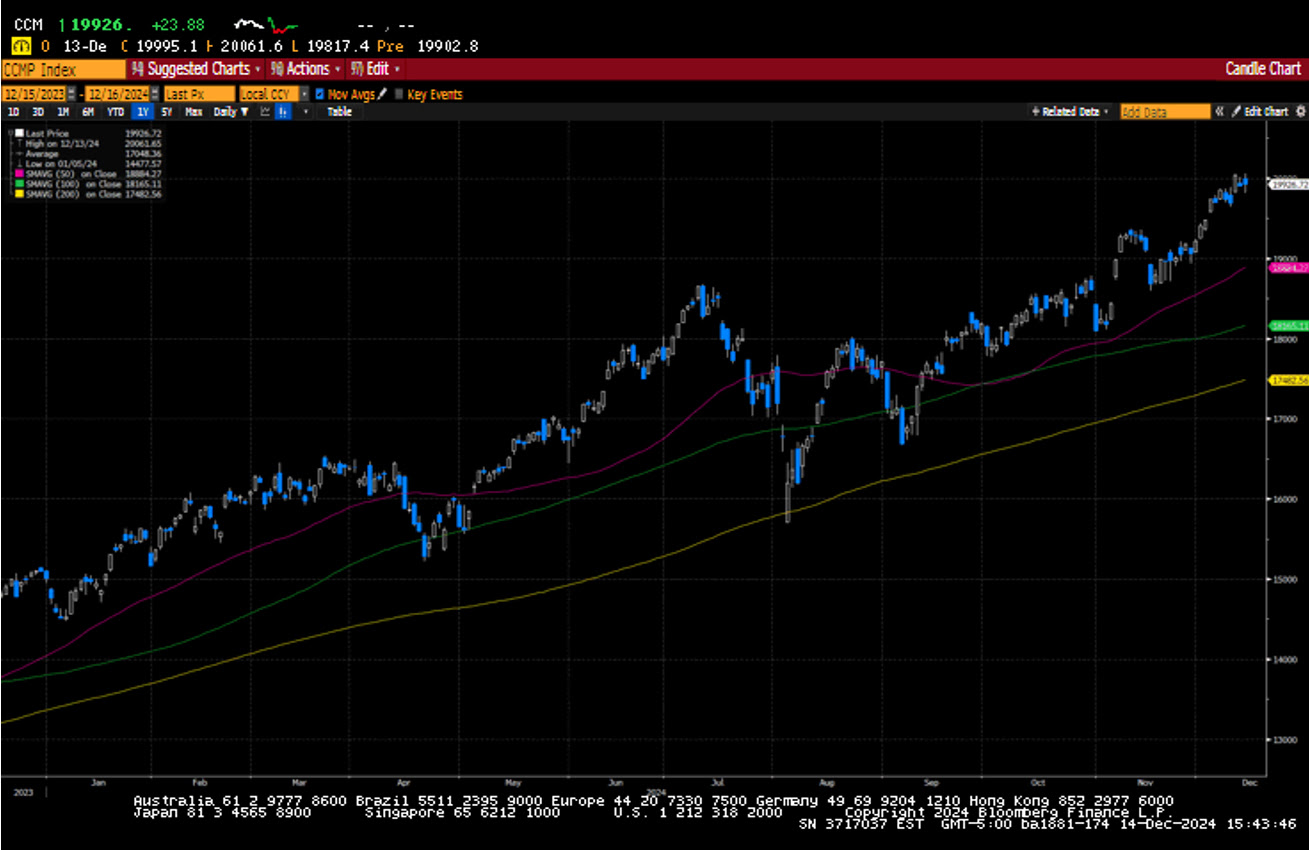
Sticky US inflation data and a softer print in initial claims did not change the market’s expectation that the Fed would cut by twenty-five basis points in next week’s FOMC meeting. The European Central Bank cut its policy rate by twenty-five basis points, while the Bank of Canada and the Swiss National Bank opted for a fifty-basis-point cut. Chinese officials announced more monetary easing and plans to boost domestic consumption, but investors were left with very few details. We are expecting the Fed to cut by twenty-five basis points but will be more focused on the Fed’s Summary of Economic Projections that may show the Fed curtailing rate cuts in 2025.
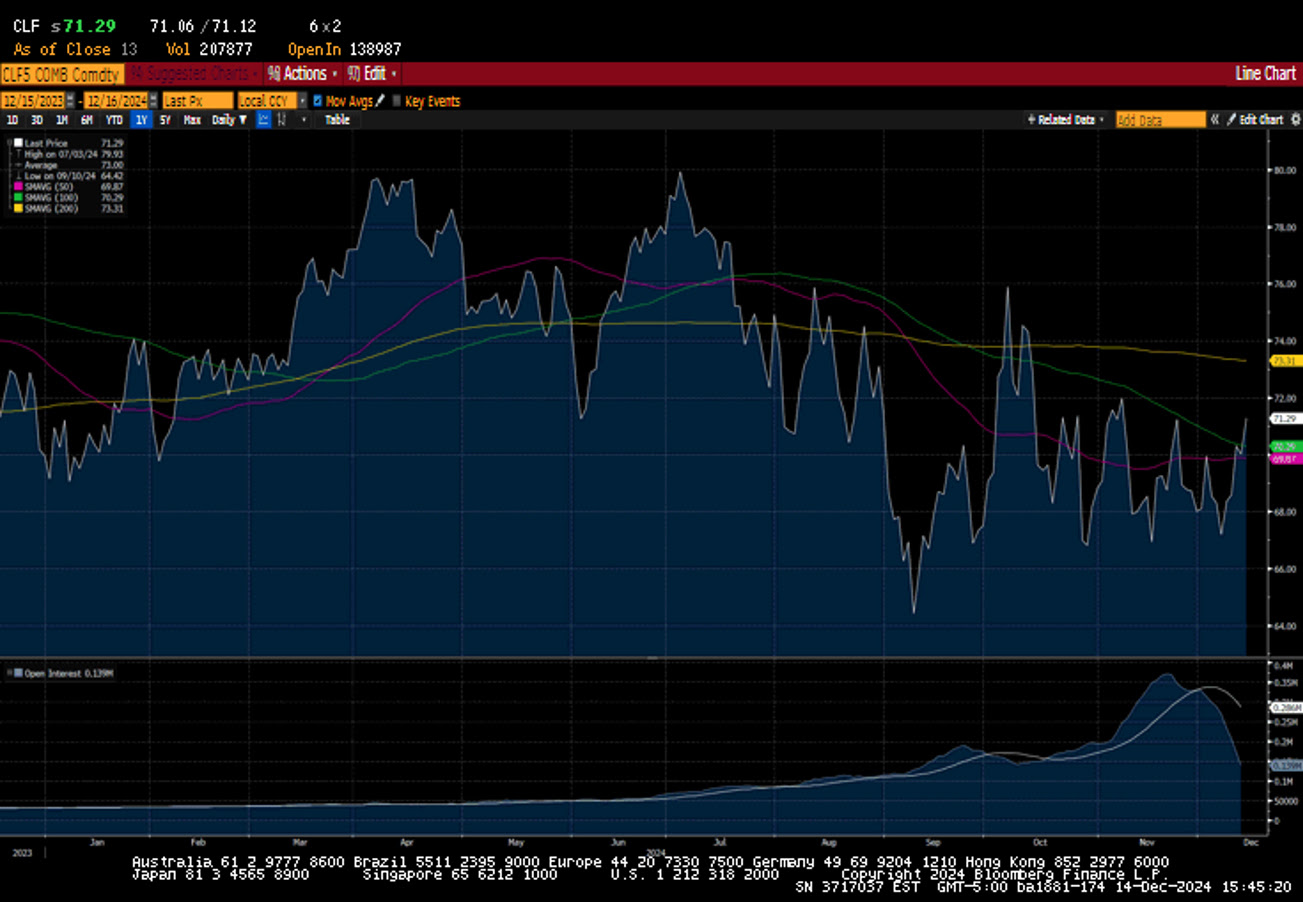
The S&P 500 lost 0.6%, the Dow fell by 1.8%, the Nasdaq gained 0.3%, and the Russell 2000 lagged, losing 2.6%. Interestingly, market breadth has been skewed toward more stocks losing than gaining over the last nine market sessions. This comes even as Wall Street Strategist projects more gains in 2025. Oppenheimer expects the S&P 500 to be at 7100 by the end of 2025, while Citi’s strategist sees a base case for 6500. US Treasuries had the worst week in a couple of months as yields moved higher across the curve. The 2-year yield increased by fourteen basis points to 4.24%, while the 10-year yield rose by twenty-five basis points to 4.40%. Oil was well-bid on the week, gaining over 6% or $4.12 to close at $71.29. Crude rose on the idea of tighter sanctions and more enforcement from President-elect Trump on Iran and Russia’s oil exports. Gold prices rose by $17.90 to $2676.70. Copper prices were unchanged on the week at $4.20. Bitcoin regained the $100,000 mark and closed at $101,200. The US Dollar index closed the week higher by 1% at 107.02. There was notable weakness in the Chinese Yuan after Chinese officials floated the idea of a weaker currency to address potential Trump tariffs.
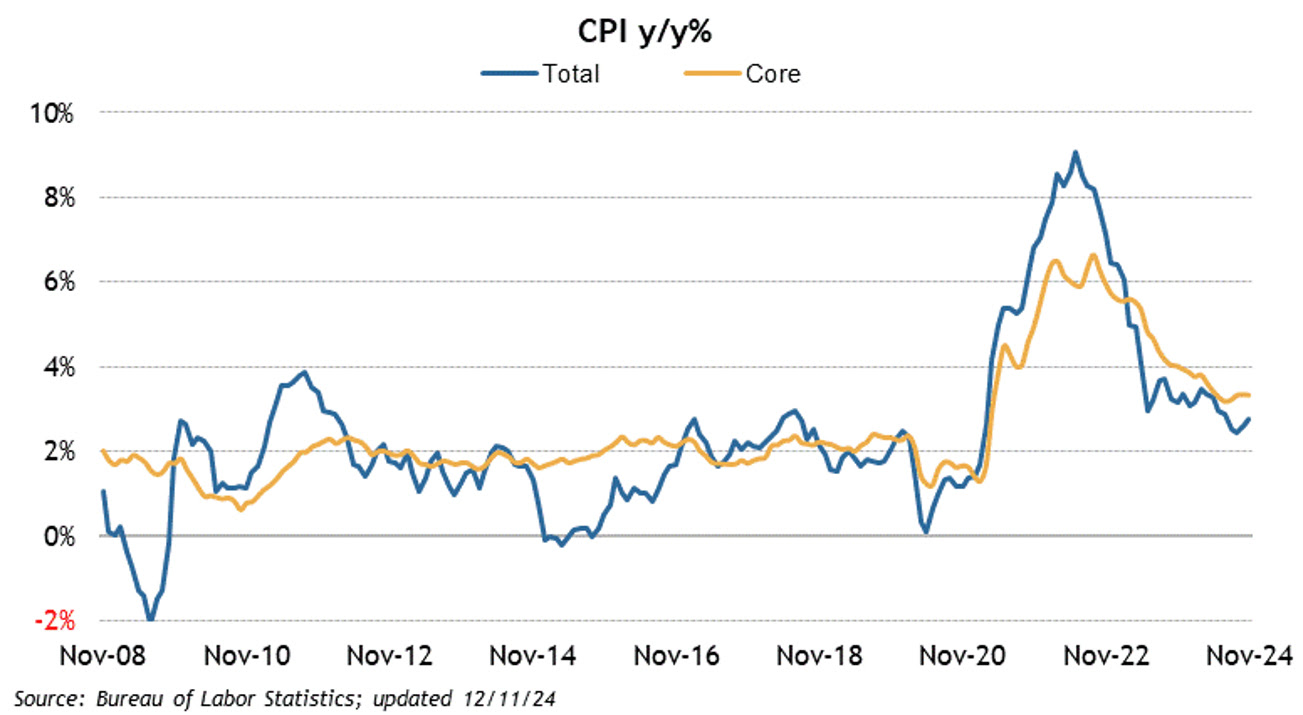
The economic calendar showed little progress on inflation. The Consumer Price Index (CPI) showed an increase of 0.3% in November, which was in line with the street’s expectations. The headline print was up 2.7% on a year-over-year basis, up from 2.6% in October. The Core reading, which excludes food and energy, was also up 0.3% and 3.3% year-over-year, unchanged from October. Notably, shelter prices rose at the smallest level since April of 2021. The Producer Price Index (PPI) increased by 0.4%, above the consensus estimate of 0.2%. On a year-over-year basis, prices rose 3% versus 2.6% in October. Core PPI rose 0.2%, in line with expectations, but rose 3.45% year-over-year, up from 3.37% in October. Food prices were the most significant contributor to the PPI reading. An uptick in Initial Claims caught investor’s eyes. The print increased by 17k over the prior week to 242k. Continuing Claims increased by 15k to 1.886M.
Investment advisory services offered through Foundations Investment Advisors, LLC (“FIA”), an SEC registered investment adviser. FIA’s Darren Leavitt authors this commentary which may include information and statistical data obtained from and/or prepared by third party sources that FIA deems reliable but in no way does FIA guarantee the accuracy or completeness. All such third party information and statistical data contained herein is subject to change without notice. Nothing herein constitutes legal, tax or investment advice or any recommendation that any security, portfolio of securities, or investment strategy is suitable for any specific person. Personal investment advice can only be rendered after the engagement of FIA for services, execution of required documentation, including receipt of required disclosures. All investments involve risk and past performance is no guarantee of future results. For registration information on FIA, please go to https://adviserinfo.sec.gov/ and search by our firm name or by our CRD #175083. Advisory services are only offered to clients or prospective clients where FIA and its representatives are properly licensed or exempted.

3 Big Retirement Rule Changes Are Coming in 2025—How They Could Affect Your Savings
Key Takeaways
- Some provisions related to the Secure 2.0, a federal retirement law, will go into effect in 2025.
- Workers ages 60, 61, 62, or 63 will be able to make catch-up contributions of up to $11,250 in 2025.
- Workplace retirement plans such as 401(k) and 403(b) plans must automatically enroll participants at a savings rate of 3% to 10%.
- And some beneficiaries of inherited IRAs will start incurring penalties for not taking distributions from their retirement accounts.
With the new year will come new retirement savings rules.
On Jan. 1, some new provisions of Secure 2.0, a federal retirement law, will take effect. These new rules could help you save more for retirement or force you to start withdrawing funds.
Here’s how they will affect your retirement savings and inheritance.
Older Workers Can Contribute Even More To Their Retirement Plans
Some older workers may be eligible to make larger catch-up contributions to their workplace retirement plans like 401(k)s and 403(b) thanks to new Secure 2.0 provisions,1
Workers who are ages 60, 61, 62, or 63 will be able to make catch-up contributions of up to $11,250 in 2025, compared to $7,500 for all other workers age 50 and older.2
Michael Griffin, a CFP at Henssler Financial, recommends that older workers who still want to save and have extra income to invest take advantage of the new rule.
“If you have the capacity to save additional money, we certainly suggest you do that,” said Griffin. “If you already have quite a lot of money in your retirement account, perhaps the additional catch-up contribution is not that beneficial for you.”
Employers Must Automatically Enroll Workers In Retirement Plans
New rules will also require 401(k) and 403(b) plans to automatically enroll workers unless they choose to opt out.
Workers must be enrolled at initial rates of 3% to 10%. After that, the savings rate is increased by one percentage point each year until it reaches at least 10%, though it is capped at 15%.
“We certainly have a saving problem in the U.S., where younger employees don’t want to contribute to retirement accounts,” said Griffin. “You [might] start saving at 3% and look at that [account] five years down the road and say ‘Wow, this is benefiting me.’”
While the policy is meant to encourage people to save for retirement, some Vanguard research indicates that automatic enrollment and increases may not benefit workers who frequently switch jobs and don’t stay long enough to experience the benefits of the increased savings rate.
Inherited an IRA? You’ll Need To Take Required Minimum Distributions
In the past, people who inherited IRAs from their parents or grandparents could let the investments in that account grow over time, deferring taxes and taking distributions when they chose. The Secure Act eliminated these “stretch IRAs,” requiring people to take distributions over a 10-year period instead.
“If someone receives money from a parent, or really, anyone other than their spouse, that’s when these new rules come into effect,” said Brett Koeppel, CFP and founder of Eudaimonia Wealth. Spouses who inherit IRAs can still take advantage of the “stretch IRA,” though.
The rule only applies to those who inherited IRAs from people who passed away in 2020 or later.3 The IRS recently provided clarification on how these distributions will be taken out.
Starting in 2025, non-spouse beneficiaries of inherited IRAs must take distributions from their account every year until the end of the 10-year period, when the account must be completely emptied, explained Rob Williams, managing director of Financial Planning at Charles Schwab.
And if someone fails to take a distribution from their inherited IRA by the deadline, they could be on the hook for a penalty worth up to 25% of the undistributed amount.4
https://www.investopedia.com/3-big-retirement-rule-changes-coming-2025-how-they-could-affect-your-savings-8742265
IRA Rollovers and Roth Contributions: Today’s Slott Report Mailbag
By Sarah Brenner, JD
Director of Retirement Education
Question:
Can a person do a rollover from both his traditional AND Roth IRAs in the same twelve months?
Best regards,
Matthew
Answer:
Hi Matthew,
The once-per-year rollover rule restricts an individual from rolling over more than one IRA distribution during a 365-day period. For purposes of this rule, traditional and Roth IRAs are aggregated. If you have both types of IRAs, you can only do one rollover from either the traditional IRA or the Roth in a one-year period.
Question:
I have a 60-year-old client who has the opportunity to contribute to a Roth 401(k). Is he permitted to contribute to both his Roth 401(k) and his Roth IRA? Are there limits?
Thanks for your help!
Linda
Answer:
Hi Linda,
To fully fund a Roth IRA, you must have earned income. Additionally, your modified adjusted gross income (MAGI) for 2024 must be under $230,000 if married filing jointly (or under $146,000 if filing single). If he meets these requirements, he can fund both the Roth 401(k) and the Roth IRA. Funding one does not affect the other.
https://irahelp.com/slottreport/ira-rollovers-and-roth-contributions-todays-slott-report-mailbag/
Who Must Take a 2024 RMD?
By Sarah Brenner, JD
Director of Retirement Education
The holidays are upon us. There is shopping to do, gifts to wrap, and parties to attend. Amidst the hustle and bustle of the season, you may be forgiven if your retirement account is not at the top of your mind. However, for some retirement account owners and beneficiaries, a very important deadline is looming. December 31 is the deadline to take 2024 required minimum distributions (RMDs) for many individuals.
Retirement Account Owners
Which IRA owners must take an RMD for 2024? If you have a traditional, SEP, or SIMPLE IRA and you are age 74 or older in 2024, you must take an RMD by the end of this year. Also, if you are age 74 or older and have funds in an employer plan such as a 401(k) and you are not eligible to take advantage of the “still-working” exception, you must take a 2024 RMD.
If you have reached age 73 in 2024, you catch a break. You do not need to take your 2024 RMD until April 1, 2025. However, if you wait until next year to take your 2024 RMD, you will need to take two RMDs in 2025 because you are required to take your 2025 RMD by December 31, 2025.
What if you have a Roth account? You are in luck! You are never required to take RMDs from your Roth account in your lifetime.
Retirement Account Beneficiaries
Many retirement account beneficiaries need to take their 2024 RMD by December 31. If you inherited a retirement account before 2020 and you are using the stretch provision under the old rules, you must take your 2024 RMD by the end of the year. Also, if you inherited an account in 2020 or later and you are an eligible designated beneficiary (EDB), you must take an RMD by the end of 2024.
Although Roth accounts are not subject to an RMD requirement while the owner is alive, annual RMDs do apply to Roth beneficiaries who inherited before 2020 and to Roth IRA EDBs who inherited in 2020 or later and chose the stretch option.
Beneficiaries who are subject to both the 10-year rule under the SECURE Act and the final RMD regulations requirement that annual RMDs must be taken during it do not have to take an RMD for 2024. Due to all the confusion over these rules, the IRS has again waived the RMD requirement within the 10-year period. This waiver only applies to this specific group of beneficiaries and only applies for 2024. Going forward, beginning next year, if you are in this situation, you must take those annual RMDs during the 10-year period.
Don’t Delay
You may be thinking it is still early in December, so I have plenty of time to take my 2024 RMD. Do not delay! Many financial organizations have cutoff dates for processing transactions for 2024 that are much earlier than December 31. Add in end of the year staff vacations and waiting until the last minute to take your 2024 RMD is a recipe for trouble. Failing to take your RMD will result in a 25% penalty. Get it done now and enjoy the holidays!
https://irahelp.com/slottreport/who-must-take-a-2024-rmd/
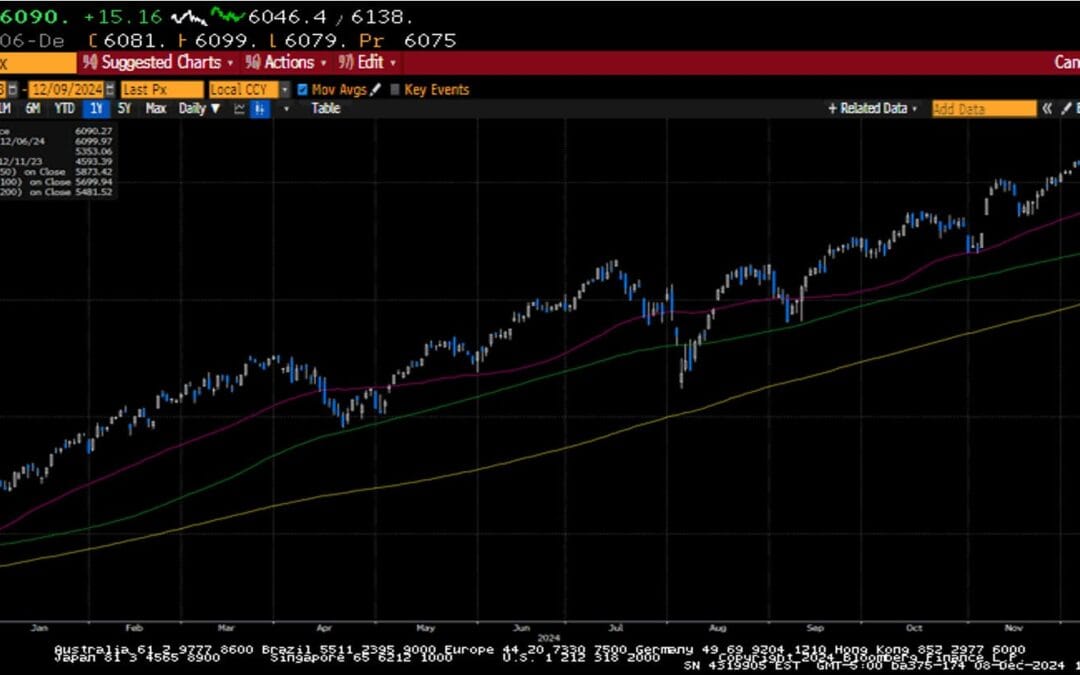
Weekly Market Commentary
The S&P 500 forged another set of all-time highs as investors embraced the idea of an economy running at a pace appropriate for the Fed to consider further rate cuts. Leadership in the market toggled back to the mega-cap technology issues, with the communication services, information technology, and consumer discretionary sectors leading the way. Salesforce.com’s 3rd quarter results reminded the street of the enormous opportunity in AI with an encouraging outlook from the software provider. President-elect Trump continued to define his administration and policy with the nomination of Kash Patel as FBI director and warning BRIC nations of dismantling the US dollar as the world’s reserve currency. Trump also insisted that the hostages in Gaza be released just as the ceasefire between Israel and Hezbollah appeared to be falling apart.
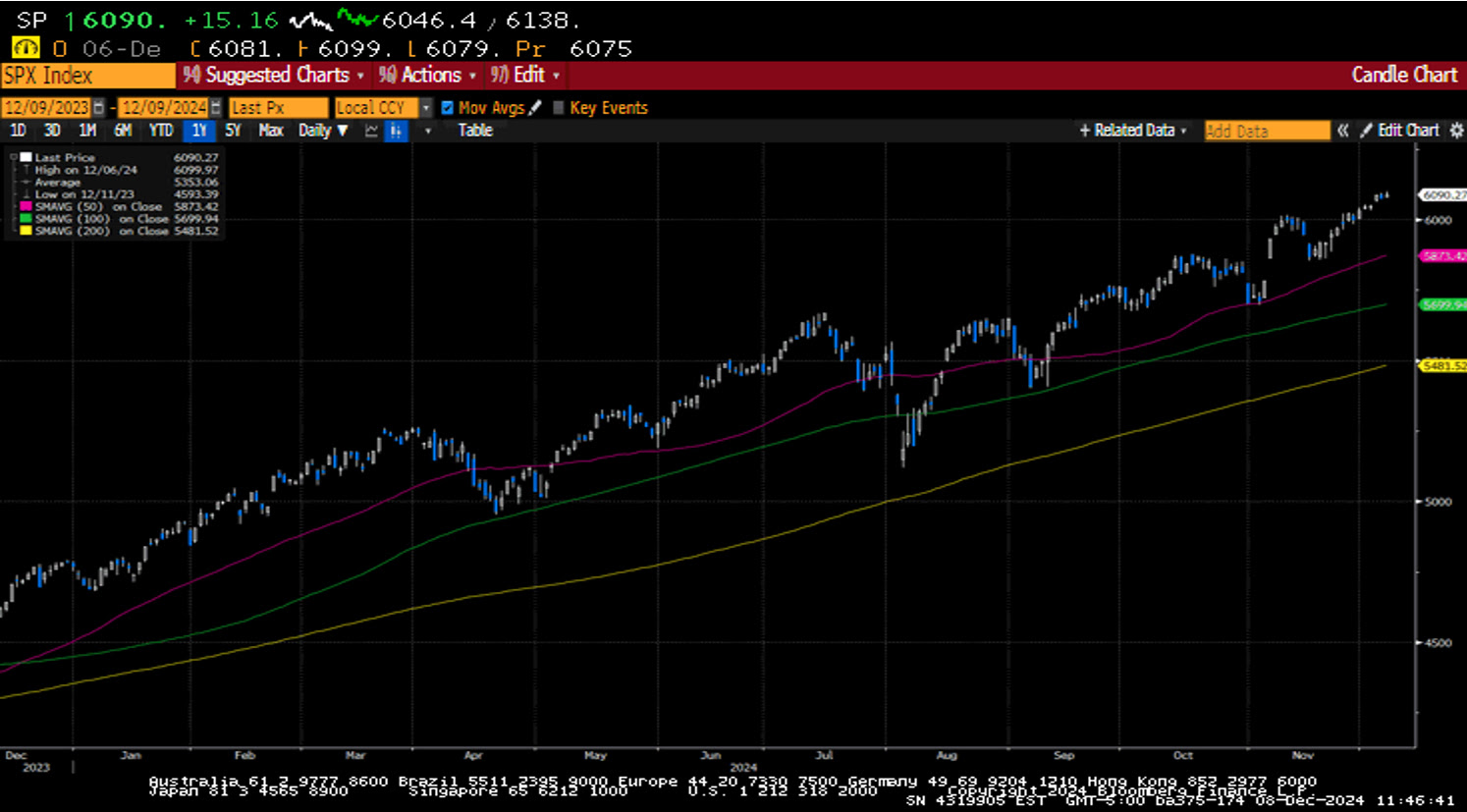
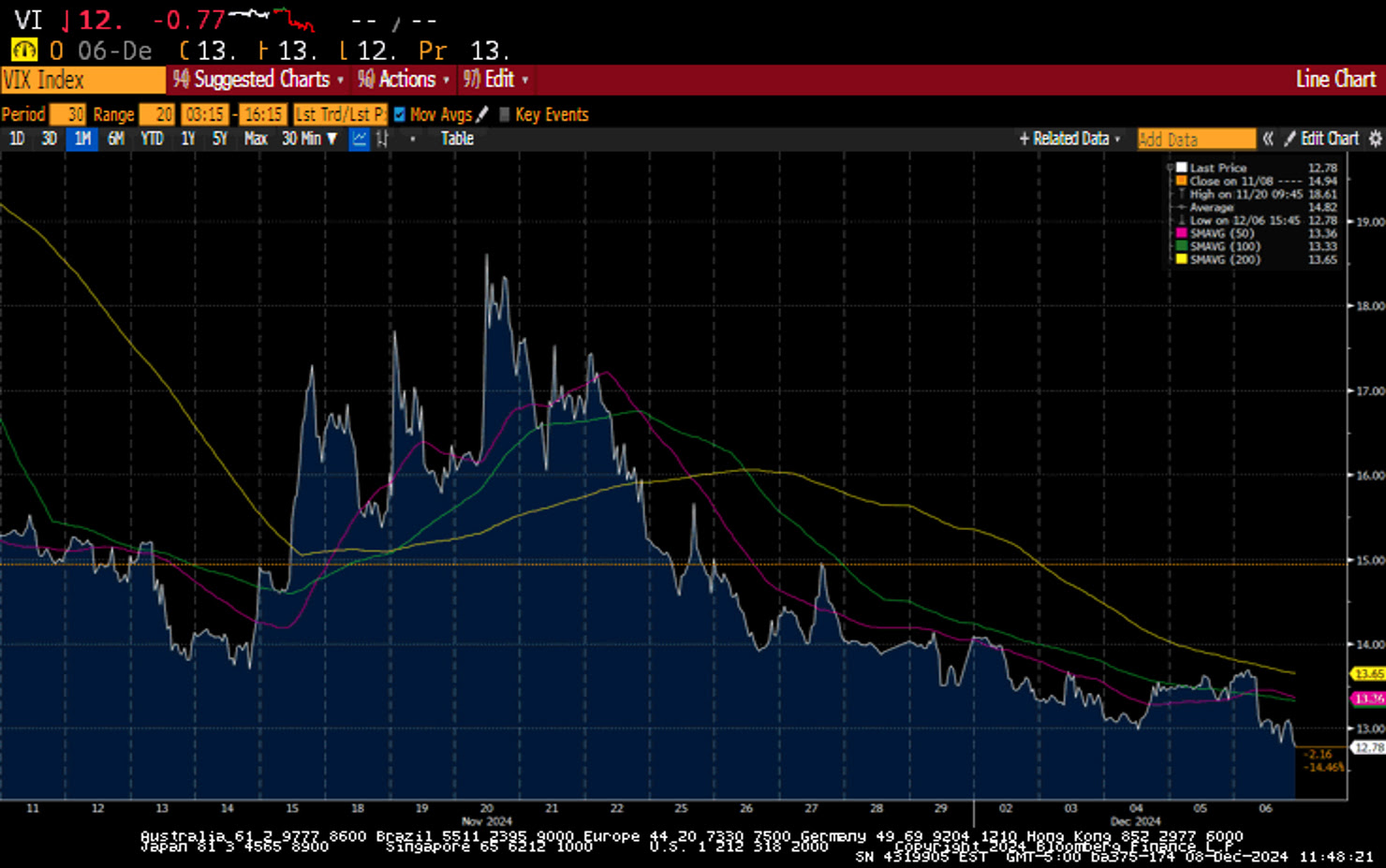
The S&P 500 gained 1% and is now up 27.7% for the year. The Dow closed lower by 0.6%; the NASDAQ outperformed, returning 3.3% and the Russell 2000 fell by 1.1%. US Treasuries ended the week higher across the curve as the 2-year yield fell by six basis points to 4.10%, and the 10-year yield fell by three basis points to 4.15%. Oil prices fell by $1.28 or 1.9% to $67.17 as OPEC + stayed the course with their production outlook. Gold prices fell fractionally to close at $2658.90. Copper prices rose by $0.06 to $4.20 per Lb. Bitcoin regained the $100k mark before closing at $99,400 on Friday. The US dollar index gained 0.3% and closed at 106.09. Notably, the VIX, a measure of market volatility, closed at 12.72, down 37% from just before the US Presidential election.
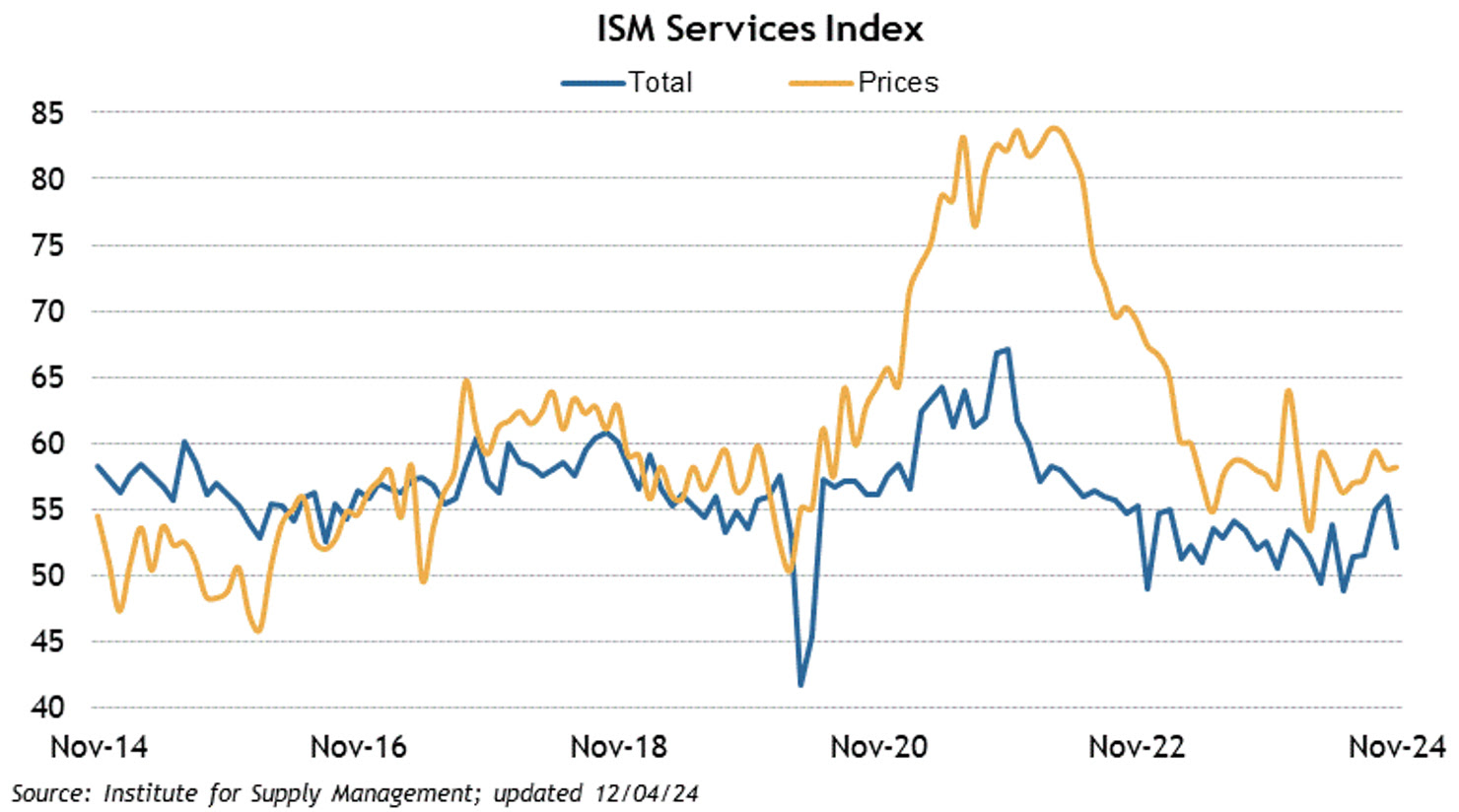
The Economic calendar showcased the November Employment Situation Report, which showed a bounce back in payrolls. Non-farm payrolls increased by 227k versus the street consensus of 220k. Private payrolls increased by 194k versus the consensus estimate of 190k. The Unemployment rate ticked higher by 0.1% to 4.2%. Average Hourly earnings came in at 0.4% above the previous print of 0.3%. The data aligned with expectations and strengthened the argument that the Federal Reserve will cut their policy rate by twenty-five basis points at their December 18th meeting. ADP employment figures, Initial Claims, and Continuing Claims continued to show a resilient labor market. ISM Manufacturing came in at 48.4, above the prior reading of 46.5, but still showed that part of the economy was in contraction. ISM Non-Manufacturing came in at 52.1, which was much weaker than the prior reading of 56. Finally, a preliminary look at the University of Michigan’s Consumer Sentiment Index saw a nice uptick to 74 from the previous reading of 71.8.
Investment advisory services offered through Foundations Investment Advisors, LLC (“FIA”), an SEC registered investment adviser. FIA’s Darren Leavitt authors this commentary which may include information and statistical data obtained from and/or prepared by third party sources that FIA deems reliable but in no way does FIA guarantee the accuracy or completeness. All such third party information and statistical data contained herein is subject to change without notice. Nothing herein constitutes legal, tax or investment advice or any recommendation that any security, portfolio of securities, or investment strategy is suitable for any specific person. Personal investment advice can only be rendered after the engagement of FIA for services, execution of required documentation, including receipt of required disclosures. All investments involve risk and past performance is no guarantee of future results. For registration information on FIA, please go to https://adviserinfo.sec.gov/ and search by our firm name or by our CRD #175083. Advisory services are only offered to clients or prospective clients where FIA and its representatives are properly licensed or exempted.
The Still-Working Exception and Roth Conversions in an RMD Year: Today’s Slott Report Mailbag
By Ian Berger, JD
IRA Analyst
Question:
If you continue to work past age 73, are you exempt from required minimum distributions (RMDs)? My 73 year-old wife is still working and contributing to her company’s 401(k), and she doesn’t own more than 5% of the company. Is she required to take out any RMD?
Could you please clarify this rule for me? Thank you.
Answer:
Assuming your wife’s plan allows it (most do), she can defer RMDs until her retirement under the “still-working exception.” That exception is not available for anyone who owns more than 5% of the company maintaining the plan. Even though she can defer RMDs from her 401(k), your wife must still take RMDs from any IRA starting this year.
Question:
I have a question about the new rule that requires that all IRA required minimum distributions (RMDs) must be satisfied prior to doing a Roth IRA conversion.
If the only RMD I have to take is from an inherited IRA (I am only 65 years old), then does this rule come into play? I was planning on doing my Roth conversion early in January 2025, but the RMD from my inherited IRA can’t easily be taken until April 2025 (when my CDs mature). Does this rule apply to inherited IRA RMDs?
Thanks,
Brian
Answer:
Hi Brian,
Good question! No, the rule requiring that RMDs from all IRAs must be taken before a Roth conversion (or 60-day rollover) is done only applies to your own IRAs — not IRAs that you have inherited. So, you can do the Roth conversion before you take the RMD from your inherited IRA.
https://irahelp.com/slottreport/the-still-working-exception-and-roth-conversions-in-an-rmd-year-todays-slott-report-mailbag/

Retirement Vs. Resignation: Which Is Better?
Retirement Vs. Resignation: Which Is Better?
There is a big difference between retirement and resignation. However, both involve leaving your place of work. If you choose to retire, you may be entitled to some social benefits such as pension and healthcare, which can typically vary significantly with organizations. In addition, you need to have attained a certain age or have served for a specific duration to retire. On the other hand, to resign means you voluntarily quit your job, and as a result, you’re not entitled to the same benefits as a retiree.
What is Retirement
If you choose to retire, it means you are leaving your job and will no longer be a full-time employee of your former employer. Typically, your age and the time you’ve worked in the organization may dictate your retirement. Companies have a retirement age for their employees; when you’ve attained this age, you are free to retire. However, if, for instance, you’ve suffered an injury and cannot perform your duties as you should, you may also be required to retire.
You must write a resignation letter and complete a formal retirement application. If you’ve worked in the organization for a long time, giving the company some notice before you retire is a good idea. After retirement, you are entitled to social benefits like insurance and healthcare for a specific period. You will also be entitled to the money you saved during your career as a pension.
Your retirement eligibility depends on different factors that can vary from one company to another. People plan for retirement years in advance, and companies have policies you need to initiate in advance, which could be several months before the retirement date.
Process of Retirement
You need to follow specific steps in your retirement process, which can vary from company to company. However, the general process would take the following format.
1. Verbally inform your boss about your retirement.
2. Make a written letter to your boss and copy the same to the company’s human resource department.
3. Inform your coworkers about your retirement
4. Share your plans to retire with your family, friends, and clients
5. Share the same information on your social media
Contents of the Retirement Letter
A retirement letter is a formal notice of your retirement and should include details like the retirement date and personal information. Remember to put your letter in a cheerful voice, which should be short and formal. Having only three paragraphs is ideal because the only purpose of the letter is to announce your retirement. Have a short part in the letter where you express gratitude or thank your colleagues and the company.
- Paragraph 1- About your retirement date
- Paragraph 2 – Highlight your career and express gratitude
- Paragraph 3 – Express your gratitude or thank your coworkers and the company for the support they gave you and what you’re looking forward to in your retirement
The essential point is to formally inform your boss and the HR department about your retirement plans. You can have your retirement party if you choose to celebrate
What is Resignation
Resignation means you’ve opted to leave your job voluntarily. The reason for leaving could be that you have found a better job or don’t like the company. Alternatively, maybe you want to take a break from working. Depending on your situation, resignation could be temporary or permanent. For example, some may resign from their job to take a year off, only to decide they do not want to return to work. Therefore, you can take a temporary resignation, which extends to a permanent one.
Process of Resignation
It is a straightforward process if you decide to resign from your job. Most companies will require you to write a signed resignation letter and forward it to your employer. Typically, people give notice in their resignation letters that range between two weeks and one month.
From employee experience, you need to discuss with your financial advisor the drawbacks, such as losing health insurance. You need to ask yourself if it’s the right decision to resign if you do not have any other source of income. Remember you still have to pay all the bills. It is critical to remember that without health insurance, life can be challenging.
Which One is Better
When considering retirement vs resignation, both possibilities involve leaving your job; however, there are some benefits you’re entitled to get when you retire instead of resigning. If you’ve reached retirement age, the best option would be to retire instead of resigning.
Most people who have attained retirement age often choose to retire to enjoy the benefits that come with retirement. However, if you resign, even if you have reached retirement age, you will not be eligible for benefits such as pension benefits or health insurance.
You need to assess your situation and decide the best option for your case. A financial advisor will guide you to make an informed decision.
After Retirement
After retirement, most people take up part-time jobs. Retirees are often healthy and can work; some may choose volunteer work. Most people want to take time to relax and get part-time jobs or casual work after some time, often after several months. You can also consider working from home because there are many jobs you can do remotely working from home.
If you choose to retire due to disability, finding work that suits your pace and abilities is still possible. Finding part-time work after retirement can help supplement your income so that you don’t have to use much of your savings immediately. Additionally, it’s a great way to have something that occupies your time.
Key Takeaways
Retirement and resignation are often options that come to mind for anyone at one point in time, and both involve quitting your job. You will not get social benefits like health insurance if you choose to resign. However, if you choose to retire, you will enjoy these benefits.
Additionally, you have to assess your situation and use the services of a financial advisor to decide which option best suits your situation. Whether you retire or resign is up to you and depends on your unique situation.
https://www.qualee.com/blog/retirement-vs-resignation-which-is-better
QCD Timing
By Andy Ives, CFP®, AIF®
IRA Analyst
Year after year, this topic continues to bubble up. Confusion exists over when a QCD can be done in relation to the RMD. Qualified charitable distributions (QCDs) can offset all or a portion of an RMD (required minimum distribution). However, for whatever reason, the sequencing of these items (QCDs and RMDs) confounds people. Let’s set the record straight, starting with some QCD fundamentals:
- QCDS are only available to IRA owners who are age 70½ and over.
- For 2024, the QCD cap is $105,000. (This cap increases to $108,000 in 2025.)
- QCDs cannot be done from employer plans – like a 401(k).
- Yes, QCDs can be done from an inherited IRA if the owner is 70 ½ or older. (It does not matter how old the now-deceased previous owner was.)
- Donations paid directly from an IRA to an eligible charity may be excluded from income. However, there can be no benefit back to the taxpayer.
That’s the easy part. This next section is where the confusion starts:
A popular recommendation is to execute a QCD early in the year to avoid any conflict with the “first-dollars-out rule.” The first dollars withdrawn from an IRA are deemed to count toward the RMD. Once an RMD is taken, it cannot be retroactively offset with a later QCD. Hence the advice to do your QCDs early to avoid this mistake.
Example: John is 75 in 2024. The RMD on his IRA is $5,000. John committed to his church that he would gift this full amount. Prior to doing any QCDs, John takes a $2,000 distribution from his IRA in January 2024 to help pay the credit card bills from the previous holiday. Now it is December 2024. John informs his advisor that he would like to offset his entire RMD with a QCD. John cannot retroactively offset the $2,000 he took back in January. That $2,000 will be taxable. Since John has $3,000 remaining on his 2024 RMD, he has a handful of QCD options:
- John can do a $3,000 QCD to his church to offset the remaining portion of his RMD, but this would leave him short of his donation commitment.
- To meet his commitment, John can still do a $5,000 QCD to his church. This will result in $7,000 being withdrawn from his IRA for the year. This is perfectly acceptable, assuming John is willing to withdraw more than his RMD.
- In fact, John could do a QCD of $105,000 to his church. The total QCD amount is NOT limited to the RMD amount. The end result would be $107,000 distributed from his IRA, with only $2,000 being taxable to John.
The point is that QCDs can be done at any time throughout the year. QCDs can also be done after all or a portion of the RMD has already been taken. The only reason it is suggested to do QCDs early is to avoid what John did – mistakenly take a taxable distribution that cannot be retroactively offset with a future QCD.
End Note: Since 2024 is coming to a close, there is another reason to do QCDs early: Some IRA accounts allow check-writing privileges. Checks written to a charity from a “checkbook IRA” qualify as a valid QCD. However, the custodian may not recognize the distribution until the check is cashed! That could be in early 2025…and then we have problems.
https://irahelp.com/slottreport/qcd-timing/
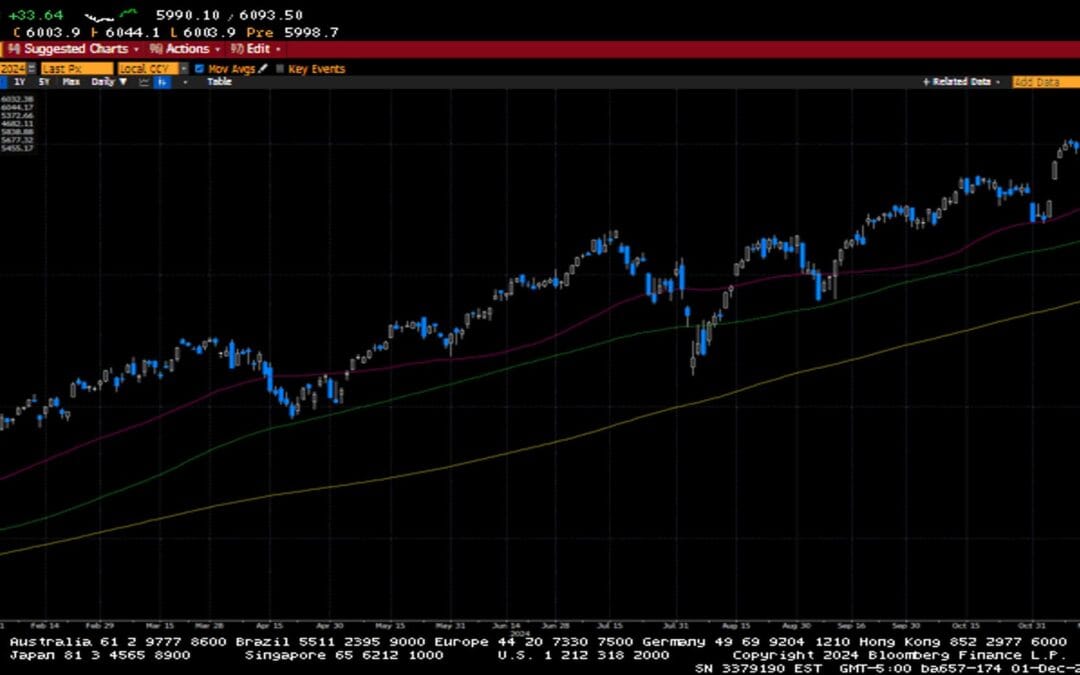
Weekly Market Commentary
-Darren Leavitt, CFA
The holiday-shortened week saw the S&P 500 and Dow rise to new all-time highs. Investors cheered the nomination of Scott Bessent as Treasury Secretary, who is seen as a fiscal hawk and someone who will support Trump’s trade policies. US Treasuries rallied significantly on the idea of fiscal restraint. Markets were tested on the announcement that Trump plans to place an additional 10% tariff on Chinese goods while imposing a 25% tariff on goods from Mexico and Canada. The news catalyzed the leaders of Mexico and Canada to come to the table to strengthen policy on immigration and border security. A ceasefire agreement between Israel and Hezbollah was also constructive for the broader market, even as the war premium in oil faded. The 60-day agreement will likely be tested, and everyone recognizes this is a complicated situation that will require an extension of the timeline to find a comprehensive resolution. Third-quarter results posted this week from Dell, Hewlett Packard, Crowdstrike and Macy’s were disappointing.
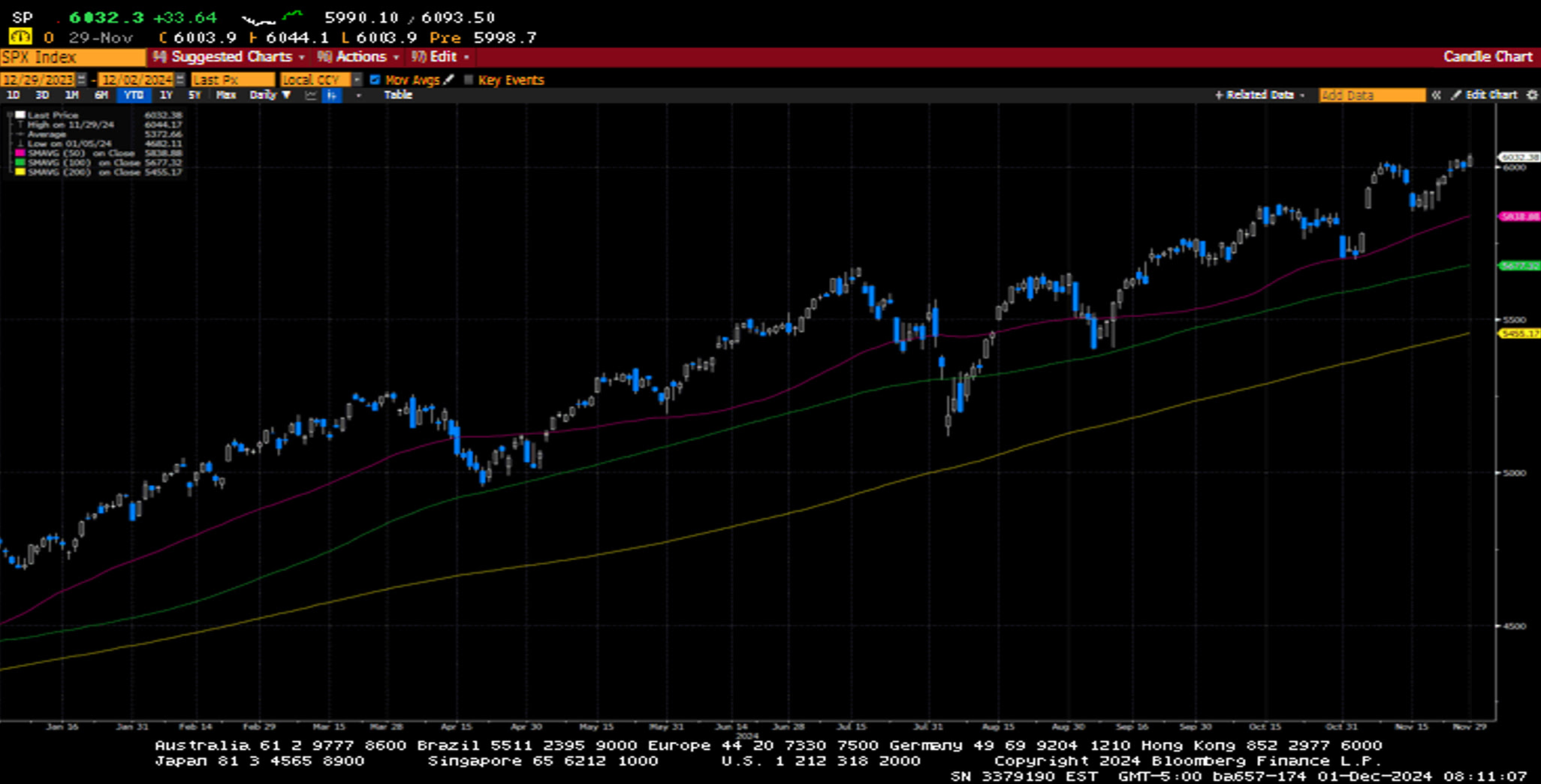
The S&P 500 gained 1.4%, the Dow added 1.7%, the NASDAQ increased 1.4%, and the Russell 2000 rose 1.4%. US Treasuries had a fantastic week of gains. The 2-year yield fell by twenty-one basis points to 4.16%, while the 10-year yield decreased by twenty-three basis points to 4.18%. Oil prices tumbled 4% or $2.83 to close at $68.45 a barrel. Gold prices fell 1.2% to close at $2678.10 an Oz. Copper price increased by five cents to $4.14 per Lb. Bitcoin fell by ~$900 to close at $96,600. The US Dollar index fell for the first time in eight weeks by 1.6% to 105.80.
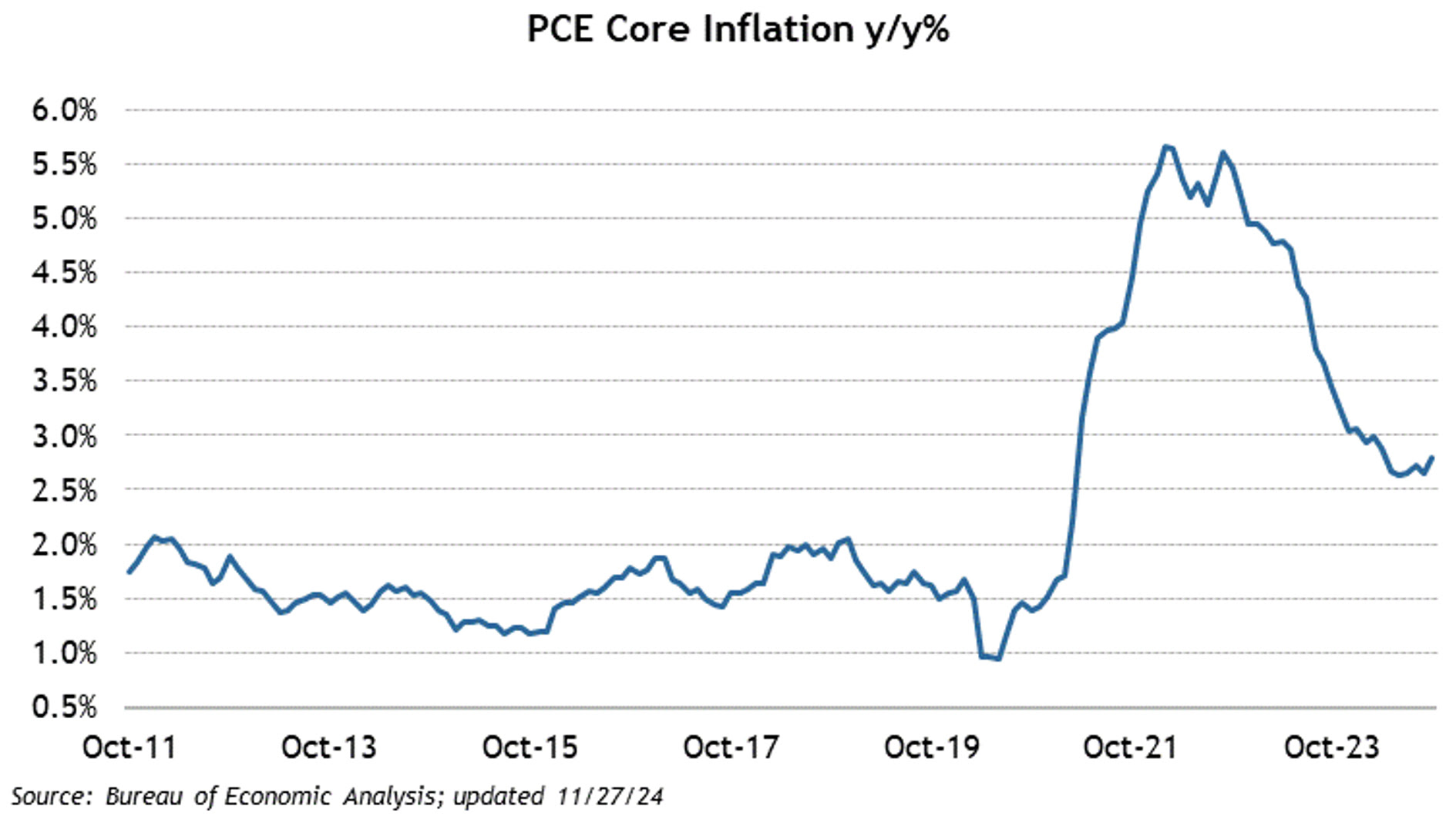
The economic calendar featured the Fed’s preferred measure of inflation, the PCE, which showed little progress on inflation. Headline PCE for the month of October came in line with expectations at 0.2% but, on a year-over-year basis, ticked to 2.3% from 2.1% in September. The core reading that excludes food and energy came in at 0.3%, which is also in line with the street’s expectations but rose 2.8% on a year-over-year basis, up from 2.7% in September. Notably, the price index for services rose to 3.9% in October from 3.7% in September. The data could provide the Fed some cover if it decides to hold rates at the current level at the December FOMC meeting. Fed Fund futures currently ascribe a 66% probability of a twenty-five basis point rate cut on December 18th. Personal Income increased by 0.6%, while Personal Spending rose by 0.4%. New Home Sales fell short of the consensus estimate at 610k. Consumer Confidence came in at 111.7, well above the prior reading of 109.6. The 2nd estimate of Q3 GDP came in at 2.8%, while the forecast for the GDP deflator came in at 1.9%. Initial Claims were unchanged at 213k, while Continuing Claims increased by 9k to 1907k.
Investment advisory services offered through Foundations Investment Advisors, LLC (“FIA”), an SEC registered investment adviser. FIA’s Darren Leavitt authors this commentary which may include information and statistical data obtained from and/or prepared by third party sources that FIA deems reliable but in no way does FIA guarantee the accuracy or completeness. All such third party information and statistical data contained herein is subject to change without notice. Nothing herein constitutes legal, tax or investment advice or any recommendation that any security, portfolio of securities, or investment strategy is suitable for any specific person. Personal investment advice can only be rendered after the engagement of FIA for services, execution of required documentation, including receipt of required disclosures. All investments involve risk and past performance is no guarantee of future results. For registration information on FIA, please go to https://adviserinfo.sec.gov/ and search by our firm name or by our CRD #175083. Advisory services are only offered to clients or prospective clients where FIA and its representatives are properly licensed or exempted.

6 End-of-Year Retirement Deadlines You Shouldn’t Miss for 2024
Navigate these tax and retirement milestones to optimize savings and avoid penalties.
Staying on top of year-end tasks helps you avoid penalties and take full advantage of tax benefits.
Key Takeaways
- Contributions to retirement accounts like 401(k)s must be made by Dec. 31, while contributions to individual retirement accounts and SEP IRAs can be made until the tax filing deadline in April 2025.
- Required minimum distributions must be taken by Dec. 31 to avoid penalties, but first-time RMD takers have until April of the following year.
- Roth IRA conversions must be completed by Dec. 31, while recharacterizations back to a traditional IRA have an extended deadline of Oct. 15 of the following year.
- Retirement savers over 50 can make catch-up contributions, with deadlines tied to tax filing.
- Charitable contributions must be made by Dec. 31 to qualify for deductions.
The end of the year brings several deadlines that could be costly for investors to overlook. Chief among them are tax-related deadlines for retirement account contributions and capital gains harvesting.
Staying vigilant about these year-end tasks saves you money in penalties for missed deadlines and helps you utilize the benefits of the tax code. These year-end retirement deadlines include:
- Qualified account contribution deadlines
- Mandatory withdrawal deadlines
- Deadlines for conversion or recharacterization
- Deadlines for catch-up contributions
- Deadline for charitable contributions
- Medicare and Social Security deadlines
Qualified Account Contribution Deadlines
If you plan to contribute to your employer-sponsored 401(k) plan, the deadline is Dec. 31.
However, if you intend to contribute to an individual retirement account, you have until the tax filing deadline in April 2025.
If you are a business owner and would like to set up a simplified employee pension, or SEP IRA, that deadline is also April 2025, said Stefan Greenberg, managing partner at Lenox Advisors in Stamford, Connecticut, in an email.
“If you plan to contribute to a solo 401(k), your employee contributions need to be made by Dec. 31, but the employer contributions can be made before the business files their taxes,” Greenberg said.
Mandatory Withdrawal Deadlines
One of the most important year-end withdrawal deadlines concerns required minimum distributions from IRAs. Those withdrawals must be made before Dec. 31 or the account owner faces a penalty.
Signed into law in December 2022, the SECURE 2.0 Act reduced the penalty for a missed RMD or incomplete withdrawal to 25% from 50%, and the penalty may be reduced to 10% if the mistake is corrected within two years.
A U.S. House of Representatives Ways and Means Committee report from March 2022 found that many failures to take an RMD are inadvertent rather than attempts to avoid taxation. The committee said it wanted to take steps to reduce the penalty on retirement savers who attempt to correct an honest mistake.
“If this is your first time taking an RMD, you get a little extra time,” Greenberg said. “You can take your distribution by April of the following year. Your RMDs thereafter would adhere to the Dec. 31 deadline.”
Deadlines for Conversion or Recharacterization
The deadline for converting a traditional IRA to a Roth IRA is Dec. 31.
A Roth conversion involves transferring funds from a traditional IRA or 401(k) to a Roth account, with the converted amount subject to income tax. Investors use this strategy to benefit from tax-free withdrawals in retirement.
According to brokerage Fidelity, a Roth recharacterization typically occurs for one of three reasons:
- An investor wants the tax deduction from a traditional IRA.
- An investor wants tax-free earnings from a Roth.
- An investor’s income is too high to qualify for a Roth.
The timetable for recharacterizing a Roth IRA contribution back to a traditional IRA contribution differs from some of the other retirement account cutoff dates.
“The deadline for recharacterizing a Roth IRA contribution back to a traditional IRA contribution is Oct. 15 of the year following the year in which you need to make the adjustment,” said Aaron Cirksena, founder and CEO of MDRN Capital in Annapolis, Maryland, in an email.
Deadlines for Catch-Up Contributions
According to the Internal Revenue Service, retirement savers who are age 50 or older at the end of the calendar year can make annual catch-up contributions.
The catch-up contribution limit for 401(k) and similar employer-sponsored plans is $7,500 in 2024.
The IRS allows catch-up contributions of up to $1,000 to your traditional or Roth IRA. Catch-up contributions to an IRA are due by the due date of your tax return in April or in October for those who extend their tax filing.
Deadline for Charitable Contributions
These days, fewer Americans itemize their taxes, but it’s still possible to deduct up to 60% of adjusted gross income when you make a cash donation to a qualified charity. If you donate appreciated securities, you may be able to deduct 30%.
However, you must make contributions by Dec. 31 to get those deductions.
If you don’t itemize your taxes, you could still get the deduction using a strategy called bunching. That involves clustering charitable deductions in a single year, then skipping the following year or even a few subsequent years.
According to Fidelity, “This strategy can work well when your total itemized deductions for a single year fall below the standard deduction. Charitable contributions for several years made at once may allow the total of itemized deductions to exceed the standard deduction, making it possible to obtain a tax deduction for at least part of the charitable contributions.”
Medicare and Social Security Deadlines
The enrollment period for Medicare begins three months before you turn 65 and ends three months after your 65th birthday.
The open enrollment period runs from Oct. 15 through Dec. 7. “You can apply during this time if you missed the initial enrollment period, but keep in mind you may have to pay a late enrollment penalty,” said Kendall Meade, a certified financial planner at San Francisco-based SoFi, in an email.
Social Security has no particular deadlines pegged to the year’s end. New recipients can apply for their Social Security retirement benefits up to four months in advance and begin receiving benefits as early as age 62, said Meade.
“The Social Security Administration will reduce your benefit if you do not wait until full retirement age, which is 67 for most,” she added. “Some people may choose to delay until age 70 to receive the maximum benefit. There is no benefit to waiting past age 70.”
Related:
Reasons to Take Social Security Late at Age 70
Importance of Adhering to These Deadlines
Adhering to end-of-year investing and tax deadlines is crucial if you want to maximize the benefits of saving and minimize penalties.
By taking action in a timely fashion as required by tax law, you can capitalize on investment opportunities. You’ll also avoid missed contributions that could impact your financial health in the long term.
https://money.usnews.com/money/retirement/401ks/articles/year-end-retirement-planning-deadlines
What We Are Thankful for at The Slott Report
Sarah Brenner, JD
Director of Retirement Education
Each year it is a Thanksgiving tradition here at the Slott Report to take a moment to give thanks for the rules that are helpful to retirement savers. There are many times when rules governing retirement accounts can seem illogical, confusing, and maybe even unfair. However, there are other rules that work well and give us the tools necessary to not only save for a secure retirement but maybe even get a few tax breaks along the way.
Here are a few retirement account rules for which we are thankful in 2024:
All Things Roth! – Who doesn’t love tax-free savings? With Roth accounts, qualified distributions in retirement are tax-free. The Roth IRA first became available in 1998. Since then, Roth savings opportunities have grown. Roth employee deferrals are now common, Roth employer contributions accounts are now available, and millions of retirement savers have done Roth conversions. Roth savings continue to grow under the recent SECURE Act and SECURE 2.0 and for this we are thankful.
New Rules for Spouse Beneficiaries – Believe it or not we are feeling thankful for the IRS. The SECURE 2.0 Act upended the rules for spouses who inherit retirement accounts and left confusion in its wake. This year the IRS stepped in and provided some much-needed guidance. The recently released regulations provide unexpected clarity on the new rules and expand the advantages to spouse beneficiaries of retirement accounts.
The NUA Strategy – In 2024, with the markets booming, many individuals have seen substantial growth in their retirement plan balances. If the account includes company stock, then it can be a good strategy to distribute that stock in-kind to a nonqualified account to take advantage of lower capital gains rates on the net unrealized appreciation (NUA). For this tax break, we are grateful!
Portability. Nowadays people change jobs frequently. The days of staying in one job for life and retiring with a pension are long gone. We give thanks for the rules which recognize the increased mobility of the workforce and allow more portability between retirement plans. Rollovers from plans to IRAs and trustee-to-trustee transfers between IRAs allow us to protect and maximize our retirement savings.
Qualified Charitable Distributions – A QCD allows an IRA owner to move funds from her IRA to charity tax-free. A QCD is a great way to get a tax break for giving if you are charitably inclined and use the standard deduction. A QCD can also satisfy an RMD. What is not to like? We are grateful for this tax break that not only helps the IRA owner but also contributes to the greater good.
Happy Thanksgiving from all of us at the Slott Report!
https://irahelp.com/slottreport/what-we-are-thankful-for-at-the-slott-report/
So Many IRA Beneficiary Variables!
By Andy Ives, CFP®, AIF®
IRA Analyst
When an IRA owner dies, what is the payout schedule for the beneficiary? The key to distinguishing the correct program (i.e., 10-year rule, stretch RMDs, 5-year rule, etc.) is to identify all the important variables. But there are so many! Nevertheless, each detail must be considered. Every scenario requires that we navigate through a mental flow chart. The correct answer lies at the end of every beneficiary maze.
For example, questions that we must definitively ask include:
1. When did the original IRA owner die? This is the foundational question for every case. If the answer is 2019 or earlier, then the “old rules” apply. The SECURE Act does not apply to deaths prior to 2020. So, we literally have two sets of rules to maintain within our mental filing cabinet. The answer to Question #1 dictates which filing drawer of information we access.
2. How old was the original owner when he died/RBD? After identifying when the IRA owner died (assume it was after the SECURE Act), we must know how old the person was at death. Did he die before or after the required beginning date (RBD)? It is imperative to know if required minimum distributions (RMDs) were started by the deceased IRA owner.
3. Is this a Roth or traditional IRA? This question is often overlooked. The payout rules are slightly different for Roth and traditional IRAs. Since RMDs do not apply to Roth IRA owners while they are alive, Roth IRA owners are always deemed to have died before the RBD. (As such, Question #2 is irrelevant for Roth IRAs.)
4. Who/what type of beneficiary is listed (NDB, EDB or NEDB)? This is the biggie. Questions #1 – 3 narrow the scope of each beneficiary situation. Question #4 about the type of beneficiary nails down the applicable payout.
- If the beneficiary is a Non-Designated Beneficiary (NDB, or what I like to call a “non-person”), then we have either the 5-year rule or the “ghost rule” depending on the age of the deceased (Question #2).
- If the beneficiary is a Non-Eligible Designated Beneficiary (NEDB), then we have the 10-year rule. Whether annual RMDs apply in years 1 – 9 of the 10-year rule is also dictated by Question #2 above. If RMDs were started by the deceased IRA owner, then they must continue within the 10-year period.
- If the beneficiary is an Eligible Designated Beneficiary (EDB), then we have a full stretch RMD situation. RMDs based on the single life expectancy of the beneficiary must begin in the year after the year of death.
These four questions will lead us nearly to the end of the “beneficiary payout mental flowchart.” However, there are always minor tweaks. For example, if death is before the RBD (Q2), then an EDB can choose between the 10-year rule or a full lifetime stretch. Also, don’t forget to ask if we are talking about an inherited IRA that was already passed to the first beneficiary. If such is the case, then we must open our mental file cabinet drawer containing the “Successor Beneficiary Rules.” Without knowing ALL the variables, it is impossible to answer a beneficiary payout question accurately. Each and every situation requires a meticulous navigation of what is nothing more than an “if this, then that” flow chart. The proper answer does exist at the end.
https://irahelp.com/slottreport/so-many-ira-beneficiary-variables/
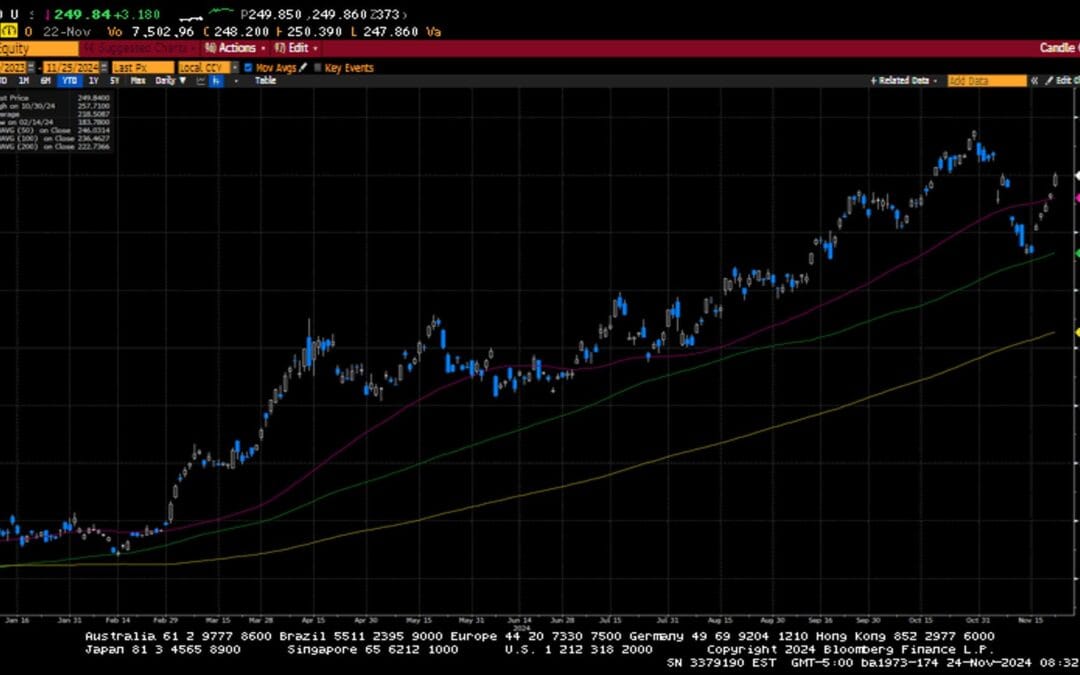
Weekly Market Commentary
-Darren Leavitt, CFA
Markets bounced back as investors reengaged the pro-growth Trump 2.0 trade. President-elect Trump continued to fill out his cabinet and, late Friday announced Scott Bessent as his nominee for Treasury Secretary. Wall Street has endorsed Bessent, who is seen as a fiscal hawk who will support Trump’s tariffs and trade policies. Matt Gaetz removed himself as the nominee for Attorney General amid allegations of sexual misconduct, which prompted Trump to nominate Pam Bondi for the position. Current SEC Chairman Gary Gensler announced he would step down in January, which led to more discussions on deregulation, with much attention placed on the Cryptocurrency markets. Notably, Bitcoin approached $100k in Friday’s session.

An escalation of tensions in the Russia-Ukraine war sent investors to safe-haven assets such as gold, the US Dollar, and US Treasuries. The use of US and British-made missiles by Ukraine on Russian assets prompted the Kremlin to update its nuclear doctrine and to use an intercontinental ballistic missile in a subsequent attack on Ukraine.
All eyes were on NVidia and its third-quarter earnings results. The company did not disappoint, posting better-than-expected results and raising guidance for the coming quarter. The stock ended the week flat, which is kind of crazy, given the market expectations for a sizeable move in either direction post-earnings. Other notable earnings included solid results from Walmart, Ross, and Snowflake. Target’s results were a disaster, sending shares lower by more than 20%.

The S&P 500 gained 1.2%, the Dow jumped 2%, the NASDAQ advanced 1.7%, and the Russell 2000 increased by 4.5%. Despite an early week’s bid into Treasuries, the yield curve saw selling at the front end of the curve. The 2-year yield increased by seven basis points to 4.37%, while the 10-year yield fell by two basis points to 4.41%. The 2-10 spread compressed to just four basis points.
Oil prices advanced by 6.3% or $4.26 to close at $71.28 a barrel. Gold prices increased by 5.5% to $2713.10, the largest weekly move since May 2023. Copper prices rose by $0.02 to $4.09 per Lb. Bitcoin rose by $6300 to $97,455, falling just short of 100k on Friday. The US Dollar index rose for the eighth consecutive week, gaining 0.8% and closing at 107.55. The Euro fell to 1.0410, while the Japanese Yen closed the week just under 155.

The economic calendar was relatively quiet. Housing Starts and Permits were weaker than expected as Existing Home Sales topped estimates. S&P Global Manufacturing and Services PMI data were weak globally, but Eurozone data was materially weaker than anticipated. In the US, Services data indicated further expansion, coming in at 57 versus 55 in October. Manufacturing in the US remained in contraction, but the pace of contraction was less than in October. Initial Jobless Claims fell by 6k to 213k, while Continuing Claims increased by 36k to 1908k. The final reading of the University of Michigan’s Consumer Sentiment Index came in at 71 versus the consensus estimate of 73.
Investment advisory services offered through Foundations Investment Advisors, LLC (“FIA”), an SEC registered investment adviser. FIA’s Darren Leavitt authors this commentary which may include information and statistical data obtained from and/or prepared by third party sources that FIA deems reliable but in no way does FIA guarantee the accuracy or completeness. All such third party information and statistical data contained herein is subject to change without notice. Nothing herein constitutes legal, tax or investment advice or any recommendation that any security, portfolio of securities, or investment strategy is suitable for any specific person. Personal investment advice can only be rendered after the engagement of FIA for services, execution of required documentation, including receipt of required disclosures. All investments involve risk and past performance is no guarantee of future results. For registration information on FIA, please go to https://adviserinfo.sec.gov/ and search by our firm name or by our CRD #175083. Advisory services are only offered to clients or prospective clients where FIA and its representatives are properly licensed or exempted.
Qualified Charitable DIstributions and Inherited IRAs: TOday’s Slott Report Mailbag
By Andy Ives, CFP®, AIF®
IRA Analyst
QUESTION:
Hello Ed Slott Team,
We have a client with an IRA who wants to do a qualified charitable distribution (QCD) to a charity. The charity also has an account with the same custodian of the IRA and has asked that the client simply journal assets from her IRA directly to the charity’s account. Logistically, this can be done. Two questions on the topic: 1.) Is it OK to journal assets directly in this manner and still have it count as a QCD? 2.) Do QCDs need to be done in cash, or can they be done in positions?
Dustin
ANSWER:
Dustin,
If the custodian is willing to do so, then yes, they can journal the assets from the IRA to the charity’s account. As long as the custodian reports the transaction as a distribution from the IRA, then all will be well. As for question #2, QCDs do not have to be in the form of cash. If a charity is willing to accept, for example, shares of stock, then shares of stock delivered directly to the charity can qualify as a valid QCD.
QUESTION:
I inherited an IRA from my mother in 2015. I misunderstood that it was an IRA and have not been taking required minimum distributions (RMDs). In his most recent book, Ed Slott mentions that the IRS frequently waives the missed RMD penalty. Do I have to file Form 5329 for each of the years I missed taking the RMD (back to 2015)? Should I pay the penalty, or try to get it waived?
Thanks,
Leslie
ANSWER:
Leslie,
The IRS has shown that it is agreeable to waiving the 25% (previously 50%) missed RMD penalty for good cause. There is a process for requesting a waiver: 1.) Take all the past missed RMDs. 2.) Complete a Form 5329 for each year with a missed RMD. (You may need the help of a tax professional.) 3.) Submit the forms to the IRS along with a brief letter explaining what happened, that the oversight has been corrected (i.e., missed RMDs have been taken), and you have taken steps to make sure it won’t happen again. Finally, do not pay the penalty. If the IRS declines your waiver request, it will be in touch. Otherwise, you can assume your waiver request has been granted.
https://irahelp.com/slottreport/qualified-charitable-distributions-and-inherited-iras-todays-slott-report-mailbag/

Three Changes Coming for Social Security in 2025
The Social Security Administration has announced the 2025 final COLA, wage cap, and amount needed to earn SS credits.
Anticipating changes coming to Social Security in 2025 can help you start planning for the new year and identify any adjustments you can make to maximize your eligibility for the most benefits.
People who think these changes only impact retirees would be wrong. Current workers need to keep an eye on accumulating enough Social Security credits and understand how much of their wages will be subject to the 6.2% Social Security tax.
1. Social Security cost of living adjustment for 2025
The Social Security annual cost-of-living adjustment (COLA) for 2025 is 2.5%, the Social Security Administration (SSA) announced recently. This is the smallest increase since 2020, as expected, and follows an increase of 3.2% in 2024.
According to the SSA, the 2.5% increase will translate to an additional $49 for the average retiree, increasing the average monthly check from $1,927 to $1,976. Married couples will see an average increase of $75, raising their monthly benefit to $3,089 up from $3,014.
The COLA for 2025 is 2.5%. The final number is based on the July, August and September CPI numbers. These three sets of numbers are used by the SSA to determine the annual COLA.
Keep in mind that while a lower inflation rate should lead to a smaller increase in prices, it does nothing to lower the current prices for groceries, utilities or housing that many are struggling to meet.
2. Full retirement age (FRA) in 2025
Retirees will have to wait a little longer to reach their full retirement age (FRA) in 2025. The full retirement age is increasing gradually if you were born from 1955 to 1960, until it gets up to 67.
In 2025, the full retirement age will be 66 years and 10 months. For those who turned 66 in 2024, FRA is 66 years and eight months.
Here is when you will reach your FRA, by birth year:
- If you were born in 1958, your FRA is age 66 and six months and was reached in 2024
- If you were born in 1959, your FRA is age 66 and 10 months and is reached in 2025
- If you were born in 1960 or later, your FRA is age 67 and will be reached in 2026 and after
- NOTE: People born on January 1 of any year, refer to the previous year.
If you retire at age 62, the earliest possible Social Security retirement age, your benefit will be lower than if you wait till your FRA. The more months remaining between age 62 and your FRA, the more your monthly payments will be reduced.
Early retirement will reduce your benefits by 5/9 of one percent for each month before normal retirement age, up to 36 months. If the number of months exceeds 36, then the benefit is further reduced by 5/12 of one percent per month.
If you choose to continue working beyond your full retirement age and delay applying for benefits, you can increase future Social Security benefits in two ways: Each extra year you work adds another year of earnings to your Social Security record, and higher lifetime earnings can mean higher benefits when you retire.
Benefits will increase from the time you reach full retirement age until you start to receive benefits, or until you reach age 70. For each full year you delay receiving Social Security benefits beyond full retirement age, 8% is added to your benefit.
3. Social Security credits and taxes in 2025
In 2025, you’ll have to earn more to qualify for Social Security credits, and the wage cap for Social Security taxes will increase.
Social Security credits. You must earn a minimum number of Social Security credits to qualify for retirement benefits. The Social Security Administration cannot pay you benefits if you don’t have enough credits. You must earn 40 work credits to become eligible for benefits, and you are allowed to earn up to four credits per year.
The SSA also uses the number of credits you’ve earned to determine your eligibility for retirement or disability benefits, Medicare, and your family’s eligibility for survivor benefits.
To earn one credit in 2025, you must have wages and self-employment income of $1,810, and you must earn $7,240 to get four full credits. This amount increases annually, so it will rise in 2026. In 2024, you only needed to earn $1,730 to earn a credit, $80 less than what you need to earn in 2025.
Once you earn the 40 credits, earning more credits won’t increase your benefit payment. Instead, your retirement benefit is based on how much you earned during your working years.
Wage cap. Social Security caps the amount of income you pay taxes on and get credit for when benefits are calculated. The Social Security tax limit in 2025 is $176,100, up $7,500 from $168,600 in 2024. The tax limit is indexed to inflation and is therefore estimated to rise in 2026.
In 2024, the wage cap rose by $8,400 to $168,600 from $160,200 the previous year.
https://www.kiplinger.com/retirement/social-security/changes-coming-for-social-security-in-2025
Nothing SIMPLE About It: 3 Different Catch-Up Limits for 2025
Ian Berger, JD
IRA Analyst
Here’s something you can only find in the Internal Revenue Code: Starting in 2025, there will be not one, not two, but three different catch-up limits for older SIMPLE IRA participants.
Like IRAs and workplace plans like 401(k)s, SIMPLE IRAs allow annual elective deferrals up to a dollar limit and “catch-up” contributions for those who reach age 50 or older by the end of the year. Both of these limits are indexed for inflation. For 2024, the regular elective dollar limit is $16,000, and the catch-up limit is $3,500 – for a total limit of $19,500. For 2025, the regular elective deferral limit increases to $16,500, but the catch-up remains $3,500 – for a total of $20,000.
But Congress could not leave well enough alone. Starting this year, the SECURE 2.0 legislation bumped up both of these limits by 10% for many – but not all – SIMPLE IRA plans. The 10% bonus applies to plans sponsored by companies with 25 or fewer employees – which includes most SIMPLE plans. But it also applies to companies with more than 25 employees if the company agrees to increase its SIMPLE IRA employer contribution to a level higher than usually required. (If the employer matches deferrals, the match must be up to 4% of pay instead of the usual 3% of pay. If the employer contributes to all eligible employees, the contribution must be 3% of pay instead of the usual 2%.) The 10% bonus boosted the 2024 regular deferral limit to $17,600 and the catch-up limit to $3,850 – for a total limit of $21,450. Both limits are indexed for inflation, but because of indexing rules, they will remain $17,600/$3,850 for 2025.
Adding even more complexity to the mix, starting in 2025 SIMPLE IRA participants turning 60, 61, 62 or 63 by the end of a calendar year can make an even higher catch-up contribution for that year. This “super catch-up” is $5,250 (150% of $3,500 – the 2025 regular catch-up limit.)
So, if you’re an older SIMPLE IRA plan participant, where does that leave you for 2025 (besides confused)? Assuming your plan already allows the standard $3,500 age 50-or-older catch-up (as most do), here are the rules for increased catch-ups for 2025:
- If you’ll be between ages 50 and 59 OR age 64 or older on December 31, 2025 and your company has 25 or fewer employees, you can defer up to $3,850 of catch-ups (on top of regular deferrals of $17,600).
- If you’ll be between ages 50 and 59 OR age 64 or older on December 31, 2025 and your company has more than 25 employees, you’ll be eligible for catch-ups up to $3,850 (on top of regular deferrals of $16,500) only if your employer elects to make a higher-than-usual company contribution (as outlined above). If your employer doesn’t, your catch-up limit will be the standard $3,500 (on top of regular deferrals of $16,500).
- If you’ll be between ages 60 and 63 on December 31, 2025, you can defer up to $5,250 of catch-ups (on top of regular deferrals of either $17,600 or $16,500). It doesn’t matter how many employees work for your company or if the plan offers the higher company contribution.
SIMPLE, isn’t it?
https://irahelp.com/slottreport/nothing-simple-about-it-3-different-catch-up-limits-for-2025/
