

Market Review and Outlook
Weekly Market Commentary
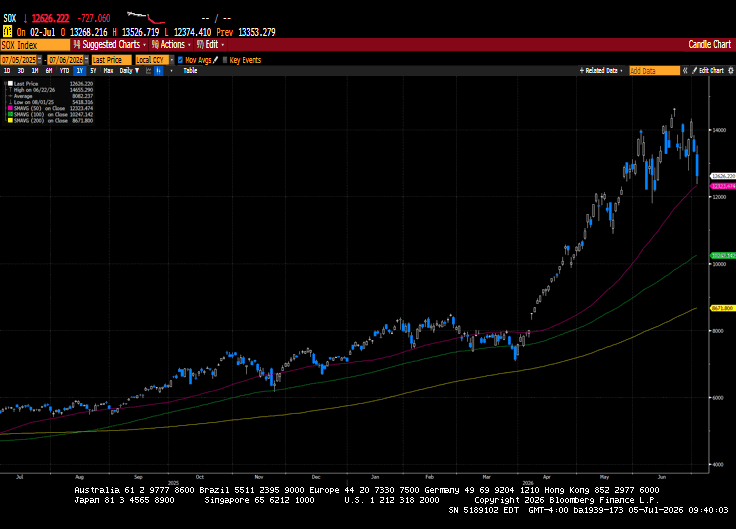
The holiday-shortened week saw the end to the best 2nd quarter in six years as the S&P 500 added over $8 trillion in market value. The Semiconductor sector recorded its best quarter ever with a gain of 87.75% as AI demand for chips continued. That said the semiconductor names saw huge swings in prices last week and ended the week with a 2-day 11% plunge. Tensions in the Middle East eased as the US and Iran resumed peace talks. Oil prices continued to decline, and economic data showed a decline in manufacturing input costs likely due to oil price declines. Kevin Warsh, the Fed Chairman, speaking at the ECBs summit in Sintra Portugal, said inflation risks have come down. This statement coupled with a weaker than expected Employment Situation Report likely gives the Fed reason to stay put with its monetary policy. Currently, Fed Fund futures are pricing in a twenty-five basis point hike in December of this year.

The S&P 500 rose 1.78% as the market rally broadened out as evidenced by the equally weighted S&P 500 index hitting an all-time high. The Dow also forged a new high last week after gaining 1.99%. The NASDAQ climbed 2.12%, while the Russell 2000 fell by 0.42%. The Treasury curve steepened as yields climbed across the curve. The 2-year yield increased by five basis points, while the 10-year yield increased by twelve basis points. Oil prices fell by $0.56 to $68.82 a barrel. Gold prices climbed by $29.20 to $4,125.90 an ounce. Silver prices rose by 5.2% or $3.15 to $62.82 an ounce. Copper prices fell by four cents to $6.17 per pound. Bitcoin’s price increased by $3,200 to $63,200. The CBOE Volatility Index fell by 14% to 15.81. The US Dollar index fell by 0.5% to 100.87.

The economic calendar featured the June Employment Situation Report which showed weaker than expected payrolls figures. Non-Farm Payrolls came in at 57K versus the consensus estimate of 130k, while Private Payrolls increased by 49k, well below the estimated 98k. The Unemployment rate fell to 4.2% from 4.3%. Average Hourly Earnings and the Average Work week were in line with expectations at 0.3% and 34.3 hours, respectively. Job Openings in June increased to 7.594m, while ADP Private Payrolls increased by 98k. Initial Jobless claims declined by 1k to 215k, while Continuing Claims increased by 2k to 1814k. June Consumer Confidence rose to 91.2 from 90.6 in May. ISM Manufacturing remained in expansion, coming in at 53.3, down from the previous reading of 54.

Investment advisory services offered through Foundations Investment Advisors, LLC (“FIA”), an SEC registered investment adviser. FIA’s Darren Leavitt authors this commentary which may include information and statistical data obtained from and/or prepared by third party sources that FIA deems reliable but in no way does FIA guarantee the accuracy or completeness. All such third party information and statistical data contained herein is subject to change without notice. Nothing herein constitutes legal, tax or investment advice or any recommendation that any security, portfolio of securities, or investment strategy is suitable for any specific person. Personal investment advice can only be rendered after the engagement of FIA for services, execution of required documentation, including receipt of required disclosures. All investments involve risk and past performance is no guarantee of future results. For registration information on FIA, please go to https://adviserinfo.sec.gov/ and search by our firm name or by our CRD #175083. Advisory services are only offered to clients or prospective clients where FIA and its representatives are properly licensed or exempted.
The Pro-Rata Rule and Non-U.S. Citizen Beneficiaries: Today’s Slott Report Mailbag
By Ian Berger, JD
IRA Analyst
Question:
If someone has a SIMPLE IRA and is interested in doing a backdoor Roth IRA conversion, does the SIMPLE IRA count under the pro-rata rule?
Answer:
The pro-rata rule that determines the taxation of a backdoor Roth IRA conversion includes all of a person’s IRAs owned as of the end of the calendar year in which it is done. This includes SEP and SIMPLE IRAs, but not Roth IRAs or inherited IRAs. Even IRAs held at different financial institutions are aggregated.
Question:
Hi Mr. Slott,
I have a dual citizenship, U.S. and The Philippines. I have an IRA and would like to have my chronically ill/disabled nephew as one of my beneficiaries. Can he be my beneficiary if he is not a U.S. citizen?
Thank you so much,
Erlinda
Answer:
Dear Erlinda,
Yes, a non-U.S. citizen can be named as beneficiary, whether the beneficiary lives in the U.S. or abroad. If the beneficiary is a nonresident alien, distributions from the inherited IRA may be subject to a 30% U.S. withholding tax, unless reduced by a tax treaty between the U.S. and the country of residence.
If you have technical questions you would like to have answered, be sure to submit them to mailbag@irahelp.com, to be answered on an upcoming Slott Report Mailbag, published every Thursday.
https://irahelp.com/the-pro-rata-rule-and-non-u-s-citizen-beneficiaries-todays-slott-report-mailbag/

Why a Retirement Income Plan Matters More Than Your Investment Returns
Many people spend decades focused on growing their retirement savings. They watch the markets, contribute to retirement accounts, and celebrate when their balances increase. But when retirement finally arrives, one question becomes far more important than, “How much have I saved?”
The better question is: How will I turn my savings into reliable income?
A successful retirement isn’t measured by your account balance—it’s measured by your ability to maintain the lifestyle you’ve worked so hard to achieve.
Retirement Has Changed
Years ago, many retirees relied on pensions that provided predictable monthly income for life. Today, most retirees are responsible for creating their own retirement paycheck.
That means making decisions about:
- When to begin Social Security benefits
- Which retirement accounts to withdraw from first
- How to reduce taxes during retirement
- How to protect savings from market downturns
- How to prepare for inflation and rising healthcare costs
- How to leave a meaningful legacy for loved ones
Without a well-designed strategy, even substantial retirement savings can disappear faster than expected.
It’s Not Just About Investments
Investment performance is important, but it is only one piece of a much larger financial picture.
A comprehensive retirement income strategy also considers:
Tax Efficiency
The amount you keep often matters more than the amount you earn. Coordinating withdrawals from taxable, tax-deferred, and tax-free accounts may help reduce unnecessary taxes throughout retirement.
Social Security Timing
For many retirees, Social Security represents one of the largest guaranteed income sources they’ll ever receive. Making the right claiming decision could increase lifetime benefits by tens of thousands of dollars.
Managing Market Risk
Experiencing significant investment losses early in retirement can have long-lasting consequences. Building strategies that help reduce volatility while maintaining growth potential may improve long-term financial confidence.
Healthcare Planning
Healthcare expenses continue to rise, and many retirees underestimate the costs they may face. Planning ahead can help reduce surprises and protect retirement assets.
Retirement Should Be About Living
Financial planning isn’t simply about numbers.
It’s about having the confidence to travel when you want, spend time with family, pursue hobbies, volunteer, support causes you care about, and enjoy retirement without constantly worrying about money.
A thoughtful retirement income plan helps provide clarity, confidence, and peace of mind—allowing you to focus on the moments that matter most.
The Value of Professional Guidance
Every retirement journey is unique. Your income needs, tax situation, investment portfolio, family goals, and healthcare considerations are different from anyone else’s.
Working with a financial professional can help bring all of these moving pieces together into one coordinated strategy designed around your personal goals.
Final Thoughts
Building wealth is only half the journey.
The real challenge—and opportunity—is creating a retirement plan that transforms years of hard work into dependable income, tax-efficient withdrawals, and lasting financial confidence.
If you’re approaching retirement or have recently retired, now is an excellent time to review your current strategy. Small adjustments today can have a meaningful impact on your financial future for years to come.
Schedule a complimentary retirement review today and discover whether your current plan is designed not only to grow your assets—but to help you enjoy them with confidence throughout retirement.
IRS Provides Fix for Trump Account Gift Tax Issue
By Sarah Brenner, JD
Director of Retirement Education
In just a few days, on July 4, Trump accounts will be available. As we come down to the wire, the IRS has stepped in to provide a safe harbor to address concerns about potential gift tax issues with contributions.
The Gift Tax Issue
Contributions to Trump accounts do not qualify under the annual gift tax exclusion ($19,000 for 2026). Only gifts of “present interest” qualify. A gift of “present interest” means a gift that the recipient can immediately access and use. Trump accounts are not considered gifts of “present interest” because they cannot be accessed until the year the child turns 18.
Congress did not include a provision in the One Big Beautiful Bill Act (OBBBA) to exempt Trump accounts, like it did many years ago for section 529 plans. Unless Congress or the IRS intervened, there was concern that a gift tax return (Form 709) would be required for individuals making Trump account contributions.
The Fix
On June 29, the IRS issued Rev. Proc. 2026-25. This guidance provides a gift tax reporting safe harbor for Trump account contributions made before the year the child reaches age 18.
Under the safe harbor, if certain requirements are met, contributions made by individual donors to Trump accounts in a given year will not be subject to gift tax reporting requirements for that year.
The IRS said that a safe harbor was necessary for several reasons. For many of those who contributed to Trump accounts, the cost and other burdens of complying with gift tax reporting requirements could outweigh the anticipated financial savings benefit of making contributions. In addition, gift tax reporting compliance by Trump account contributors could dramatically increase the burden on the IRS, who would have to process gift tax returns for taxpayers who would be unlikely to ever be subject to gift, estate, or generation-skipping tax. Also, according to the IRS, the fact that nearly six million Trump accounts have already been opened means the number of gift tax returns filed annually could be expected to increase from roughly 300,000 to several million.
If you have technical questions you would like to have answered, be sure to submit them to mailbag@irahelp.com, to be answered on an upcoming Slott Report Mailbag, published every Thursday.
https://irahelp.com/irs-provides-fix-for-trump-account-gift-tax-issue/
“The Law of the Plan is the Law of the Land”
By Andy Ives, CFP®, AIF®
IRA Analyst
When it comes to the rules governing specific workplace retirement plans like a 401(k), there are the foundational rules dictated by law, and there are “in-house rules” put into place by the plan itself. Plans can choose to be far more restrictive than what the law allows. For example, while loans are permitted to be taken from a 401(k), a specific plan can be designed to refuse all loan requests. Workplace plans can implement all sorts of restrictions that plan participants may not be aware of…until it comes time to access their funds. Plans are perfectly within their rights to do so, and any complaints will fall on deaf ears. When it comes to plan design, we like to say, “the law of the plan is the law of the land.”
In one egregious scenario, a small (20-employee) blue-collar business installed a 401(k) plan for its employees. The problem was that the business owner appeared to suffer from some level of paranoia. He was so concerned that an employee would quit and use his 401(k) funds to start a competing business that he designed the 401(k) to be incredibly restrictive when it came to withdrawals. In fact, participants could not access a penny of their retirement money – even if they separated from service – until age 65 or death.
Recently, I was contacted by a member of Ed Slott’s Elite IRA Advisor Group℠ whose successful client was preparing to retire early, at age 56, from a large medical company (approximately 300,000 employees). The client had a significant balance in her 401(k). The idea was for the client to delay a rollover of the 401(k) to her IRA until she was 59½. Until then, she would take periodic distributions from the 401(k) to cover whatever expenses she had.
On its surface, this seemed like a wise planning strategy. The advisor had done his homework and was aware of the “age 55 exception” to the 10% early withdrawal penalty. When a person leaves her job in the year she turns age 55 or older, she can take penalty-free withdrawals from the 401(k) held at that business. The age 55 exception is written into the tax law and is claimed on a taxpayer’s federal return using Form 5329. The advisor in this case also knew the age 55 exception applies to plan withdrawals only. It does not apply to distributions from an IRA, hence the need to leave the 401(k) assets where they were for a few years.
The advisor and his client contacted the 401(k) provider to explain their intentions…and their best-laid plans fell apart.
In fact, the plan design of this large 401(k) did not allow for partial withdrawals before age 59½. For anyone in the age 55 to 59½ range, the plan contained an all-or-nothing withdrawal rule. Essentially, this 401(k) legislated out the age 55 exception. Ultimately, it appeared the plan was intentionally structured this way to discourage early retirement among highly skilled employees who would otherwise be most likely to separate from service. Most of these employees have no idea how much the plan rules disadvantage them, and the plan is within its rights to do so.
It would be wise to get a handle on what your plan does and does not allow before it is too late. After all, the law of the plan is the law of the land.
https://irahelp.com/the-law-of-the-plan-is-the-law-of-the-land/
Weekly Market Commentary
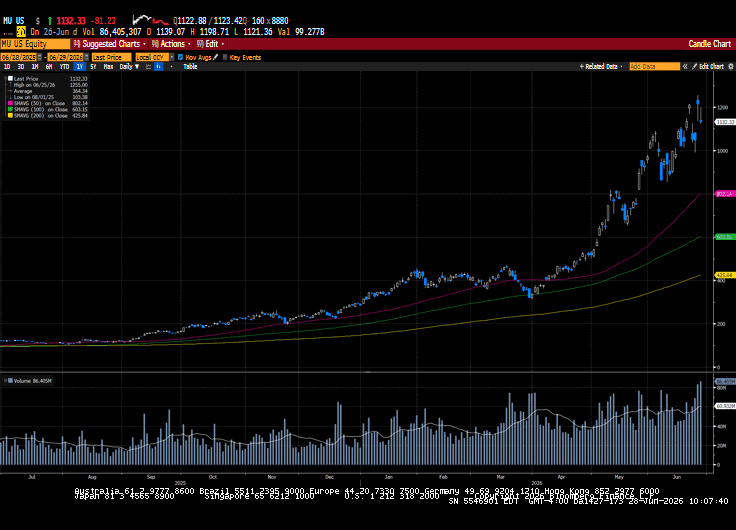
Markets finished the week mixed, with a noticeable rotation out of mega-cap technology issues to healthcare, real estate, and consumer staples. Concerns about the return on investment from a massive capital-expenditure binge on artificial intelligence resurfaced. Additionally, news that Google’s top AI engineer was leaving for Anthropic, along with news that OpenAI will delay its IPO, dampened sentiment on the AI trade. Trade in the Semiconductor sector was extremely volatile even as Micron announced fantastic first-quarter results. The demand for memory pushed Micron’s gross margin to 86%, demonstrating its pricing power. The news sent Apple shares lower as rising memory prices prompted the company to raise product prices. The healthcare sector was among the best-performing sectors of the week, with several acquisitions announced between drug makers. The energy sector struggled as oil prices continued to fall amid constructive signals from US-Iran ceasefire negotiations. That said, late Friday, Iran attacked another tanker in the Strait of Hormuz, which in turn led to the US conducting airstrikes on Iranian air defense and drone facilities.

The S&P 500 lost 2% and is now up 7.4% year to date. The Dow rose by 0.6%, the NASDAQ tumbled 4.6%, and the Russell 2000 advanced by 1%. Yields fell across the curve in a symmetrical fashion. The 2-year yield fell by nine basis points to 4.09%, while the 10-year yield fell by eight basis points to 4.37%. Oil prices fell by $7.35, or 9.5%, to $69.24 a barrel. Gold prices fell by $148.60 to close the week at $4,096.70 per ounce. Silver prices fell by 9.9% to $59.67 per ounce. Copper prices lost eighteen cents to $6.21 per Lb. Bitcoin’s price fell by 6.29% to ~$60,000. The VIX, which measures volatility, rose 12.2% to close the week at 18.41. The Japanese Yen remained weak at 161.72 against the US Dollar, even as the US Dollar index fell 0.1% to 101.35.

The Fed’s preferred measure of inflation, the PCE, came in as expected on both the headline and core readings at 0.4% and 0.3%, respectively. The headline figure increased to 4.1% from 3.8 in April on a year-on-year basis, while the Core figure increased to 3.4% from 3.3%. Markets reacted very little to the numbers, but investors seemed encouraged that these figures would decline in the coming months given the decrease in oil prices. Personal Spending and Income were both up 0.7%, better than the consensus estimates for each. S&P Global US Manufacturing and Services PMIs showed improvement from the previous readings, coming in at 55.7 and 51.3, respectively. The third estimate of Q1 GDP improved to 2.1% from 1.6%. Initial Jobless Claims fell by 12k to 215K, while Continuing Claims rose by 21k to 1.821m. The Final June reading of the University of Michigan’s Consumer Sentiment Index increased to 49.5 from 48.9 in May.

Investment advisory services offered through Foundations Investment Advisors, LLC (“FIA”), an SEC registered investment adviser. FIA’s Darren Leavitt authors this commentary which may include information and statistical data obtained from and/or prepared by third party sources that FIA deems reliable but in no way does FIA guarantee the accuracy or completeness. All such third party information and statistical data contained herein is subject to change without notice. Nothing herein constitutes legal, tax or investment advice or any recommendation that any security, portfolio of securities, or investment strategy is suitable for any specific person. Personal investment advice can only be rendered after the engagement of FIA for services, execution of required documentation, including receipt of required disclosures. All investments involve risk and past performance is no guarantee of future results. For registration information on FIA, please go to https://adviserinfo.sec.gov/ and search by our firm name or by our CRD #175083. Advisory services are only offered to clients or prospective clients where FIA and its representatives are properly licensed or exempted.

The Retirement Tax Trap: Why Keeping More of Your Money Matters More Than Chasing Higher Returns
When people think about retirement, they often focus on growing their investments. They search for higher returns, the next great investment opportunity, or ways to outperform the market. While investment performance is important, many retirees discover that one of the biggest threats to their financial future isn’t market volatility—it’s taxes.
A well-designed retirement strategy isn’t just about accumulating wealth. It’s about creating a plan that helps you keep as much of that wealth as possible.
Retirement Has Changed
Years ago, retirement planning was relatively straightforward. Many Americans relied on pensions, Social Security, and personal savings. Today, retirees often depend heavily on 401(k)s, IRAs, and other tax-deferred accounts.
The challenge is that every dollar withdrawn from many retirement accounts may be subject to income taxes. Without proper planning, retirement income can trigger unexpected tax consequences that reduce the money available to spend on the lifestyle you’ve worked so hard to build.
Taxes Don’t Retire When You Do
Many people assume they’ll automatically move into a much lower tax bracket after leaving the workforce. While this may be true for some, it isn’t guaranteed.
Several income sources can combine to create a larger taxable income than expected, including:
- Traditional IRA withdrawals
- 401(k) distributions
- Pension income
- Rental property income
- Part-time employment
- Required Minimum Distributions (RMDs)
- Social Security benefits
Without a coordinated withdrawal strategy, retirees may pay significantly more in taxes than necessary.
The Hidden Cost of Required Minimum Distributions
Once you reach the age when Required Minimum Distributions begin, the IRS requires withdrawals from most tax-deferred retirement accounts.
These mandatory withdrawals can:
- Push you into a higher tax bracket
- Increase taxation on Social Security benefits
- Raise Medicare premiums through IRMAA surcharges
- Reduce the overall longevity of your retirement savings
Planning years before RMDs begin can provide much greater flexibility later.
Diversification Should Include Taxes
Most investors understand the importance of diversifying investments across stocks, bonds, mutual funds, and other asset classes.
However, many overlook another important concept: tax diversification.
Having retirement assets spread across different tax treatments can provide flexibility when generating retirement income.
Examples may include:
- Tax-deferred accounts
- Tax-free accounts (when qualified)
- Taxable investment accounts
Having options allows retirees to potentially manage taxable income more efficiently during retirement.
Social Security Is Part of the Bigger Picture
One of the most common questions retirees ask is:
“When should I claim Social Security?”
The answer depends on far more than age alone.
Factors may include:
- Overall retirement income
- Life expectancy
- Spousal benefits
- Tax considerations
- Other retirement assets
- Long-term income goals
A personalized claiming strategy may significantly impact lifetime retirement income.
Retirement Planning Is About Coordination
Successful retirement planning brings multiple pieces together into one coordinated strategy.
This often includes:
- Investment management
- Income planning
- Tax-efficient withdrawal strategies
- Medicare planning
- Estate planning
- Long-term care considerations
- Insurance protection
- Legacy planning
Each decision can affect the others, making comprehensive planning more valuable than addressing each area separately.
Don’t Wait Until Retirement to Create a Strategy
One of the biggest advantages you have is time.
Planning five to ten years before retirement often creates more opportunities than waiting until retirement has already begun.
Small adjustments made today may help improve financial flexibility for years to come.
Your Retirement Deserves More Than Guesswork
Every family’s financial situation is unique. The strategies that work well for one retiree may not be appropriate for another.
Working with a knowledgeable financial and insurance professional can help you evaluate your current retirement plan, identify potential risks, and develop strategies designed around your personal goals, income needs, and long-term financial objectives.
Whether retirement is five years away or already here, having a comprehensive plan can provide greater confidence and clarity about the road ahead.
Disclaimer: This article is for educational purposes only and should not be considered tax, legal, or investment advice. Individuals should consult with qualified financial, tax, and legal professionals before making financial decisions. Investment and insurance products involve risk, and guarantees are subject to the claims-paying ability of the issuing insurance company.
Breaking the Barriers to Access Your Retirement Plan Funds While Working
By Ian Berger, JD
IRA Analyst
The June 15, 2026 Slott Report described the strict barriers employees face when attempting to access their 401(k) and other plan funds while still working. One exception to those barriers is for hardship withdrawals. Plans are not required to offer hardship withdrawals, but the overwhelming majority – estimated at 80-90% – do.
If you’re a 401(k) or 403(b) plan participant, you must satisfy three conditions to qualify for a hardship withdrawal:
- Your withdrawal must be for an “immediate and heavy financial need.” Most plans allow you to satisfy this requirement only if your expense fits into one of seven “safe harbor” categories: medical expenses; home purchase costs; post-secondary educational expenses; payments necessary to prevent eviction or mortgage foreclosure; funeral expenses; expenses to repair home damage; and disaster-related expenses and losses. As an alternative to using these safe harbors, your plan can evaluate each request individually using objective standards. But that is relatively rare.
- The amount you’re requesting can’t be more than is necessary to cover the expense (including any federal and state taxes and also, if applicable and the plan permits, the 10% early distribution penalty).
- You don’t have enough cash or other assets readily available to cover the expense.
If you’re a 457(b) plan participant, a stricter hardship standard applies: Your expense must have resulted from an “unforeseeable emergency.” This means an “extraordinary and unforeseeable circumstance” arising as a result of events beyond your control. This would include expenses due to imminent foreclosure or eviction from your primary residence, medical expenses, or funeral expenses of a spouse or dependent. However, the purchase of a home or payment of college tuition would not qualify because they are not “unforeseeable emergencies.” 457(b) hardships also must satisfy requirements similar to the second and third 401(k)/403(b) requirements.
Even if your withdrawal doesn’t qualify as a hardship withdrawal, you may still be able to tap into your workplace funds while still working. That would be the case if your plan allows withdrawals for one or more reasons that qualify as an exception to the 10% early distribution penalty for those under age 59½. One example would be withdrawals after the birth or adoption of a child. However, many plans don’t allow withdrawals due to birth or adoption or for other penalty exception reasons.
So, you can access your retirement plan funds while working if the plan allows, and you qualify for, hardship withdrawals or withdrawals for reasons that are exceptions to the 10% penalty. But keep in mind that, in either case, any pre-tax funds distributed to you will still be subject to taxes. And, if you’re under age 59½, the withdrawal may also be subject to the penalty.
If you have technical questions you would like to have answered, be sure to submit them to mailbag@irahelp.com, to be answered on an upcoming Slott Report Mailbag, published every Thursday.
https://irahelp.com/breaking-the-barriers-to-access-your-retirement-plan-funds-while-working/
Trump Accounts Are Almost Here: What Parents Need to Know
By Sarah Brenner, JD
Director of Retirement Education
On July 4, contributions to Trump accounts, a new savings vehicle for children, will become available. In these final days before their launch, we have been getting questions from parents about exactly what they should be doing to take advantage of this new savings opportunity. Here is what parents need to know as we count down the days to the arrival of Trump Accounts:
How can I sign up my child for a Trump account?
You can sign your child up for a Trump account by completing IRS Form 4547 and submitting it by hard copy, electronic filing or through the trumpaccounts.gov website. You can also use Form 4547 to sign up for the $1,000 contribution from the federal government for children born between 2025 and 2028.
There is no cost to open an account. Trump accounts must be invested by the custodian in a diversified index fund of U.S. stocks and must minimize fees and expenses.
I’ve signed my child up for a Trump account. What’s next?
Look for an email confirming that your election to open your child’s Trump account was processed and prompting you to complete the account activation.
Follow the instructions in the email to set up your child’s Trump account through the Trump accounts app (available in the Apple App Store and Google Play) or by visiting Trumpaccounts.gov. If you do not have access to a mobile device, you can access the web version of the official Trump Accounts app through https://trumpaccount.com/
How will the government update me on what is going on with my child’s Trump account?
As Trump account activation begins, concerns about potential scams are growing. Families should know that the initial legitimate communications about Trump Account activation will be sent only by email from no-reply@TrumpAccounts.Treasury.gov.
Future communications will be available in the Trump accounts app. When in doubt, visit the official app. There will be no text messages or phone calls about Trump account activation. If you receive a call or text about a Trump account, do not respond. It is likely a scam.
When will my child receive the $1,000 contribution from the government?
Starting July 4, 2026, eligible children will begin receiving the $1,000 pilot program contribution from the U.S. Department of the Treasury deposited directly into their Trump account.
When can I contribute to my child’s Trump account?
Beginning July 4, 2026, Trump accounts will be able to accept contributions from parents, family members, employers, and other eligible contributors.
If you have technical questions you would like to have answered, be sure to submit them to mailbag@irahelp.com, to be answered on an upcoming Slott Report Mailbag, published every Thursday.
https://irahelp.com/trump-accounts-are-almost-here-what-parents-need-to-know/
Weekly Market Commentary
Happy Father’s Day to all the fathers out there. The holiday-shortened week brought gains to US equities and saw the Japanese and South Korean markets forge new all-time highs. The signing of a memorandum of understanding between the US and Iran extended the ceasefire by 60 days, with negotiations on a permanent treaty to start this weekend. Equity markets rallied on the signing of the MOU, while oil prices plunged to levels not seen since before the war started. As I write this note, the Strait of Hormuz has been closed by Iran on the back of increased hostilities in Lebanon. Vice President Vance is en route to Switzerland to meet the rest of the US envoy and their Iranian counterparts to start negotiations to permanently end the war.
Global central bank policy was also top of mind for investors as the new Fed Chairman, Kevin Warsh, took the podium for the first time post the FOMC meeting. As expected, the Fed kept its policy rate unchanged at 3.50%-3.75%. The Fed’s statement removed forward guidance and shifted its bias away from its full labor mandate to inflation. Fed Chairman Warsh did not provide his estimates for the Summary of Economic Projections, but the SEP showed an outright hawkish stance from the other members of the Fed. In his post-statement commentary, the Chairman announced that he had assembled five task forces to address the Fed’s communication, balance sheet, data sources, its assessment of productivity and jobs, and its inflation framework. He hopes that by year-end, these task forces will have found solutions that will allow the Fed to move forward. It is clear that Warsh will head a very different Federal Reserve, one that is likely to be more tempered in its projections and more pragmatic in real time rather than delayed and data-dependent. Markets sold off after the Q&A, on the idea that the Fed will be less transparent, which will inherently increase market volatility. That said, it can be argued that a less transparent Fed will strengthen the impact of its monetary policy decisions. Interestingly, the long end of the yield curve rallied on the news, likely due to a perceived more disciplined Fed. The Bank of Japan raised its policy rate by twenty-five basis points to 1%, a level not seen since 1999. The move did little to stem the weakness of the Yen. The Bank of England held it rate at 3.75% with two dissents favoring a rate hike. The Swiss National Bank and the Norges Bank made no changes to their policy rates.

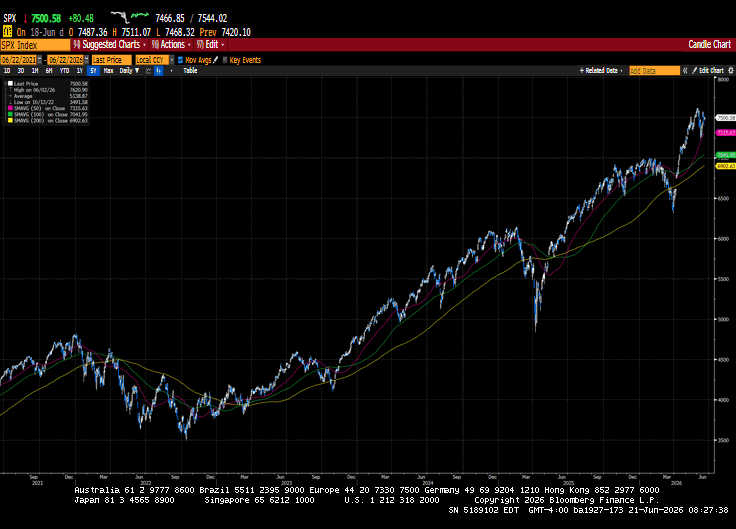
The S&P 500 gained 1%, the Dow rose 0.8%, the NASDAQ added 2.7%, and the Russell 2000 advanced 1.5%. The US Treasury curve flattened, with a weakening bias at the front end and a rally in longer-duration paper. The 2-year yield increased by nine basis points to 4.18%, while the 10-year yield fell by six basis points to 4.45%. West Texas Intermediate crude plunged 9.7% to $76.59 a barrel. Gold prices increased by $6.10 to $4,245.30 an ounce. Silver prices fell by 4.5% to $64.91 per ounce. Copper prices fell by five cents to $6.39 per Lb. Bitcoin’s price fell by ~$500 to $63,600. The US Dollar index closed at 100.86, a 13-month high.

The economic calendar was quiet. Housing Starts and Permits were both weaker than expected, coming in at 1177k and 1413k, respectively. Headline Retail Sales were better than expected at 0.9% versus the consensus estimate of 0.6%. The Ex-Auto Retail Sales figure came in at 0.8% versus the estimate of 0.6%. Initial Jobless Claims fell by 4k to 226k, while Continuing Claims increased by 24k to 1810k.

Investment advisory services offered through Foundations Investment Advisors, LLC (“FIA”), an SEC registered investment adviser. FIA’s Darren Leavitt authors this commentary which may include information and statistical data obtained from and/or prepared by third party sources that FIA deems reliable but in no way does FIA guarantee the accuracy or completeness. All such third party information and statistical data contained herein is subject to change without notice. Nothing herein constitutes legal, tax or investment advice or any recommendation that any security, portfolio of securities, or investment strategy is suitable for any specific person. Personal investment advice can only be rendered after the engagement of FIA for services, execution of required documentation, including receipt of required disclosures. All investments involve risk and past performance is no guarantee of future results. For registration information on FIA, please go to https://adviserinfo.sec.gov/ and search by our firm name or by our CRD #175083. Advisory services are only offered to clients or prospective clients where FIA and its representatives are properly licensed or exempted.
529 Plan Rollovers and Investments in Trump Accounts: Today’s Slott Report Mailbag
By Andy Ives, CFP®, AIF®
IRA Analyst
QUESTION:
Our client has funds left over in her 529 plan. She is not working. Can she roll over the 529 dollars to a Roth IRA? Does she need earned income? Can you do it as a spousal Roth contribution?
Thanks,
Mary
ANSWER:
Mary,
Unused 529 funds can only be rolled over to a Roth IRA if the beneficiary has compensation in the year of the rollover at least up to the amount of the rollover. Also, a rollover must be in the name of the 529 beneficiary (so no rollovers to a spouse). There are a number of other rules to follow, including: the 529 must have been open for at least 15 years; there is a lifetime 529-to-Roth rollover cap of $35,000; and only up to the annual Roth IRA contribution amount can be rolled over in any year.
QUESTION:
What kind of investments will be allowed in the Trump accounts for kids?
Joey
ANSWER:
Joey,
An eligible investment for a Trump account is a low-cost mutual fund or exchange-traded fund (ETF) that tracks the S&P 500 index or any other “qualified index” comprised of stocks in primarily U.S. companies, and that does not use leverage. A mutual fund or ETF will be considered “low-cost” if its expense ratio is less than 0.1%. A “qualified index” does not include any industry or sector-specific index, but may include an index based on market capitalization. An index will be treated as comprised of “primarily” U.S. companies if those companies represent at least 90 percent of the index based on their weighting in the index.
If you have technical questions you would like to have answered, be sure to submit them to mailbag@irahelp.com, to be answered on an upcoming Slott Report Mailbag, published every Thursday.
https://irahelp.com/529-plan-rollovers-and-investments-in-trump-accounts-todays-slott-report-mailbag/
Form 8606 and the Pro-Rata Rule: Not the End of the World
By Andy Ives, CFP®, AIF®
IRA Analyst
If a person has after-tax (non-deductible) money in any traditional IRA, SEP or SIMPLE IRA, then the pro-rata rule is just something that needs to be dealt with. But pro-rata is not the end-of-days hurdle that many people perceive it to be. In fact, with current tax software doing most of the heavy lifting, pro-rata might be considered a non-issue.
When after-tax (non-Roth) money exists in an IRA, the IRA owner cannot cherry-pick only those dollars for withdrawal or conversion to a Roth IRA. Barring a few exceptions, a proportionate amount of pre-tax (taxable) dollars and after-tax (non-taxable) dollars are required to be included in any withdrawal. That is the pro-rata rule in a nutshell.
How does an IRA owner document the after-tax dollars in his IRA and the amount of any withdrawal (or conversion) that is taxable? On IRS Form 8606. When a person makes a non-deductible contribution to a traditional IRA, Form 8606 is required to “claim the basis.” Form 8606 is essentially the IRA owner waving a flag to the IRS and saying, “I am putting after-tax dollars into my IRA.” Often, people intentionally make a non-deductible contribution to initiate a Backdoor Roth IRA transaction. But sometimes non-deductible contributions happen by mistake. Someone will contribute to a traditional IRA, realize later that it is not eligible for a deduction, and then just leave the contribution as-is.
Where people often get sideways with the pro-rata rule is thinking it applies to each IRA individually. Such is not the case. The pro-rata rule considers all of a person’s traditional IRAs, SEP and SIMPLE IRAs as one big bucket of money. If a person with pre-tax (non-Roth) dollars in one IRA makes a non-deductible contribution to another IRA (and the only dollars in that IRA are those after-tax dollars), a subsequent full Roth conversion of just that second IRA does NOT mean that only the after-tax dollars can be converted. As mentioned, the IRS considers all of a person’s IRAs for the pro-rata rule. No cherry picking.
Misunderstandings of the pro-rata rule like this, especially when it comes to the Backdoor Roth strategy, happen all the time. And when the IRA owner realizes that Form 8606 is now involved, along with a potential lifetime of pro-rata math, panic often ensues. How do I unwind this? How can I avoid pro-rata? How can I make this all go away?
To this, we say, “Just breathe. It is not the end of the world.”
Form 8606 is only needed in the year of a non-deductible contribution and in any year when a subsequent withdrawal or conversion is done. So, after a non-deductible IRA contribution is made, if the IRA owner makes no further such contributions, takes no distributions or does no Roth conversions for the next decade, then no Form 8606 is required for those years. Once the original basis is claimed on the form, it is locked in. And if the information on Form 8606 is properly entered into tax prep software, the software should carry that information forward for years to come. When a future distribution is taken or a Roth conversion is done, the tax software will simply compute the pro-rata math for you. Easy peasy.
If you have technical questions you would like to have answered, be sure to submit them to mailbag@irahelp.com, to be answered on an upcoming Slott Report Mailbag, published every Thursday.
https://irahelp.com/form-8606-and-the-pro-rata-rule-not-the-end-of-the-world/

The Retirement Mistake Nobody Talks About: Having a Plan But Never Updating It
Many Americans spend years preparing for retirement. They contribute to their 401(k)s, open IRAs, purchase insurance, and work diligently to build their nest egg. Yet one of the biggest mistakes retirees and pre-retirees make isn’t failing to create a financial plan—it’s failing to update it.
A retirement strategy created five or ten years ago may no longer reflect today’s reality.
Life changes. Markets change. Tax laws change. Your retirement plan should change too.
Why Retirement Plans Become Outdated
When most people create a retirement plan, it’s based on the information available at that moment.
However, over time, several factors can dramatically impact the effectiveness of that plan:
- Inflation increases living expenses.
- Healthcare costs continue to rise.
- Investment markets fluctuate.
- Family circumstances evolve.
- Tax laws are updated.
- Retirement goals shift.
What worked five years ago may not be the best strategy today.
Inflation Is Changing Everything
One of the most overlooked threats to retirement is inflation.
The cost of groceries, utilities, insurance, travel, and healthcare has increased significantly over the past several years. Retirees living on fixed incomes often feel the impact more than anyone.
If your retirement income strategy was developed before recent inflationary pressures, it may be worth revisiting your assumptions and spending projections.
Even modest inflation can reduce purchasing power substantially over a 20- to 30-year retirement.
Your Risk Tolerance May Have Changed
Many investors discover that their comfort level with risk changes as retirement gets closer.
When you’re 20 years away from retirement, market volatility may seem manageable. When you’re already drawing income from your portfolio, market downturns can feel very different.
Regular reviews can help determine whether your current investment allocation still aligns with your retirement goals and income needs.
Tax Planning Should Be an Ongoing Conversation
Many retirees focus heavily on growing assets but spend little time planning how those assets will be taxed.
Questions worth revisiting include:
- Would a Roth conversion make sense?
- How will Required Minimum Distributions impact future taxes?
- Could Social Security benefits become taxable?
- What strategies may help reduce lifetime tax exposure?
Tax planning is not a one-time event. It’s an ongoing process that can potentially create significant long-term benefits.
Insurance Needs Often Change in Retirement
Many people carry insurance policies they purchased years ago without reviewing whether the coverage still fits their current situation.
Retirement may create new needs and eliminate old ones.
Important areas to review include:
- Life insurance
- Long-term care planning
- Medicare coverage
- Supplemental insurance
- Annuities
- Legacy planning strategies
A periodic review can help ensure your protection strategy remains aligned with your overall financial objectives.
Beneficiaries and Estate Documents Need Attention Too
One of the simplest yet most overlooked retirement planning tasks is reviewing beneficiary designations.
Life events such as:
- Marriage
- Divorce
- Birth of grandchildren
- Death of a spouse
- Changes in family relationships
can make existing documents outdated.
Your will, trust, powers of attorney, healthcare directives, and beneficiary forms should be reviewed periodically to ensure they still reflect your wishes.
Retirement Is Not a Destination
Many people view retirement as a finish line.
In reality, retirement is often a new chapter that can last 20 to 30 years or more.
Your goals, priorities, and financial needs will likely evolve throughout that journey.
The most successful retirees are often those who regularly evaluate their strategy and make adjustments when necessary.
The Bottom Line
Creating a retirement plan is an important first step—but keeping that plan current may be even more important.
A retirement strategy should be viewed as a living document that evolves alongside your life, finances, and goals.
By reviewing your investments, income plan, tax strategy, insurance coverage, healthcare planning, and estate documents regularly, you may be better positioned to navigate life’s uncertainties and enjoy greater confidence throughout retirement.
Is It Time for a Retirement Plan Review?
If it has been more than a year since your last financial review, now may be the ideal time to revisit your strategy. Small adjustments today could make a meaningful difference in your financial future tomorrow.
Accessing 401(k) Funds While You’re Still Working
By Ian Berger, JD
IRA Analyst
If you are faced with expenses that require you to tap into your savings, what are your options? You should always look to non-retirement savings first. Dipping into retirement funds could cause you to lose out on future tax-deferred (or tax-free) growth, and you may have to pay taxes and a penalty on the withdrawal.
But if you must touch your retirement funds, you may be surprised to know that the access rules differ between IRAs and company plans. You can always reach your traditional or Roth IRAs (with possible taxes and penalty) at any age. But tapping into your 401(k), 403(b) or 457(b) plan funds can be more difficult. That’s because Congress has set strict restrictions on withdrawals from those plans. And, to make matters worse, plans are free to impose even more restrictive rules than required by Congress. So, check your plan’s written summary or ask your plan administrator or HR rep for the particular access rules that apply to your plan.
If you leave your employer, you can usually take out all of your plan funds. By contrast, there are barriers to accessing your funds while you’re still working (through an “in-service withdrawal”). The rules are different for each of the various types of contributions within your plan:
- Pre-tax and Roth Elective Deferrals. Generally, 401(k) and other plans cannot by law allow in-service withdrawals of pre-tax and Roth deferrals (and associated earnings) before age 59½. But, if the plan allows, you can access these dollars before that age if you have a financial hardship or for certain other specific reasons. Most plans do allow in-service withdrawals once you reach age 59½.
- After-Tax Contributions. If your plan offers non-Roth after-tax contributions, the plan may allow you to reach those funds (and earnings) at any time, even before age 59½.
- Employer Contributions. Your plan may provide employer contributions, including matches. In that case, it may follow the same withdrawal restrictions for those contributions (and earnings) that apply to pre-tax and Roth elective deferrals. This simplifies plan administration. But some plans are more liberal and allow withdrawals at a specified age (even earlier than 59½), after you’ve been in the plan for at least five years or after the contribution has been in the plan for at least two years.
- Rollover Contributions. Some plans allow you to roll over funds from other plans you previously participated in, or from IRAs, into your current plan. Plans can allow you to access these rolled-in dollars (and earnings) at any time, regardless of your age or service. But this is not mandatory and here again, your plan might apply the same restrictive rules that apply to pre-tax and Roth elective deferrals.
Even if your plan doesn’t usually permit in-service withdrawals before age 59½, you still may be able to dip into your plan funds if you have a financial hardship or on account of another specified reason. Or, you may qualify for a plan loan. We’ll cover those options in a future Slott Report article.
If you have technical questions you would like to have answered, be sure to submit them to mailbag@irahelp.com, to be answered on an upcoming Slott Report Mailbag, published every Thursday.
https://irahelp.com/accessing-401k-funds-while-youre-still-working/
Weekly Market Commentary
It was a hectic week on Wall Street as investors contended with heightened tensions in the Middle East, awaited the largest IPO in history, and received elevated inflation readings. The US and Iran appear to be very close to extending a fragile ceasefire, but as I write this, a deal has not yet been signed. Tension increased over the week as Iran shot down a US Black Hawk helicopter, which in turn led to US airstrikes on Iranian infrastructure. On Thursday, Trump suspended attacks, claiming the two sides were close to a deal. Oil prices remain volatile but fell sharply in hopes that the Strait of Hormuz would reopen soon. West Texas Intermediate Crude prices fell by 6.2% to $84.88 a barrel, the lowest price since mid-April. The much-anticipated initial public offering of SpaceX took place on Friday, with the company valued at $1.75 trillion. The IPO priced at $135 a share, opened at $150 a share, and closed the day at $160.95, up nearly 20% from the IPO price. The successful IPO is being seen as a positive for this bull market and opens the door for several other companies to come public. Anthropic and OpenAI have both filed to go public in the coming months. Elevated energy prices led to inflation readings that remain high and will likely keep the Federal Reserve on hold. The ECB raised its monetary policy rate by 25 basis points, and the Bank of Japan is widely expected to raise its policy rate next week.

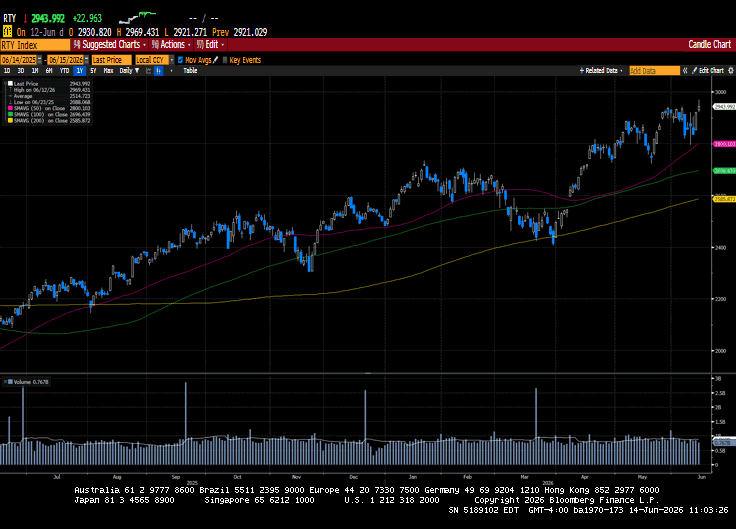
The S&P 500, Dow, and NASDAQ rose by 0.7% this week, while the Russell 2000 increased by 3.9%. There was a broadening out in markets with several sectors participating in the rally. Semiconductor equipment and memory stood out as leaders, while the Software sector lagged due to a weak outlook from Oracle. US Treasuries were bid up across the curve, with shorter-duration paper outperforming. The 2-year yield declined by seven basis points to 4.09%, while the 10-year yield fell by five basis points to 4.49%. As I mentioned, Oil prices tumbled by $5.69, closing the week at $84.88 per barrel. Gold prices fell by 2.9% to $4,239.20 per ounce. Silver prices fell by $1.13, or 1.6%, to $ 67.97 per ounce. Copper prices increased by 2.3% to $6.44 per Lb. Bitcoin’s price rose by 4% to $64,400. The VIX, a measure of market volatility, fell 17% to 17.68. The US Dollar index declined by 0.3% to close the week at 99.7.

This week’s economic calendar highlighted the Consumer Price Index and the Producer Price Index. Headline CPI came in at 0.5% versus the expected 0.6% and was up 4.2% year-over-year, above the 3.8% increase in April. 60% of the increase in the headline number was due to energy prices. Core CPI, which strips out food and energy prices, rose 0.2%, less than the consensus estimate of 0.4%. The Core reading increased to 2.9% from 2.8% in April, year over year. Headline PPI increased by 1.1% versus the estimate of 0.8% and was up 6.5% year over year. The Core PPI increased by 0.4%, less than the anticipated increase of 0.5%, and was up 4.9% over the last year. Initial Jobless claims for the week rose by 4k to 229k, while Continuing Claims increased by 14k to 1795k. A preliminary look at the June University of Michigan Consumer Sentiment increased to 48.9 from the final reading in May of 44.8.

Investment advisory services offered through Foundations Investment Advisors, LLC (“FIA”), an SEC registered investment adviser. FIA’s Darren Leavitt authors this commentary which may include information and statistical data obtained from and/or prepared by third party sources that FIA deems reliable but in no way does FIA guarantee the accuracy or completeness. All such third party information and statistical data contained herein is subject to change without notice. Nothing herein constitutes legal, tax or investment advice or any recommendation that any security, portfolio of securities, or investment strategy is suitable for any specific person. Personal investment advice can only be rendered after the engagement of FIA for services, execution of required documentation, including receipt of required disclosures. All investments involve risk and past performance is no guarantee of future results. For registration information on FIA, please go to https://adviserinfo.sec.gov/ and search by our firm name or by our CRD #175083. Advisory services are only offered to clients or prospective clients where FIA and its representatives are properly licensed or exempted.
Children vs. Grandchildren Beneficiaries and the First Required Minimum Distribution Year: Today’s Slott Report Mailbag
By Ian Berger, JD
IRA Analyst
Question:
Are the rules for a grandchild who inherits an IRA the same as the rules for a child who inherits?
Thank you,
Steven
Answer:
Hi Steven,
No, the rules are very different. An IRA owner’s child who is under age 21 when the owner dies is considered an “eligible designated beneficiary” (EDB). As such, the child can stretch required minimum distributions (RMDs) until the year he turns age 30, but must empty the remaining inherited account by the end of his age-31 year. However, if the IRA owner died before the owner’s required beginning date (RBD) for starting RMDs, the child can elect instead to have the 10-year payment rule apply. In that case, the inherited IRA must be emptied by the 10th year following the year of the IRA owner’s death, but no annual RMDs are required in years 1-9. On the other hand, a grandchild is a “non-eligible designated beneficiary” (NEDB). So, the 10-year payment rule applies and, if the IRA owner died on or after his RBD, the grandchild also must take annual RMDs in years 1-9.
Question:
I have a client who was born on November 27, 1959. Does he need to start RMDs at age 73 or age 75?
Thank you,
Glenn
Answer:
Hi Glenn,
For anyone born after 1950 and before 1960, such as your client, the first RMD year is age 73. The age-75 first RMD year applies to those born in 1960 or later. Note that the RMD for the first RMD year can be delayed until April 1 of the following year, but then two RMDs must be taken in the following year – one for the first RMD year and one for the following year.
If you have technical questions you would like to have answered, be sure to submit them to mailbag@irahelp.com, to be answered on an upcoming Slott Report Mailbag, published every Thursday.
https://irahelp.com/children-vs-grandchildren-beneficiaries-and-the-first-required-minimum-distribution-year-todays-slott-report-mailbag/

Mid-Year Financial Checkup: Why June Is the Perfect Time to Reassess Your Financial Plan
As we reach the halfway point of the year, many people take stock of their health, careers, and personal goals—but often overlook one of the most important areas of their lives: their finances. Just as an annual physical helps identify potential health concerns before they become serious, a mid-year financial review can uncover opportunities, address challenges, and help keep you on track toward your long-term objectives.
Whether you’re approaching retirement, already retired, or simply working toward greater financial security, now is an ideal time to evaluate where you stand and determine if adjustments are needed.
Why a Mid-Year Financial Review Matters
The financial landscape can change quickly. Market fluctuations, inflation, interest rates, tax laws, and personal circumstances all play a role in shaping your financial future. A strategy that made sense in January may benefit from adjustments today.
A mid-year review allows you to:
Measure progress toward your goals
Identify potential risks
Rebalance investments if necessary
Review retirement income plans
Evaluate insurance coverage
Consider tax-saving opportunities before year-end
The earlier adjustments are made, the more time you have to benefit from them.
Review Your Retirement Readiness
One of the most common questions people ask is: “Am I still on track for retirement?”
A mid-year checkup is an excellent opportunity to review:
Retirement account balances
Contribution levels
Pension and Social Security projections
Expected retirement age
Income needs during retirement
If market performance or life circumstances have changed, your retirement strategy may need updates to ensure it continues supporting your long-term goals.
Revisit Your Investment Allocation
Many investors create a portfolio based on their risk tolerance and objectives, but over time, market movements can cause allocations to drift.
For example, a portfolio originally designed to hold 60% stocks and 40% fixed-income investments may look very different after a strong market rally.
Rebalancing helps:
Maintain your desired level of risk
Preserve diversification
Align investments with your current goals
Reduce exposure to concentrated positions
A professional review can help determine whether your portfolio remains appropriate for your current stage of life.
Examine Tax Planning Opportunities
Many tax-saving opportunities are easier to implement before the end of the year.
Mid-year planning may include:
Roth conversion evaluations
Charitable giving strategies
Capital gains management
Required Minimum Distribution (RMD) planning
Tax-efficient withdrawal strategies
Waiting until December often limits your options. Taking action now may provide greater flexibility and potential tax benefits.
Evaluate Your Insurance Coverage
Life changes quickly. Marriage, divorce, new grandchildren, retirement, home purchases, and business ownership can all impact your insurance needs.
Reviewing your coverage helps ensure you have appropriate protection for:
Life insurance
Long-term care planning
Disability income protection
Health insurance and Medicare coverage
Umbrella liability protection
Insurance should evolve alongside your financial plan rather than remain static for years at a time.
Check Your Estate Planning Documents
Estate planning is often postponed until a crisis occurs. However, reviewing documents regularly can help ensure your wishes remain accurately reflected.
Consider reviewing:
Wills
Trusts
Powers of Attorney
Healthcare directives
Beneficiary designations
Even small changes in family dynamics can create unintended consequences if documents are outdated.
Prepare for the Second Half of the Year
Financial success is rarely the result of one major decision. More often, it comes from consistently making informed adjustments over time.
The second half of the year offers an opportunity to:
Increase savings contributions
Reduce unnecessary expenses
Pay down high-interest debt
Reassess retirement goals
Implement tax strategies
Strengthen your overall financial foundation
The Bottom Line
A mid-year financial review is not about predicting the future—it’s about preparing for it. Taking time now to evaluate your progress can help you make more informed decisions and stay focused on what matters most.
If it’s been more than six months since you’ve reviewed your financial strategy, retirement plan, investments, or insurance coverage, now may be the perfect time to schedule a comprehensive financial checkup.
The most successful financial plans are not set-and-forget strategies—they are living plans that evolve as life changes.
Ready to see if you’re still on track toward your financial goals?
Contact our office today to schedule a complimentary financial review. Together, we can evaluate your current strategy, identify opportunities, and help position you for a more confident financial future.
3 IRA Tax Breaks for Same-Sex Couples
By Sarah Brenner, JD
Director of Retirement Education
June is PRIDE Month. June also marks the anniversary of the landmark Supreme Court case Obergefell v. Hodges, which legalized same-sex marriage. When it comes to IRA rules, spouses have many advantages, and couples in same-sex marriages are no exception. From enhanced contribution rules to special rules for beneficiaries, marriage has its benefits when it comes to your retirement account.
Here are three IRA tax breaks available for married couples that same-sex couples should know about:
1. Enhanced Contribution Rules
If you are not working, you may think you are ineligible to make an IRA contribution. That might not be the case. If you are married, you may be able to contribute to your IRA based on your spouse’s taxable compensation for the year. An individual could make spousal IRA contributions in some years and regular IRA contributions in others.
To make a spousal contribution for 2026, you must be legally married on December 31, 2026 and file a joint federal income tax return for 2026. For same-sex couples, this would not include civil unions. If you are divorced or legally separated as of that date, neither is eligible for a spousal contribution, even if they were married earlier in the year.
2. Smaller RMDs for Some
When you reach age 73, you must start taking distributions annually, called required minimum distributions (RMDs). These are calculated by using life expectancy tables provided by the IRS. IRA spouse beneficiaries who are more than ten years younger than the IRA owner may use the Joint Life Expectancy Table. This results in smaller RMDs versus using the Uniform Lifetime Table, which is required to be used to calculate lifetime RMDs for all other IRA owners.
3. Special Rules for Spouse Beneficiaries
Only a spouse beneficiary can roll over or transfer an inherited IRA from her deceased spouse into her own IRA. This is known as a spousal rollover. There is no deadline for a spousal rollover. Once the spousal rollover is done, the funds are treated like any other IRA funds you own. There are no RMDs if you are not yet age 73. Non-spouse beneficiaries do not have this “spousal rollover” option.
Not every spouse beneficiary will want to do a spousal rollover. Sometimes, to avoid early distribution penalties, it can make more sense to keep an inherited IRA. Under the SECURE Act, most beneficiaries will need to empty the inherited IRA by December 31 of the tenth year following the year of death. However, eligible designated beneficiaries (EDBs) will still be able to take RMDs from the inherited IRA based on their own life expectancy. A spouse is one of those EDBs.
As a spouse beneficiary you can take advantage of a special rule unavailable to non-spouse beneficiaries. If you are the sole beneficiary, and if your spouse dies before their required beginning date (RBD), you can delay RMDs from the inherited IRA until the year your spouse would have attained age 73. That can mean a delay of many years before RMDs from the inherited IRA must begin.
Even when spouse beneficiaries are subject to RMDs, they receive a special break when calculating that amount. While non-spouse beneficiaries must use the Single Life Expectancy chart, spouse beneficiaries have the advantage of being able to use the Uniform Lifetime Table to calculate their life expectancy. This results in lower RMDs for spouse EDBs compared to non-spouse EDBs.
If you have technical questions you would like to have answered, be sure to submit them to mailbag@irahelp.com, to be answered on an upcoming Slott Report Mailbag, published every Thursday.
https://irahelp.com/3-ira-tax-breaks-for-same-sex-couples/
Roth IRA Conversions Do Not Count for Roth IRA Contribution Eligibility
By Andy Ives, CFP®, AIF®
IRA Analyst
If a person wants to make a Roth IRA contribution, there are two primary hurdles to get over. First, a person must have taxable compensation to make the contribution. Items like W-2 wages, commissions, professional fees or bonuses all qualify. Income from self-employment also qualifies. What does not qualify as “compensation” for IRA eligibility are things like pension and annuity income, rental income, interest income, dividend income or capital gains.
Assuming a person has taxable compensation, the next hurdle is to make sure their income level isn’t too high. Roth IRAs have income phaseout ranges. Individuals with income over the phaseout level are precluded from making a direct Roth IRA contribution. Those within the phaseout range can make a reduced Roth IRA contribution, and those below the phaseout range can make a full Roth IRA contribution. The 2026 Roth IRA phaseout ranges are $242,000 – $252,000 for those married filing jointly, and $153,000 – $168,000 for single or head-of-household filers. Note that these are modified adjusted gross income (MAGI) numbers. (For anyone married/filing separate – be careful! Your phaseout range is $0 – $10,000.)
Now that we know the basic requirements for Roth IRA eligibility, do Roth IRA conversions have any impact? After all, a Roth conversion is a taxable event that adds to a person’s income. Answer: Roth conversions are excluded from MAGI when considering the phaseout ranges. This is clearly stated in IRS Publication 590-A, “Contributions to Individual Retirement Arrangements (IRAs).”
On page 41 of the 2025 version of Publication 590-A, we find “Worksheet 2-1. Modified Adjusted Gross Income for Roth IRA Purposes.” This worksheet helps a taxpayer pinpoint exactly what their MAGI is so they can determine if they can proceed with a full Roth IRA contribution, a partial contribution, or none at all.
- Line 1 of the worksheet is for the tax filer’s adjusted gross income (line 11a, Form 1040).
- Line 2 is for any income resulting from the conversion of an IRA to a Roth IRA.
- Line 3 says to subtract Line 2 from Line 1.
There are additional lines on the worksheet, but for this Slott Report™ entry we only need the first three to confirm the title of this article: Roth conversions do not count for Roth IRA contribution eligibility.
Example: Jim and Jane file a married/filing joint tax return. Jim and Jane’s combined W-2 income in 2026 is $200,000. Jim did a Roth conversion in January of 2026 for $100,000. With $300,000 of total income for the year, the couple thinks they are ineligible to make direct Roth IRA contributions. Jim and Jane have an astute financial advisor who tells them that Jim’s Roth conversion does not count when considering Roth IRA eligibility. Since they are under the phaseout range, both Jim and Jane proceed with full Roth IRA contributions in 2026.
If you have technical questions you would like to have answered, be sure to submit them to mailbag@irahelp.com, to be answered on an upcoming Slott Report Mailbag, published every Thursday.
https://irahelp.com/roth-ira-conversions-do-not-count-for-roth-ira-contribution-eligibility/
Weekly Market Commentary
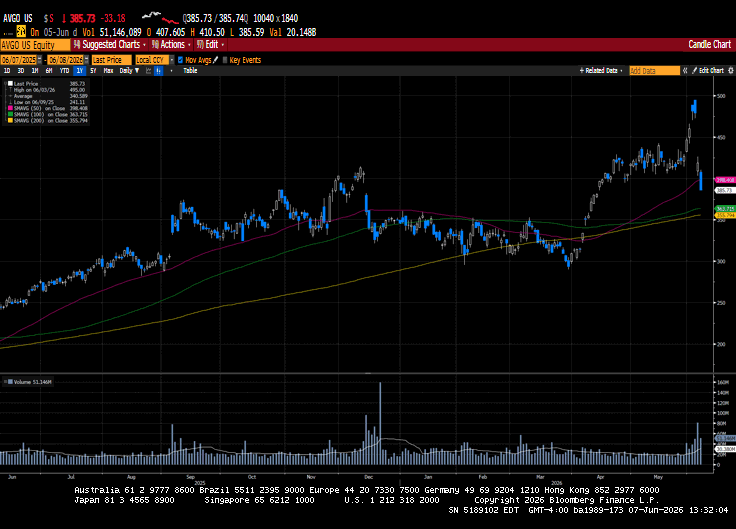
The S&P 500 was unable to make it a 10th straight week of gains as the market pulled back sharply late in the week amid a sense that the AI trade may have gone too far, too fast. Technology issues were absolutely hammered on Thursday and Friday after better-than-expected 1st quarter results from Broadcom, Ciena, and CrowdStrike were met with a massive sell-off. Broadcom’s outlook was stronger than forecast, but the company suggested that the Artificial Intelligence boom will be met with supply chain issues as we move into 2027 and 2028. The supply chain kinks could take various forms, including a lack of energy infrastructure to support high-performance computing and an insufficient supply of rare earth metals needed for manufacturing semiconductors and other technological components. The sharp sell may be followed by further weakness, but the consolidation of the move we have seen from the March lows actually seems healthy for a long-term bull market. We still need to contend with the Iran war, where there has been very little clarity on the progress toward extending the ceasefire and reopening the Strait of Hormuz. There was an uptick in rhetoric around the supply chain issues that will arise if the Strait remains closed for another month. Oil traded higher as tensions appear to be escalating rather than declining. Higher energy costs, coupled with a strong Employment Situation report, sent yields materially higher for the week and strengthened the argument for the Federal Reserve to hike interest rates later this year. It’s now widely expected that the European Central Bank will raise its monetary policy rate in June, while strong inflation data in Japan, along with a weakening Yen, prompted Bank of Japan officials to consider a rate hike at its next meeting.

The S&P 500 lost 2.6%, the Dow shed 0.3%, the NASDAQ declined by 4.7%, and the Russell 2000 gave back 2.9%. The CBOE’s gauge of equity volatility, the VIX, increased by 40% to 21.51. Yields were higher across the curve, but shorter-duration paper was hit harder than longer-dated paper, thus flattening the curve. The 2-year yield rose 16 basis points to 4.16%, while the 10-year yield rose 9 basis points to 4.54%. WTI crude increased by 3.16% or $3.15 to $90.57 per barrel. Gold prices fell by 4.9% to $4367.40 per ounce. Silver prices plunged 8.6% to $69.10 per ounce. Copper prices fell by $0.10 to $6.29 per Lb. Bitcoin’s price fell by 15.54% to $62, 200. The US Dollar index rose by 1.2% to 100.5. The Japanese Yen fell against the US Dollar to 160.16, a level that will likely prompt the BOJ to intervene again in the currency markets.

The economic calendar was skewed to labor market data. JOLTS showed an increase in job openings to 7.618m from 6.887m. ADP private payrolls increased to 122k versus the consensus estimate of 100k. Non-Farm Payrolls increased by 172k vs. the consensus estimate of 96k, while Private Payrolls increased by 120k vs. the estimated 89k. The Unemployment rate stayed at 4.3% as Average Hourly earnings ticked 0.3% higher. The Average Work Week stayed at 34.3 hours. Initial Jobless Claims increased by 13k to 225k, while Continuing Claims fell by 8k to 1777k. Strong labor data raised expectations for a rate hike. There is now a 79% chance of a rate hike in 2026 priced into the markets. ISM Manufacturing and Services were both better than expected at 54 and 54.5, respectively.

Investment advisory services offered through Foundations Investment Advisors, LLC (“FIA”), an SEC registered investment adviser. FIA’s Darren Leavitt authors this commentary which may include information and statistical data obtained from and/or prepared by third party sources that FIA deems reliable but in no way does FIA guarantee the accuracy or completeness. All such third party information and statistical data contained herein is subject to change without notice. Nothing herein constitutes legal, tax or investment advice or any recommendation that any security, portfolio of securities, or investment strategy is suitable for any specific person. Personal investment advice can only be rendered after the engagement of FIA for services, execution of required documentation, including receipt of required disclosures. All investments involve risk and past performance is no guarantee of future results. For registration information on FIA, please go to https://adviserinfo.sec.gov/ and search by our firm name or by our CRD #175083. Advisory services are only offered to clients or prospective clients where FIA and its representatives are properly licensed or exempted.
The Once-Per-Year IRA Rollover Rule and 529-to-Roth Transfers: Today’s Slott Report Mailbag
By Sarah Brenner, JD
Director of Retirement Education
Question:
Hello,
Last December 15, I withdrew $10,000 from my traditional IRA. Thirty days later, I deposited $4,000 in a Roth IRA and $6,000 in a different traditional IRA. Can I treat the $4,000 Roth IRA deposit as a taxable Roth IRA conversion, and treat the $6,000 traditional IRA deposit as a non-taxable IRA rollover? Or, have I violated the once-per-year IRA rollover rule?
Thank you,
Jeffrey
Answer:
Hi Jeffrey,
There is no problem here with the once-per-year rollover rule. The rule limits you to rolling over one distribution received from your IRAs within a 365-day period. Here you only have one distribution. It does not matter if that distribution is split and rolled over to multiple IRAs. Also, one of your rollovers was a Roth IRA conversion, and the once-per-year rollover rule never applies to Roth IRA conversions.
Question:
I am both the owner and beneficiary of a 529 plan, and my wife is owner and beneficiary of another one. If we have $20,000 in earned income in 2026, what is the total that my wife and I are allowed to roll over from our 529 plans to make contributions to our Roth IRAs?
Thanks,
Mike and Becky
Answer:
Hi Mike and Becky,
The SECURE 2.0 Act allows up to $35,000 total to be moved from a 529 plan to a Roth IRA. The rollover counts towards the annual Roth IRA contribution limit, and you must have earned income to be eligible. However, the Roth IRA contribution income limits do not apply. For 2026, if you have $20,000 in earned income you can each contribute $7,500 ($8,600 if you are age 50 or over) to a Roth IRA from the 529 plan of which you are the beneficiary.
If you have technical questions you would like to have answered, be sure to submit them to mailbag@irahelp.com, to be answered on an upcoming Slott Report Mailbag, published every Thursday.
https://irahelp.com/the-once-per-year-ira-rollover-rule-and-529-to-roth-transfers-todays-slott-report-mailbag/

Retirement Isn’t Just About Saving Money—It’s About Creating Income You Can Count On
For many Americans, retirement planning begins with one simple question: “How much money do I need to retire?” While building savings is important, a more critical question is often overlooked:
“How will I create a reliable income throughout retirement?”
Retirement today can last 20, 30, or even 40 years. Without a well-designed income strategy, even substantial savings can face challenges from market volatility, inflation, taxes, and unexpected expenses.
That’s why successful retirement planning isn’t just about accumulating assets—it’s about creating a strategy that helps those assets support your lifestyle for years to come.
The Shift From Accumulation to Distribution
During your working years, the focus is typically on saving and investing. Contributions to retirement accounts, employer-sponsored plans, and personal investments are all designed to help grow your wealth.
However, retirement introduces a completely different challenge: turning those accumulated assets into a dependable income stream.
This transition requires careful planning and often involves decisions regarding:
- Social Security timing
- Retirement account withdrawals
- Tax-efficient income strategies
- Healthcare and long-term care planning
- Investment risk management
- Legacy and estate considerations
A thoughtful distribution strategy can help maximize income while preserving assets for the future.
Understanding Retirement Income Sources
Most retirees receive income from multiple sources. These may include:
Social Security Benefits
For many retirees, Social Security provides an important foundation of guaranteed income. Determining when to claim benefits can significantly impact lifetime income and should be carefully evaluated.
Retirement Accounts
401(k)s, IRAs, and other qualified plans often represent a substantial portion of retirement savings. Withdrawal strategies can greatly influence tax obligations and portfolio longevity.
Investment Portfolios
Stocks, bonds, mutual funds, and other investments can help provide growth and income, but they should be aligned with your risk tolerance and retirement objectives.
Insurance-Based Solutions
Certain insurance products may offer features designed to provide predictable income, principal protection, or legacy benefits depending on an individual’s goals and circumstances.
Managing Risk in Retirement
One of the greatest concerns retirees face is the possibility of outliving their savings. Unlike previous generations, many retirees no longer have access to traditional pension plans that provide guaranteed lifetime income.
Additional risks include:
- Market downturns
- Rising healthcare costs
- Inflation
- Increased longevity
- Unexpected life events
A comprehensive retirement strategy seeks to address these risks while helping maintain financial confidence throughout retirement.
The Importance of Tax Planning
Taxes don’t disappear when you retire.
In fact, many retirees are surprised to discover that withdrawals from certain retirement accounts, Social Security benefits, investment gains, and other income sources may create tax liabilities.
Strategic planning may help reduce unnecessary taxes and improve overall retirement income efficiency.
Areas often reviewed include:
- Required Minimum Distributions (RMDs)
- Roth conversion opportunities
- Tax diversification strategies
- Charitable giving techniques
- Legacy planning considerations
Healthcare and Long-Term Care Considerations
Healthcare costs remain one of the largest expenses retirees face.
While Medicare can help cover many medical expenses, it does not cover everything. Long-term care services, extended healthcare needs, and out-of-pocket expenses can place significant pressure on retirement assets.
Planning ahead can help retirees prepare for these potential costs while protecting their financial goals.
Retirement Planning Is Personal
No two retirements are exactly alike.
Some individuals prioritize travel and leisure. Others focus on family, charitable giving, business ventures, or creating a financial legacy for future generations.
Because every situation is unique, retirement planning should be customized to reflect individual goals, resources, risk tolerance, and personal values.
Building a Retirement Strategy with Confidence
A successful retirement is about more than reaching a specific account balance. It’s about creating a strategy that helps support the lifestyle you’ve worked hard to achieve.
By coordinating investments, insurance solutions, tax strategies, healthcare planning, and income generation, individuals can position themselves to navigate retirement with greater confidence and clarity.
Partnering with a Trusted Financial Professional
Retirement planning involves many moving parts, and making informed decisions can have a lasting impact on your financial future.
An experienced financial and insurance professional can help evaluate your current situation, identify potential gaps, and develop a personalized strategy designed to help you pursue your long-term goals.
The future you envision deserves a plan. If you’re preparing for retirement or already retired, now is the perfect time to review your strategy and ensure your income, assets, and protection plans are working together to support the life you want to live.
What in the World is Modified Adjusted Income (MAGI), and Why Does It Matter?
By Ian Berger, JD
IRA Analyst
Some of you may have come across the term “modified adjusted gross income” (MAGI) and figured it has something to do with “adjusted gross income” (AGI). But, unless you’re a tax geek, that may be all you know.
That’s a shame because when it comes to tax breaks, MAGI is a very important number. It determines eligibility for many federal income tax deductions and exclusions. In the IRA world, MAGI determines eligibility for deductible traditional IRA contributions and eligibility for annual Roth IRA contributions.
So, what exactly is MAGI? MAGI always starts with AGI. AGI is your total income subject to taxes. This includes things like wages, interest and dividends, capital gains, and retirement plan and IRA income. For most people, total income is exactly the same as AGI. But in some cases, total income must be adjusted before you get to AGI. (AGI can be found on line 11a of your Form 1040.)
Often, MAGI will be the same as AGI. But sometimes certain items must be added back, or can be subtracted from AGI to get to MAGI. What’s really confusing is that there isn’t one uniform definition of MAGI in the tax law. Instead, the specific required adjustments to AGI are completely different, depending on the specific tax rule using MAGI. In fact, there are over a dozen different versions of MAGI! (And none of those definitions are reported on your 1040.)
The version of MAGI used for IRA deductibility and for Roth IRA eligibility requires you to add several items to AGI, the most common of which is student loan interest. For Roth IRA eligibility only, you also get to subtract out income generated if you converted an IRA or a pre-tax retirement plan to a Roth IRA in the same year. IRS Publication 590-A includes helpful worksheets for IRA deductibility and Roth IRA eligibility.
Here’s one last point that trips up some people: On your tax return, you can reduce your AGI by either taking a flat dollar amount deduction (the standard deduction) or itemizing deductions. You can further reduce AGI by claiming other deductions, such as those under the One Big Beautiful Bill Act (OBBBA). Reducing AGI by these deductions produces your total taxable income – the amount you owe federal taxes on. But taxable income is a totally different calculation than any definition of MAGI. No matter which MAGI definition is used, MAGI is always determined before the standard deduction or itemized deductions are taken. So, taxable income has nothing to do with any definition of MAGI.
Example: Zoe, age 45 and single, had a total income of $150,000 in 2025. That year, Zoe made $3,000 of health savings account (HSA) contributions directly to the HSA provider (rather than through payroll deduction). She can subtract that $3,000 from total income, bringing her 2025 AGI down to $147,000. Zoe wanted to make a 2025 Roth IRA contribution. The MAGI used for Roth IRA eligibility requires that certain tax items be added back to AGI, but Zoe didn’t have any of those items. So, her MAGI was also $147,000. For 2025, single taxpayers could make a full Roth IRA contribution if MAGI was below $150,000. So, Zoe qualified for a full $7,000 2025 contribution. Meanwhile, in doing her taxes, Zoe elected to use the standard deduction ($15,000) to reduce her AGI from $147,000 to $132,000. That $132,000 was her 2025 taxable income, the amount that she had to pay taxes on. But Zoe’s MAGI of $147,000, used to determine her Roth IRA eligibility, was determined before the $15,000 standard deduction. So, her $132,000 of taxable income had nothing to do with her MAGI of $147,000.
Still confused? A knowledgeable financial advisor or tax professional can help.
If you have technical questions you would like to have answered, be sure to submit them to mailbag@irahelp.com, to be answered on an upcoming Slott Report Mailbag, published every Thursday.
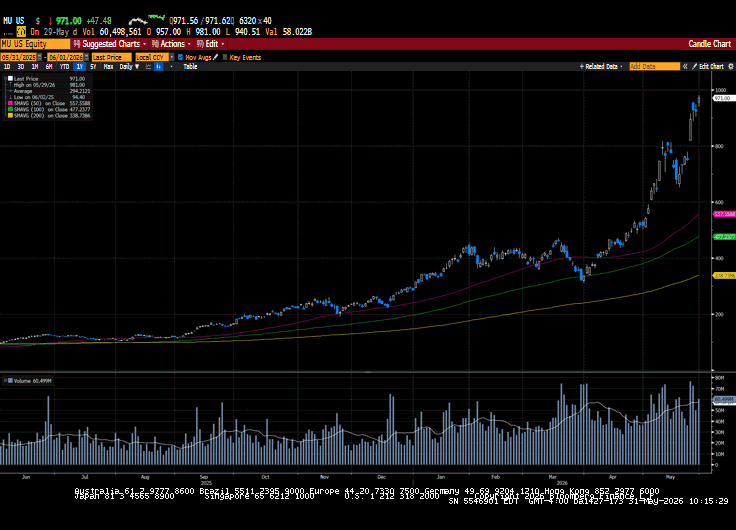
Weekly Market Commentary
Global equity markets rallied in May and received a final boost in the final week of the month on optimism that the US and Iran were close to extending the current ceasefire agreement. However, the negotiations between the two parties were described as “clear as mud” in a recent article I read, and the analogy couldn’t be truer. Despite the day-to-day back-and-forth in the negotiations, markets were able to look past the fact that the Strait of Hormuz has been closed for three months, elevating energy costs around the world and increasing global inflation. Several inflation data points over the month were higher than expected, which in turn sent US yields higher and the prospect of a rate cut by the Federal Reserve lower. Q1 earnings continued to come in much better than expected, and commentary from several companies remained constructive, especially on the artificial intelligence front. Earnings per Share growth of nearly 30% was the catalyst that drove markets higher despite the current geopolitical landscape and a heightened inflationary environment. In the last week, Dell and Snowflake announced fantastic first-quarter results. Capital spending on AI pushed the market caps of Micron Technology, Samsung, and SK Hynix above $ 1 trillion. The rebound from the March lows was fast and steep, sending the S&P 500, Dow, and NASDAQ to several new highs in May. In the coming month, investors will await arguably the most anticipated IPO, SpaceX. The company is set to go public at a $2 trillion valuation, and the hype has sent shares of other space economy companies materially higher over the last few months. There is a ton of optimism in the market right now, and while it does appear the market may be over its skis a bit, we remain constructive on the idea of continued solid corporate earnings, positive inertia from the AI infrastructure build out, and on hopes that the US and Iran can end the conflict and open the Strait, which in time will lower global energy prices.

The S&P 500 gained 4.95% in May, added 1.44% this week, and is up 11.25% year to date. The Dow increased by 0.9% this week, gained 3.25% in May, and is up 6.86% for the year. NASDAQ added 2.44% this week, was up 7.47% in May, and has advanced 16.34% for the year. The Russell 2000 gained 1.7% for the week, was up 3.89% for May, and has increased by 18.27% this year.
The US Treasury curve flattened over the month of May as shorter tenured paper sold off more than the longer end of the curve. The 2-year yield fell eleven basis points this week to 4.01%, but its yield increased by twenty-four basis points in May. The 10-year yield also fell by eleven basis points this week to 4.45% and was up six basis points over the month of May. A recalibration of monetary policy was evident in May, as inflation remained elevated due to higher energy costs and evidence that these costs have begun to raise prices for other goods and services. Kevin Warsh was sworn in as the new Fed Chairman, where he will face a growing number of Fed officials who have voiced the need for higher rates for longer.
West Texas Intermediate Crude trade over the last month was volatile to say the least. Oil prices fell 9% last week and fell 16.8% for the month of May. WTI closed the month at $87.42 a barrel. Gold prices increased by 1.4% for the week and fell by $38.20 for the month, closing at $4,592.70 per ounce. Silver prices were unchanged for the week and gained 3.1% for the month, closing at $75.88 per ounce. Copper prices increased by a penny this week, adding $0.41, or 6.8%, for the month to close at $6.39 per pound. Bitcoin’s price ended the week at $73,800, down 2.12% for the week and off 3.09% for the month. The US Dollar index was up 0.8% for the month. Of note, the Japanese Yen closed the month at 159.22, just below the 160 level that induced the Bank of Japan to intervene. What is troubling is that, despite interventions throughout the month totaling nearly $73 billion, the Yen has crept back to this important level.

This week’s economic calendar was highlighted by the Fed’s preferred measure of inflation, the PCE. The reading showed better-than-expected results for both the headline and core on a month-over-month basis, but showed increased levels of inflation on a year-over-year basis. The headline reading showed an increase of 0.4% versus the consensus of 0.5%, while it increased by 3.8% from 3.5% in April. The Core reading, which strips out food and energy prices, increased by 0.2% in May versus the estimated increase of 0.3%. The year-over-year figure came in at 3.3%, up from 3.2% in April. Personal income in May was flat, while Personal Spending increased by 0.5%. Consumer Confidence fell to 93.1 from 93.8. The 2nd look at the 1st quarter GDP, fell to 1.6% from 2.2%. Initial Claims increased by 5k to 215k, while Continuing Claims increased by 15k to 1786k.

Investment advisory services offered through Foundations Investment Advisors, LLC (“FIA”), an SEC registered investment adviser. FIA’s Darren Leavitt authors this commentary which may include information and statistical data obtained from and/or prepared by third party sources that FIA deems reliable but in no way does FIA guarantee the accuracy or completeness. All such third party information and statistical data contained herein is subject to change without notice. Nothing herein constitutes legal, tax or investment advice or any recommendation that any security, portfolio of securities, or investment strategy is suitable for any specific person. Personal investment advice can only be rendered after the engagement of FIA for services, execution of required documentation, including receipt of required disclosures. All investments involve risk and past performance is no guarantee of future results. For registration information on FIA, please go to https://adviserinfo.sec.gov/ and search by our firm name or by our CRD #175083. Advisory services are only offered to clients or prospective clients where FIA and its representatives are properly licensed or exempted.

Kitchen Remodeling Trends That Add Value, Functionality, and Style to Your Home
The kitchen is often called the heart of the home—and for good reason. It’s where families gather, meals are shared, and memories are made. As one of the most frequently used spaces in any house, a well-designed kitchen can dramatically improve both daily living and overall property value.
Whether you’re planning a complete renovation or updating key features, today’s kitchen remodeling trends focus on creating beautiful, functional spaces that fit modern lifestyles.
Why Remodel Your Kitchen?
A kitchen remodel is one of the most rewarding home improvement projects homeowners can undertake. Beyond enhancing appearance, remodeling can improve functionality, increase storage, boost energy efficiency, and make your home more enjoyable for years to come.
Many homeowners also find that kitchen renovations offer one of the highest returns on investment when it comes time to sell.
Open-Concept Living Continues to Grow
One of the most requested remodeling upgrades is creating a more open and connected floor plan. Removing non-load-bearing walls can help kitchens flow seamlessly into dining and living areas, making the space feel larger and more inviting.
Open-concept designs are especially popular for families who enjoy entertaining guests or keeping conversations going while preparing meals.
Large Kitchen Islands Take Center Stage
Kitchen islands have become much more than additional counter space. Today’s homeowners are using oversized islands as multipurpose hubs for cooking, dining, homework, and socializing.
Popular island features include:
- Additional storage cabinets
- Built-in microwaves
- Beverage refrigerators
- Seating for family and guests
- Charging stations and electrical outlets
A thoughtfully designed island can quickly become the centerpiece of the entire kitchen.
Smart Storage Solutions
Modern kitchen remodeling focuses heavily on maximizing organization and reducing clutter.
Popular storage upgrades include:
- Pull-out pantry shelves
- Deep drawer storage
- Hidden trash and recycling compartments
- Corner cabinet organizers
- Appliance garages
- Custom spice and utensil storage
These solutions help homeowners make the most of every square foot while keeping countertops clean and functional.
Durable and Beautiful Countertops
Countertops remain one of the most important design decisions during a kitchen renovation.
Quartz continues to be a leading choice due to its durability, low maintenance requirements, and wide variety of colors and patterns. Many homeowners also choose natural stone options such as granite or marble for their unique beauty and timeless appeal.
The right countertop can instantly elevate the look and feel of the entire kitchen.
Energy-Efficient Appliances
Today’s appliances offer improved performance while using less energy and water. Homeowners are increasingly selecting ENERGY STAR® rated refrigerators, dishwashers, ovens, and cooktops that help reduce utility costs while supporting environmental sustainability.
Many smart appliances also provide added convenience through mobile controls, scheduling features, and advanced cooking technologies.
Custom Cabinetry for Personalized Design
Cabinets often define the overall style of a kitchen. Custom and semi-custom cabinetry allows homeowners to create a look that reflects their personal taste while maximizing storage and functionality.
Current cabinet trends include:
- Shaker-style doors
- Two-tone color combinations
- Natural wood finishes
- Soft-close hinges and drawers
- Floor-to-ceiling cabinetry
- Hidden storage compartments
These features blend timeless design with modern convenience.
Improved Lighting Makes a Big Difference
Lighting plays a critical role in both the functionality and atmosphere of a kitchen.
A successful remodel typically combines:
- Recessed ceiling lighting
- Pendant lights above islands
- Under-cabinet task lighting
- Accent lighting for display areas
Layered lighting creates a bright workspace while adding warmth and visual appeal.
Investing in Your Home’s Future
A kitchen remodel isn’t simply about aesthetics—it’s an investment in your home’s comfort, functionality, and long-term value. Whether you’re updating an outdated layout or creating your dream kitchen from the ground up, thoughtful planning and professional craftsmanship can transform your space into one you’ll enjoy every day.
Partner with Experienced Kitchen Remodeling Professionals
Every successful kitchen renovation starts with a clear vision and a trusted construction team. From design and planning to construction and finishing details, experienced professionals can help bring your ideas to life while ensuring quality workmanship every step of the way.
If you’re considering a kitchen remodel, now is the perfect time to explore the possibilities. A beautifully remodeled kitchen can enhance your lifestyle, improve your home’s value, and become the centerpiece of your home for years to come.
Ready to transform your kitchen? Contact our team today to schedule a consultation and start planning the kitchen you’ve always wanted.
Five Things to Know about the Five-Year Rule on Converted Roth Funds
By Sarah Brenner, JD
Director of Retirement Education
If you are under age 59½ and you converted your traditional IRA to a Roth IRA, you will need to watch out for the five-year rule for penalty-free distributions of converted funds. Not understanding how the rule works can result in unexpected penalties when you withdraw your Roth IRA funds. Here are five things you need to know:
- If you make contributions to your Roth IRA, you can always access those funds tax- and penalty-free. You can also always access your converted funds tax-free – even if you are under age 59½. That makes sense because you already paid the tax bill when you did the conversion. There is no five-year rule to worry about with regard to taxation of converted funds.
- While converted funds are never taxable when distributed from your Roth IRA, it’s a different story when it comes to the 10% early distribution penalty. If you are under age 59½, you must normally satisfy a five-year holding period on funds that were taxable when converted before you can access those funds penalty-free. However, if you qualify for a penalty exception, such as for disability or higher education expenses, the penalty is waived even if the five-year period hasn’t been met.
- The five-year holding period will restart for each year a conversion is done and is effective as of January 1 of the year of conversion. If a conversion was done any time in 2026, the five-year holding period for that conversion begins on January 1, 2026. If two more conversions are done in 2027, the five-year rule for both those conversions would start January 1, 2027.
- The best way to understand this five-year rule for penalty-free distributions of converted funds is to know exactly what it is set up to prevent. When you take a distribution from your traditional IRA and convert it to a Roth IRA, that distribution is taxable but not subject to the 10% early distribution penalty. So, soon after Roth IRAs became law, those looking for tax loopholes started advising traditional IRA owners under 59½ that they could get out of the 10% penalty by doing a conversion. IRA owners could just convert their IRA to a Roth IRA and then, the next day, withdraw funds from the Roth IRA tax- and penalty-free.
Congress quickly shut this loophole and that is why we have this rule. If the converted funds are not held for at least five years or until age 59½, any withdrawal before that time would be subject to the 10% penalty the account owner would have paid if she had withdrawn from her traditional IRA.
- Don’t confuse this “conversion five-year rule” with the other five-year rule (the “forever five-year rule”) that also applies to Roth IRAs. The forever five-year rule determines whether distributions of earnings from Roth IRAs are tax-free. That rule works differently from the conversion rule. The forever rule for tax-free distributions always applies no matter what your age is. Also, it begins with your first contribution or conversion to any Roth IRA, and it never restarts even if future contributions or conversions are made.
If you have technical questions you would like to have answered, be sure to submit them to mailbag@irahelp.com, to be answered on an upcoming Slott Report Mailbag, published every Thursday.
https://irahelp.com/five-things-to-know-about-the-five-year-rule-on-converted-roth-funds/
Combining Retirement Accounts and Roth Conversions: Today’s Slott Report Mailbag
By Sarah Brenner, JD
Director of Retirement Education
Question:
I have a new client who has an old SEP IRA as well as a traditional IRA with funds that were rolled over from his 401(k) plan. Can we combine these two accounts?
Answer:
Yes. These accounts can be combined. A SEP IRA is really just the same as a traditional IRA once the contributions are made. There is no reason to keep these accounts separate.
Question:
I am working with a couple on possible Roth conversions and retirement distribution planning. The husband inherited an IRA from his mother. If the husband passes and the wife inherits this inherited IRA, what are the options available to the surviving spouse on this inherited IRA? Can she do a Roth conversion?
Thanks,
Rick
Answer:
Hi Rick,
A Roth conversion would not be possible in this situation. The IRA was originally inherited by the husband from his mother. The husband is a non-spouse beneficiary, and non-spouse beneficiaries cannot convert inherited IRAs. If the wife inherits this IRA as a successor beneficiary, she would be a non-spouse beneficiary as well because she was not married to the original IRA owner (her husband’s mother). That means conversion is not allowed.
If you have technical questions you would like to have answered, be sure to submit them to mailbag@irahelp.com, to be answered on an upcoming Slott Report Mailbag, published every Thursday.
https://irahelp.com/combining-retirement-accounts-and-roth-conversions-todays-slott-report-mailbag/

7 Financial Mistakes That Can Derail Your Retirement — And How to Avoid Them
Retirement should be a time filled with freedom, confidence, and peace of mind — not uncertainty and financial stress. Yet many people unknowingly make decisions during their working years that can create major challenges later in life. The good news is that most retirement mistakes are avoidable with the right planning and guidance.
Whether you are approaching retirement or still years away, understanding these common financial pitfalls can help you build a stronger and more secure future.
1. Waiting Too Long to Start Planning
One of the biggest mistakes people make is assuming retirement planning can wait until later. The earlier you begin, the more time your money has to grow through compounding interest and long-term investment strategies.
Even small contributions made consistently over time can create significant long-term results. Waiting too long often means needing to save much more aggressively later in life.
What You Can Do:
- Start contributing to retirement accounts as early as possible
- Increase savings gradually each year
- Review your retirement goals annually
- Work with a financial professional to stay on track
2. Underestimating Healthcare Costs
Healthcare expenses are one of the largest retirement costs many people fail to properly prepare for. Medicare helps cover many expenses, but it does not cover everything.
Long-term care, prescriptions, dental care, vision, and out-of-pocket medical costs can place significant pressure on retirement savings.
What You Can Do:
- Understand your Medicare options early
- Explore supplemental insurance coverage
- Consider long-term care planning
- Build healthcare expenses into your retirement income strategy
Planning ahead can help protect both your savings and your lifestyle.
3. Relying Too Heavily on Social Security
Social Security can provide an important foundation for retirement income, but it was never intended to be the sole source of retirement funding.
Many retirees discover that Social Security alone may not fully cover housing, healthcare, travel, inflation, and everyday living expenses.
What You Can Do:
- Create additional retirement income sources
- Maximize retirement account contributions
- Develop a diversified income strategy
- Review optimal Social Security claiming strategies
A balanced retirement plan should include multiple income streams designed to support long-term stability.
4. Ignoring Inflation
Inflation quietly reduces purchasing power over time. What costs $100 today may cost significantly more 10 or 20 years from now.
Many retirees underestimate how much inflation can impact their ability to maintain their lifestyle throughout retirement.
What You Can Do:
- Keep part of your portfolio positioned for growth
- Review your income plan regularly
- Adjust spending expectations over time
- Avoid overly conservative strategies too early
Planning for inflation helps ensure your retirement income keeps pace with rising costs.
5. Carrying Too Much Debt Into Retirement
Entering retirement with large debt obligations can create unnecessary stress and limit financial flexibility. Mortgage payments, credit card balances, and personal loans can reduce available retirement income quickly.
What You Can Do:
- Develop a debt reduction strategy before retirement
- Prioritize high-interest debt first
- Avoid unnecessary borrowing
- Create a realistic retirement budget
Reducing debt can provide greater freedom and confidence during retirement.
6. Failing to Review Insurance Coverage
Life changes over time — and your insurance coverage should evolve with it. Many people either become underinsured or continue paying for coverage they no longer need.
Insurance plays an important role in protecting income, preserving assets, and supporting loved ones.
Important Areas to Review:
- Life insurance
- Medicare coverage
- Long-term care options
- Disability insurance
- Annuities and guaranteed income products
Regular policy reviews can help ensure your protection strategies still align with your goals.
7. Trying to Navigate Retirement Alone
Financial decisions become increasingly complex as retirement approaches. Tax strategies, Medicare enrollment, income planning, insurance options, estate considerations, and market volatility all require careful coordination.
Trying to manage every aspect alone can lead to costly mistakes or missed opportunities.
The Value of Professional Guidance
A trusted financial and insurance advisor can help you:
- Build a customized retirement strategy
- Evaluate risk and income needs
- Coordinate insurance and investment planning
- Adjust strategies as life changes
- Stay focused during market uncertainty
Having a plan — and a professional partner — can make a tremendous difference in long-term confidence.
Final Thoughts
Retirement planning is about more than numbers. It is about creating a future where you can enjoy life with greater confidence, security, and flexibility.
Avoiding common financial mistakes today can help position you for a more comfortable tomorrow. No matter where you are in your financial journey, taking proactive steps now may help you protect your savings, reduce unnecessary risk, and prepare for the retirement lifestyle you envision.
If you have questions about retirement planning, insurance solutions, Medicare options, or income strategies, working with a knowledgeable financial professional can help you make informed decisions tailored to your goals.
529-to-Roth: Still No News on 15-Year Clock
sfgsf
By Andy Ives, CFP®, AIF®
IRA Analyst
It’s been nearly 3½ years, and still no news. No guidance. No updates.
Background: In December 2022, the SECURE 2.0 Act was signed into law. That legislation contained an extensively discussed provision – allowing excess dollars in a 529 college savings plan to be rolled over to a Roth IRA. However, that provision included a number of significant restrictions. For example:
- The maximum lifetime amount that can be rolled over is $35,000.
- Rollovers are subject to the annual Roth IRA contribution limit. So, for example, since the Roth IRA contribution limit in 2026 is $7,500, then no more than $7,500 can be rolled over from a 529 to a Roth IRA in 2026. Consequently, a full $35,000 529-to-Roth IRA rollover would need to be done over several years.
- The 529 beneficiary doing the rollover must have compensation in the year of the rollover at least equal to the amount being rolled over.
- The Roth IRA must be in the name of the 529 beneficiary – not the 529 owner (if different).
And here’s the big sticking point:
- The 529 plan must have been open for at least 15 years.
That rule in and of itself is not too high of a hurdle. The problem is that, here we are 3½ years later, and we still do not know if changing the beneficiary of the 529 account resets the 15-year clock. Will the existing time period applicable to the initial account opening carry over to the new beneficiary? No one on the planet has that information. Accordingly, advisors and custodians alike have been advising clients to leave the 529 beneficiary as-is until confirmation is received as to how the 15 years will be applied. Jumping the gun could result in a decade-and-a-half additional wait time to roll over excess 529 dollars to a Roth IRA.
In the meantime, while we all anxiously refresh our computers every few minutes to see if the IRS has released any 529 beneficiary change updates (sarcasm), it’s important to recognize additional 529-to-Roth rules we know are in effect:
- Rollover amounts cannot include any 529 contributions (or earnings on those contributions) made in the preceding five-year period.
- Any actual Roth IRA (or traditional IRA) contributions made by the 529 beneficiary will count against the permitted annual rollover amount.
- There are no income limits restricting the 529-to-Roth IRA rollover for either the beneficiary or 529 owner.
- The rollover from the 529 plan to the Roth IRA is a nontaxable transaction.
If you have technical questions you would like to have answered, be sure to submit them to mailbag@irahelp.com, to be answered on an upcoming Slott Report Mailbag, published every Thursday.
https://irahelp.com/529-to-roth-still-no-news-on-15-year-clock/
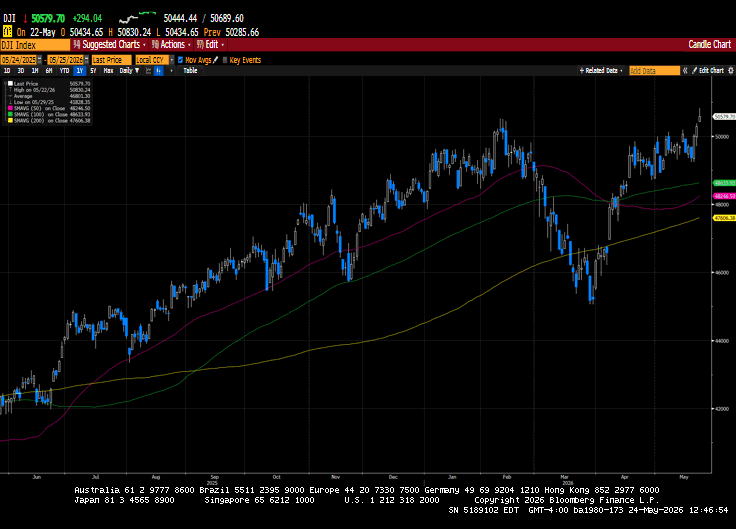
Weekly Market Commentary
Happy Memorial Day weekend, and thank you to all the brave men and women who have served our country to ensure our freedom. Markets took a step forward last week in what I would consider a complete reversal of the prior week’s action. A broadening-out trade could be seen, with interest-rate-sensitive parts of the market getting a bid. The S&P 500 posted its eighth straight week of gains while the Dow Jone Industrials hit an all-time high. Healthcare led while utilities and real estate outperformed. Information Technology performed okay as Nvidia once again posted better-than-expected Q1 results, but the results were met with a muted market response. Negotiations between the US and Iran continued, and later in the week, it appeared that both sides were close to extending the already 6-week ceasefire. Pakistan, the UAE, Qatar, and Saudi Arabia appealed to President Trump for more time to secure a comprehensive deal to reopen the Strait of Hormuz. Twenty-five ships crossed the Strait last week after Iran granted permission to pass. Oil prices remained volatile and elevated. On Friday, Kevin Warsh was sworn in as the new Federal Reserve Chairman. He takes over the role as several Fed officials have backed away from cutting interest rates in 2026.

The S&P 500 gained 0.9%, the Dow rose by 2.1%, the NASDAQ added 0.5%, and the Russell 2000 led gains with a 2.7% advance. The US yield curve flattened as shorter-tenured paper sold off and longer-maturity paper traded higher. The 2-year yield increased by four basis points to 4.12%, while the 10-year yield fell by four basis points to 4.56%. West Texas Intermediate crude prices fell 8.8% to $96.13 a barrel, while Brent crude ended the week at $100.21 a barrel. Gold prices fell by $34.90 to $4,526.90 per ounce. Silver prices fell by 1.2% or $0.96 to $75.20 per ounce. Copper prices rose by eight cents to $6.38 per Lb. Bitcoin’s price fell by 3.65% to $75,500. The US Dollar index was little changed on the week, closing at 99.26.

S&P 500 5/22/2026
News on the economic front was quiet. Housing Starts and Building permits were slightly better than expected, coming in at 1465k and 1442k, respectively. Initial Jobless claims fell by 3k to 209K, while Continuing Claims rose by 6k to 1782k. The S&P Global Manufacturing PMI increased to 55.3 from the previous reading of 54.5. The S&P Global Services PMI fell to 50.9 from 51, but remained in expansion. The University of Michigan’s Consumer Sentiment Index for May fell to the lowest level since the index was created. The index came in at 44.8, down from April’s reading of 49.8. Consumer concerns about rising costs and the inability to earn more than inflation were the primary factors driving the index lower.

Investment advisory services offered through Foundations Investment Advisors, LLC (“FIA”), an SEC registered investment adviser. FIA’s Darren Leavitt authors this commentary which may include information and statistical data obtained from and/or prepared by third party sources that FIA deems reliable but in no way does FIA guarantee the accuracy or completeness. All such third party information and statistical data contained herein is subject to change without notice. Nothing herein constitutes legal, tax or investment advice or any recommendation that any security, portfolio of securities, or investment strategy is suitable for any specific person. Personal investment advice can only be rendered after the engagement of FIA for services, execution of required documentation, including receipt of required disclosures. All investments involve risk and past performance is no guarantee of future results. For registration information on FIA, please go to https://adviserinfo.sec.gov/ and search by our firm name or by our CRD #175083. Advisory services are only offered to clients or prospective clients where FIA and its representatives are properly licensed or exempted.
401(k) Rollovers and Spousal Contributions: Today’s Slott Report Mailbag
By Andy Ives, CFP®, AIF®
IRA Analyst
QUESTION:
I have a 401(k) plan with a previous employer that is a mix of pre-tax and Roth money. I’m considering a direct rollover of the 401(k) to an IRA. How would that work since it’s a mix of pre-tax and after-tax funds? Would I need to open separate rollover and Roth IRAs?
Thanks,
Greg
ANSWER:
Greg,
If you do not already have any existing IRAs, you will need to open a traditional IRA and a Roth IRA to receive the 401(k) rollover. The pre-tax funds in the 401(k) will be rolled over to the traditional IRA, and the Roth 401(k) dollars will go to the Roth IRA. If you do have existing IRAs (traditional or Roth), the 401(k) dollars can be rolled over to the respective current IRAs. There is no reason to keep the rollover dollars in a different IRA (traditional or Roth) if you don’t want to.
QUESTION:
What options are available for a non-working spouse to contribute to a traditional/Roth IRA, provided her significant other is employed and has compensation?
Respectfully,
Richard
ANSWER:
Richard,
If a married couple files a joint tax return, the spouse with no compensation can make an IRA contribution based on the compensation from the working spouse who has compensation. The same annual contribution limits apply as do the phaseout ranges for Roth IRA eligibility. Other than this being called a “spousal contribution,” there is no difference between a contribution based on one’s own compensation vs. a contribution based on a spouse’s compensation.
If you have technical questions you would like to have answered, be sure to submit them to mailbag@irahelp.com, to be answered on an upcoming Slott Report Mailbag, published every Thursday.
https://irahelp.com/401k-rollovers-and-spousal-contributions-todays-slott-report-mailbag/

Retirement Planning in 2026: Building Confidence for the Years Ahead
Retirement is no longer viewed as simply “stopping work.” For many individuals and families, retirement is about creating freedom, protecting the lifestyle they’ve worked hard to build, and gaining peace of mind for the future. With rising healthcare costs, market volatility, inflation concerns, and longer life expectancy, retirement planning has become more important than ever.
The good news? A thoughtful retirement strategy can help you feel more prepared and more confident about what lies ahead.
Why Retirement Planning Matters
A successful retirement doesn’t happen by accident. It requires preparation, organization, and a long-term approach designed around your personal goals. Whether retirement is five years away or twenty-five years away, having a plan in place allows you to make smarter financial decisions today while preparing for tomorrow.
Retirement planning helps answer important questions such as:
- Will my savings last throughout retirement?
- How much income will I need each month?
- When should I begin taking Social Security?
- How can I prepare for healthcare expenses?
- What strategies can help reduce taxes in retirement?
- How do I protect my family and legacy?
Without a strategy, many retirees risk outliving their savings or being unprepared for unexpected financial challenges.
Start With a Clear Vision
Every retirement plan should begin with a vision for the future. Retirement looks different for everyone. Some people dream of traveling the world, while others want to spend more time with family, volunteer, start a business, or simply enjoy a slower pace of life.
Understanding your retirement goals helps shape the financial strategies needed to support them.
Consider questions like:
- What age would you like to retire?
- Where do you want to live?
- What kind of lifestyle do you want to maintain?
- Will you continue working part-time?
- What expenses may increase or decrease in retirement?
The clearer your vision, the more effective your retirement plan can become.
The Importance of Income Planning
One of the biggest concerns retirees face is generating reliable income. During your working years, you likely relied on a paycheck. In retirement, that paycheck must come from your savings, investments, Social Security benefits, pensions, or other income sources.
A retirement income strategy helps create a roadmap for turning your assets into sustainable income while helping manage risks along the way.
Common retirement income sources may include:
- Employer-sponsored retirement accounts
- IRAs and Roth IRAs
- Social Security benefits
- Pension income
- Investment portfolios
- Annuities or insurance-based solutions
- Personal savings
Balancing growth potential with income stability is essential to building a retirement strategy that aligns with your goals and comfort level.
Protecting Against Market Volatility
Market ups and downs are a natural part of investing, but they can become especially concerning as retirement approaches. Significant losses early in retirement may impact how long your savings last.
That’s why diversification and risk management are key components of retirement planning.
A well-balanced strategy may include:
- Diversified investment allocations
- Conservative income solutions
- Emergency savings reserves
- Insurance products designed for protection
- Ongoing portfolio reviews and adjustments
The goal is not simply to grow assets, but also to help protect what you’ve built over time.
Preparing for Healthcare Costs
Healthcare expenses are often one of the largest retirement concerns. Medical costs, prescription expenses, long-term care needs, and Medicare coverage gaps can place unexpected pressure on retirement savings.
Planning ahead can help reduce surprises and create a stronger financial foundation.
Areas to review include:
- Medicare options and enrollment timing
- Supplemental insurance coverage
- Long-term care strategies
- Health savings accounts (HSAs)
- Estate and legacy planning considerations
Working with a financial and insurance professional can help you better understand your options and identify strategies tailored to your needs.
The Value of Professional Guidance
Retirement planning involves many moving parts, including investments, taxes, insurance, healthcare, estate considerations, and income distribution strategies. Having a trusted advisor by your side can help simplify the process and provide clarity during important financial decisions.
An experienced financial and insurance professional can help you:
- Evaluate your current retirement readiness
- Identify potential gaps in your strategy
- Create personalized retirement income plans
- Review insurance and protection needs
- Adjust strategies as life changes occur
Most importantly, professional guidance can help you stay focused on your long-term goals, even during uncertain times.
It’s Never Too Early — or Too Late — to Start
One of the most common retirement planning mistakes is waiting too long to begin. The earlier you start, the more time your money has the potential to grow. However, even if retirement is approaching quickly, there are still meaningful steps you can take to strengthen your financial future.
Small improvements today can make a significant difference tomorrow.
Final Thoughts
Retirement should be a time to enjoy the life you’ve worked hard to build — not a time filled with financial stress and uncertainty. A comprehensive retirement plan can help provide direction, confidence, and peace of mind for the future.
No matter where you are in your financial journey, now is a great time to review your goals, evaluate your current strategy, and begin planning for the retirement you deserve.
Ready to Take the Next Step?
If you would like help building a personalized retirement strategy, our team is here to guide you through the process. We’re committed to helping individuals and families prepare for retirement with confidence, clarity, and long-term financial focus.
Contact us today to schedule a consultation and start planning for your future.
The “Required Beginning Date” vs. “First RMD Year” Confusion
By Ian Berger, JD
IRA Analyst
Most of you are probably familiar with the concept of the “required beginning date” (RBD). The RBD is the deadline for taking the first required minimum distribution (RMD) from an IRA or workplace retirement plan. If you’re a traditional IRA owner, your RBD is April 1 of the year following the year you turn age 73 (if born between 1951 and 1959) or age 75 (if born after 1959). If you’re a retirement plan participant, your RBD is usually the same date. However, if you’re still working beyond the year you reach age 73 and you don’t own more than 5% of the sponsoring employer, you can usually delay your RMD until April 1 of the year following the year you eventually retire. This is called the “still-working exception.”
The RBD is also important in applying several other RMD rules. For example, if you’re an IRA beneficiary subject to the 10-year payout rule (a “non-eligible designated beneficiary”), you must take RMDs during years 1-9 of the 10-year period if the IRA owner died on or after his RBD. In addition, if you’re a beneficiary eligible to stretch RMDs over your life expectancy (an “eligible designated beneficiary”), you can instead elect the 10-year rule with no annual RMDs if the IRA owner died before his RBD.
However, although the RBD is often the date that dictates whether an RMD rule applies, it’s not always the deciding factor. For some retirement account rules, your “first RMD year” (usually the year you turn age 73) – not the RBD – is what counts. Here’s one common example that causes lots of confusion: Let’s say you retire in the year you turn age 73. If you want to roll over your 401(k) funds to an IRA in the year of retirement, do you have to take an RMD from the 401(k) before doing the rollover?
Since your RBD isn’t until April 1 of the year after your retirement year, you might think that you shouldn’t have to take an RMD if you do a rollover before that April 1. But this is one of those cases where the “first RMD year” controls – not the RBD. The first funds that are distributed out of the plan in your first RMD year (or any subsequent year) are considered part of the RMD. However, RMDs can never be rolled over. This means that if you want to roll over your 401(k) funds in the year you retire (or after) your age-73 year, you must first take your 401(k) RMD.
What if you don’t take the RMD first and instead roll it over? Then, you have an excess IRA contribution. But that’s usually not a problem. As long as the rolled-over amount, along with earnings or losses attributable to the excess (net income attributable, or “NIA”), are withdrawn from the IRA by October 15 of the year after the year of the rollover, you won’t have to pay a penalty.
One way to avoid having to take a 401(k) RMD in the year of retirement is to delay your rollover into the following year (no later than April 1). But then you’d have to take two RMDs in that following year – the year-of-retirement RMD and the following-year RMD – before rolling over the rest of your funds.
If you have technical questions you would like to have answered, be sure to submit them to mailbag@irahelp.com, to be answered on an upcoming Slott Report Mailbag, published every Thursday.
https://irahelp.com/the-required-beginning-date-vs-first-rmd-year-confusion/
New “Trump IRA” Is Fake News
By Sarah Brenner, JD
Director of Retirement Education
On April 30, 2026, President Trump signed an executive order to promote retirement savings for American workers. In its aftermath, we have had a flurry of questions about a new savings option called a “Trump IRA.” This is, as the saying goes, “fake news.”
Here are three things you need to know to separate fact from fiction about the new presidential order and its impact on retirement savings.
1. There is no such thing yet as a “Trump IRA.” The executive order did not create a new tax-advantaged account to save for retirement. The President cannot, in fact, do this on his own. Only Congress can change the tax code and create a new savings vehicle. The President, however, can establish a website, and that is what happened. The executive order calls for the establishment of a website (TrumpIRA.org) by January 1, 2027.
2. The new website (TrumpIRA.org) will promote the Saver’s Match. The Saver’s Match is not a newly created initiative. It was already in the works. It was enacted in 2022 as part of the SECURE 2.0 Act and is effective starting in 2027.
The Saver’s Match will replace the current Saver’s Credit and will provide a federal matching contribution of 50% on the first $2,000 of annual retirement contributions (up to $1,000 annually) for eligible lower-income savers. This match is deposited directly into a 401(k), 403(b), or IRA. For single filers, the Modified Adjusted Gross Income (MAGI) phaseout range is between $20,500 and $35,500. For those who are married filing jointly, the MAGI phaseout range is between $41,000 and $71,000. Unlike the current Saver’s Credit, the Saver’s Match is available even for eligible savers who don’t owe federal income tax.
The executive order also says that the new website will list financial institutions that offer IRAs that will accept the Saver’s Match and meet certain other criteria to enhance retirement savings. The website will allow users to filter and select IRAs based on their cost and quality.
3. The new order has nothing to do with Trump Accounts. Trump Accounts are tax-deferred investment vehicles for children under 18, created under the One Big Beautiful Bill Act of 2025. Contributions to these new investment accounts are scheduled to be available on July 4, 2026. More guidance is expected to be released soon to explain more about how exactly these accounts will work, but the executive order does not do this.
Another factor making things even more confusing is that while a Trump Account is subject to special rules until the year the child reaches age 18, at that point it then becomes a traditional IRA, subject to all the normal IRA rules. So, while the account does change from being a Trump Account to being a regular traditional IRA, there never is a point where it is a “Trump IRA.”
If you have technical questions you would like to have answered, be sure to submit them to mailbag@irahelp.com, to be answered on an upcoming Slott Report Mailbag, published every Thursday.
https://irahelp.com/new-trump-ira-is-fake-news/
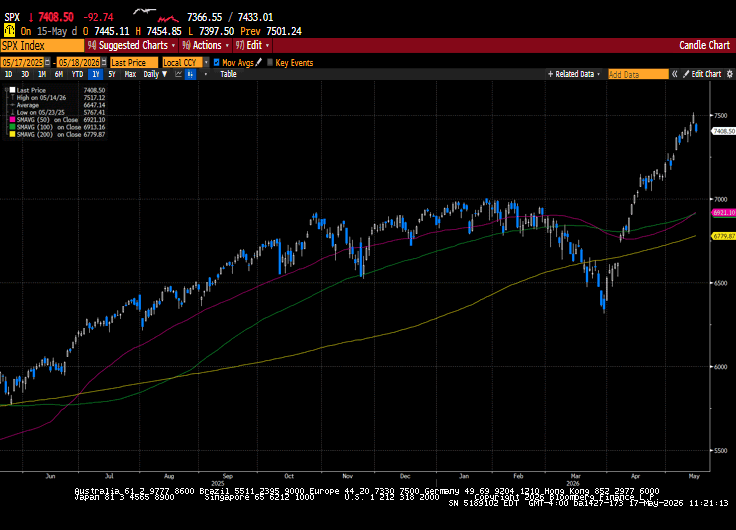
Weekly Market Commentary
US equity markets finished the week mixed in volatile trade. Hotter-than-expected inflation data, coupled with increased tensions in the Middle East, sent US Treasury yields significantly higher. The US-China summit ended with both sides with no real incremental policy changes. XI and Trump did discuss trade, Taiwan, and the War in Iran. The Mega-Cap technology names continued to provide leadership, with Semiconductors leading the AI charge. However, on Friday, the Semiconductor sector was hammered as traders took profits on one of the year’s hottest and most overcrowded trades. The broader market continued to struggle as advancing issues relative to declining issues, known as “breadth”, deteriorated further. Rate-sensitive parts of the market, such as Mid-Caps, Small Caps, Real Estate, Utilities, and the Consumer Discretionary sector, were notable laggards. We would expect markets to come under further pressure if global interest rates continue to move higher. Notably, the US 10-year yield is now above 4.50%, coming as 10-year Gilts and 10-year JGB yields have hit levels not seen in decades. Kevin Warsh was confirmed as the new Federal Reserve Chairman this week, as futures markets currently price in no rate cuts in 2026.

The S&P 500 gained 0.1%, the Dow fell 0.2%, the NASDAQ declined by 0.1%, and the Russell 2000 slid 2.4%. As I mentioned, US Treasuries fell meaningfully across the curve. The 2-year yield increased by nineteen basis points to 4.08%, while the 10-year yield increased by twenty-four basis points to close the week at 4.60%. West Texas Intermediate crude prices increased by 10.5% or $10.10 to $105.49 per barrel as the Strait of Hormuz continued to be at a standstill. Gold prices fell by 3.5% to $4,561.80 per ounce. Silver prices declined by 4.1% to $77.55 per ounce. Copper prices were unchanged for the week, closing at $6.30 per Lb. Bitcoin’s price declined by 2.88% to $78,200. The US Dollar index advanced by 1.5% to 98.99. A measure of volatility, VIX, increased by 7.2% to 18.43.

iShares 20-year US Treasury ETF 5/15/2026
The economic calendar highlighted two inflation measures: the Consumer Price Index and the Producer Price Index. Both readings showed a material year-over-year uptick. Headline April CPI came in at 0.6% versus the consensus estimate of 0.5%. The measure increased by 3.8% over last year, up from 3.3% in March. The Core CPI, which excludes food and energy prices, increased by 0.4%, in line with expectations. On a year-over-year basis, the reading ticked to 2.8% from 2.6% in March. Energy prices increased by 3.8% month-over-month and is up 17.9% on an annual basis. Headline PPI came in at 1.4% versus the consensus estimate of 0.4%, and was up 6% annually from 4.3% in March. Core PPI increased by 1%, well above the consensus estimate of 0.3%. On a year-on-year basis, the Core reading increased by 5.2% in April, up from 4% in March. April Retail sales increased by 0.5%, higher than the estimate of 0.4%. Ex-Autos came in at 0.7%, which was better than the 0.4% estimate. Initial Jobless Claims increased by 12k to 211k, while Continuing Claims increased by 24k to 1782k.

Investment advisory services offered through Foundations Investment Advisors, LLC (“FIA”), an SEC registered investment adviser. FIA’s Darren Leavitt authors this commentary which may include information and statistical data obtained from and/or prepared by third party sources that FIA deems reliable but in no way does FIA guarantee the accuracy or completeness. All such third party information and statistical data contained herein is subject to change without notice. Nothing herein constitutes legal, tax or investment advice or any recommendation that any security, portfolio of securities, or investment strategy is suitable for any specific person. Personal investment advice can only be rendered after the engagement of FIA for services, execution of required documentation, including receipt of required disclosures. All investments involve risk and past performance is no guarantee of future results. For registration information on FIA, please go to https://adviserinfo.sec.gov/ and search by our firm name or by our CRD #175083. Advisory services are only offered to clients or prospective clients where FIA and its representatives are properly licensed or exempted.

Understanding Fixed Indexed Annuities: Balancing Growth Potential and Protection
In today’s unpredictable financial environment, many retirees and pre-retirees are searching for ways to protect their savings while still maintaining the opportunity for growth. One financial tool that continues to gain attention is the Fixed Indexed Annuity, often referred to as an FIA.
While no financial strategy is one-size-fits-all, fixed indexed annuities may offer a unique balance between market participation and principal protection — making them worth understanding for those focused on retirement planning.
What Is a Fixed Indexed Annuity?
A Fixed Indexed Annuity is a long-term financial product designed to provide growth potential tied to a market index, such as the S&P 500, while helping protect your principal from direct market losses.
Unlike investing directly in the stock market, an FIA does not place your money directly into equities. Instead, your returns are linked to the performance of a chosen index, subject to caps, participation rates, or other contract features established by the insurance company.
One of the key attractions for many retirees is this combination of:
Principal protection from market downturns
Tax-deferred growth potential
Optional lifetime income features
Protection from emotional market decisions during volatility
Protection During Market Volatility
Market swings can create stress for investors, especially those nearing or already in retirement. A major market correction at the wrong time can significantly impact retirement income plans.
Fixed indexed annuities are often appealing because they are designed to shield principal from direct market losses. While gains may be limited by contract terms, the tradeoff for many people is knowing they can avoid losing accumulated value due to market declines.
For individuals who value stability and predictability, this feature can provide added confidence during uncertain economic periods.
Tax-Deferred Growth Potential
Another advantage often associated with fixed indexed annuities is tax-deferred accumulation. This means earnings grow without immediate taxation until withdrawals are taken.
For some individuals, this may help create additional opportunities for long-term accumulation while managing taxable income during working years or retirement.
As always, withdrawals prior to age 59½ may be subject to IRS penalties, and annuities are generally intended for long-term retirement planning purposes.
Optional Lifetime Income Strategies
Many fixed indexed annuities offer optional riders designed to provide guaranteed lifetime income. These features can help address one of the biggest retirement concerns many Americans face: outliving their savings.
Depending on the contract, income may continue for:
Your lifetime
You and your spouse’s lifetime
A guaranteed period of years
This can create an additional layer of retirement income alongside Social Security, pensions, investments, or other assets.
Is a Fixed Indexed Annuity Right for You?
A fixed indexed annuity may not be appropriate for everyone. These products can include surrender charge periods, limitations on liquidity, fees for optional riders, and contract-specific rules that should be carefully reviewed.
However, for individuals seeking:
Protection from market downturns
Predictable retirement income
Conservative growth opportunities
Long-term retirement planning solutions
…a fixed indexed annuity may be worth exploring as part of a broader financial strategy.
Final Thoughts
Retirement planning is about more than chasing returns — it’s about building a strategy designed to support your goals, lifestyle, and future confidence.
Fixed indexed annuities can offer a combination of growth potential, protection, and income planning that appeals to many retirees looking for balance in uncertain times. Understanding how these products work — and where they may fit within an overall retirement strategy — is an important step toward making informed financial decisions.
Before making any financial decision, it’s important to consult with a qualified financial professional to review your personal goals, risk tolerance, and retirement objectives.
Reporting a Recharacterization
By Andy Ives, CFP®, AIF®
IRA Analyst
We know that Roth conversions are permanent. Recharacterization of a conversion is no longer allowed. Once the conversion is done, there is no going back. However, recharacterization is still available for IRA contributions. A traditional IRA contribution can be recharacterized to a Roth IRA or vice versa. A contribution can be recharacterized for any reason as long as it can be a valid contribution to the other type of IRA. This means that the person must be eligible to contribute to the type of IRA to which the funds are being recharacterized.
Why recharacterize? There are multiple scenarios where recharacterization could be the proper strategy. For example, an individual who contributed to a traditional IRA and later discovered the contribution was not deductible could recharacterize the contribution to a Roth IRA (assuming Roth IRA eligibility). A person who contributed to a Roth IRA not knowing his income for the year will be above the phaseout limits could recharacterize that contribution to a traditional IRA.
To recharacterize a contribution, the IRA custodian will transfer the funds, along with the earnings or losses (“net income attributable” or NIA), from the first IRA to the second. NIA is determined by a special IRS formula, which is the same formula used to determine NIA when removing an excess IRA contribution. The deadline for recharacterization is October 15 of the year following the year for which the original contribution was made. The recharacterized contribution is treated as if it had always been made to the intended IRA.
While this is a tax-free transaction, both IRAs report the transactions to the account owner and the IRS. The first IRA custodian will report the recharacterized amount, plus NIA, as a distribution on Form 1099-R. The second IRA (the receiving IRA) custodian will generate a Form 5498. On the Form 1099-R, both the recharacterized contribution amount and the NIA (i.e., the current fair market value of the recharacterized amount) are reported in Box 1, Gross distribution, with “0” in Box 2a, Taxable amount. The distribution code will be either an “N” or “R.”
From the Instructions for Form 1099-R for 2025 recharacterizations:
“N—Recharacterized IRA contribution made for 2025. Use Code N for a recharacterization of an IRA contribution made for 2025 and recharacterized in 2025 to another type of IRA by a trustee-to-trustee transfer or with the same trustee.”
“R—Recharacterized IRA contribution made for 2024 or a previous year. Use Code R for a recharacterization of an IRA contribution made for 2024 and recharacterized in 2025 to another type of IRA by a trustee-to-trustee transfer or with the same trustee.”
Form 5498 will report the total amount being recharacterized in Box 4, Recharacterized contributions. Note: If an unwanted (or disallowed) Roth IRA contribution is recharacterized to a non-deductible traditional IRA contribution, be sure to file Form 8606 to claim that basis.
If you have technical questions you would like to have answered, be sure to submit them to mailbag@irahelp.com, to be answered on an upcoming Slott Report Mailbag, published every Thursday.
https://irahelp.com/reporting-a-recharacterization-2/
A Cheat Sheet for Retirement Account Beneficiary RMDs
By Ian Berger, JD
IRA Analyst
The SECURE Act completely changed the rules for beneficiary IRA (and workplace retirement plan) required minimum distributions (RMDs). It’s now been more than 6 years since the SECURE Act became law and almost 2 years since the IRS finalized its RMD regulations. Yet there’s still plenty of confusion about how these rules work. To help keep things straight, we present our beneficiary RMD cheat sheet.
Keep in mind that these are the rules for retirement accounts inherited after 2019. Pre-SECURE Act rules applied for accounts inherited before 2020, and those old rules were grandfathered and continue to apply for those accounts. Also note that there are separate rules for successor beneficiaries (beneficiaries of beneficiaries).
Where to Begin
To begin with, we need to answer two questions:
- Did the IRA owner die before or after the required beginning date (RBD) for starting RMDs? The RBD is April 1 of the year following the year the IRA owner reaches age 73 (if born between 1951 and 1959) or age 75 (if born after 1959). A Roth IRA owner is always considered to have died before the RBD.
- What kind of beneficiary do we have? An eligible designated beneficiary (EDB) is a surviving spouse of the IRA owner; a minor child (under age 21) of the owner; a chronically-ill or disabled person; or someone who is not more than 10 years younger than the account owner. A non-eligible designated beneficiary (NEDB) is an individual beneficiary who’s not an EDB. A non-designated beneficiary (NDB) is a beneficiary who’s not a person, such as an estate, a charity or a non-qualified trust.
Rules That Apply When a Traditional IRA Owner Dies BEFORE the RBD OR a Roth IRA Owner Dies at Any Time
EDB (other than a minor child): An EDB other than a minor child can either (1) take annual RMDs over the EDB’s life expectancy, or (2) use the 10-year payment rule. If the 10-year rule is elected, the inherited account must be emptied by December 31 of the 10th year following the year of death, but annual RMDs aren’t required during the 10-year period. A surviving spouse EDB can also do a rollover to the surviving spouse’s own IRA (usually not recommended until age 59½).
EDB (minor child): A minor child EDB can either (1) take annual RMDs until the year the child turns age 30 and then empty the inherited account by the end of the following year, or (2) have the 10-year payment rule apply. If the 10-year rule is elected, the inherited account must be emptied by December 31 of the 10th year following the year of death, but no annual RMDs are required.
NEDB: The 10-year rule applies, but annual RMDs aren’t required.
NDB: The 5-year rule applies. The entire account must be emptied by December 31 of the 5th year following the year of death, but no annual RMDs are required during the 5-year period.
Rules That Apply When a Traditional IRA Owner Dies ON OR AFTER the RBD
EDB (other than a minor child): An EDB other than a minor child can take annual RMDs over the EDB’s life expectancy. But if the EDB is older than the deceased IRA owner, the EDB can use the deceased person’s longer life expectancy in calculating RMDs. A surviving spouse EDB can also do a rollover to the surviving spouse’s own IRA (usually not recommended until age 59½).
EDB (minor child): A minor child EDB can take annual RMDs until the year the child turns age 30 and must empty the inherited account by the end of the following year.
NEDB: The 10-year rule applies, and annual RMDs are required during the 10-year period (based on the beneficiary’s single life expectancy starting in the year after the year of death).
NDB: Annual RMDs must continue over the deceased IRA owner’s remaining single life expectancy assuming the owner had lived (the “ghost rule”).
If you have technical questions you would like to have answered, be sure to submit them to mailbag@irahelp.com, to be answered on an upcoming Slott Report Mailbag, published every Thursday.
https://irahelp.com/a-cheat-sheet-for-retirement-account-beneficiary-rmds/
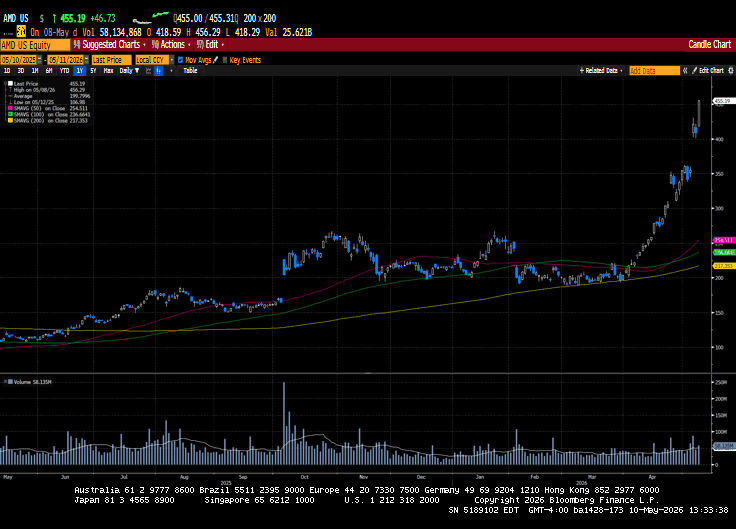
Weekly Market Commentary
Global markets hit record highs as Q1 earnings continued to exceed expectations. Despite continued tensions in the Middle East and the Strait of Hormuz effectively closed, investors bought mega-cap technology issues alongside Semiconductor companies. AMD posted stellar earnings results, catalyzing technology shares higher. NVIDIA will report earnings in a couple of weeks, and its results are expected to drive a 9% move in the stock price. According to FactSet, 86% of the S&P 500 have reported Q1 earnings; of those, 84% have beaten on the bottom line, and 80% have beaten on revenue. The quarter has seen Earnings Per Share growth of 27.7%, the best since the fourth quarter of 2021. Revenue growth has come in at 11.3%. Expectations are for full-year 2026 Earnings Per Share growth of 21%. This is what has been driving markets higher. Yes, the global economy will still face significant consequences from the closure of the Strait of Hormuz and supply chain disruptions, but for now, the earnings story has taken precedence. The US continues to wait for a response to its most recent peace deal, even as the ceasefire appears more fragile than ever. At this point, I am not sure we can even claim a ceasefire exists, as there have been several reports of Iranian attacks on Gulf Nation assets. President Trump will meet with President Xi this week, but few believe anything consequential will come of it. The war in the Middle East, trade, rare earth metals, and technology export curbs are likely on the table for discussion. The two leaders are set to meet three more times this year.

The S&P 500 gained 2.3%, the Dow rose 0.2%, the NASDAQ increased by 4.5%, and the Russell 2000 added 1.7%. Notably, the S&P 500, the NASDAQ, South Korea, and Japan hit record highs this week. US Treasury trade was quite volatile this week, tied to gyrations in oil and to several economic data prints. The 2-year yield closed the week unchanged at 3.89%, while the 10-year yield fell by two basis points to 4.36%. Fed Funds futures currently suggest no monetary policy changes in 2026. Oil prices remained volatile amid news from the Middle East. West Texas Intermediate fell 6.3% on the week to close at $95.39 per barrel. Gold prices advanced by 1.8% to $4,730.20 per ounce. Silver prices jumped 6.47% to $80.87 per ounce, while Copper prices surged 5.1% to $6.30 per Lb. Bitcoin’s price increased by 2.8% to $80,800. The US Dollar Index fell by 0.3% to 97.93.

NASDAQ 5/8/2026
The economic calendar was packed. The Employment Situation report showed more payrolls than expected. Non-Farm Payrolls increased by 115k versus expectations of 67k. Private Payrolls increased by 123k versus the consensus estimate of 60k. The Unemployment Rate stayed at 4.3%, while Average Hourly Earnings increased by 0.2%. The Average Work Week increased to 34.3 hours from 34.2 hours. While the report was better than expected, there were some concerns regarding earnings, which grew at 3.6% year over year, just above inflation. The small margin may curb consumer spending. JOLTS data showed fewer job openings from the prior reading at 6.886M. ADP Private Payrolls increased by 109k versus the estimated 79k. Initial Jobless Claims increased by 10k to 200k, while Continuing Claims fell by 10k to 1766k. April ISM Non-Manufacturing stayed in expansion at 53.6, but fell from the prior reading of 54. Finally, a preliminary look at the University of Michigan’s Consumer Sentiment showed a decline to 48.2, a record low for the data series. The decline was attributed to increased energy costs and labor concerns.

Investment advisory services offered through Foundations Investment Advisors, LLC (“FIA”), an SEC registered investment adviser. FIA’s Darren Leavitt authors this commentary which may include information and statistical data obtained from and/or prepared by third party sources that FIA deems reliable but in no way does FIA guarantee the accuracy or completeness. All such third party information and statistical data contained herein is subject to change without notice. Nothing herein constitutes legal, tax or investment advice or any recommendation that any security, portfolio of securities, or investment strategy is suitable for any specific person. Personal investment advice can only be rendered after the engagement of FIA for services, execution of required documentation, including receipt of required disclosures. All investments involve risk and past performance is no guarantee of future results. For registration information on FIA, please go to https://adviserinfo.sec.gov/ and search by our firm name or by our CRD #175083. Advisory services are only offered to clients or prospective clients where FIA and its representatives are properly licensed or exempted.
Required Minimum Distributions and Inherited IRAs Prior to 2020: Today’s Slott Report Mailbag
By Sarah Brenner, JD
Director of Retirement Education
Question:
My spouse and I have a combined six-figure required minimum distribution (RMD) from my two IRAs and her smaller IRA. Our CPA suggested that for 2026 we only withdraw 50% of her smaller RMD, and that I should pick up the balance to fulfill her requirement.
I questioned her about this situation. She said that since we are married filing jointly, I should do it. I have some concerns about this approach.
Thank you,
Tom
Answer:
Hi Tom,
You are right to have some concerns. When it comes to RMDs, spouses are not considered together, even if they are married and filing jointly. Aggregation of RMDs with a spouse is not permitted. You must each take your own RMDs.
Question:
An adult son inherited an IRA from his mother in 2016. He has been taking annual RMDs. This year, it will be ten years since he inherited the IRA. Does the SECURE Act require him to empty this inherited IRA in 2026?
Warm regards,
Carolyn Sue
Answer:
Hi Carolyn Sue,
The SECURE Act does impose a 10-year payout rule on most adult children who inherit IRAs from their parents. However, this rule does not apply to accounts inherited prior to 2020 when the SECURE Act was enacted. This IRA was inherited in 2016. Therefore, the 10-year rule does not apply and annual RMDs can continue.
If you have technical questions you would like to have answered, be sure to submit them to mailbag@irahelp.com, to be answered on an upcoming Slott Report Mailbag, published every Thursday.
https://irahelp.com/required-minimum-distributions-and-inherited-iras-prior-to-2020-todays-slott-report-mailbag/

Why Retirement Planning Should Start Earlier Than Most People Think
When people hear the words “retirement planning,” many immediately picture someone in their 60s preparing to leave the workforce. The reality is very different. The most successful retirement strategies often begin decades before retirement is even on the horizon. Starting early gives individuals and families the opportunity to build confidence, create flexibility, and potentially avoid many of the financial pressures that can appear later in life.
One of the biggest advantages of early retirement planning is time. Time allows investments the opportunity to grow through the power of compounding, where earnings can continue generating additional earnings year after year. Even modest contributions made consistently over time can create significant long-term results. Waiting too long often means people must contribute much larger amounts later in order to try and catch up.
Retirement planning is about much more than simply saving money. A well-rounded financial strategy should consider income planning, tax efficiency, healthcare expenses, inflation, estate planning, insurance protection, and legacy goals. Every stage of life presents different financial priorities, which is why reviewing and adjusting a plan regularly can be so important.
Many people also underestimate how long retirement may last. With people living longer than ever before, retirement can easily span 20 to 30 years or more. Without a thoughtful strategy, there is a real risk of outliving savings or being forced to make difficult financial decisions later in life. Proper planning can help create a roadmap designed to provide stability throughout retirement years.
Another common misconception is that retirement planning only benefits high-income earners. In reality, everyone can benefit from having a financial strategy in place. Whether someone is just beginning their career, approaching retirement, or already retired, taking steps toward organizing finances and preparing for the future can provide greater peace of mind and financial clarity.
Market volatility and economic uncertainty also highlight the importance of professional guidance. Financial markets naturally experience ups and downs, and emotional decision-making during uncertain times can negatively impact long-term goals. Working with a financial professional can help individuals stay focused on their strategy rather than reacting emotionally to short-term market movements.
Social Security is another important piece of the retirement puzzle. Understanding when to claim benefits, how benefits may be taxed, and how Social Security fits into an overall retirement income strategy can make a substantial difference over time. Coordinating these decisions with other retirement assets is often critical to creating a more efficient financial plan.
Healthcare planning should never be overlooked either. Medical costs in retirement can become one of the largest expenses many retirees face. Planning ahead for Medicare, supplemental insurance options, long-term care considerations, and out-of-pocket expenses can help reduce unexpected financial stress later in life.
Estate planning also plays a major role in a comprehensive retirement strategy. Preparing wills, trusts, powers of attorney, and beneficiary designations can help ensure assets are distributed according to personal wishes while helping loved ones avoid unnecessary complications. Financial planning is not only about protecting personal wealth — it is also about protecting the people who matter most.
Perhaps the greatest benefit of retirement planning is confidence. Knowing there is a strategy in place can help individuals feel more prepared for the future, regardless of what life may bring. Financial planning is not about predicting every outcome perfectly; it is about creating flexibility and building a framework designed to adapt over time.
No matter where someone currently stands financially, it is never too early — or too late — to begin planning for retirement. Small steps taken today can create meaningful opportunities for tomorrow. A strong retirement strategy can help turn future uncertainty into a clearer path forward, allowing individuals and families to focus more on enjoying life and less on worrying about finances.
The Once-Per-Year Rollover Rule: Multiple Deposits vs. Multiple Distributions
By Sarah Brenner, JD
Director of Retirement Education
The once-per-year IRA rollover rule sounds easy. However, there are many ways to go wrong. One common confusion with this rule occurs when there are multiple distributions or multiple deposits. These two circumstances have very different outcomes.
How the Once-Per-Year Rollover Rule Works
The once-per-year rollover rule says that an IRA owner cannot roll over an IRA distribution that is received within a 365-day period of a prior distribution that was rolled over. Traditional and Roth IRAs are combined for purposes of the once-per-year rule. So, for example, a distribution and subsequent rollover between your Roth IRAs will prevent another rollover of a distribution from your traditional IRA received within one year of the Roth IRA distribution. The bottom line is that an IRA-to-IRA (or Roth IRA-to-Roth IRA) 60-day rollover may not be done if you received a prior distribution within the last year (365 days) that you also rolled over.
The once-per-year rollover rule does NOT apply to rollovers between plans and IRAs or Roth IRA conversions.
One Distribution and Multiple Rollover Deposits
If an IRA owner takes a distribution, she may split the funds and roll them over to multiple IRAs. This could be done on different days and that would not be a problem. Multiple rollover deposits are acceptable for purposes of the once-per-year rollover rule because only one distribution is received even though there is more than one rollover deposit.
Example: Sophie receives a $100,000 distribution from her IRA on June 15. On June 20, Sophie rolls over $75,000 to an IRA. On June 25, she decides to roll over the remaining $25,000 to another IRA. This is not a violation of the once-per-year rollover rule because Sophie received only one distribution. Even though she did two deposits on two different dates to complete her rollover transaction, there are no issues with these transactions.
Multiple Distributions and One Rollover Deposit
If an IRA owner is permitted to take a distribution on one day and roll it over on multiple different days, is the opposite scenario also allowed? Can an IRA owner take multiple distributions on different days and deposit them at one time as one consolidated rollover? The answer is no. Even if all the distributions were taken from the same IRA, this is still not allowed. The reason is that only one distribution is eligible for rollover within a 60-day period.
Example: James takes a $2,000 distribution from his IRA on January 10 and another $30,000 distribution on January 12. His plan is to roll over both distributions on the same day to a new IRA. Unfortunately for James, only one of his IRA distributions is eligible for rollover. This is because the once-per-year rule limits him to rolling over only one distribution within a 365-day period.
Do Direct Transfers Between Your IRAs
Confusion about the impact of multiple deposits or distributions and the once-per-year rollover rule is just one of many reasons why 60-day rollovers should be avoided. If there is no 60-day rollover, then there is no once-per-year rollover rule to worry about. How, then, can you move your retirement funds? The best advice is to directly transfer the funds from one retirement account to another rather than taking a distribution payable to yourself and then rolling it over to another retirement account. You can do as many direct transfers between IRAs annually as you want.
If you have technical questions you would like to have answered, be sure to submit them to mailbag@irahelp.com, to be answered on an upcoming Slott Report Mailbag, published every Thursday.
https://irahelp.com/the-once-per-year-rollover-rule-multiple-deposits-vs-multiple-distributions/
The Simultaneous QCD/RMD Transaction
By Andy Ives, CFP®, AIF®
IRA Analyst
Qualified charitable distributions (QCDs) and required minimum distributions (RMDs) are two separate and distinct transactions. Here are some of the basics of each:
QCDs are only available to IRA owners and beneficiaries age 70½ or older. You cannot do a QCD from a 401(k) plan. The QCD limit for 2026 is $111,000. With a QCD, IRA funds are sent directly to a qualifying charity, and no goods or services can be received for the donation. Assuming all the rules are followed, the amount of the QCD is excluded from the IRA owner’s income. And since charities do not pay tax, the result is that no taxes are ever paid on the donated dollars.
RMDs are forced withdrawals from traditional IRAs (and from the pre-tax portion of a company retirement plan). When a person reaches a certain age (currently age 73), IRA RMDs must begin. The purpose of an RMD is to force a taxable distribution from what has been a tax-deferred pot of money. Congress allows IRA owners to shelter funds for decades. At age 73, it is time to pay the piper. Understandably, many IRA owners are not thrilled about forced withdrawals and a potentially elevated tax bill.
However, by combining the QCD and RMD rules, a person can satisfy their RMD, avoid any taxes due, and donate to charity all at the same time.
Where people get sideways with QCDs and RMDs is when it comes to timing. A common saying is, “Do your QCD before your RMD.” The purpose of this phrase is to ensure a person does not miss the opportunity to offset RMD income with a QCD. Once a normal (non-QCD) RMD is taken, that income cannot be offset with a future QCD. There is no such thing as a “prior-year” QCD or a “retroactive” QCD. If a person takes their RMD, those funds will be taxable.
But the “do your QCD before your RMD” axiom is misleading. If the goal is to offset all or a portion of an RMD, then the QCD and RMD are done simultaneously. We do not have two separate distributions. There is a single distribution that counts as both a QCD and RMD.
Example: Mike, age 75, has an IRA RMD of $10,000. If Mike’s RMD is distributed directly to him, then $10,000 will be included in his taxable income. Mike wants to avoid paying any tax on his RMD. So, he requests that his IRA custodian process a $10,000 QCD to Mike’s favorite charity. Upon the IRA custodian sending the check to the charity, Mike has killed two birds with one stone. Simultaneously, a QCD was completed, and Mike’s RMD was satisfied.
As mentioned, once a normal RMD is taken, a later QCD cannot offset the income from that earlier distribution. Yes, a person can do a QCD after satisfying their RMD, but that later QCD will just be an additional distribution over and above what was already distributed. Keep in mind that QCDs are not done “before” an RMD. When offsetting the income of an RMD with a QCD, a lone transaction simultaneously satisfies both the RMD as well as delivering funds to a charity as a QCD.
If you have technical questions you would like to have answered, be sure to submit them to mailbag@irahelp.com, to be answered on an upcoming Slott Report Mailbag, published every Thursday.
https://irahelp.com/the-simultaneous-qcd-rmd-transaction/
Backdoor Roth IRAs and Inherited IRAs: Today’s Slott Report Mailbag
By Andy Ives, CFP®, AIF®
IRA Analyst
QUESTION:
When someone under age 59½ uses the “backdoor” method of making Roth IRA contributions, does the 10% penalty apply to subsequent withdrawals if the IRA contribution was non-deductible?
Thank you,
John
ANSWER:
John,
The “backdoor Roth” contribution method involves making a non-deductible contribution to a traditional IRA, and then converting those dollars to a Roth IRA. Backdoor Roth IRA contributions are necessary for anyone with income that exceeds the annual Roth IRA contribution phase-out ranges. If the non-deductible dollars are then withdrawn from the Roth IRA after the conversion, there is no 10% early withdrawal penalty on those specific funds, regardless of a person’s age. However, any earnings on the non-deductible dollars would be subject to the penalty if they are received before the Roth IRA owner turns age 59½ (assuming no exception exists).
QUESTION:
Hello,
I am looking for some direction on how to title a beneficiary IRA. My mother passed away in March of this year at age 94, and my sister and I are 50/50 beneficiaries. The custodian wants to title the account as: “John R. Doe as beneficiary of Jane C. Doe IRA” (implying that Jane has died, rather than explicitly stating the fact). If I recall, the title should include “for the benefit of” and be something like: “Jane C. Doe deceased (3/28/2026) FBO John R. Doe, Beneficiary.” Please provide guidance on the proper title content and format.
Thank you and keep up the great work!
Jim
ANSWER:
Jim,
Sorry for the loss of your mother. As for the “proper” titling of an inherited IRA, there is no universally required method or set format. The deceased IRA owner’s name must remain on the account, and it must be clear that it is an inherited IRA. This is typically accomplished by using the words “beneficiary,” “beneficiary IRA” or “inherited IRA.” Both examples you provided are acceptable, although we prefer a title similar to what you suggested: “Jane C. Doe IRA (deceased 3/28/2026) F/B/O John R. Doe, Beneficiary.”
If you have technical questions you would like to have answered, be sure to submit them to mailbag@irahelp.com, to be answered on an upcoming Slott Report Mailbag, published every Thursday.
https://irahelp.com/backdoor-roth-iras-and-inherited-iras-todays-slott-report-mailbag/
Grandparents Should Be Very Careful Before Opening Trump Accounts
By Ian Berger, JD
IRA Analyst
Contributions to Trump Accounts, the new tax-deferred savings vehicle for children, can’t be made until July 4, 2026. However, the opportunity to open a Trump Account, either through filing Form 4547 or using a dedicated IRS website, forms.trumpaccounts.gov, has been available for several months.
We have heard several reports that grandparents are establishing Trump Accounts for their grandchildren. While grandparents will be able to make contributions on behalf of grandchildren to Trump Accounts, IRS rules appear to strictly limit the circumstances where they can open up those accounts. Making matters worse, grandparents may be committing perjury without even knowing it when signing Form 4547 or using the website.
The IRS proposed regulations say there can only be one Trump Account per child, and the regulations set out two rules for who can establish those accounts. For grandparents, here’s the way the rules work:
- If the grandchild was born since January 1, 2025, a grandparent can only make an election to claim the $1,000 federal government contribution if the grandchild is a dependent of the grandparent’s. In that case, the grandparent can, at the same time as claiming the $1,000, also make an election to open up a Trump Account.
- In any other situation (for example, if the grandchild was born before January 1, 2025), there is a hierarchy as to who can legally open a Trump Account. A grandparent is last in line after a legal guardian, a parent, and an adult sibling. So, a grandparent can’t legally establish a Trump Account for a grandchild born before 2025 unless there is no legal guardian, parent or adult sibling “available” to do so. But neither the IRS regulations nor the Form 4547 instructions specify what not being “available” means. Does it mean deceased? Not legally responsible? Failing to act within a certain period? Something else?
According to the IRS regulations, by making this election, the grandparent must represent, under penalty of perjury, that he is authorized to open the Trump Account and that“there is no other person with a higher priority available to make the election.”The instructions to Form 4547 have similar language. However, the Form 4547 itself and the website only require a grandparent opening a Trump Account to declare, under penalty of perjury, that he has examined the form and “to the best of my knowledge and belief, it is true, correct, and complete.” There’s nothing on Form 4547 or the website warning the grandparent that, by making the election for a grandchild born before 2025, he is also representing to the IRS that no other person with a higher priority is “available” (whatever that means) to make the election. If it turns out that any of these other people are actually “available,” is the election invalid? Or worse, did the grandparent commit perjury by signing the form or completing the website election?
For these reasons, until we get much-needed guidance from the IRS, grandparents should be very careful before making an election to set up Trump Accounts through either Form 4547 or the IRS website. To reiterate: If the grandchild was born since January 1, 2025, the grandparent cannot make the election to claim the $1,000 federal government contribution and elect to open the Trump Account at the same time, unless the grandchild is a dependent of the grandparent’s. And if the grandchild was born before 2025 and has a parent (or legal guardian or adult sibling), the grandparent is not legally authorized to establish the account.
If you have technical questions you would like to have answered, be sure to submit them to mailbag@irahelp.com, to be answered on an upcoming Slott Report Mailbag, published every Thursday.
https://irahelp.com/grandparents-should-be-very-careful-before-opening-trump-accounts/

Why Financial Confidence Starts With a Plan
For many people, financial confidence is not about having millions of dollars or a perfect investment strategy. It is about feeling secure, prepared, and in control of what lies ahead.
Life is unpredictable. Expenses appear unexpectedly, markets fluctuate, health situations change, and retirement often arrives faster than expected. Without a plan, these changes can feel overwhelming.
A financial and insurance strategy helps create clarity, direction, and confidence for both today and the future.
Financial Planning Is About More Than Numbers
Financial planning is often misunderstood as something only wealthy individuals need. In reality, everyone can benefit from having a strategy.
A financial plan is not just about investments or retirement accounts—it is about understanding where you are today and building a path toward where you want to go.
Planning may help answer questions such as:
- Am I saving enough?
- How can I better protect my family?
- What happens if something unexpected occurs?
- Will I have enough income in retirement?
- How can I make smarter financial decisions?
When these questions go unanswered, uncertainty can grow.
The Role Insurance Plays in Financial Stability
Insurance is one of the most important pieces of a strong financial foundation.
While many people think of insurance as something they only need “just in case,” it often serves a much larger purpose.
Insurance can help provide:
- Financial protection for loved ones
- Income replacement
- Mortgage protection
- Long-term care support
- Retirement income strategies
- Business protection and continuity
The right insurance strategy may help reduce financial risks while supporting long-term goals.
Why Confidence Comes From Preparation
Confidence does not come from hoping everything works out—it comes from being prepared.
When individuals have a financial roadmap, they often feel more secure because they understand:
- What they currently have
- Where financial gaps may exist
- How to prepare for future expenses
- What steps to take next
A clear plan helps replace uncertainty with direction.
Small Financial Decisions Matter
Many people delay planning because they think they need a large amount of money to begin.
The truth is that small decisions made consistently over time can create a significant long-term impact.
Examples include:
- Reviewing insurance coverage annually
- Increasing savings gradually
- Creating an emergency fund
- Paying down debt strategically
- Building retirement contributions over time
Small improvements often lead to meaningful progress.
Financial Planning Evolves With Life
Your financial needs change throughout life.
Major milestones often create the need to revisit your plan:
- Getting married
- Buying a home
- Starting a family
- Changing careers
- Preparing for retirement
- Caring for aging parents
A flexible strategy helps ensure your financial plan grows with your goals.
The Value of Professional Guidance
Financial and insurance decisions can feel overwhelming because there are many choices.
Working with a trusted advisor can help simplify the process and provide education, guidance, and personalized recommendations.
A professional advisor may help identify gaps, uncover opportunities, and create a strategy designed around your priorities.
Final Thoughts
Financial confidence is not built overnight.
It grows from preparation, consistency, and having a strategy that supports your goals.
Whether you are planning for retirement, protecting your family, building wealth, or preparing for life’s unknowns, having a financial and insurance roadmap can make a meaningful difference.
The sooner you begin planning, the more confidence you may gain in the future you are building.
5 Steps to Spring-Clean Your IRA
By Sarah Brenner, JD
Director of Retirement Education
Spring is here! Now is the time when many people spring-clean their homes. It is an opportunity to get organized, get rid of clutter, and simplify. This year, consider taking the same approach with your retirement savings.
Here are five steps you can take to tidy up your IRA and other retirement accounts this spring.
1. Roll over old employer plans. Things have changed. The era of working at one job for 50 years and getting a pension from that job upon retirement is long gone. Workers change jobs frequently. The result can be multiple retirement accounts. You may have several 401(k) plans still with old employers. Consider rolling 401(k) or other plan assets from old employers to an IRA to consolidate your retirement savings. You might also consider moving funds to your current employer’s plan if it accepts rollovers from other retirement accounts.
2. Consolidate your IRAs. Maybe you have multiple IRAs. While having multiple retirement accounts can sometimes serve a purpose, such as investment diversification, in many cases it can happen by accident. The result is more accounts to keep track of and more paperwork. Why not take the time to tidy up your IRAs?
3. Reevaluate your investments. You may have an IRA that you established years ago. At the time the investment lineup made sense, but does it now? It is always a good idea to reevaluate your investment strategy in terms of current market conditions. Why not tidy up by getting rid of old investments that are no longer working? You might even consider moving your IRA to a different custodian. If you do, keep in mind the best way to move your IRA money is to do a trustee-to-trustee transfer. This avoids all the complications that can come with a 60-day rollover.
4. Review your account information. Your retirement accounts produce a lot of paperwork. Tidy it up! Now is the time to get rid of old records you no longer need. While you’re at it, check the correspondence you are receiving. Is all the information accurate? Mistakes can happen and it is better to discover them sooner rather than later.
5. Update your beneficiary form. When you are tidying up your IRA or other retirement account, do not forget about your beneficiary form. You may have completed this form years ago and not given it another thought. Check it now. Does it still reflect your intent as to who will inherit your retirement assets? Many times, things change over the years. There are divorces, marriages, and births of children and grandchildren. Your beneficiary form should be updated to reflect all these changes.
If you have technical questions you would like to have answered, be sure to submit them to mailbag@irahelp.com, to be answered on an upcoming Slott Report Mailbag, published every Thursday.
https://irahelp.com/5-steps-to-spring-clean-your-ira/
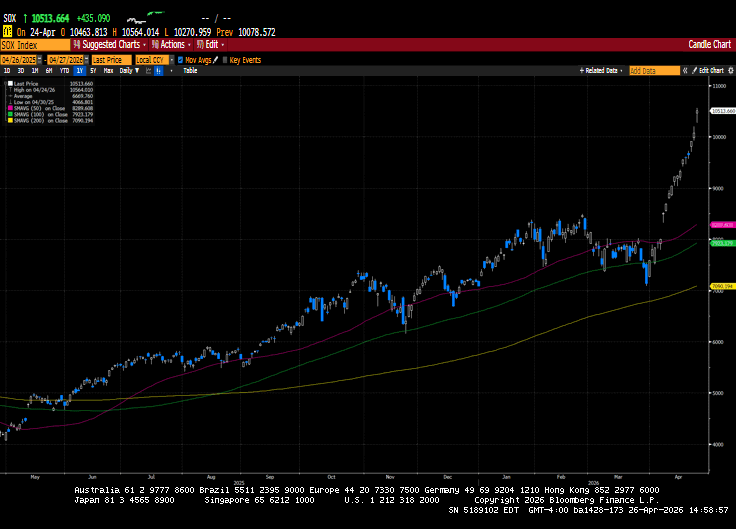
Weekly Market Commentary
Global markets had mixed results last week as headlines about the US-Iran conflict continued to affect trade. Conflicting reports of the US and Iran meeting to negotiate a ceasefire came and went without the two sides meeting. The Strait of Hormuz continued to be closed while the US continued to impose a blockade on Iranian ships. A fractured Iranian leadership has likely reduced hopes for negotiations, and while a ceasefire remains in place by the US, this timeline is very much in question. As the War enters its ninth week, concerns about global growth are mounting, and the damage to supply chains is worsening. Despite concerns about the conflict, Q1 earnings have come in much better than expected. Solid results from several technology companies, along with more news related to AI collaboration, helped propel the S&P 500 and NASDAQ to all-time highs. A fantastic quarter and outlook from Intel pushed the Philadelphia Semiconductor Index materially higher for the week. According to FactSet, 28% of the S&P 500 have reported first-quarter results. Of these results, 84% have beaten earnings per share estimates, while 81% have beaten revenue estimates. Currently, earnings per share growth for the quarter is 15.1%, while revenue growth is 10.3%. Other corporate highlights included the announcement that Apple’s Tim Cook would step down as CEO and that John Ternus would take over as CEO starting September 1st. Amazon and Anthropic announced a deal that includes a $25 billion investment by Amazon in Anthropic and a 10-year, $100 billion AWS deal between the companies. Elsewhere, it appears that Kevin Warsh will be confirmed as the next Federal Reserve Chairman. Mr. Warsh, during his confirmation hearing, stood by the independence of the Federal Reserve, was critical of the size of the Fed’s balance sheet, and will seek a new framework to contend with inflation. The DOJ, late in the week, dropped the criminal probe into current Fed Chairman Powell and his oversight of the renovation of the Federal Reserve’s building, which has cost $2.5 billion.

The S&P 500 gained 0.5%, the Dow was lower by 0.4%, the NASDAQ added 1.5%, and the Russell 2000 increased by 0.4%. US Treasury yields climbed across the curve. The 2-year yield increased by ten basis points to 3.78%, while the 10-year yield increased by six basis points. Oil prices jumped by 12.1% to close at $94.42 per barrel. Gold prices fell by 2.8% to $4,739.80 per ounce. Silver prices fell by $5.32, closing the week at $76.41 per ounce. Copper prices fell by eight cents to $6.03 per Lb. Bitcoin’s price increased by 3.49% to close the week at ~$78,000. The CBOE Volatility Index increased by 7%, closing at 18.71. The US Dollar index increased by 0.3% to 98.54.

S&P 500 Index 4/24/2026
The economic calendar was quiet last week. March Retail Sales came in better than expected, but the results were tempered by the fact that most of the gains were driven by price increases rather than volume. The headline number came in at 1.7% versus the consensus estimate of 1.3%. The Ex-Autos figure increased by 1.9% versus the estimated 0.9%. March Pending Home Sales increased by 1.5%, better than the 0.5% that was expected. Initial Jobless Claims increased by 6k to 214K, while Continuing Claims increased by 12k to 1.821m. A preliminary look at the S&P Global Manufacturing and Services PMIs showed that both were better than the previous readings. The final reading for the University of Michigan’s April Consumer Sentiment Index increased to 49.8 from 47.6, but the increase comes on the back of a record low made in March. The slight uptick was attributed to lower gas prices following the ceasefire agreement.

Investment advisory services offered through Foundations Investment Advisors, LLC (“FIA”), an SEC registered investment adviser. FIA’s Darren Leavitt authors this commentary which may include information and statistical data obtained from and/or prepared by third party sources that FIA deems reliable but in no way does FIA guarantee the accuracy or completeness. All such third party information and statistical data contained herein is subject to change without notice. Nothing herein constitutes legal, tax or investment advice or any recommendation that any security, portfolio of securities, or investment strategy is suitable for any specific person. Personal investment advice can only be rendered after the engagement of FIA for services, execution of required documentation, including receipt of required disclosures. All investments involve risk and past performance is no guarantee of future results. For registration information on FIA, please go to https://adviserinfo.sec.gov/ and search by our firm name or by our CRD #175083. Advisory services are only offered to clients or prospective clients where FIA and its representatives are properly licensed or exempted.

Protecting Your Wealth Through Every Stage of Life
When people think about financial planning, they often focus only on retirement accounts or investment strategies. While these are important pieces of the puzzle, true financial security comes from creating a complete plan that protects your wealth through every stage of life. Financial planning and insurance work together to help individuals, families, and business owners prepare for the unexpected while building long-term confidence.
A strong financial plan is not just about growing assets—it is also about protecting them. Life changes quickly. A new job, marriage, children, business ownership, retirement, or unexpected medical expenses can all impact your financial future. Without the proper protection in place, years of hard work and savings can be affected by events outside of your control.
Why Financial Planning Matters
Financial planning provides a roadmap for your future. It helps you understand where you are today, where you want to go, and what steps are necessary to get there. A well-designed financial strategy can help you:
- Build and grow wealth over time
- Prepare for retirement
- Reduce financial stress
- Plan for major purchases
- Create a legacy for loved ones
- Protect against unexpected risks
Every person’s financial situation is unique. Some individuals may focus on preparing for retirement, while others may need strategies for reducing debt, building emergency savings, or protecting their family’s future.
The Role of Insurance in Financial Security
Insurance is one of the most important components of a complete financial strategy. While investments focus on growth, insurance focuses on protection.
Insurance helps create a safety net that protects income, assets, and loved ones during life’s uncertainties.
Life Insurance
Life insurance can provide financial support for loved ones in the event of an unexpected loss. It may help cover:
- Mortgage payments
- Daily living expenses
- Education costs
- Outstanding debts
- Final expenses
For families, life insurance can offer peace of mind knowing that loved ones may still maintain financial stability.
Disability Insurance
Many people insure their home, vehicle, and belongings—but forget to protect their income. Disability insurance may help replace a portion of income if an illness or injury prevents someone from working.
Your ability to earn an income is often your most valuable asset. Protecting it can be just as important as protecting your savings.
Long-Term Care Planning
As people age, healthcare costs may increase. Long-term care planning can help prepare for future care needs, whether at home, in assisted living, or in a care facility.
Planning early may help reduce financial stress later in life while preserving retirement savings.
Building a Financial Strategy for Every Life Stage
Financial priorities often shift over time. A strategy that works in your twenties may look very different from one designed for retirement.
Early Career Years
During the early stages of adulthood, many individuals focus on:
- Building credit
- Paying off debt
- Establishing savings habits
- Starting retirement contributions
- Purchasing first-time insurance coverage
Family & Growth Years
As families grow, financial planning often expands to include:
- Life insurance protection
- College savings plans
- Mortgage planning
- Income protection strategies
- Estate planning basics
Pre-Retirement Planning
As retirement approaches, priorities may shift toward:
- Maximizing retirement savings
- Reducing risk
- Creating income strategies
- Healthcare planning
- Legacy planning
Retirement Years
Retirement planning focuses on preserving wealth while generating income to maintain lifestyle goals. This stage often includes:
- Income distribution planning
- Tax-efficient withdrawal strategies
- Insurance reviews
- Estate planning updates
- Long-term care considerations
Why Working With a Financial & Insurance Advisor Matters
Financial planning can feel overwhelming without guidance. A financial and insurance advisor helps bring clarity to important decisions by creating a strategy that aligns with your goals.
An advisor may help identify gaps in coverage, uncover opportunities for growth, and build a personalized roadmap designed around your life stage and priorities.
Working with a trusted advisor allows you to make informed decisions with greater confidence.
Final Thoughts
Financial confidence is not built overnight. It comes from making intentional decisions, protecting what matters most, and preparing for life’s changes.
Whether you are just beginning your financial journey or preparing for retirement, combining smart financial planning with the right insurance strategies can help create a stronger, more secure future.
The best time to start planning is today.
Learn how financial planning and insurance work together to protect your income, assets, and family through every stage of life. Discover smart strategies for long-term financial security.
Ready to build a stronger financial future? Contact our team today to discuss personalized financial and insurance strategies designed around your goals.
The Net Unrealized Appreciation (NUA) Strategy and Roth IRA Contribution Eligibility: Today’s Slott Report Mailbag
By Ian Berger, JD
IRA Analyst
Question:
Hello,
I’ve run into someone who is retired, age 77, and therefore taking required minimum distributions (RMDs) from his Caterpillar 401(k) plan. He has approximately $5M in Caterpillar stock within the plan. It seems murky as to whether he would be eligible for the net unrealized appreciation (NUA) strategy. I have seen that taking RMDs will likely prevent eligibility for NUA treatment due to the lack of distribution of the entire balance in one taxable year. Any thoughts?
Thanks,
Derek
Answer:
Hi Derek,
Eligibility for the NUA strategy requires a triggering event and a lump sum distribution. A lump sum distribution means that the entire 401(k) account balance must be emptied all in one calendar year. The calendar year must be the same year in which the triggering event occurs or a later calendar year. After hitting a trigger, certain distributions (such as taking an RMD) require the entire remaining account balance to also be taken that same year, or else the trigger is lost and the NUA treatment is no longer available.
This person had a triggering event when he retired, so, if he started RMDs before 2026, then he would have needed to complete the lump sum distribution in that first RMD year. Failing to do that means the NUA strategy cannot be used.
Question:
Can a person, age 73, who is now required to take a traditional IRA RMD, still contribute to a Roth IRA if he is still working and has earned income?
Thank you,
Michael
Answer:
Hi Michael,
Yes, someone can make a Roth IRA contribution as long as he (or, if married, his spouse) has earned income at least as high as the contribution, and he meets the Roth IRA income limits. Taking RMDs from the traditional IRA does not affect eligibility for the Roth IRA contribution. However, the RMDs cannot count as earned income for Roth IRA contribution purposes.
If you have technical questions you would like to have answered, be sure to submit them to mailbag@irahelp.com, to be answered on an upcoming Slott Report Mailbag, published every Thursday.
https://irahelp.com/the-net-unrealized-appreciation-nua-strategy-and-roth-ira-contribution-eligibility-todays-slott-report-mailbag/
6 Required Questions to Determine an IRA Beneficiary Payout Structure
By Andy Ives, CFP®, AIF®
IRA Analyst
1. When did the decedent die? The SECURE Act impacts beneficiaries of decedents who died in 2020 or later. Anyone who passed away prior to 2020 falls under the old rules. Prior to the SECURE Act, all living, breathing beneficiaries were able to stretch annual required minimum distributions (RMDs) from their inherited IRA over their single life expectancy. For deaths in 2020 or later, the SECURE Act grandfathered certain beneficiaries under the old rules and introduced a 10-year rule for “non-eligible designated beneficiaries” (NEDBs). The year of death of the IRA owner must be identified so we know which path to take – old rules or new rules.
2. What was the date of birth (DOB) of the decedent? If the beneficiary is an NEDB, we must know the DOB of the decedent. Did he die before or after his required beginning date (RBD)? For IRAs, the RBD is April 1 of the year after the year a person turns age 73. For NEDBs, death before the RBD means no RMDs within the 10-year rule. Death on or after the RBD dictates that the beneficiary must take annual RMDs during the 10-year period.
3. Who (or what) is the beneficiary? Of course, we need to know who the beneficiary is. But is the beneficiary a person or a non-living entity like an estate? A non-living beneficiary means the 5-year rule applies for deaths before the RBD, and the “ghost rule” applies for deaths on or after the RBD. The type of beneficiary decides which direction we go.
4. What is the relationship between the decedent and beneficiary? This question is necessary to determine if the beneficiary is a spouse or a non-spouse. Spouse beneficiaries have a set of options available only to them – like a spousal rollover. Identifying whether the beneficiary is a spouse or not further narrows the path toward the proper payout.
5. What was the DOB of the beneficiary? Knowing the age of the beneficiary is crucial. For example, a spouse beneficiary under age 59½ could elect an inherited IRA to have penalty-free access to the inherited funds, and then do a spousal rollover at age 59½. For non-spouse beneficiaries, identifying the age of the beneficiary is just as important. Is this a minor child of the IRA owner? Is the beneficiary “not more than 10 years younger” than the decedent? Both would qualify the beneficiary as an eligible designated beneficiary (EDB) and allow for annual RMDs over the single life expectancy of that beneficiary (for a minor child, only up to age 31).
6. What type of IRA is this? Whether the IRA being passed to the beneficiary is a Roth or traditional matters. Roth IRA owners are always deemed to die prior to the RBD. That means there are never RMDs within the 10-year rule for Roth IRAs inherited by an NEDB. For non-person beneficiaries of Roth IRAs (like an estate), the 5-year rule will always apply.
By layering these six questions on top of each other, we can identify the applicable beneficiary payout structure. Yes, there are additional clarifying questions to help winnow down the final answer, but without answering these foundational questions, the correct path forward is impossible to determine.
If you have technical questions you would like to have answered, be sure to submit them to mailbag@irahelp.com, to be answered on an upcoming Slott Report Mailbag, published every Thursday.
https://irahelp.com/6-required-questions-to-determine-an-ira-beneficiary-payout-structure/
How Will States Tax Trump Account Contributions?
By Ian Berger, JD
IRA Analyst
Trump Account contributions can be made as early as this July 4. But before making a contribution on behalf of a child, you should understand that the way these contributions are treated under federal tax law may be different than the way they are treated under state law.
As a reminder, four types of Trump Account contributions will be permitted:
(1) A one-time $1,000 federal government contribution for children born between 2025 and 2028;
(2) Individual contributions by parents, grandparents, or anyone else on behalf of a child, up to $5,000 in 2026;
(3) Contributions by employers for teenage employees and dependents of employees; and
(4) Contributions by tax-exempt organizations or any government.
For federal income tax purposes, Trump Account contributions in categories (1), (3) and (4) are considered pre-tax IRA contributions. This means that taxation of those contributions and their earnings can be deferred until distribution. Individual contributions (category (2)) are considered after-tax IRA contributions. Taxation of earnings is deferred until distribution.
But that’s only half the story. There is also the question of how states will tax Trump Account contributions. Nine states (Alaska, Florida, Nevada, New Hampshire, South Dakota, Tennessee, Texas, Washington and Wyoming) don’t have state income tax, so that isn’t an issue if you reside there. And, according to the Tax Foundation, 20 states and the District of Columbia broadly match federal tax law. Those 20 states are: Alabama, Colorado, Connecticut, Delaware, Illinois, Iowa, Kansas, Louisiana, Maryland, Missouri, Montana, Nebraska, New Mexico, New York, North Dakota, Oregon, Rhode Island, Utah, Vermont and West Virginia. Those states will likely tax Trump Account contributions like federal law does.
What about the remaining 21 states? According to a March 2, 2026 story by Julie Z. Weil of The Washington Post, they are handling Trump Account contributions in different ways:
- Three states (Arkansas, Idaho and Virginia) specifically say they will follow federal law.
- Georgia, Indiana and Maine have legislation pending to coordinate state law with federal law. (Although Vermont normally follows federal law, Ms. Weil reports that it also has pending legislation.)
- Three states (Minnesota, Mississippi and North Carolina) say they will take up the issue at a later date.
- Seven states (California, Hawaii, Kentucky, Massachusetts, Pennsylvania, South Carolina and Wisconsin) say they won’t recognize the federal tax treatment of Trump Accounts. In other words, they won’t treat Trump Accounts as IRAs. This means that earnings on all types of contributions will be taxed annually. (In California and possibly others of the seven states, contributions from employers and tax-exempt organizations will be taxed in the year made.)
- The remaining states did not respond to Ms. Weil.
If you live in one of the undecided states or a state that didn’t respond to the reporter, you should check with your state tax office.
Just because a state has said it won’t follow the federal tax treatment of Trump Account contributions doesn’t necessarily mean that a contribution is unwise. It just adds another factor that you must consider before pulling the trigger. Seeking help from a competent financial advisor is highly recommended.
If you have technical questions you would like to have answered, be sure to submit them to mailbag@irahelp.com, to be answered on an upcoming Slott Report Mailbag, published every Thursday.
https://irahelp.com/how-will-states-tax-trump-account-contributions/
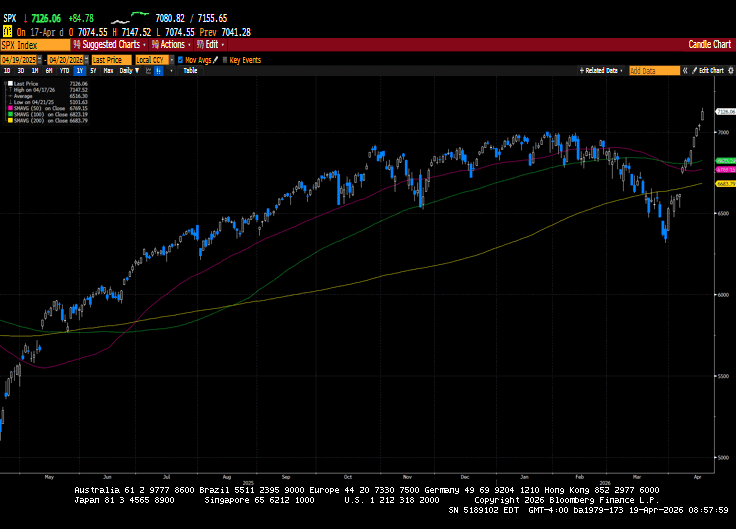
Weekly Market Commentary
Global markets continued to rally in hopes of an extended ceasefire and Friday’s reopening of the Strait of Hormuz. However, the rally will be tested on Monday after Iran shut down the Strait of Hormuz on Saturday, with the ceasefire ending on Tuesday. Negotiations between the US and Iran are scheduled for this coming Monday in Islamabad. A 10-day ceasefire between Israel and Lebanon was also announced last week and continues to hold. Conflict in the Middle East will continue to dominate markets, but a solid start to Q1 earnings also helped propel markets higher last week. Technology shares continued to provide leadership after a weak start to the year. Several AI partnership announcements, coupled with solid Q1 results from Taiwan Semiconductor, catalyzed the AI trade. Additionally, several banks announced better-than-expected results, although the reaction from the street was mixed. We will receive another full dose of earnings this week with Tesla, Boeing, United Healthcare, Vertiv, Lam Research, and SK Hynix as highlights. Also of interest will be the confirmation hearing for Fed Chairman nominee Kevin Warsh, scheduled for Tuesday.

The S&P 500 traded above 7000 for the first time, adding 4.5% on the week. The NASDAQ extended its rally to thirteen straight days and forged a new all-time high, gaining 6.8% on the week. The Dow rose 3.2%, and the Russell 2000 inked a 5.6% gain. Of note, the Japanese equity market also posted an all-time high, and emerging markets broke out to a new high. US Treasuries were bid up across the curve. The 2-year yield declined by ten basis points to 3.70%, while the 10-year yield fell by seven basis points to 4.25%. Oil prices plunged on the reopening of the Strait of Hormuz. WTI prices declined by 12.7%, closing at $84.22 a barrel. Gold prices increased by $93.20 or 1.9% to $4,880.50 per ounce. Silver prices advanced by 6% to $80.93 per ounce. Copper prices rose by $0.23 to $6.11 per Lb. Bitcoin’s price increased by 5.8% on the week to close Friday afternoon at $77,300, but has since fallen back to $75,000 amid heightened tensions between the US and Iran. The US Dollar Index fell by 0.7% to 98.01.

Emerging Markets ETF IEMG 4/17/2026
A weaker-than-expected March Producer Price Index was the highlight of this week’s economic calendar. Headline PPI came in at 0.5% versus the consensus estimate of 1.2%. Core PPI came in at 0.1% versus expectations of 0.4%. On a year-over-year basis, the headline print was up 4% versus 3.4% in February, while the Core reading was up 3.8%, unchanged from the prior reading. Initial Jobless Claims were lower by 11k to 207k, while Continuing Claims increased by 31k to 1818k.

Investment advisory services offered through Foundations Investment Advisors, LLC (“FIA”), an SEC registered investment adviser. FIA’s Darren Leavitt authors this commentary which may include information and statistical data obtained from and/or prepared by third party sources that FIA deems reliable but in no way does FIA guarantee the accuracy or completeness. All such third party information and statistical data contained herein is subject to change without notice. Nothing herein constitutes legal, tax or investment advice or any recommendation that any security, portfolio of securities, or investment strategy is suitable for any specific person. Personal investment advice can only be rendered after the engagement of FIA for services, execution of required documentation, including receipt of required disclosures. All investments involve risk and past performance is no guarantee of future results. For registration information on FIA, please go to https://adviserinfo.sec.gov/ and search by our firm name or by our CRD #175083. Advisory services are only offered to clients or prospective clients where FIA and its representatives are properly licensed or exempted.
The Five-Year Rule and Rollovers to Employer Plans: Today’s Slott Report Mailbag
By Sarah Brenner, JD
Director of Retirement Education
QUESTION:
Hi,
I was wondering if my Roth account that is a part of my Thrift Savings Plan (TSP) through federal employment counts toward my five-year rule for a Roth IRA? If I wanted to transfer the money from my workplace Roth account to a Roth IRA outside of my employment. Does the clock for the five-year rule start with my workplace Roth or with the Roth IRA I open separately?
Thank you!
Judy
ANSWER:
Hi Judy,
This is a good question and one we hear frequently. When it comes to tax-free distributions of qualified earnings, the Roth IRA will have its own five-year holding period. You do not get credit for the time the Roth plan account has been open. Instead, the clock for tax-free earnings starts with your first contribution or conversion to a Roth IRA. If you are looking to roll over the funds from your TSP to a Roth IRA, you may benefit by getting a jump-start on the five-year clock by doing a conversion or Roth IRA contribution as soon as you can.
QUESTION:
Hello!
I reached age 73 on February 9, 2026. I am still working and have a current 401(k) account. I don’t intend to retire, but plan to work for a couple of years, until I reach age 75.
I have a traditional IRA account. To avoid taking required minimum distributions (RMDs) from the IRA account, I am considering rolling over that account to my 401(k) account. Please let me know if I can do it and avoid RMDs. If that is fine, what is the deadline for the rollover from IRA to 401(k) plan?
Jay
ANSWER:
Hi Jay,
The rules do allow rollovers of pre-tax funds to employer plans. The rules also allow a delay for RMDs on funds in an employer plan if the “still-working” exception is available. There is no deadline for doing this rollover. However, because you reach age 73 in 2026, you must take your RMD for 2026 from your IRA prior to the rollover. The RMD is not eligible for rollover to the plan.
If you have technical questions you would like to have answered, be sure to submit them to mailbag@irahelp.com, to be answered on an upcoming Slott Report Mailbag, published every Thursday.
https://irahelp.com/the-five-year-rule-and-rollovers-to-employer-plans-todays-slott-report-mailbag/

The Hidden Risk of “Waiting Too Long” to Get Your Financial House in Order
Most people do not ignore their finances because they do not care.
They ignore them because life gets busy.
Work takes over. Family needs attention. Retirement feels far away. Insurance paperwork feels confusing. Estate planning gets pushed to “later.” Before long, years have passed, and important decisions are still sitting on the back burner.
The truth is, waiting too long to put your financial house in order can create problems that are much harder — and more expensive — to fix later.
Why People Delay Financial Planning
For many people, it is not laziness. It is uncertainty.
They may be asking themselves:
- Do I have enough saved for retirement?
- Am I paying for the right insurance coverage?
- What happens to my family if something unexpected happens to me?
- Am I making costly tax mistakes?
- When should I take Social Security?
- Do I even have a clear plan?
These are big questions, and when people do not know where to start, they often do nothing at all.
The Cost of Waiting
Delaying financial decisions can have a ripple effect across every part of your future.
1. Missed retirement opportunities
The longer you wait to save and invest strategically, the less time your money has to grow. Even small delays can make a major difference over time.
2. Insurance gaps
Many families assume they are protected until they actually review their policies. In reality, they may be underinsured, overpaying, or missing key protections altogether.
3. Higher stress during emergencies
When there is no clear plan in place, unexpected events can create panic. A job loss, market downturn, illness, or death in the family becomes even more overwhelming when financial decisions have not already been organized.
4. Missed legacy planning
Without beneficiary reviews, estate strategies, and updated legal documents, loved ones may be left with confusion, delays, and unnecessary financial burdens.
Small Steps Now Can Make a Big Difference Later
The good news is that getting started does not require perfection. It just requires action.
A solid financial strategy often begins with a few simple steps:
- Reviewing current income, savings, and debt
- Evaluating retirement accounts
- Looking at life, health, long-term care, or annuity options where appropriate
- Checking beneficiaries on existing accounts
- Identifying gaps in protection
- Creating a plan for income in retirement
These conversations can bring clarity, confidence, and peace of mind.
It Is Not Just About Money
Financial planning is not only about numbers on a page.
It is about protecting your lifestyle.
It is about caring for your spouse and family.
It is about making sure your hard work leads somewhere meaningful.
It is about having confidence in your future instead of hoping things work out on their own.
That is why having a trusted financial and insurance advisor matters. A good advisor helps simplify the process, explain your options, and build a strategy that fits your goals.
Final Thought
The best time to get your financial house in order was years ago.
The second-best time is now.
You do not have to solve everything in one day. But taking the first step today can help you avoid costly mistakes tomorrow.
If you have been putting off retirement planning, insurance reviews, or income planning, now may be the right time to sit down, ask questions, and create a strategy designed to protect what matters most.
Ready to take the next step? Contact our office today to schedule a complimentary review and see whether your current financial and insurance strategy is aligned with your long-term goals.
How an Excess IRA Contribution Can Happen to You
By Sarah Brenner, JD
Director of Retirement Education
Not all funds in an IRA belong there. When a contribution is not permitted in an IRA, it is considered an excess contribution and needs to be fixed to avoid penalties. Some excess contributions are easy to understand. Others may surprise you.
Here are some ways an excess IRA contribution can happen to you:
Your income is too high to make a Roth IRA contribution.
A common cause of excess Roth IRA contributions is contributing in a year when income is too high. If your income fluctuates or you have unexpected income in the year, you are particularly vulnerable. Watch out for the annual income limits. For traditional IRAs, there are no income limits for eligibility to contribute, so this is never a problem.
You do not have enough earned income or taxable compensation.
A more frequent occurrence is an IRA owner not having sufficient earned income or taxable compensation to fund an IRA contribution for the year. While you can use a spouse’s taxable compensation to fund your IRA, a multitude of different income sources do not qualify for an IRA contribution, including Social Security, rental income and investment income. You may have a high income, but still not be eligible to fund an IRA. If you go ahead anyway, the result is an excess IRA contribution.
You contribute more than the annual limit.
If you contribute more than the annual limit to an IRA for the year, that will be an excess contribution. This may seem like an easy rule to follow. You may wonder who is going around contributing tens of thousands of dollars to IRAs in violation of the contribution limits. In fact, most IRA custodians will not accept contributions over the yearly limit. However, an individual with multiple IRAs with different custodians could exceed the limit by contributing to each of them.
You violate the 60-day or once-per-year rollover rule.
You may be surprised to know that a failed rollover attempt can result in an excess contribution. How can this happen? Well, there are a variety of ways you can end up in this position. One possibility would be a violation of one of the rollover rules. If you mistakenly roll over after the 60-day rollover period has already expired, or if you violate the once-per-year rollover rule, you will end up with an excess contribution instead of a rollover in your IRA.
You roll over your RMD.
If you are older, you may be at greater risk of excess contribution due to rollover mistakes. Older clients can be at a higher risk for excess contributions due to rollover mistakes. This is because of the rule that says that the required minimum distribution (RMD) for the year cannot be rolled over. In fact, the RMD for the IRA must be taken before any of the funds in the IRA are eligible for rollover. For example, an RMD must be taken before doing a Roth IRA conversion. If you mistakenly roll over your RMD, you will end up with an excess contribution.
You make a contribution to an inherited IRA.
If you inherit an IRA from someone who is not your spouse, you may not contribute to that inherited IRA or combine it with your own IRA. If you do, you will have an excess contribution.
The Fix for Excess Contributions
Now you know what can cause excess IRA contributions. That is the first step in avoiding them. If, despite your best efforts, an excess contribution occurs, the bad news is that the problem will not go away or fix itself. An excess contribution can be subject to penalties each year it remains in the IRA. The good news is that excess contributions can be corrected and often without penalty. For the right fix for your situation, be sure to talk to a knowledgeable tax or financial advisor.
If you have technical questions you would like to have answered, be sure to submit them to mailbag@irahelp.com, to be answered on an upcoming Slott Report Mailbag, published every Thursday.
https://irahelp.com/how-an-excess-ira-contribution-can-happen-to-you/
April 15: The Deadline for Some IRA Transaction, but Not All
By Andy Ives, CFP®, AIF®
IRA Analyst
April 15 is fast approaching. Not only is this the standard tax filing deadline, but it is also the deadline to complete some IRA transactions. But there is a common misconception that certain other IRA transactions can also be done up until mid-April. Such is not the case. Here are a few IRA moves that can be done by April 15, and a few that are already well past their deadline.
Prior-year traditional IRA contributions CAN be made up until April 15. So, if an IRA owner still wants to make a 2025 traditional IRA contribution, there is still time (as of this publication date). Prior-year contributions can be deductible or not. But be forewarned, even if a taxpayer files for an extension to submit his return, that extension does not extend the IRA contribution deadline. It remains April 15.
Prior-year Roth IRA contributions CAN ALSO be made up to April 15. The same extension rules mentioned above apply to Roth IRAs as well. But not all benefits are the same. For example, Roth IRAs have 5-year clocks to consider for tax-free earnings. No such clocks apply to traditional IRAs. A person who opens his very first Roth IRA (via either contribution or conversion) will receive a January 1 start date of that year for his “5-year forever” clock. What if a person who never had a Roth IRA before makes a prior-year Roth IRA contribution in early 2026 for 2025? Since the contribution was for 2025, that person receives a January 1, 2025 start date. A prior-year contribution can shave over 15 months off an initial 5-year Roth IRA clock.
What CANNOT be done up to April 15 is a “prior-year Roth IRA conversion.” There is no such thing. All Roth IRA conversions count for the year of the conversion. For a conversion to be applicable for the 2025 tax return, the dollars must have left the traditional IRA by December 31, 2025. So, a person can make a prior-year (2025) traditional IRA contribution, but if those contributory dollars are then promptly converted, the conversion will count for 2026. This is an important distinction when a person is completing a “backdoor Roth IRA” by making a non-deductible traditional IRA contribution and then converting it.
Example: On April 15, John, age 55, makes a prior-year (2025) traditional IRA contribution for $8,000 and, at the same time, makes a current year (2026) traditional IRA contribution for $8,600. John then converts all $16,600 to a Roth IRA. While the $8,000 contribution will count for 2025, the entire $16,600 conversion is documented and taxed on his 2026 return.
Another transaction that CANNOT be extended to the following year is a qualified charitable distribution (QCD). Like Roth conversions, there is also no such thing as a “prior-year” or “retroactive” QCD. When executed properly by an eligible traditional IRA owner, a QCD can exclude income that would otherwise be taxable if a person just took a normal distribution. However, once a standard withdrawal is paid out to a traditional IRA owner, the deed is done. Yes, you can subsequently give that money to charity, but you cannot claim “QCD.” A charitable deduction could work, but the opportunity to offset that income with a QCD is lost. If the goal was to exclude income in 2025 with a QCD, that QCD must have been processed by December 31, 2025.
If you have technical questions you would like to have answered, be sure to submit them to mailbag@irahelp.com, to be answered on an upcoming Slott Report Mailbag, published every Thursday.
https://irahelp.com/april-15-the-deadline-for-some-ira-transaction-but-not-all/
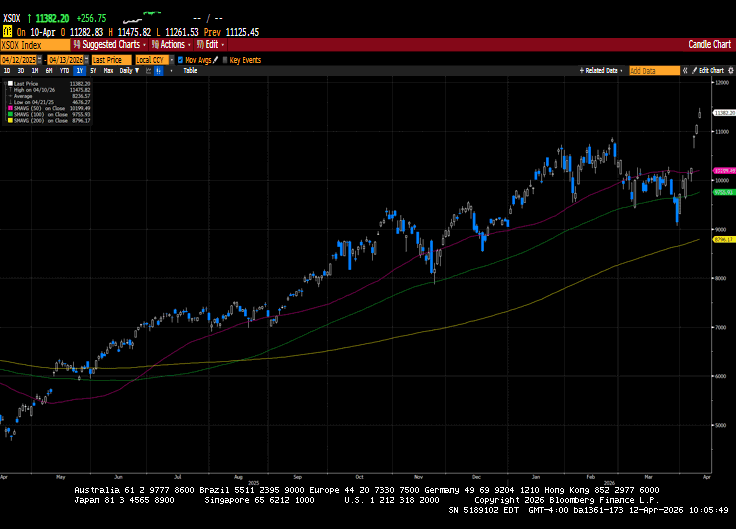
Weekly Market Commentary
Global markets rose for a second week as the US and Iran agreed to a two-week ceasefire. The two sides met in Pakistan on Saturday to negotiate an end to the war, but talks ended without a resolution. The fragile ceasefire will be tested on Monday as markets reopen, with it likely that we see higher oil prices and a stronger US Dollar. Passage through the Strait of Hormuz continues to be at a standstill. However, there were reports over the weekend that US warships had mine-swept a path through the Strait that could lead to escorted passage. Markets have and will continue to be headline-driven. First-quarter earnings will begin this week, and it’s likely we’ll see tempered guidance from corporate management teams. Increased uncertainty about energy costs, tariffs, and consumer health may keep solid results from being rewarded. That said, solid monthly results from Taiwan Semiconductor helped push the Philadelphia Semiconductor index higher by 13.5%. Communication Services and the Consumer Discretionary sectors led market gains last week, with Information Technology also performing strongly. Software as a sub-index within Information Technology continued to struggle. The Energy sector was the worst-performing sector for the week, declining 4.1% as crude prices tumbled by over 13%.

The S&P 500 gained 3.6%, the Dow rose by 3%, the NASDAQ increased by 4.7%, and the Russell 2000 added 4%. International markets also had a great week, with Japan’s Nikkei rising by 7.2%, South Korea increasing by 9%, and the European Stoxx 600 rising by 3.5%. US Treasury yields fell across the curve. The 2-year yield fell by three basis points to 3.80%, while the 10-year yield declined by three basis points to close the week at 4.32%. The announcement of a two-week ceasefire sent oil prices tumbling. West Texas Intermediate crude prices fell by 13.29% or $14.93 to close at $96.55 a barrel. Gold prices advanced by 2.3% to close the week at $4,787.30 per ounce. Silver prices jumped by $3.74 or 5.1% to $76.48 per ounce. Copper prices surged by 5.3% to $5.88 per Lb. Bitcoin’s price increased by 8.1% to $72,900. The US Dollar index fell by 1.5% to 98.66.

&P 500 4/10/2026
This week’s economic calendar showcased global inflation data. In the US, the Producer Price Index increased by 0.4% in February, in line with the street’s expectation. The headline figure increased by 2.8% on a year-over-year basis, flat from the January reading. Core PPI also increased by 0.4% but was slightly higher than the 0.3% consensus estimate. The year-over-year figure declined to 3% from 3.1% posted in January. Headline March Consumer Price Index increased by 0.9%, well above the consensus of 0.7%. On a year-on-year basis, the CPI rose by 3.3%, up from 2.4% in February. The significant jump was attributed to a 10.9% increase in energy prices in March. Core CPI, which excludes food and energy, increased by 0.2%, less than the 0.3% consensus. Core CPI increased by 2.6% year-over-year, up from 2.5% in February. The increases in the CPI were concentrated in energy, but the question is whether this increase will bleed into other prices in the coming months, and the answer is likely yes. Personal Income fell by 0.1%, while Personal Spending came in slightly below expectations at 0.5%. ISM Services remained in expansion but is losing momentum. The reading came in at 54, down from the previous reading of 56.1. The third look at 4th-quarter GDP showed another downward revision to 0.5% growth. Again, much of this lost growth in GDP can be attributed to the government shutdown. Initial Claims increased by 16k to 219k, while Continuing Claims fell by 38k to 1794k. Finally, a preliminary look at the University of Michigan’s Consumer Sentiment for April fell to 47.6 from 53.3 in March.

Investment advisory services offered through Foundations Investment Advisors, LLC (“FIA”), an SEC registered investment adviser. FIA’s Darren Leavitt authors this commentary which may include information and statistical data obtained from and/or prepared by third party sources that FIA deems reliable but in no way does FIA guarantee the accuracy or completeness. All such third party information and statistical data contained herein is subject to change without notice. Nothing herein constitutes legal, tax or investment advice or any recommendation that any security, portfolio of securities, or investment strategy is suitable for any specific person. Personal investment advice can only be rendered after the engagement of FIA for services, execution of required documentation, including receipt of required disclosures. All investments involve risk and past performance is no guarantee of future results. For registration information on FIA, please go to https://adviserinfo.sec.gov/ and search by our firm name or by our CRD #175083. Advisory services are only offered to clients or prospective clients where FIA and its representatives are properly licensed or exempted.
Non-Spouse Beneficiaries and Funding QCDS: Today’s Slott Report Mailbag
By Andy Ives, CFP®, AIF®
IRA Analyst
QUESTION:
If a non-spouse beneficiary inherits a 401(k), what are the options? Can you roll the money into an inherited IRA? Are there any other options, and over what time period does each option require the account to be drained? Thank you so much for your help.
Roger
ANSWER:
Roger,
The payout rules for non-spouse beneficiaries of 401(k) plans are the same as those that apply to non-spouse beneficiaries of IRAs. We must first determine if the non-spouse is an eligible designated beneficiary (EDB) or a non-eligible designated beneficiary (NEDB). EDBs can use their own single life expectancy to take annual required minimum distributions (RMDs) from the inherited account. NEDBs will get the 10-year rule. Whether or not RMDs apply within the 10-year period depends on the age of the deceased 401(k) plan participant. Regardless of the beneficiary’s status as either an EDB or NEDB, the inherited 401(k) can be directly rolled over to an inherited IRA, and the applicable payout schedule will follow. Note that non-designated beneficiaries (NDBs), such as an estate, cannot move plan funds to an inherited IRA. Also, 401(k) plans can be more restrictive and require a quicker payout vs. what is outlined above.
QUESTION:
I am currently retired, age 65, and have a 401(k) plan. How far in advance should I transfer money from my 401(k) to an existing traditional IRA to fund a qualified charitable distribution (QCD)? Can I use the same traditional IRA account to fund QCDs in future years? Need I transfer the entirety of my 401(k) balance into an existing traditional IRA up front, or may I do it gradually over time?
Best regards,
Ken
ANSWER:
Ken,
Step 1 is to become eligible to complete a QCD. Since a person cannot do a QCD until age 70½, you have five years to get your ducks in a row. You are correct to anticipate the need to roll over 401(k) funds to an IRA, because QCDs cannot be done from a 401(k) plan. Yes, you can use the same traditional IRA to receive your 401(k) rollover and handle all of your QCDs. You could do partial rollovers to your IRA to fund QCDs between ages 70 and 74, but this could become problematic when you are RMD age. Since you are only age 65, at age 75 there will be an RMD due on your 401(k). RMDs cannot be rolled over. So, you would need to take the RMD from the plan before doing any rollovers to your IRA. The income from the 401(k) RMD cannot then be offset with a future QCD. If your goal is to offset future RMDs with QCDs, it might be wise to roll over your entire 401(k) to your IRA before the year you turn age 75.
If you have technical questions you would like to have answered, be sure to submit them to mailbag@irahelp.com, to be answered on an upcoming Slott Report Mailbag, published every Thursday.
https://irahelp.com/inherited-iras-and-funding-qcds-todays-slott-report-mailbag/

What Inflation Is Quietly Doing to Your Retirement Plan
When most people think about retirement planning, they focus on the big numbers. How much they have saved. How much income they will need. When they want to retire.
But there is one factor that quietly works in the background year after year, and if it is not accounted for, it can slowly chip away at even the best retirement strategy.
That factor is inflation.
Inflation does not usually hit all at once. It works gradually. A little more at the grocery store. Higher gas prices. Increased insurance premiums. Rising medical costs. More expensive home repairs. Over time, those increases can have a major impact on how far your retirement dollars will actually go.
The Retirement Risk Many People Underestimate
A retirement plan that looks strong on paper today may not feel nearly as secure 10, 15, or 20 years from now if inflation is not built into the strategy.
For example, if you retire with a fixed monthly income, but your everyday expenses continue to rise, your purchasing power starts to shrink. That means the same amount of money buys less and less over time.
What feels comfortable today may feel tight later.
That is one of the biggest risks retirees face, especially those who are living on savings, Social Security, pensions, or other income sources that may not fully keep pace with rising costs.
Inflation Affects More Than Just the Cost of Living
Many people think inflation only matters when it comes to groceries or gas. But in retirement, it can touch nearly every part of your financial life.
It can increase:
- Healthcare costs
- Prescription drug expenses
- Homeowners and auto insurance premiums
- Property taxes
- Travel and leisure expenses
- Daily household bills
- Long-term care costs
Even moderate inflation, over a long enough period of time, can create a serious strain on retirement income.
Why This Matters More in Retirement
During your working years, inflation is frustrating, but you may still have options. You can earn more, work extra, adjust your budget, or delay purchases.
In retirement, those options may be more limited.
That is why inflation planning is not just an investment issue. It is an income issue. A tax issue. A healthcare issue. And for many households, it becomes a lifestyle issue.
Without a plan, inflation can force difficult decisions later, such as cutting back spending, withdrawing more from savings than expected, or taking on more financial stress than necessary.
Common Ways Inflation Can Hurt a Retirement Plan
1. It reduces purchasing power
This is the most obvious effect. Over time, your money simply does not stretch as far.
2. It can cause you to underestimate future income needs
Many retirees build a plan around today’s expenses, not tomorrow’s. That can create a gap later.
3. It may lead to higher withdrawal rates
If costs rise faster than expected, retirees may take more from their accounts, increasing the risk of running through savings too quickly.
4. It can make conservative strategies too conservative
Holding too much in low-growth accounts may feel safe, but it can also leave your money unable to keep pace with inflation over time.
5. It puts added pressure on healthcare planning
Medical expenses often rise faster than general inflation, making this one of the biggest retirement planning concerns.
What You Can Do About It
The good news is inflation is not a surprise risk. It is a known risk. And that means it can be planned for.
A well-built retirement strategy should account for rising costs and include regular reviews to make sure your income plan still works under changing conditions.
That may include:
- Reviewing whether your current retirement income is designed to grow over time
- Looking at how much of your portfolio is positioned for long-term growth
- Evaluating fixed-income sources versus inflation-sensitive needs
- Updating spending assumptions based on real life costs
- Reviewing insurance and healthcare planning regularly
- Stress-testing your retirement plan for future inflation scenarios
The goal is not just to retire. The goal is to stay retired comfortably.
Inflation Planning Is Really About Protecting Your Lifestyle
At the end of the day, inflation is not just about numbers on a chart. It is about your quality of life.
It is about whether you can maintain your independence, enjoy the lifestyle you worked hard for, help family when you want to, travel if you choose to, and feel confident that your plan is built for the future, not just for today.
A retirement plan should not only help you get to retirement. It should help you stay financially secure throughout it.
Final Thoughts
Inflation may be quiet, but its effect on retirement can be powerful.
That is why it is so important to review your financial and insurance strategy regularly and make sure your plan reflects the reality of rising costs. A thoughtful review today may help prevent a much bigger problem tomorrow.
If your retirement plan has not been reviewed recently, now may be a good time to see whether it is truly built to keep up with the future.
The Strange RMD Rules for Ex-Spouses After a Divorce
By Ian Berger, JD
IRA Analyst
“Qualified domestic relations orders” (QDROs) are court orders used to divide ERISA retirement plan assets after a divorce. Normally, after a QDRO is approved by a defined contribution plan like a 401(k), the plan will establish a separate account within the plan in the name of the ex-spouse.
Since the ex-spouse has her own separate account within the plan, you might think that required minimum distributions (RMDs) for her would be based on her age. In other words, you might think that the ex-spouse doesn’t have to start RMDs until the year she turns age 73 (or 75 if born after 1959) – regardless of the 401(k) participant’s age.
Strangely, that’s not what the IRS regulations say. Those rules say that, even though an ex-spouse has a separate account, she must start taking RMDs when the participant reaches age 73 (or 75). The IRS rules go on to say that when RMDs start for the ex-spouse, she gets to use her own single life expectancy factor to calculate RMDs. Unfortunately, it’s not clear which IRS life expectancy table should be used. Although it would seem that the more favorable Uniform Lifetime Table (usually used for lifetime RMDs) is the correct table, some large plan administrators base RMDs on the Single Life Table (usually used only for post-death RMDs).
Example: Harrison is a participant in a 401(k) plan. He and his wife, Calista, are divorced in 2026 when Harrison is 72 and Calista is 54. They agree to a QDRO in which Harrison assigns 50% of his 401(k) account balance to Calista. The plan establishes a separate account for Calista’s benefit. Harrison turns age 73 in 2027. Even though Calista will only turn age 55 in 2027, she must start taking RMDs for that year. Her RMD for 2027 would be based on a life expectancy factor of 31.6 if she uses the IRS Single Life Table, but would be 43.6 if she uses the Uniform Lifetime Table.
There is a workaround if an ex-spouse who is younger than her ex-spouse, doesn’t want to be saddled with RMDs. Most plans allow ex-spouses to roll over their separate account to their own IRA at any time. Once she does that, the ex-spouse won’t be required to start RMDs until she turns age 73 (or 75 if born after 1959). (However, if the ex-spouse does the rollover in a year in which she is subject to RMDs, she would have to take the RMD out first.)
A distribution out of a QDRO separate account is neversubject to the 10% early distribution penalty, regardless of age. The downside to the rollover strategy is that the rolled-over funds become subject to the standard IRA early distribution rules. Therefore, if the ex-spouse must tap into the rolled-over IRA funds before age 59½, that withdrawal is subject to penalty.
If you have technical questions you would like to have answered, be sure to submit them to mailbag@irahelp.com, to be answered on an upcoming Slott Report Mailbag, published every Thursday.
https://irahelp.com/the-strange-rmd-rules-for-ex-spouses-after-a-divorce/
Five Last-Minute Tips for 2025 IRA Contributions
By Sarah Brenner, JD
Director of Retirement Education
The tax-filing deadline is almost here. Are you thinking about making a 2025 IRA (traditional or Roth) contribution? Time is quickly running out. Here are some last-minute tips to keep in mind as you make your IRA contribution.
- Watch the Deadline. The deadline for making your 2025 IRA contribution is the tax-filing deadline, Wednesday, April 15, 2026. Do you have an extension? That won’t buy you more time. Even if you have an extension for filing your 2025 federal income taxes, your deadline for making a traditional or Roth IRA contribution is still April 15, 2026.
- Know Your Limits. The maximum contribution that you can make to an IRA for 2025 if you were under 50 is $7,000. If you reached age 50 (or older) in 2025, the maximum contribution limit is $8,000. The annual limit is aggregated for traditional and Roth IRAs. You cannot contribute $7,000 to your traditional IRA and $7,000 to your Roth IRA for 2025.
- Have Taxable Compensation. Your IRA contribution generally may not exceed your taxable compensation (or earned income) for 2025. However, if you are married, you may be able to use your spouse’s compensation or earned income to make your IRA contribution.
- Check Your Income. When your modified adjusted gross income (MAGI) exceeds $150,000, if you are single, or $236,000, if you are married filing jointly, your ability to contribute to a Roth IRA begins to be phased out for 2025. There are no income limits for traditional IRA contributions.
- Maximize Your Benefits. Many people miss out on the benefits of IRA contributions simply because they do not understand the rules. This is particularly true when it comes to how participation in a company plan affects your IRA contribution.
Here is some good news: Your participation in your company plan does not affect your eligibility to make a Roth IRA contribution at all! More good news: If you and your spouse, if married, are not active participants in a company plan, you can fully deduct your traditional IRA contribution, regardless of how high your income is. However, if you are an active participant in your company’s retirement plan, and your MAGI exceeds $79,000 if you are single, or $126,000 if married, your ability to deduct your 2025 traditional IRA contribution begins to phase out. If you are not an active participant, but your spouse is, your ability to deduct phases out when MAGI reaches $236,000.
If you have technical questions you would like to have answered, be sure to submit them to mailbag@irahelp.com, to be answered on an upcoming Slott Report Mailbag, published every Thursday.
https://irahelp.com/five-last-minute-tips-for-2025-ira-contributions/
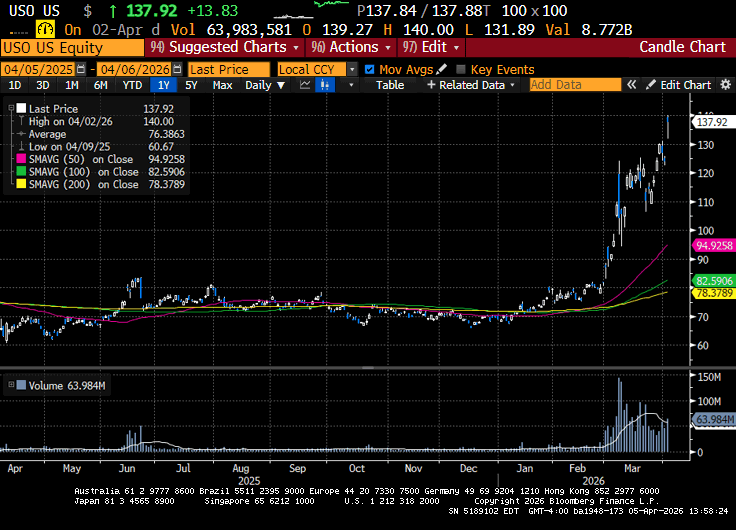
Weekly Market Commentary
The holiday-shortened week saw US equities advance even as oil prices surged amid uncertainty about the duration of the Iranian conflict. Early in the week, investors bid up risk assets on hopes of a ceasefire. President Trump’s assessment of the ongoing negotiations with Iran on a ceasefire was completely dismissed by Iran’s leadership. News that Iran was working with Oman to allow tankers to transit through the Strait of Hormuz for a toll to the Islamic Republic was, at first glance, met with optimism, but the idea that Iran would charge a toll on passage through international waters prompted several Gulf nations to consider joining the war. President Trump addressed the nation on Wednesday evening, citing severe consequences for Iran if the Strait of Hormuz is not reopened, which ignited further concerns about the war’s duration. This weekend, this message was reiterated with a deadline set for Monday evening. The message comes as Iran continues to fire missiles and drones at Gulf nations’ energy infrastructure. Concerns about economic growth and inflation persist and will only become more acute as the conflict continues.

The S&P 500 gained 3.38%, the Dow rose 2.98%, the NASDAQ advanced 4.46%, and the Russell 2000 increased by 3.34%. US Treasuries also advanced for the week, with the 2-year yield declining by twelve basis points to 3.80% and the 10-year yield falling by thirteen basis points to 4.31%. West Texas Intermediate crude prices increased by 12%, closing at $111.48 per barrel. Gold prices advanced by 4.1% to close the week at $4,679.20 per ounce. Silver prices increased by 5.2% to $73.17 per ounce. Copper prices were up eight cents on the week to $5.58 per Lb. Bitcoin’s price increased by 1.5% to close at $67,300. The US Dollar index declined by 0.2% to 100.10.

The economic calendar produced strong expected data for the week. The Employment Situation report came out on Friday, even though the equity market was closed. Non-Farm Payrolls increased by 63k, more than the consensus estimate of 51K. Private Payrolls also topped estimates at 60k. The Unemployment Rate remained at 4.4%, while Average Hourly Earnings ticked down to 0.3% from 0.4% in the prior reading. The average workweek remained at 34.3 hours. All in, the better report took some bid out of US Treasuries over the abbreviated session on Friday. Initial Claims fell by 9k to 202k, while Continuing Claims increased by 25k to 1816k. Consumer Confidence inched higher to 91.8 from 91 in the prior reading. Retail Sales increased by 0.6%, better than the consensus estimate of 0.4%, while the Ex-Auto figure advanced by 0.5%, also topping expectations. ISM Manufacturing remained in expansion at 52.7, which was also higher than the previous reading.

Investment advisory services offered through Foundations Investment Advisors, LLC (“FIA”), an SEC registered investment adviser. FIA’s Darren Leavitt authors this commentary which may include information and statistical data obtained from and/or prepared by third party sources that FIA deems reliable but in no way does FIA guarantee the accuracy or completeness. All such third party information and statistical data contained herein is subject to change without notice. Nothing herein constitutes legal, tax or investment advice or any recommendation that any security, portfolio of securities, or investment strategy is suitable for any specific person. Personal investment advice can only be rendered after the engagement of FIA for services, execution of required documentation, including receipt of required disclosures. All investments involve risk and past performance is no guarantee of future results. For registration information on FIA, please go to https://adviserinfo.sec.gov/ and search by our firm name or by our CRD #175083. Advisory services are only offered to clients or prospective clients where FIA and its representatives are properly licensed or exempted.
Tax Withholding from a Qualified Charitable Distribution (QCD) and from a Roth Conversion: Today’s Slott Report Mailbag
By Ian Berger, JD
IRA Analyst
Question:
I had my IRA custodian send my required minimum distribution (RMD) from my IRA to our church, but had 20% federal taxes withheld. Subsequently, I received two Form 1099-Rs from the custodian. One showed the withheld amount as a taxable amount and had a “7” code. The second showed the balance and had a “7Y” code. Then, when doing my taxes, the tax software also says that the amount withheld is taxable. Is there any way to correct this? Please help.
Bernie
Answer:
Hi Bernie,
You did a qualified charitable distribution (QCD), which is a direct transfer from a tax-free IRA to a charity. (A QCD can be used to offset an RMD for a year if the QCD is done first during the year.) Since QCDs are tax-free, you should not have had taxes withheld. Since the taxes withheld went to the IRS and not to your church, that amount was not a QCD and is therefore taxable to you. That explains why the custodian reported the withheld amount as taxable on the first Form 1099-R. The custodian properly used Code “7Y” for the balance on the second Form 1099-R, since the balance was a tax-free QCD. The mistake of withholding on the QCD cannot be corrected, but you can take a credit for the withholding on your tax return.
Question:
If you’re under age 59½, do a Roth conversion, and withhold from the conversion, are you subject to a 10% early distribution penalty?
Best,
Nick
Answer:
Hi Nick,
Normally, you are not subject to the 10% penalty if you do a conversion before age 59½. However, you will have to pay the penalty on any taxes withheld. That’s because the withheld amounts are not being converted and are considered a standard withdrawal that is being sent to the IRS. This is why we advise paying the taxes on a Roth IRA conversion with other, nonqualified assets – like money from your checking account.
If you have technical questions you would like to have answered, be sure to submit them to mailbag@irahelp.com, to be answered on an upcoming Slott Report Mailbag, published every Thursday.
https://irahelp.com/tax-withholding-from-a-qualified-charitable-distribution-qcd-and-from-a-roth-conversion-todays-slott-report-mailbag/

Last-Minute Tax Moves Before April 15: IRA, HSA, and Retirement Planning Tips
As April 15 approaches, many people assume the window for tax planning has already closed. The truth is, there may still be time to make a few smart financial moves that could help reduce taxable income, strengthen retirement savings, and improve long-term financial security. For most taxpayers, April 15, 2026 is the deadline to file a 2025 federal tax return, and it is also generally the deadline to make 2025 IRA contributions and 2025 HSA contributions.
Whether you are still preparing your return or simply doing a final review, here are a few last-minute areas worth checking before tax day.
1. Review Whether You Can Still Contribute to an IRA
One of the most common last-minute tax strategies is making a contribution to an Individual Retirement Account, or IRA. For many people, this can be a valuable way to continue building retirement savings while also potentially creating a tax advantage for the prior year. The IRS states that, for most people, the deadline for making 2025 IRA contributions is Wednesday, April 15, 2026.
Depending on your situation, a traditional IRA contribution may be tax-deductible, while a Roth IRA may offer future tax-free withdrawals for qualified distributions. Even if the contribution does not reduce your current tax bill, adding to retirement savings before the deadline can still be a strong long-term move.
This is also a good time to ask:
- Have you already maxed out your retirement contributions for 2025?
- Would a traditional IRA or Roth IRA make more sense based on your income and tax bracket?
- Are you missing an opportunity to strengthen your retirement strategy before the deadline?
2. Don’t Overlook HSA Contributions
If you were eligible for a Health Savings Account in 2025, you may still be able to make a contribution before April 15 and count it for the prior tax year. IRS instructions for Form 8889 say that 2025 HSA contributions can generally be made through April 15, 2026.
An HSA is one of the more powerful planning tools available because it can offer multiple tax benefits: contributions may be tax-deductible, growth can be tax-deferred, and qualified medical withdrawals can be tax-free. For individuals and families who are eligible, this can be an important last-minute planning opportunity.
Before filing, it is worth checking:
- Were you HSA-eligible during 2025?
- Have you contributed the full amount allowed for your coverage type?
- Would an additional contribution help lower your taxable income?
3. Make Sure Your Retirement Plan Still Matches Your Goals
Tax season is not just about forms and deadlines. It is also a natural time to review whether your retirement plan is still aligned with your current life and financial goals.
Your income, expenses, family needs, and timeline may have changed over the last year. That makes April a smart checkpoint for reviewing:
- Current retirement account contributions
- Beneficiary designations
- Risk tolerance and investment mix
- Long-term income planning
- Whether you are saving enough for the lifestyle you want in retirement
A last-minute IRA or HSA contribution is helpful, but the bigger opportunity is making sure all of your financial pieces are working together.
4. Check for Missed Deductions and Planning Opportunities
Many people focus only on getting their return submitted, but a quick review before filing may help uncover missed opportunities. Depending on your circumstances, that may include retirement contributions, health savings contributions, or changes in income that could affect your planning choices.
This is especially important if you experienced major life changes in 2025, such as:
- Marriage or divorce
- A new job or job loss
- Retirement or partial retirement
- A home purchase or refinance
- Higher medical expenses
- A change in business income or self-employment income
Even when the tax impact is modest, the planning conversation can still be valuable because it often reveals larger opportunities for insurance, retirement, and estate planning.
5. Use Tax Season as a Financial Reset
For many families, tax season is one of the few times each year when they gather income documents, review accounts, and take a serious look at their finances. That makes this the perfect time to reset and prepare for the rest of the year.
A good review right now may help you:
- Improve cash flow
- Increase retirement contributions moving forward
- Revisit life insurance or income protection needs
- Organize accounts more efficiently
- Make better decisions before next year’s deadline arrives
The most important point is this: tax day should not only be about filing on time. It should also be a chance to make smarter decisions for the future.
Final Thoughts
If you have not yet finalized your 2025 return, there may still be time to make meaningful financial moves before April 15, 2026. For most taxpayers, that includes reviewing IRA contributions and HSA contributions, both of which may still count for 2025 if completed by the deadline.
A few thoughtful adjustments now could help you lower taxes, boost retirement savings, and build a stronger overall financial plan.
Need help reviewing your options before the deadline?
Now is a great time to take a closer look at your retirement strategy, tax planning opportunities, and overall financial protection plan.
No Joke – Today is a Required Beginning Date!
By Andy Ives, CFP®, AIF®
IRA Analyst
Today is April 1, and that’s a big day! No, not because it’s April Fool’s Day, but because today is the required beginning date (RBD) for any traditional IRA owner who turned age 73 in 2025. Based on census data, that could be a few million Americans.
What is the RBD? It is the day when required minimum distributions (RMDs) are officially “turned on” within a traditional IRA. Regarding the RBD on company plans, older employees who do not own more than 5% of the business and whose workplace retirement plan offers the still-working exception can delay the RBD on that plan until April 1 of the year after the year of separation from service. As for Roth IRAs, they never have lifetime RMDs, so all Roth IRA owners are deemed to die prior to their RBD – even if they live to be 100. For this article, we will focus solely on the age 73 traditional IRA RBD.
For any IRA owner who turned age 73 in 2025, their first RMD is for 2025. This first RMD is taken in anticipation of reaching the RBD. The 2025 RMD is calculated by dividing the prior year-end balance (December 31, 2024) by the appropriate life expectancy factor. Most IRA owners will use the Uniform Lifetime Table to identify their applicable factor. For a 73-year-old, that factor is 26.5.
Example 1: Jim turned age 73 in 2025. His IRA balance on December 31, 2024, was $875,000. Jim divides $875,000 by 26.5 and correctly determines his 2025 RMD to be $33,019. Jim must take his first RMD by April 1, 2026.
A traditional IRA owner is only allowed to delay his very first RMD until April 1 of the following year. This grace period allows those who are new to RMDs a few extra months to get into a rhythm of taking annual mandatory distributions. If the first RMD is delayed to the following year, that does not change the original calculation amount. Also, if the first RMD is delayed, the IRA owner will ultimately have to take two RMDs that next year – the delayed first RMD, and the second RMD by December 31 of that same year.
Example 2: If Jim (from Example 1) delayed his 2025 RMD to the first part of 2026, he will have two RMDs to take in 2026 – the delayed 2025 RMD (by April 1) and his 2026 RMD (by December 31). Note that Jim will use his full IRA balance on December 31, 2025 to calculate his 2026 RMD. He does not get to reduce the balance by the delayed 2025 RMD amount.
The RBD is also important for determining the payout structure for IRA beneficiaries. If an IRA owner dies before his RBD, then there are no RMDs within the 10-year period for a non-eligible designated beneficiary (NEDB). Had death been on or after the RBD, then RMDs would apply in years 1-9 of that window. For non-designated (non-person) beneficiaries (NDBs – like an estate), death before or on/after the RBD is the difference between the 5-year rule and the “ghost” rule.
April 1 is not just for pranks. Missing an RMD could result in a substantial penalty. When it comes to lifetime RMDs and beneficiary payout rules, the RBD is nothing to joke about.
If you have technical questions you would like to have answered, be sure to submit them to mailbag@irahelp.com, to be answered on an upcoming Slott Report Mailbag, published every Thursday.
https://irahelp.com/no-joke-today-is-a-required-beginning-date/
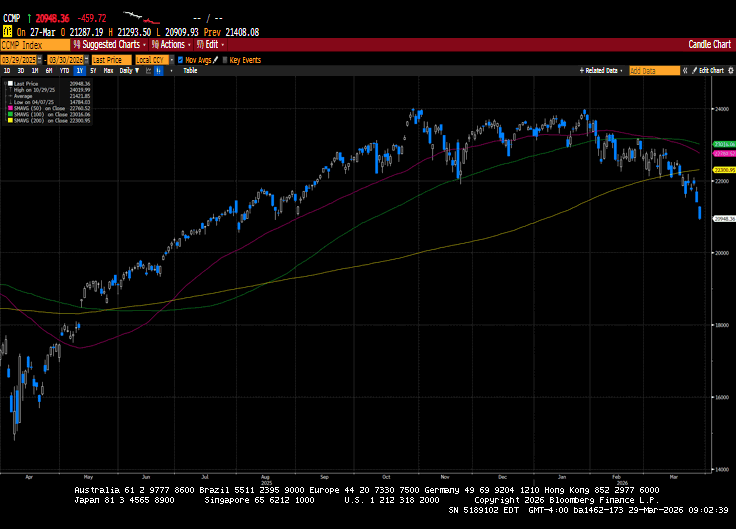
Weekly Market Commentary
US markets fell for the fourth consecutive week as the US-Israel-Iran conflict entered its 5th week. President Trump’s announcement that he would extend the deadline to reopen the Strait of Hormuz by a couple of days sent markets soaring on Monday, but gains were met with selling after Iran dismissed Trump’s demand. Later in the week, Trump extended his ultimatum by ten days to April 6th. However, investors seemed to dismiss the extension, sending markets lower. The market will continue to be driven by headlines related to the war. News that the US is sending more troops to the region, along with news that the Yemen-based Houthis have now entered the war, casts further uncertainty around the duration of the conflict. Oil prices remained volatile and ended the week higher, with Brent crude closing at $112 a barrel on Friday. Fears of higher inflation and slower global growth diminished the likelihood of a Fed rate cut and bolstered the chance of a Fed rate hike. Weakness in mega-caps was prevalent with the Vanguard Mega-Cap Growth ETF falling 4.1% on the week. Information Technology, Communication Services, and Software issues were also poor performers. The Energy sector posted a 6.2% gain for the week, while Consumer Staples and Utilities finished the week higher.

The S&P 500 lost 2.1%, the Dow fell by 0.9%, the NASDAQ shed 3.2%, and the Russell 2000 posted a gain of 0.5%. NASDAQ has now entered a technical correction, down 10.2% year-to-date. US Treasuries fell for the 4th consecutive week, but the sell-off was relatively small when compared to the prior three weeks. Treasury auctions in 2s, 3s, and 7s were weak and met with tepid demand. The 2-year yield increased by three basis points to 3.92%, while the 10-year yield increased by five basis points to 4.44%. West Texas Intermediate crude prices increased by 1.4% on the week to close at $99.51 a barrel. Gold prices fell by 1.7% to $4,492.80 per ounce. Silver prices increased by $0.44 to $69.80 per ounce. Copper prices advanced by thirteen cents to $5.50 per Lb. Bitcoin’s price fell by 5.06% to close the week at $66,888. The US Dollar index increased by 0.7% to 100.15, as the Japanese Yen crossed 160 to the US Dollar.

Vanguard Mega-Cap Index 3/27/2026
The economic calendar was very quiet this week. Initial Claims increased by 5k to 210k, while Continuing Claims fell by 32k to 1819k. The final reading of the University of Michigan Consumer Sentiment index for March fell to 53.3 from the prior reading of 55.5, reflecting concerns about the war, inflation, and the labor market.

Investment advisory services offered through Foundations Investment Advisors, LLC (“FIA”), an SEC registered investment adviser. FIA’s Darren Leavitt authors this commentary which may include information and statistical data obtained from and/or prepared by third party sources that FIA deems reliable but in no way does FIA guarantee the accuracy or completeness. All such third party information and statistical data contained herein is subject to change without notice. Nothing herein constitutes legal, tax or investment advice or any recommendation that any security, portfolio of securities, or investment strategy is suitable for any specific person. Personal investment advice can only be rendered after the engagement of FIA for services, execution of required documentation, including receipt of required disclosures. All investments involve risk and past performance is no guarantee of future results. For registration information on FIA, please go to https://adviserinfo.sec.gov/ and search by our firm name or by our CRD #175083. Advisory services are only offered to clients or prospective clients where FIA and its representatives are properly licensed or exempted.
8 Rules to Help Navigate the Multiple Plan Contribution Limits
Ian Berger, JD
IRA Analyst
More and more Americans are taking on “side gigs” or switching jobs. When that happens, they often wind up participating in two different employer retirement plans at the same time or in the same year. Here are 8 rules to help you understand how the plan contribution limits apply in those cases:
- There are two different plan contribution limits – the “deferral limit” and the “overall limit.”
- For 2026, the regular deferral limit for combined pre-tax and Roth contributions is $24,500. However, two catch-up contributions are available. If you’re age 50 or older by the end of the year, you can defer up to an additional $8,000, for a total of $32,500. And if you’re age 60–63 by year end, you can defer up to an additional $11,250, for a total of $35,750.
- Non-Roth after-tax contributions, if allowed by the plan, do not count toward the annual deferral limit. (But they do count toward the overall limit, discussed later.)
- The deferral limit is a per-employee limit. It’s based on the total pre-tax and Roth contributions you make to all your plans in one calendar year. Contributions to all plans are aggregated even if the plans are sponsored by companies that aren’t related under the tax rules.
Example 1: Mira, age 48, participates in a company 401(k) plan through her regular job with Alpha Solutions and also has a solo 401(k) through a computer repair side business. Alpha and her side business are not related entities. By October 2026, Mira has contributed $20,500 of Roth elective deferrals to Alpha’s 401(k) and $4,000 of pre-tax deferrals to her solo 401(k). Even though the companies aren’t related, Mira can’t make any additional deferrals to either plan because her combined 2026 deferral total has already reached the $24,500 limit.
- There’s one instance where contributions to all plans are not aggregated: If you’re eligible for both a 457(b) plan and either a 401(k) or a 403(b) plan, you can defer up to the maximum limit to each plan.
- For 2026, the overall limit (also known as the “annual additions limit” or “415 limit”) is $72,000, or higher if you make catch-up contributions.
- The overall limit sets the maximum amount of all contributions that can be allocated to your plan account in any year. This includes pre-tax and Roth elective deferrals, after-tax employee contributions, employer contributions, and forfeitures.
- Normally, the overall limit applies on a per-plan basis. However, if your company has more than one plan, contributions to all plans are combined for the overall limit. That’s also the case for contributions to separate plans sponsored by two or more companies that are related under the tax rules. But, if you’re in two plans sponsored by unrelated companies, you get the benefit of a separate overall limit for each plan.
Example 2: Alpha Solutions and Mira’s computer business (from Example 1) are considered unrelated businesses. So, for 2026, Mira has a separate overall limit for each 401(k) plan and could theoretically have a total of $144,000 ($72,000 x 2) of combined contributions made between the two plans. However, to achieve that result, she would have to make a large amount of after-tax employee contributions and/or receive a large amount of employer contributions. In any case, Mira’s total combined 2026 pre-tax and Roth elective deferrals between the two plans is still capped at $24,500.
If you have technical questions you would like to have answered, be sure to submit them to mailbag@irahelp.com, to be answered on an upcoming Slott Report Mailbag, published every Thursday.
https://irahelp.com/8-rules-to-help-navigate-the-multiple-plan-contribution-limits/
Eligible Designated Beneficiaries and Roth Conversions: Today’s Slott Report Mailbag
By Sarah Brenner, JD
Director of Retirement Education
Question:
Hi Ed and team,
If a parent, age 86, inherited their son’s 401(k) after the son passed at age 58, does the parent still have 10 years to withdraw the funds? A lot is discussed about beneficiaries younger than the deceased, but not really beneficiaries that are older.
Thanks!
Janet
Answer:
Hi Janet,
Under the SECURE Act, a beneficiary who is “not more than ten years younger” than the deceased is considered an eligible designated beneficiary (EDB) and can still use the stretch. A beneficiary who is older than the account owner would fit into this category of EDB. If the IRA owner died before required minimum distributions (RMDs) would have had to start, the 10-year rule would also be an option.
In this situation, the parent beneficiary could therefore choose to use the stretch and take annual RMDs over their life expectancy, or use the 10-year rule with no annual RMDs. In this case, going with the 10-year rule may be the better option because the beneficiary is age 86, and their life expectancy would be less than ten years. Additionally, because the account owner was only age 58, no annual RMDs would be required during the 10-year period, which would allow more flexibility in distribution planning.
Question:
Hello!
Can a Roth conversion happen in April for the prior year? For example, could I convert my IRA in April of 2026 and consider it a prior-year conversion for 2025?
As always, thank you!
Calvin
Answer:
Hi Calvin,
While prior-year Roth IRA contributions are permitted, prior-year conversions are not allowed. A conversion done in April of 2026 would be taxable for 2026. For the conversion to be taxable for 2025, it would have to have been done by December 31, 2025.
If you have technical questions you would like to have answered, be sure to submit them to mailbag@irahelp.com, to be answered on an upcoming Slott Report Mailbag, published every Thursday.
https://irahelp.com/eligible-designated-beneficiaries-and-roth-conversions-todays-slott-report-mailbag/

Building a Stronger Financial Future with the Right Guidance
When it comes to your financial future, confidence does not come from guessing. It comes from having a clear strategy, trusted guidance, and a plan built around your goals. Whether you are preparing for retirement, protecting your family, growing your wealth, or simply trying to make smarter financial decisions, working with a financial and insurance advisor can help bring clarity to an often complicated process.
Today, many individuals and families are facing important financial questions. How much should I be saving? Am I properly protected if something unexpected happens? Is my retirement plan really enough? Do I have the right insurance coverage in place? These are not small questions, and the answers can have a lasting impact on your future.
A financial and insurance advisor helps connect the dots between protection and planning. Financial strategies are not just about investments or saving money. They are also about managing risk, preserving what you have built, and making sure the people and priorities that matter most are protected. That is where insurance plays such an important role. Life insurance, long-term care planning, disability protection, and other coverage options are essential pieces of a complete financial picture.
A thoughtful advisor takes the time to understand your current situation, your concerns, and your long-term goals. From there, they can help create a personalized strategy that supports both your present needs and your future plans. This may include reviewing retirement income options, evaluating asset protection strategies, planning for major life events, or identifying gaps in your coverage that could leave you exposed.
One of the biggest advantages of working with a trusted advisor is having someone who can simplify complex decisions. Financial and insurance products can be overwhelming, especially when every stage of life brings new priorities. A young family may be focused on income protection and college planning. A business owner may be thinking about liability, succession, and retirement. Someone nearing retirement may be more concerned with income stability, healthcare costs, and preserving assets. No matter the stage, personalized advice matters.
Good planning is not only about preparing for the best. It is also about being ready for the unexpected. Unexpected illness, market volatility, inflation, loss of income, or changes in family circumstances can quickly affect even the most carefully built plans. Having a financial and insurance strategy in place can help create resilience and peace of mind.
Just as important, a strong advisor relationship is built on education. The right advisor does not simply recommend products. They help you understand your options, explain why certain strategies make sense, and empower you to make informed decisions with confidence. That kind of guidance can make a major difference in both your short-term security and long-term success.
Your financial life deserves more than a one-size-fits-all approach. It deserves a strategy built around your goals, your family, your future, and your values. With the right financial and insurance advisor by your side, you can move forward with a clearer vision, greater protection, and a plan designed to help you thrive through every season of life.
If you are ready to take a closer look at your financial strategy, now is the perfect time to start. A strong future begins with smart planning today.
5 Things You Need to Know about the Roth IRA Five-Year Rules
By Sarah Brenner, JD
Director of Retirement Education
Here at the Slott Report, we get a lot of questions on all sorts of different IRA topics. However, one area where we consistently get the most inquiries is the five-year rules for Roth IRA distributions.
Here are 5 things every Roth IRA owner needs to know about the five-year rules.
1. Yes, there are two five-year rules. One thing that makes the Roth IRA distribution rules so confusing is the fact that there are actually two five-year rules you need to understand to properly execute tax- and penalty-free Roth IRA distributions. One five-year rule applies for tax-free distributions of earnings, and another applies for penalty-free distributions of converted funds.
2. The five-year rule for tax-free distributions of earnings starts with your first Roth IRA conversion or contribution and it never restarts. This rule applies in the aggregate to all your Roth IRAs. It also is not necessarily five full years. For example, if you make a prior-year Roth IRA contribution in March of 2026 for 2025, your five-year clock for tax-free distributions of Roth IRA earnings starts January 1, 2025.
3. The five-year rule for penalty-free distributions of converted funds applies separately for each conversion. While a distribution of converted funds is never taxable, the 10% early distribution penalty can apply if a five-year holding period is not satisfied. This five-year rule is only an issue if you are under age 59½. It applies separately to each conversion that you do. It also may not be five full years. For example, if you convert on December 31, 2025, you can take penalty-free distributions on January 1, 2030.
4. Beneficiaries are subject to the five-year holding period for tax-free distributions of Roth IRA earnings. If a Roth IRA owner has not satisfied this five-year rule, the beneficiary must finish it out. A spouse beneficiary can use the more favorable of their own or their deceased spouse’s five-year holding period. The five-year rule for penalty-free distributions of converted funds is never an issue for beneficiaries because all IRA distributions due to death are penalty-free.
5. The Roth IRA owner must track the five-year rules. Ultimately, it is up to the Roth IRA owner to keep good records and ensure that they are not violating either of the Roth IRA five-year rules. The taxation of Roth IRA distributions is determined in the aggregate, with all of an individual’s Roth IRAs being considered and ordering rules applied. Contributions come out first, then conversions, and finally earnings. Custodians do not necessarily have all the information to determine if the Roth five-year rules are satisfied. Roth IRA owners must understand the rules. A knowledgeable advisor can help.
If you have technical questions you would like to have answered, be sure to submit them to mailbag@irahelp.com, to be answered on an upcoming Slott Report Mailbag, published every Thursday.
https://irahelp.com/5-things-you-need-to-know-about-the-roth-ira-five-year-rules/
Young Spouse, Spousal Rollover, Year-of-Death RMD…and a Penalty?
By Andy Ives, CFP®, AIF®
IRA Analyst
When an IRA owner reaches the required beginning date (RBD), required minimum distributions (RMDs) are officially “turned on.” For IRAs, the RBD is April 1 of the year after the year the IRA owner turns age 73. If an IRA owner died after reaching his RBD, then the year-of-death RMD must be considered by the beneficiary.
If an IRA owner dies prior to taking all or a portion of the year-of-death RMD, the responsibility to take whatever remains of that final RMD falls to the beneficiary. For non-spouse beneficiaries, the custodian will typically (but not always) open an inherited IRA, transfer the entire balance into the new account, and the beneficiary can then take the year-of-death RMD from this inherited IRA. As long as the year-of-death RMD is taken by December 31 of the year after the year of death, then the IRS will be satisfied. This process works well because the Form 1099-R reporting the distribution is generated from the beneficiary’s inherited IRA and includes all the appropriate taxpayer information.
The same process also applies to spouse beneficiaries, whether the surviving spouse elects to maintain an inherited IRA or do a spousal rollover. All funds are moved to the surviving spouse’s account, and then the surviving spouse takes the year-of-death RMD. Younger spouses (under age 59½) are encouraged to do inherited IRAs so as to have full access to the funds with no penalty. Upon turning 59½, the surviving spouse can then complete a spousal rollover, thereby consolidating the inherited IRA dollars into their own IRA.
An interesting scenario involving a year-of-death RMD and surviving spouses came across our desk recently. A husband died in January 2026 at the age of 75. His surviving spouse had just turned 59. The husband was beyond his RBD and was taking RMDs, but had yet to take any of his 2026 RMD. As such, that responsibility fell to the beneficiary – his wife.
As mentioned, custodians will typically transfer all the assets from the deceased IRA owner’s account to the beneficiary, and then the year-of-death RMD can be paid out from the inherited account. But in this case, there was an extra layer of rules to consider. The surviving spouse wanted to do a spousal rollover because she was turning 59½ later this year. She had no need to do an inherited IRA first. However, if we processed a spousal rollover, and if the surviving spouse then took the year-of-death RMD before turning 59½, a 10% early distribution penalty would apply. (After a spousal rollover, the inherited assets are treated as if the surviving spouse owned those funds from the very beginning, and all the normal distribution rules apply.)
One option was to hold off on the spousal rollover until later in 2026 when the surviving spouse would be 59½. Another option was to do the spousal rollover now and wait until the surviving spouse was 59½ to take the year-of-death RMD. Another option was to open an inherited IRA, take the year-of-death RMD from that account, and then complete the spousal rollover. In the end, that was the decision that was made. The advisor in charge of this account did a nice job of looking before she leapt into an irreversible transaction like a spousal rollover. A 10% penalty on a year-of-death RMD would have been a tough pill to swallow.
If you have technical questions you would like to have answered, be sure to submit them to mailbag@irahelp.com, to be answered on an upcoming Slott Report Mailbag, published every Thursday.
https://irahelp.com/young-spouse-spousal-rollover-year-of-death-rmdand-a-penalty/
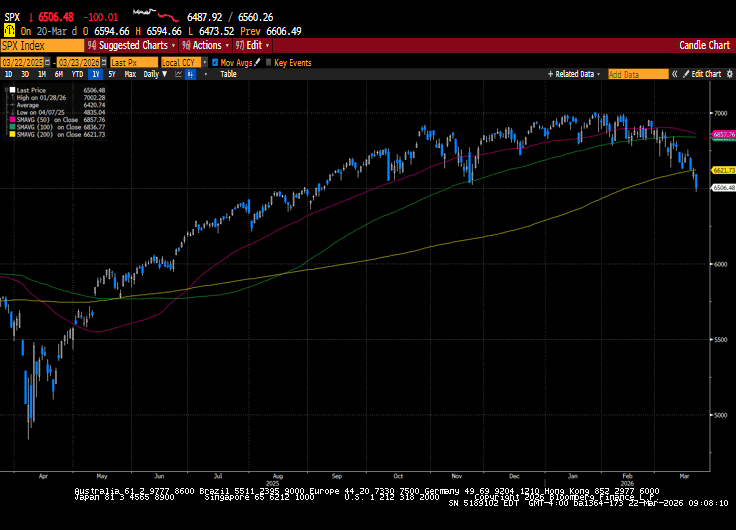
Weekly Market Commentary
US markets fell for a third consecutive week as investors continued to assess the implications of the Iran conflict. Headlines related to Iran continued to dominate market attention. Energy markets traded higher as the military’s focus shifted to energy infrastructure. The move to hit one of Iran’s largest gas fields was met with Iran targeting Qatar’s largest liquefied natural gas export plants and taking 17% of production offline for an estimated minimum of three years. On Saturday, Trump posted that the US would destroy Iranian energy plants if the Strait of Hormuz was not open in 48 hours. The US has also sent more troops to Iran, with some suggesting that the US aims to take full control of Kharg Island, Iran’s largest energy export hub. Early last week, the US and Israel killed Iran’s Security Chief, Ali Larijani, considered to have been one of the most powerful and influential leaders. His death could complicate any negotiations for a ceasefire and now fractures the regime and may create a power vacuum. Increased energy costs have put central banks in a tough spot when it comes to monetary policy. Last week, the Fed, as expected, left its policy rate in place at 3.50%-3.75%. The Fed’s Summary of Economic Projections still has one rate cut forecast for 2026, but inflation expectations also ticked up. Traders have pushed out the probability of a rate cut to late 2026. Growth expectations have also taken a hit as higher oil prices may curtail demand for other products. The ECB and the Bank of England keep their policy rates in place as well, but both banks indicated they would act on policy if inflation were to tick higher. The Bank of Japan keeps its policy rate at 0.75%, while the Bank of Australia increased its policy rate by twenty-five basis points.

The S&P 500 declined by 1.9%, the Dow shed 2.1%, the Nasdaq fell by 2.1%, and the Russell 2000 gave back 1.7%. US Treasuries were hammered for the third straight week as inflation expectations increased and the notion of Fed rate cuts diminished. The 2-year yield increased by sixteen basis points to 3.89%, while the 10-year yield increased by ten basis points to 4.39%. West Texas Intermediate crude prices fell by $0.44 to $98.12 a barrel. Gold prices tumbled to $4,574.30 per ounce, down 9.6% on the week. Silver prices fell by 13.9% to $69.66 per ounce, while Copper prices fell by 6.7% to $5.37 per Lb. Bitcoin’s price was flat for the week. Notably, traditional safe-haven assets continued to show no ballast against the decline of risk assets.

The economic calendar was relatively quiet from the last couple of weeks, but it did give us a look at producer inflation. Headline PPI came in much hotter than expected at 0.7% versus an estimated 0.3%. The reading was up 3.4% year over year, up from 2.9% in January. The Core reading, which excludes food and energy, came in at 0.5% versus the consensus estimate of 0.4%. On a year-over-year basis, the measure was up 3.9% from 3.6% in January. Price increases were seen in both goods and services, giving the Fed more cover to delay rate cuts. Initial Claims declined by 8k to 205K, while continuing claims increased by 10k to 1857k. New Home sales fell to 587k from the prior reading of 712k.

Investment advisory services offered through Foundations Investment Advisors, LLC (“FIA”), an SEC registered investment adviser. FIA’s Darren Leavitt authors this commentary which may include information and statistical data obtained from and/or prepared by third party sources that FIA deems reliable but in no way does FIA guarantee the accuracy or completeness. All such third party information and statistical data contained herein is subject to change without notice. Nothing herein constitutes legal, tax or investment advice or any recommendation that any security, portfolio of securities, or investment strategy is suitable for any specific person. Personal investment advice can only be rendered after the engagement of FIA for services, execution of required documentation, including receipt of required disclosures. All investments involve risk and past performance is no guarantee of future results. For registration information on FIA, please go to https://adviserinfo.sec.gov/ and search by our firm name or by our CRD #175083. Advisory services are only offered to clients or prospective clients where FIA and its representatives are properly licensed or exempted.
Roth 5-Year Clocks and Spousal IRA Contributions: Today’s Slott Report Mailbag
By Andy Ives, CFP®, AIF®
IRA Analyst
QUESTION:
I’m age 72 and my wife is age 63. I want to open a spousal Roth IRA. I already have a Roth for myself that I’ve owned for more than 5 years. Would she have to wait 5 years before she can make a withdrawal without a penalty, or does she have to have it for 5 years before she can withdraw anything?
Thank you,
Hass
ANSWER:
Hass,
If one spouse has little to no income but the other spouse does, the spouse with no income can make a traditional or Roth IRA contribution based on the income of the spouse who has eligible earnings (assuming they file a joint tax return). This is called a “spousal IRA” or a “spousal contribution.” This spousal IRA is fully owned by the spouse with no income, and all the normal rules apply as if she funded it with her own earnings. Since your wife is over 59½, there is never a penalty for withdrawing funds. But she will have her own 5-year clock to wait out for tax-free earnings.
QUESTION:
What options are available for a non-working spouse to contribute to a traditional/Roth IRA, provided that her significant other is employed and has earned income? Thank you.
Respectfully,
Richard
ANSWER:
Richard,
As mentioned in Question 1, both a traditional IRA and a Roth IRA are available for a non-working spouse, regardless of age. If the working spouse has enough compensation to cover both the spouse’s contribution and his own, then he can proceed to fund both of them. The couple must file a joint tax return, and once the funds are in the non-working spouse’s IRA, they are hers to do with as she pleases. All the normal IRA rules apply. If the working spouse is not “covered” by a retirement plan at work, then a spousal contribution to a traditional IRA can be deducted. If the working spouse is covered by a work plan, the phase-out range to deduct the non-working spouse’s traditional IRA contribution was $236,000 – $246,000 of the couple’s modified adjusted gross income (MAGI) for 2025 and is $242,000 – $252,000 of MAGI for 2026. The phase-out range for making a Roth IRA contribution for either spouse was $236,000 – $246,000 of MAGI for 2025 and is $242,000 – $252,000 of MAGI for 2026.
If you have technical questions you would like to have answered, be sure to submit them to mailbag@irahelp.com, to be answered on an upcoming Slott Report Mailbag, published every Thursday.
https://irahelp.com/5-year-clocks-and-ira-options-todays-slott-report-mailbag/

Why Financial and Insurance Planning Should Work Together
When people think about financial planning, they often focus on investments, retirement accounts, and growing wealth. When they think about insurance, they usually think about protecting their home, health, or family. The truth is, these two areas should never be treated separately.
A strong financial future is built not only on growth, but also on protection.
Financial planning helps you prepare for the life you want to live. Insurance planning helps protect one’s life from unexpected setbacks. Together, they create a more complete strategy for long-term confidence and stability.
Financial Planning Is About More Than Investing
Many people assume financial planning begins and ends with choosing investments. In reality, a well-rounded financial strategy looks at much more, including:
Retirement income needs
Tax-efficient strategies
Estate and legacy planning
Emergency savings
Debt management
Long-term goals for family, business, or lifestyle
A financial advisor helps organize these moving parts into one strategy designed around your personal goals and timeline.
Insurance Planning Protects What Matters Most
Even the best financial plan can be disrupted by an unexpected illness, accident, disability, market downturn, or death in the family. Insurance is what helps create a safety net.
Depending on your needs, insurance strategies may include:
Life insurance
Long-term care planning
Disability income protection
Annuities for guaranteed income
Medicare planning
Health coverage solutions
Asset protection strategies
These tools can help reduce financial risk and provide more certainty when life takes an unexpected turn.
Why These Strategies Belong Together
Financial growth without protection can leave major gaps. Insurance without broader planning can lead to buying coverage that does not fully support your long-term goals.
When financial and insurance planning work together, you can:
Protect income for your family
Prepare for retirement with greater confidence
Help reduce exposure to major financial setbacks
Create more predictable income streams
Align protection with your long-term financial objectives
This kind of coordinated planning helps make sure each part of your strategy supports the others.
Planning for Retirement Requires Both Growth and Protection
Retirement is one of the biggest reasons people seek professional guidance. But retirement planning is not only about how much money you save. It is also about how well you protect what you have built.
Questions many people face include:
Will my income last throughout retirement?
How will I handle rising healthcare costs?
What happens if the market drops at the wrong time?
How can I leave something behind for my loved ones?
Do I have enough protection in place if I need long-term care?
These are not just investment questions. They are financial and insurance questions together.
Every Family and Business Has Different Needs
There is no one-size-fits-all strategy. A young family may need life insurance and a savings roadmap. A business owner may need succession planning, key person coverage, and retirement strategies. A retiree may need income planning, Medicare guidance, and asset preservation.
That is why personalized advice matters.
An advisor who understands both financial planning and insurance strategies can help evaluate your current position, identify gaps, and build a coordinated approach that fits your goals.
The Value of Working With a Trusted Advisor
A trusted advisor does more than recommend products. They help you think through decisions, prepare for uncertainty, and stay focused on what matters most.
The right guidance can help you:
Clarify your goals
Organize your financial life
Review your current protection
Identify risks and opportunities
Build a strategy designed for both today and tomorrow
Final Thoughts
Financial planning and insurance planning are most effective when they work hand in hand. One helps you build. The other helps you protect. Together, they can create a stronger foundation for your future.
Whether you are preparing for retirement, protecting your family, or building a long-term wealth strategy, a coordinated plan can make all the difference.
A confident future is not just about accumulating assets. It is about protecting what you have worked so hard to build.
Moving the Clocks Ahead and Reviewing the Roth IRA 5-Year Clocks
By Ian Berger, JD
IRA Analyst
A few Saturdays ago, many of us moved our clocks one hour ahead to usher in Daylight Saving Time. Adjusting our clocks is a reminder to review the confusing rules surrounding the Roth IRA distribution clocks. It’s no surprise that we continue to get more questions about these rules than just about any other topic.
A good way to keep these rules straight is to remember that there are two different 5-year clocks (also known as “holding periods”). The first determines whether a distribution of converted Roth IRA funds is subject to the 10% early distribution penalty. The second determines whether a distribution of earnings on Roth IRA contributions or conversions is subject to taxes.
The First Clock: Is a Distribution of Converted Dollars Subject to Penalty?
You’re never subject to a 10% penalty when you do a Roth IRA conversion – even if you’re under age 59½. You’re also never subject to a penalty if you receive a distribution of converted Roth amounts when you’re age 59½ or older. But you could be hit with the penalty if you receive a distribution of converted funds when you’re under 59½. This is the only time the first 5-year clock comes into play.
This first clock starts ticking on January 1 of the year of the conversion (no matter what date during the year you actually do the conversion). If you’re under age 59½ and take out converted dollars before the end of the 5-year period, you’ll be penalized (assuming no penalty exception applies). If you do Roth conversions in different years, each year of conversions has its own 5-year clock. But remember: If you don’t touch the converted funds until age 59½ or later, you’ll never have to worry about the first 5-year clock.
The Second Clock: Is a Distribution of Earnings Subject to Taxes?
The second clock helps determine whether earnings on Roth IRA contributions (and conversions) are taxable when distributed. Earnings avoid taxes if two conditions are met: The second 5-year clock is satisfied and you’re at least age 59½ (or disabled or a first-time home buyer). If you satisfy both conditions, your distribution is considered “qualified.”
This second clock starts ticking on January 1 of the year of your first contribution or conversion to ANY Roth IRA. Unlike the first clock, there’s always just one 5-year period for the second clock. If you take out earnings before the end of this 5-year clock, those earnings will be taxable regardless of your age. Getting this second clock ticking is why it’s so important to open up a Roth IRA as early as possible – even if it’s funded with a small amount.
What if you withdraw from your Roth IRA before you meet both conditions for a “qualified distribution?” Favorable Roth IRA “ordering rules” allow contributions and conversions to come out before earnings. This means you can always receive a tax-free distribution of an amount equal to your Roth IRA contributions and conversions. (The amount equal to your contributions is always penalty-free, and the amount equal to your conversions is penalty-free at age 59½ or after the first clock described above is satisfied.) Only after an amount equal to all your Roth IRA contributions and conversions is depleted do you even reach your earnings. Since your withdrawal is “non-qualified,” you’ll have to pay taxes (and possibly a penalty) on that portion of your withdrawal.
If you have technical questions you would like to have answered, be sure to submit them to mailbag@irahelp.com, to be answered on an upcoming Slott Report Mailbag, published every Thursday.
https://irahelp.com/moving-the-clocks-ahead-and-reviewing-the-roth-ira-5-year-clocks/
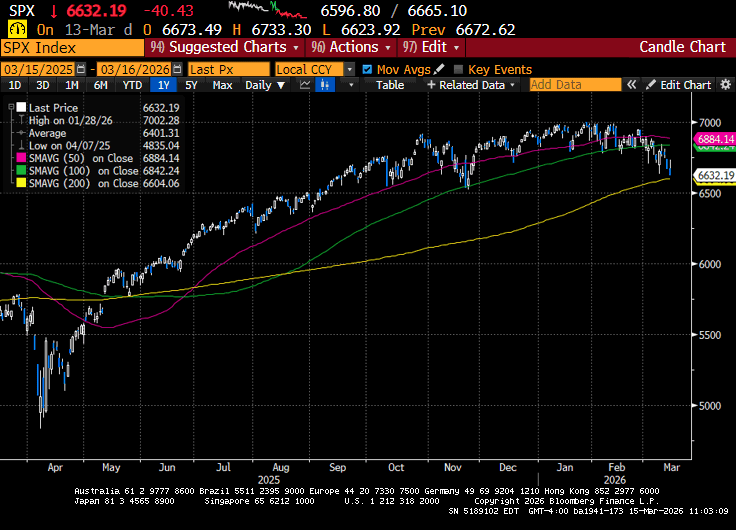
Weekly Market Commentary
Markets remained volatile, driven by headlines related to the Iran war. Whipsaw action was prominent across multiple asset classes, while several historically safe-haven assets offered no cover for investors. Questions about the duration of the war and the closure of the Strait of Hormuz sent Brent Oil’s price to $120 a barrel, closing the week at just over $100 a barrel. Iran began targeting energy infrastructure, causing several facilities to curtail production. On Friday, the US and Israel “obliterated” Iran’s Kharg Island, one of Iran’s most significant energy hubs. The damage to any energy infrastructure extends the duration of supply disruption and is likely to lead to higher oil prices. These higher prices have pushed out the likelihood of a Federal Reserve cut to its monetary policy rate. Currently, the market has priced in one cut this year, most likely coming in September. The Federal Reserve will meet this week to discuss monetary policy and will provide its most recent Summary of Economic Projections. The Fed is not expected to change its policy rate; however, a significant shift to a more hawkish stance would likely be a negative catalyst for the market. Of note, a federal judge has thrown out a couple of subpoenas in the DOJ’s criminal probe into the Federal Reserve’s renovation of its office buildings.

The S&P 500 lost 1.6%, the Dow gave back 1.9%, the NASDAQ fell 1.2%, and the Russell 2000 sank by 1.9%. All these indices are now in negative territory for the year. US Treasuries were hammered for the second week in a row amid war-related inflation fears. The 2-year yield increased by seventeen basis points to 3.73%, while the 10-year yield increased by sixteen basis points to 4.29%. West Texas Intermediate crude price increased by 8.4%, closing at $98.56 a barrel. Gold prices retreated by 1% to close the week at $5061.70 per ounce. Silver prices fell by 4.4% to close at $80.56 per ounce. Copper prices fell by five cents to $5.76 per Lb. Bitcoin’s price increased by 6.6% to close the week at $71,400. The US Dollar index increased by 1.4%, closing at 100.36. The Japanese Yen fell against the greenback to 159.63, prompting jawboning by the Bank of Japan.

There was a full slate of economic data on the calendar that showed a mixed picture of the economy. The Fed’s preferred measure of inflation, the PCE, came in line with expectations on both the headline and core readings. On a year-over-year basis, the Core reading was a touch higher than the reading in December. The bottom line is that inflation remains above the Fed’s 2% target, and with oil prices surging, this will likely keep the Fed on hold. The Consumer Price Index also came in line with expectations on both the headline and core readings. The year-over-year figures were unchanged from the prior month. Personal Income was up 0.4% in line with the consensus estimate, while Personal Spending was higher than expected at 0.4%. The second look at 4th-quarter GDP fell to 0.7% from 1.4%, with most of the decline due to the government shutdown; however, there were some indications that consumer spending regressed. The University of Michigan’s Consumer Sentiment reading fell to a three-month low at 55.5 on inflation and labor concerns. Initial Jobless Claims fell by 1k to 213k, while Continuing Claims fell by 21k to 1850k. Finally, Existing Home Sales and Housing Starts came in better than expected, while Building Permits were below expectations.

Investment advisory services offered through Foundations Investment Advisors, LLC (“FIA”), an SEC registered investment adviser. FIA’s Darren Leavitt authors this commentary which may include information and statistical data obtained from and/or prepared by third party sources that FIA deems reliable but in no way does FIA guarantee the accuracy or completeness. All such third party information and statistical data contained herein is subject to change without notice. Nothing herein constitutes legal, tax or investment advice or any recommendation that any security, portfolio of securities, or investment strategy is suitable for any specific person. Personal investment advice can only be rendered after the engagement of FIA for services, execution of required documentation, including receipt of required disclosures. All investments involve risk and past performance is no guarantee of future results. For registration information on FIA, please go to https://adviserinfo.sec.gov/ and search by our firm name or by our CRD #175083. Advisory services are only offered to clients or prospective clients where FIA and its representatives are properly licensed or exempted.
Qualified Charitable Distributions and Roth IRA 5-Year Rules: Today’s Slott Report Mailbag
By Ian Berger, JD
IRA Analyst
Question:
Hello Mailbag Folks,
I may have missed something in one of the Ed Slott newsletters, but I thought that if one contributed to a non-profit directly from an IRA account to the non-profit, the amount would not be taxed. I made my first required minimum distribution (RMD) in this way and my new Form 1099-R shows that the RMD is taxable. Am I incorrect? Are you able to point me in the direction of something to read about this for 2025-2026, please?
Looking forward to any information.
Kind Regards,
Marlene
Answer:
Hi Marlene,
You are correct that a direct transfer from an IRA to a qualifying charity is a non-taxable transaction known as a qualified charitable distribution (QCD). A QCD can satisfy an RMD if it is paid out of the IRA before the RMD comes out. When the custodian issued you a 2025 Form 1099-R, it reported your RMD as fully taxable because it did not know you used a QCD to satisfy all or part of that RMD. It is up to you to disclose on your 2025 Form 1040 that your RMD (or part of it) is not taxable. You do that by reporting the full amount in line 4a, reporting only the difference between the RMD amount and the QCD in box 4b, and checking box 2 (“QCD”) in line 4c.
Question:
We have a client, age 73, that wants to start converting his traditional IRA to a Roth IRA over a period of several years. He has other Roth IRAs that were established over 5 years ago. He was told by an IRS representative that each Roth conversion would have its own 5-year rule before the earnings could be withdrawn without a penalty. I thought that since he is over the age of 59½ and that he has other Roth IRAs that were established over 5 years ago, that the 5-year rule would not apply to his Roth conversions. What do you say on this? I cannot find the answer to this on the IRS website.
Thanks!
Frank
Answer:
Hi Frank,
There are two 5-year holding periods (or clocks) for Roth IRA distributions: one for determining if there’s a penalty on distributions of converted amounts before age 59½, and the other for determining if earnings on Roth IRA contributions and conversions are taxable. Your client doesn’t have to worry about the first 5-year clock because his withdrawals will come out after age 59½. He also doesn’t have to worry about the second clock because his withdrawals will come out after age 59½ and he has had a Roth IRA for at least 5 years. So, all of his Roth IRA distributions will be tax and penalty-free.
If you have technical questions you would like to have answered, be sure to submit them to mailbag@irahelp.com, to be answered on an upcoming Slott Report Mailbag, published every Thursday.
https://irahelp.com/qualified-charitable-distributions-and-roth-ira-5-year-rules-todays-slott-report-mailbag/

Understanding Annuities: Turning Retirement Savings Into Reliable Income
Planning for retirement has changed dramatically over the past few decades. In the past, many retirees relied on pensions and Social Security to provide dependable income throughout retirement. Today, pensions have largely disappeared, leaving many retirees responsible for creating their own income strategy.
One financial tool designed specifically for this purpose is an annuity. While annuities are sometimes misunderstood, when used appropriately they can play an important role in helping retirees create predictable, long-term income.
Let’s take a closer look at how annuities work and why many retirees consider them as part of their retirement plan.
What Is an Annuity?
An annuity is a financial contract between you and an insurance company. In exchange for a lump sum or series of payments, the insurance company agrees to provide income payments either immediately or at a future date.
The primary goal of an annuity is simple:
To help ensure you don’t outlive your retirement savings.
Unlike many investment accounts that fluctuate with market performance, certain types of annuities are designed to provide guaranteed income for life, regardless of how long you live.
Why Retirement Income Matters More Than Ever
One of the biggest concerns retirees face today is longevity risk — the risk of living longer than expected and running out of money.
Consider this:
A healthy 65-year-old couple today has a strong chance that one spouse will live into their 90s.
That means retirement savings may need to last 25 to 30 years or more.
Creating a sustainable income strategy is essential. Annuities can help address this challenge by converting a portion of retirement savings into steady, reliable income.
Types of Annuities
Not all annuities work the same way. Several types exist, each designed to address different financial goals.
Fixed Annuities
Fixed annuities offer a guaranteed interest rate for a specific period of time. They are often used by individuals who want stability and protection from market volatility.
Key benefits include:
• Predictable returns
• Principal protection
• Tax-deferred growth
Fixed Indexed Annuities
Indexed annuities provide returns that are linked to the performance of a market index, such as the S&P 500, while still protecting the principal from market losses.
This structure allows retirees to potentially benefit from market growth without directly participating in market risk.
Benefits often include:
• Downside protection
• Potential for higher returns than traditional fixed products
• Optional lifetime income riders
Immediate Annuities
Immediate annuities begin paying income almost right away, typically within 30 days to one year after purchase.
They are often used by retirees who want to convert a lump sum into guaranteed monthly income.
Deferred Income Annuities
Deferred income annuities allow you to purchase income today that will begin at a future date—often later in retirement.
This strategy can be helpful for individuals who want to lock in future income while they are still working or early in retirement.
Key Advantages of Annuities
When used as part of a balanced retirement plan, annuities can offer several potential benefits.
Lifetime Income
Certain annuities can provide income that lasts as long as you live, regardless of market conditions.
Protection from Market Volatility
Some annuities protect your principal from losses during market downturns.
Tax-Deferred Growth
Like retirement accounts, annuities allow your earnings to grow tax-deferred until withdrawals begin.
Retirement Income Planning
Annuities can help create a predictable income stream, making it easier to budget and manage expenses throughout retirement.
Are Annuities Right for Everyone?
While annuities can provide valuable benefits, they are not a one-size-fits-all solution. Each person’s financial situation, goals, and retirement timeline are unique.
Annuities are often considered by individuals who:
• Want more predictable retirement income
• Are concerned about market volatility
• Wish to protect a portion of their retirement savings
• Want to reduce the risk of outliving their money
The key is determining how an annuity may fit within a broader financial strategy that includes other assets such as retirement accounts, investments, and Social Security.
Building a Balanced Retirement Strategy
A strong retirement plan typically includes several components:
• Growth investments to help keep up with inflation
• Stable assets designed to preserve capital
• Guaranteed income sources such as Social Security or pensions
• Income strategies that provide long-term financial security
Annuities can play a role in helping to bridge the gap between retirement savings and reliable income.
Final Thoughts
Retirement planning isn’t just about accumulating assets — it’s about creating a strategy that allows you to use those assets confidently throughout retirement.
For many individuals, annuities provide a way to transform savings into predictable income while reducing certain financial risks.
If you’re exploring ways to strengthen your retirement income plan, understanding how annuities work is a valuable first step.
A financial professional can help evaluate whether an annuity fits within your overall retirement strategy and long-term financial goals.
Fatal Error: Mistakes That Cannot Be Fixed – Part 2
By Andy Ives, CFP®, AIF®
IRA Analyst
In our Slott Report entry from March 2 (“Fatal Error: Mistakes That Cannot Be Fixed – Part 1,”) we discussed three irreversible mistakes and the negative consequences of each. Despite any repercussions, certain IRA and retirement plan transactions simply cannot be unwound. As a follow-up to the March 2 entry, here are a few more “fatal errors” that cannot be fixed:
Roth Conversions. While recharacterization of IRA contributions is still allowed, recharacterization of Roth conversions is not permitted. Once the conversion is entered, whatever taxes due will be due. A Roth conversion done by mistake or one that is not wanted “after sleeping on it” cannot be undone. Be sure you understand the ramifications of hitting [ENTER].
NUA Stock Rolled Over to an IRA. The net unrealized appreciation (NUA) tax strategy enables a person to pay long-term capital gains tax on the appreciation of company stock purchased within a company retirement plan. But if the shares are rolled over to an IRA, the NUA opportunity is forever lost. This is a fatal error. The rollover cannot be reversed, and any potential NUA tax savings disappear.
Modifying a 72(t) Plan. A 72(t) distribution program allows a person under age 59½ to access retirement dollars with no 10% early withdrawal penalty. But this is a slippery slope. A modification to a 72(t) distribution schedule, such as randomly changing the amount of the distributions or adding new funds to the account, will disqualify the 72(t) program. The 10% early distribution penalty will apply retroactively to all distributions taken prior to age 59½.
The “Same Property” Rollover Rule. The same property withdrawn from an IRA is the only property eligible to be rolled over. If an IRA owner withdraws cash, then only cash can be rolled over. If a specific stock is withdrawn, then only that stock can be rolled over. If a different property is rolled over, the “illegal” assets in the receiving IRA must be withdrawn as an excess, and the original distribution will face any applicable tax and (potentially) an early withdrawal penalty. (Note that the only exception to this rule is for a distribution from an employer plan where the asset can be sold and the cash from the sale can be rolled over to an IRA.)
Prohibited Transactions. Examples of prohibited transactions include, among other things, self-dealing and transactions with a “disqualified person.” A prohibited transaction will generally disqualify the IRA as of the first day of the year and the assets will become includable in income for that year. Essentially, the entire IRA is deemed to be distributed, and there is no universal fix.
This is not the end of the fatal error list. For example, it is imperative to understand how to divide IRA and retirement plan assets after divorce. Also, be sure to recognize that missing the deadline to establish inherited IRAs could saddle the beneficiaries with a less desirable payout structure. Be careful with all IRA and retirement plan transactions. Some roads are one-way streets, and there is no going back. If the wrong path is taken, there could be no recourse to correct whatever subsequent disaster follows.
If you have technical questions you would like to have answered, be sure to submit them to mailbag@irahelp.com, to be answered on an upcoming Slott Report Mailbag, published every Thursday.
https://irahelp.com/fatal-error-mistakes-that-cannot-be-fixed-part-2/
Act Quickly to Avoid Double Taxation on Excess 401(k) Deferrals
By Ian Berger, JD
IRA Analyst
If you made excess deferrals to your 401(k) or 403(b) plan(s) in 2025, you need to correct the error while there’s still time. The deadline is April 15, 2026. If you don’t act before then, you’ll be double-taxed on the excess deferrals.
The maximum pre-tax and Roth-elective deferrals you could make for 2025 were $23,500 (plus another $7,500 if you were at least age 50, or another $11,250 if you were age 60-63 at year-end). However, contributions you make to ALL plans during the year are normally combined when applying that limit. (That aggregation rule doesn’t apply if one of your plans is a 457(b) plan.)
You should have no problem if you were in only one plan during 2025. Your plan should have automatically blocked you from exceeding the deferral limit. Even if that didn’t happen, the plan is responsible for fixing the problem.
But you may have a problem if you were in two different plans during the year because you had two jobs at the same time or changed jobs. Since one plan could not be expected to know how much you contributed to the other plan, the burden is on you to keep track of your combined deferrals. Your 2025 Form W-2 from each employer shows the amount of pre-tax and Roth deferrals in Box 12. Or, you can check your plan account statements.
If you’ve overcontributed, IMMEDIATELY contact the administrator of one of the plans and make them aware of the problem. To avoid double taxation (see below), the administrator must correct the error by April 15, 2026.
How is the error corrected? The plan will make a “corrective distribution” to you. A corrective distribution is the excess over the 2025 limit, adjusted for earnings or losses attributable to the excess. The excess deferrals must be added to your 2025 taxable income. (You’ll need to amend your 2025 tax return if you’ve already filed it.) Earnings on the excess are taxable to you in 2026. In early 2027, you’ll receive two 1099-Rs – for the excess deferrals (which you already reported as 2025 taxable income) and the second for earnings (which you’ll need to report as 2026 income).
Example: Ebony, age 49, made $16,000 of 2025 pre-tax deferrals to Alpha Inc.’s 401(k) plan before leaving to work for Beta Inc. in July 2025. Ebony didn’t keep track of her total 2025 deferrals and made another $15,500 of pre-tax deferrals to Beta’s 401(k) – for a total 2025 contribution of $31,500. She exceeded her 2025 deferral limit by $8,000 ($31,500 – $23,500). The excess deferrals earned $1,000. Ebony became aware of this problem in early 2026 and contacted Beta. On March 31, 2026, Beta’s 401(k) made a corrective distribution of $9,000 ($8,000 + $1,000) to her. Ebony must add the $8,000 excess deferral to the 2025 taxable income that she reports on her 2025 tax return. She will add the $1,000 of earnings to her 2026 taxable income when she files her 2026 tax return.
Why is it so important to have this fixed by April 15? If the error isn’t corrected by that date, you’ll be hit with double taxation. The excess deferrals won’t be paid to you, but they’ll still count as 2025 taxable income. Meanwhile, the excess amount, along with related earnings, will be taxable to you a second time in the year they are eventually distributed to you.
If you have technical questions you would like to have answered, be sure to submit them to mailbag@irahelp.com, to be answered on an upcoming Slott Report Mailbag, published every Thursday.
https://irahelp.com/act-quickly-to-avoid-double-taxation-on-excess-401k-deferrals/
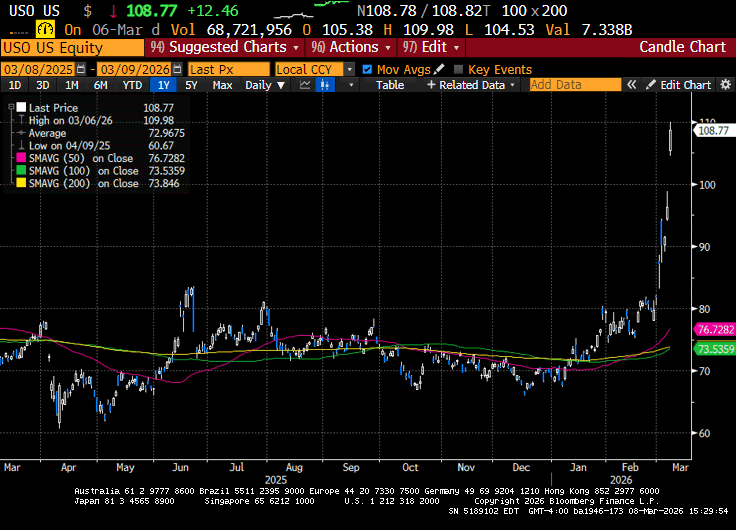
Weekly Market Commentary
Investors endured a difficult week as the conflict between the US, Israel, and Iran continued. Iran’s efforts to target US military bases in the region broaden the conflict across the Middle East. Energy shipments through the Strait of Hormuz have come to a standstill, and some regional energy producers have had to curtail, if not shut down, production due to a lack of supply capabilities. Oil and Natural Gas prices surged throughout the week, stoking inflation fears worldwide. Europe and Asia are much more dependent on imported energy, with Asia feeling the brunt of this week’s market sell-off. The duration of this conflict and the closure of the Strait of Hormuz will likely dictate how the market will react in the coming days and weeks. The Trump administration has suggested it might provide tankers safe passage through the Strait of Hormuz, and China has been negotiating with Iran to allow shipments to continue without threat. President Trump has indicated he wants an Unconditional Surrender, as Iran has announced there is a new Supreme Leader, although the leader has not been named at this time. The recalibration of monetary policy considerations was front and center last week, as inflation fears increased, while labor market data came in much weaker than expected. A potential delay or cancellation of rate cut expectations that were considered a tailwind for US financial markets coming into the year may dampen market return expectations.

The S&P 500 lost 2%, the Dow gave back 3%, the NASDAQ shed 1.2%, and the Russell 2000 plunged 4.1%. Rotation in the market was intriguing, as traditional safe-haven bids were absent. U.S. Treasuries sold off across the curve on inflation concerns. The 2-year yield increased by eighteen basis points to 3.56%, while the 10-year yield increased by seventeen basis points to 4.13% after trading below 4% in the prior week. West Texas Intermediate crude prices increased by $23.80 or 35% to close the week at $90.86 a barrel. Gold prices fell by 1.6% to $5,159.30 per ounce, while silver prices decreased by 9.6% to $84.31 per ounce. Copper prices declined by 4.1% or $0.25 to $5.81 per Lb. Much of the weakness in precious metals was attributed to a strong US Dollar, which gained 1.4% on the week. Bitcoin’s price was all over the place this week, surging to over $73,000 before closing the week around $67,000.

The economic calendar provided investors with a little bit of everything. ADP Private Payrolls were better than expected at 63k, while the Employment Situation Report for February was decisively weak. Non-Farm Payrolls declined by 92k versus an estimated increase of 60k. Private Payrolls declined by 86k versus the consensus estimate of 78k. The Unemployment rate increased to 4.4% from 4.3%, and Average Hourly Earnings ticked up by 0.4%, up from an estimated 0.3%. The Average Work Week came in at 34.3 hours, in line with estimates. Initial Claims for the week were unchanged from the prior week, while Continuing Claims increased by 63k. ISM Manufacturing remained in expansion, although ticked slightly lower from the prior reading at 52.4%. ISM Non-Manufacturing expanded further, coming in at 56.1%, up from the prior reading of 53.8%. January Retail sales missed the mark, with the headline number declining by 0.2% and the Ex-Autos figure coming in flat. Some of the decline in retail sales was attributed to the extreme winter weather in January, keeping consumers out of shops. In the coming week, we will receive more inflation data with the Consumer Price Index and the Fed’s preferred measure of inflation, the PCE. We will also get a deluge of data on the housing market and a second look at Q4 GDP.

Investment advisory services offered through Foundations Investment Advisors, LLC (“FIA”), an SEC registered investment adviser. FIA’s Darren Leavitt authors this commentary which may include information and statistical data obtained from and/or prepared by third party sources that FIA deems reliable but in no way does FIA guarantee the accuracy or completeness. All such third party information and statistical data contained herein is subject to change without notice. Nothing herein constitutes legal, tax or investment advice or any recommendation that any security, portfolio of securities, or investment strategy is suitable for any specific person. Personal investment advice can only be rendered after the engagement of FIA for services, execution of required documentation, including receipt of required disclosures. All investments involve risk and past performance is no guarantee of future results. For registration information on FIA, please go to https://adviserinfo.sec.gov/ and search by our firm name or by our CRD #175083. Advisory services are only offered to clients or prospective clients where FIA and its representatives are properly licensed or exempted.
IRA Beneficiaries and Contribution Limits: Today’s Slott Report Mailbag
By Sarah Brenner, JD
Director of Retirement Education
Question:
Is it wise to designate a grandchild as primary beneficiary for IRA accounts?
Answer:
You can choose to name whomever you want as your IRA beneficiary. If you want your IRA funds to go to your grandchildren, that is your decision and there is nothing wrong with making that choice.
There are some things you will want to be aware of, though, before updating your beneficiary designation. The first is that the SECURE Act has eliminated the stretch for most non-spouse IRA beneficiaries. Your grandchildren will be subject to the 10-year rule unless they are disabled or chronically ill.
There are also some special concerns if your grandchildren are minors. If so, they should not be named directly on the beneficiary form since minors do not have legal authority to conduct business on an investment account. Instead, consider naming a Uniform Transfers to Minors Act (UTMA) or Uniform Gifts to Minors Act (UGMA) account if the custodian will allow it, or a trust if it is a large IRA.
Question:
When mentioning contribution limits to IRAs, shouldn’t you also mention that earned income is an overriding factor?
Jim
Answer:
Hi Jim,
Tax season is the time when many people consider making contributions to IRAs. Your comment is a good reminder that an individual (or their spouse if married) must have earned income or taxable compensation to contribute to an IRA. This can be wages or income from self-employment. Without it, no IRA contribution is possible, and if your taxable compensation is less than the maximum contribution limit for the year, you will only be able to contribute up to the amount of taxable compensation that you (and your spouse if married) have.
If you have technical questions you would like to have answered, be sure to submit them to mailbag@irahelp.com, to be answered on an upcoming Slott Report Mailbag, published every Thursday.
https://irahelp.com/ira-beneficiaries-and-contribution-limits-todays-slott-report-mailbag/

The Retirement Wildcard: How Healthcare Costs Can Impact Your Financial Future
When most people think about retirement planning, they focus on the obvious questions:
Will my savings last?
How much income will I need?
When should I take Social Security?
But there’s one major expense that often catches retirees off guard.
Healthcare.
In fact, healthcare is one of the largest and most unpredictable costs retirees face — and without a plan, it can significantly impact even the most carefully built retirement strategy.
Let’s take a closer look at why healthcare planning deserves a central place in your retirement plan.
Healthcare Costs in Retirement Are Rising
Many people assume that once they reach Medicare age, most of their medical costs will be covered.
While Medicare is a powerful program, it does not cover everything.
Retirees may still face expenses such as:
Medicare premiums
Deductibles and copayments
Prescription drug costs
Dental, vision, and hearing care
Long-term care services
According to industry estimates, the average retired couple may need hundreds of thousands of dollars set aside to cover healthcare expenses throughout retirement.
Without proper planning, these costs can quietly erode retirement savings.
Medicare Is Only One Piece of the Puzzle
Many people are surprised to learn that Medicare comes with several parts and choices:
Part A – Hospital coverage
Part B – Medical services
Part D – Prescription drug coverage
Medicare Advantage or Supplement plans
Each option comes with different coverage levels, costs, and potential out-of-pocket expenses.
Choosing the right structure for your situation can make a significant difference in how much you pay over time.
The Role Insurance Planning Plays in Retirement
This is where thoughtful insurance planning can help.
Insurance strategies can help retirees manage risk and reduce financial uncertainty in areas such as:
Medical costs not covered by Medicare
Prescription drug expenses
Long-term care needs
Income protection for a spouse
A well-designed insurance strategy works alongside your investments to help protect the retirement lifestyle you’ve worked hard to build.
Income Planning and Healthcare Go Hand in Hand
One of the most overlooked parts of retirement planning is how healthcare costs affect income planning.
For example:
Large medical expenses can force withdrawals from retirement accounts
Withdrawals may trigger additional taxes
Higher income could increase Medicare premiums
Without proper planning, one financial decision can create a ripple effect across your entire retirement strategy.
Coordinating healthcare planning with income planning helps retirees avoid these surprises.
Planning Ahead Creates Confidence
The goal of retirement planning isn’t just numbers on a spreadsheet.
It’s confidence.
Confidence that you can:
Maintain your lifestyle
Handle unexpected expenses
Protect your spouse and family
Enjoy retirement without constant financial stress
By incorporating healthcare planning into your financial strategy, you can create a more resilient plan designed to handle life’s uncertainties.
Final Thoughts
Retirement is about more than saving money — it’s about protecting the life you’ve worked hard to build.
Healthcare costs will likely play a significant role in your retirement journey, but with thoughtful planning and the right strategies, they don’t have to derail your financial future.
Taking the time to review your options today can help ensure that your retirement years are focused on what matters most: living well, staying healthy, and enjoying the freedom retirement was meant to bring.
Rolling Over Your Retirement Plan? Here Are 5 Things to Know About Your RMD
By Sarah Brenner, JD
Director of Retirement Education
These days many Americans are still working long beyond what has traditionally been retirement age. This may be by choice or by necessity. If this is your situation, you may be keeping funds in your employer plan well into your seventies and maybe even later. There are some big benefits to extending a career. You can continue to contribute to your retirement account and may even be able to take advantage of rules that allow required minimum distributions (RMDs) to be delayed.
Eventually, however, the time will likely come when you will want to take some or all of the funds out of your plan. You may want to roll over those funds to an IRA. A large percentage of employer plan funds do end up in an IRA eventually. At that time, you will need to pay special attention to your RMD if you have one for the year.
Here are five things to know about your RMD when you are doing a rollover from your plan to your IRA.
1. You must take the RMD from your plan. The first thing to understand is that if you have an RMD from the plan for the year, you will need to take that RMD. It is NOT eligible for rollover to an IRA. It cannot be converted to a Roth IRA. The bottom line is that there is no way around it; you must take it.
2. The first-money-out rule applies. The next thing to know is that the
first money out of your plan is your RMD. This is called the first-money-out rule and many people run afoul of it. You cannot roll part of the funds over now to an IRA and take the RMD later from the plan. You cannot roll over your entire plan balance to your IRA and then take the RMD from the IRA later. If you do either of these, you will wind up with an excess contribution in your IRA. That can mean penalties if it is not corrected on time.
3. There is no aggregation for plan and IRA RMDs. Your plan RMD cannot be aggregated with RMDs from your IRA. This means you cannot take it from your IRA. Also, qualified charitable distributions (QCDs) are not available from plans. They are only available from IRAs, so you cannot offset the income from a plan RMD with a QCD.
4. After the rollover, you have an IRA. Once you have taken your RMD, you may roll over the remainder of your eligible plan funds. When they are deposited to your IRA, they become IRA funds and will be subject to all the IRA rules. There will be no IRA RMD due for the funds rolled over to the IRA for the year of the rollover (because you already took your RMD from the plan prior to the rollover). However, in years going forward, RMDs will be due on these funds just like any other IRA funds.
5. Moving your retirement funds can be complicated and the stakes are high. This is especially true when there is an RMD involved. Failing to follow the rules for your RMD can result in adverse tax consequences and penalties. If you have questions about your own situation, the best way to get it right and avoid costly mistakes is to consult with a financial or tax advisor who is knowledgeable in this very specialized area.
If you have technical questions you would like to have answered, be sure to submit them to mailbag@irahelp.com, to be answered on an upcoming Slott Report Mailbag, published every Thursday.
https://irahelp.com/rolling-over-your-retirement-plan-here-are-5-things-to-know-about-your-rmd/
Fatal Error: Mistakes That Cannot Be Fixed – Part 1
By Andy Ives, CFP®, AIF®
IRA Analyst
When a transactional mistake is made with retirement plan or IRA assets, there is oftentimes a mechanism to correct the error. For example, if too much money is contributed to an IRA, a person can leverage the excess contribution withdrawal rules to remove the excess without penalty (assuming the excess is withdrawn prior to the October 15 correction deadline). In another example, if an IRA owner failed to take his required minimum distribution (RMD), there are procedures in place whereby the person can take the missed RMD and formally request a waiver of the missed RMD penalty from the IRS.
On the other hand, some transactional mistakes have no corrective steps. Once the deed is done, there is no going back. Such missteps can create massive tax bills and result in unintended penalties. Many of these “fatal errors” involve rollovers. Here are a few:
Non-Spouse Beneficiary Rollovers. Only a spouse beneficiary can move inherited plan or IRA dollars between custodians via 60-day rollover. Non-spouse beneficiaries can only move inherited dollars via direct transfer. If pre-tax inherited IRA or plan funds are distributed and payable to a non-spouse beneficiary, those dollars are taxable. End of story. If the recipient tries to roll over the funds, the doors at all potential receiving institutions will be closed. There is no transaction a non-spouse beneficiary can do to reverse what has been done. Any taxes due will be due. As such, it is imperative that non-spouse beneficiaries understand the rollover rules and limitations when attempting to move inherited plan or IRA funds. Failure to do so could result in a significant tax bill and eliminate any ability to spread taxable distributions over a multi-year period.
Spousal Rollover. Spouse beneficiaries are the only beneficiaries that can move inherited dollars into their own account. This is called a “spousal rollover.” However, once this common transaction is completed, it cannot be unwound. If a surviving spouse under age 59½ does a spousal rollover, the inherited assets will follow all the normal rules applicable to a person’s own IRA – including the early distribution rules. If the young surviving spouse then takes a withdrawal from the account, a 10% early distribution penalty will apply (unless an exception exists). If a young spouse knows that she will need access to the funds, a better choice is to delay the spousal rollover for now and maintain an inherited IRA. Any withdrawals from the inherited IRA will be penalty-free, and she can always do a spousal rollover later, after she turns age 59½.
Exceeding the One-Rollover-Per-Year Rule. An IRA owner is only allowed to roll over one distribution received within any 12-month period (for IRA-to-IRA or Roth-IRA-to-Roth-IRA rollovers). If more than one rollover is done, that mistake cannot be fixed. The illegal rollover is deemed to be an excess contribution in the receiving IRA and must be removed. Any pre-tax dollars included in the failed rollover will be taxable. Note that the one-rollover-per-year rule also applies to spousal rollovers if done via 60-day rollover. To sidestep the one-rollover-per-year rule, do direct transfers.
In Part 2 (to be published on March 11), we will discuss more fatal errors that cannot be fixed.
If you have technical questions you would like to have answered, be sure to submit them to mailbag@irahelp.com, to be answered on an upcoming Slott Report Mailbag, published every Thursday.
https://irahelp.com/fatal-error-mistakes-that-cannot-be-fixed-part-1/
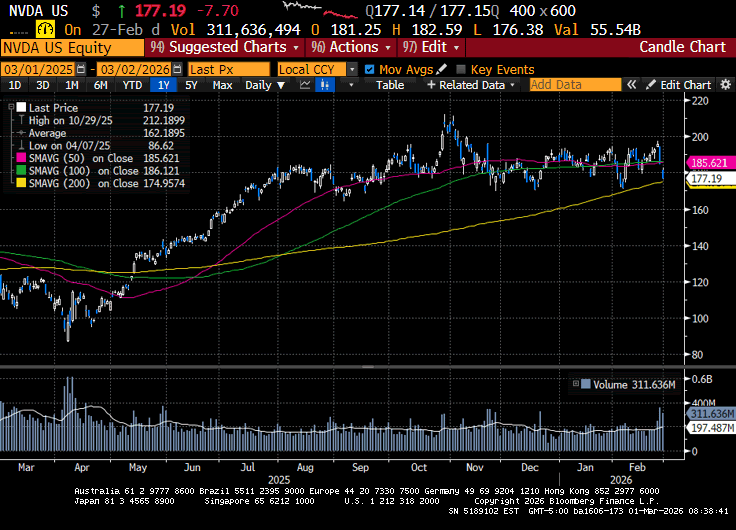
Weekly Market Commentary
US equity markets regressed as several themes that have propelled the market higher over the last couple of years have had to be reassessed. Return on investment from AI capex, a Federal Reserve on hold, tariff uncertainty, and increased geopolitical tensions have investors recalibrating their market expectations.
Return on investment (ROI) on capital expenditures related to AI has been a recurring question mark for investors. Some problems in private credit have heightened concerns about the debt financing of AI initiatives. Nvidia’s 4th-quarter earnings were fantastic, but despite better-than-expected results and guidance, the company’s shares got hammered. “Sell the news” has been prevalent during this earnings season, especially with mega-cap technology companies. A clear rotation out of mega-caps and into other parts of the market occurred throughout February. Trades to value from growth have also been a prominent trend.

Recent economic data appears to be pushing out the timeline for a rate cut by the Federal Reserve. Hotter-than-expected inflation readings, along with a resilient labor market, have several Fed officials pushing back against the idea of a rate cut. Coming into the year, the market expected two rate cuts, which was considered a tailwind for markets. Currently, the market is expecting a rate cut in July, but the likelihood of this cut has diminished throughout February.
Companies are also considering their options in the current tariff environment. What does the recent Supreme Court ruling against the tariffs mean for businesses, and do Trump’s countermeasures delay business decisions, dampening corporate activity?
Saturday morning, the US and Israel attacked Iran, killing several key government officials, including the supreme leader. President Trump called for regime change, and it appears this conflict will not be measured in days but will likely last months, if not longer. There will be a bid for safe-haven assets once the markets open, and we saw signs of this last week with US Treasuries and gold trading higher. Oil has traded higher over the last couple of months amid heightened tensions between the US and Iran, but the closure of the Strait of Hormuz will have profound consequences for energy markets and global trade.
The S&P 500 lost 0.44%, the Dow shed 1.3%, the NASDAQ fell 0.95%, and the Russell 2000 declined by 1.18%. The NASDAQ lost 3.33% in February, while the Russell outperformed with a gain of 0.81%. As I mentioned earlier, US Treasuries were well bid last week, with the 2-year yield declining by ten basis points to 3.38%- the lowest level since August of 2022. The 10-year yield fell by thirteen basis points to 3.96%. For the month, the 10-year yield fell by twenty-eight basis points, while the 2-year yield declined by fifteen basis points. Oil prices increased by $0.57 to $67.06 per barrel. With the Strait of Hormuz closed, it is likely we will see an immediate $5 to $7 increase in oil prices when the market opens, and some have called for oil to trade above $100 a barrel if the Strait is closed for a prolonged period. OPEC on Sunday announced that it would increase production, but I am not sure how this will impact prices if the primary shipping lane is closed. Gold prices increased by 3.3% to $5,248.20 per ounce. Silver prices jumped 12.6% to $92.68 per ounce. Copper prices traded twenty-two cents higher at $6.06 per Lb. Bitcoin’s price fell 2% to $66,500. The US Dollar index fell by 0.2% to 97.60.

S&P 500 2/27/2026
The Producer Price Index came in hotter than expected. The headline reading for January increased by 0.5% versus the consensus estimate of 0.3%. The reading was up 3% year over year, up from 2.9% in December. The Core reading rose 0.8%, well above the consensus estimate of 0.3%, and 3.6% year over year, up from 3.3% in December. Interestingly, the increase in producer prices did very little to curb the bid into Treasuries but did push out rate-cut expectations. Consumer Confidence in February increased to 91.2 from 89 in January. Initial claims increased by 4k to 212k, while Continuing Claims fell by 31k to 1833k.

Investment advisory services offered through Foundations Investment Advisors, LLC (“FIA”), an SEC registered investment adviser. FIA’s Darren Leavitt authors this commentary which may include information and statistical data obtained from and/or prepared by third party sources that FIA deems reliable but in no way does FIA guarantee the accuracy or completeness. All such third party information and statistical data contained herein is subject to change without notice. Nothing herein constitutes legal, tax or investment advice or any recommendation that any security, portfolio of securities, or investment strategy is suitable for any specific person. Personal investment advice can only be rendered after the engagement of FIA for services, execution of required documentation, including receipt of required disclosures. All investments involve risk and past performance is no guarantee of future results. For registration information on FIA, please go to https://adviserinfo.sec.gov/ and search by our firm name or by our CRD #175083. Advisory services are only offered to clients or prospective clients where FIA and its representatives are properly licensed or exempted.

The Retirement Income Plan Most People Think They Have — But Don’t
Retirement isn’t about how much you’ve saved.
It’s about how you turn your savings into income you can rely on — for 20, 30, or even 40 years.
Most people believe their 401(k), IRA, or brokerage account is their retirement plan.
But an investment account is not an income strategy.
And that’s where many retirees get into trouble.
The Big Difference: Savings vs. Income
While you’re working, you live on income.
When you retire, that paycheck stops — and now your portfolio becomes the paycheck.
That shift changes everything.
A true retirement income plan answers questions like:
How much can I safely withdraw each year?
What happens if the market drops early in retirement?
How do I reduce taxes on withdrawals?
When should I claim Social Security?
How do I make sure I don’t run out of money?
If those questions haven’t been clearly mapped out, you may not actually have an income plan.
The Hidden Risk: Sequence of Returns
One of the biggest threats to retirees isn’t inflation.
It isn’t taxes.
It’s timing.
If the market drops in the first few years of retirement while you’re withdrawing income, your portfolio may never fully recover. This is known as sequence of return risk.
Two retirees with identical portfolios can have completely different outcomes depending on market timing.
Without an income structure in place, early losses can permanently reduce retirement sustainability.
The 4 Pillars of a Real Retirement Income Strategy
A comprehensive retirement income plan typically includes:
1. Income Layering
Instead of relying on one source, income is layered:
Social Security
Pensions (if available)
Investment withdrawals
Tax-efficient income streams
Conservative income reserves
The goal is predictability — not guesswork.
2. Tax-Efficient Withdrawal Strategy
Not all dollars are taxed the same.
Strategic planning can help manage:
Required Minimum Distributions (RMDs)
Roth conversion opportunities
Widow’s penalty exposure
Medicare IRMAA brackets
Capital gains timing
The order in which you withdraw assets matters more than most people realize.
3. Risk Positioning
Your investment strategy should shift as retirement approaches.
It’s no longer just about growth — it’s about sustainability.
This often includes:
Reducing unnecessary volatility
Creating short-term income reserves
Protecting core income needs
Structuring assets based on time horizon
4. Longevity Planning
People are living longer than ever.
A retirement income plan should consider:
30+ year retirements
Rising healthcare costs
Long-term care considerations
Inflation adjustments
Retirement planning isn’t just about getting to retirement.
It’s about staying retired.
Why “The 4% Rule” Isn’t a Plan
You’ve probably heard about withdrawing 4% per year.
But the 4% rule was based on historical data from a very specific period of market performance.
Today’s economic environment, tax laws, and longevity trends are different.
A personalized retirement income strategy should be built around:
Your goals
Your lifestyle
Your risk tolerance
Your tax situation
Your legacy priorities
Generic rules don’t account for real life.
The Real Question
It’s not:
“Do I have enough saved?”
It’s:
“Do I have a structured income plan that adapts to market changes, taxes, and longevity?”
Because retirement confidence doesn’t come from a balance sheet.
It comes from clarity.
Ready to See What Your Retirement Income Could Look Like?
If you’d like a clearer picture of:
How much income your portfolio can generate
How to reduce unnecessary tax exposure
When to take Social Security
Whether your current strategy can handle a market downturn
Let’s build a structured retirement income analysis tailored to you.
👉 Schedule Your Retirement Income Review Today
Trump Accounts and Required Minimum Distributions: Today’s Slott Report Mailbag
By Andy Ives, CFP®, AIF®
IRA Analyst
QUESTION:
What’s your opinion of the value of Trump Accounts? Worth it for kids? Should the child do a Roth conversion at age 18? Or is it better just to do a Uniform Transfers to Minors Act (UTMA) account? Or perhaps a mix of both since the IRA/Roth is retirement-only money and the UTMA would be able to be used before retirement?
ANSWER:
There is no right answer as every person is different and has different objectives. However, you cannot argue with the mathematics of compounding interest. Trump Accounts are saddled with several restrictions, but the long-term saving possibilities cannot be denied. Assume annual $5,000 contributions go into a Trump Account for a child until they reach age 18. Those dollars are required to be invested in a vehicle that tracks the S&P 500 index (or any other index comprised of stocks in primarily U.S. companies). As such, it is not unreasonable to imagine the account being worth north of $150,000 by age 18. Trump Accounts then begin following the standard IRA rules and can be converted to a Roth IRA. With a conservative (by historical standards) 6% average annual return, the account could be worth over $1.7 million, tax-free, by the time the child is age 60.
QUESTION:
I’m age 75 and started to take my required minimum distribution (RMD) from my IRA at age 73. I want to know if I don’t need my RMD money, can I just dump it into my Roth IRA account? I can survive on my pension and Social Security that I receive monthly. Please help!
Thank you,
Barbara
ANSWER:
Barbara,
RMDs are not allowed to be converted, so those dollars cannot be dumped into your Roth IRA. However, after your RMD for the year is satisfied, you could then do a Roth conversion at any time during the rest of the year for whatever amount you wish. While this strategy will generate more taxable income now, it will also reduce future RMDs and result in tax-free earnings on the dollars you convert; short-term pain for potential long-term gain.
If you have technical questions you would like to have answered, be sure to submit them to mailbag@irahelp.com, to be answered on an upcoming Slott Report Mailbag, published every Thursday.
https://irahelp.com/trump-accounts-and-required-minimum-distributions-todays-slott-report-mailbag/
New Trump Account Developments
By Ian Berger, JD
IRA Analyst
With contributions to Trump Accounts expected to begin in just a few months, there are some new developments to report.
As a reminder, Trump Accounts are tax-deferred savings accounts for children. They were established by Congress last July as part of the One Big Beautiful Bill Act (OBBBA). Several different kinds of contributions can be made to Trump Accounts:
- A one-time $1,000 contribution from the federal government for children born between 2025 and 2028.
- Individual contributions by parents, grandparents or others on behalf of a child. For 2026, these contributions are limited to $5,000 and are available even for children who don’t qualify for the federal government contribution.
- Employer contributions for children of employees (or for teenage employees). The 2026 annual limit is $2,500, and these contributions count against the $5,000 individual contribution limit.
- Contributions by tax-exempt organizations and governments. These contributions have no annual dollar limit and don’t count against the $5,000 limit.
- Note that none of these contributions can be made before July 4, 2026, and the last three are only for children in the years before they reach age 18.
Trump Accounts are (non-Roth) traditional IRAs. However, until the year the child turns age 18, several special rules apply. For example, the accounts cannot be withdrawn for any reason. In addition, the funds must be invested in a low-cost mutual fund or ETF that tracks the S&P 500 index or another similar index that consists primarily of the stock of U.S. companies.
Here are the new developments:
- On December 2, 2025, the IRS issued Notice 2025-68, which answered some questions about how Trump Accounts will work. Among other things, the IRS said that a Trump Account can be established by filing Form 4547, either by itself or with the 2025 federal income tax return. The IRS has recently created a website, forms.trumpaccounts.gov, that allows Form 4547 to also be completed online. Parents or grandparents can also use Form 4547 to accept the $1,000 federal government contribution for qualifying children.
- Recently, some estate tax attorneys have said that individuals making Trump Account contributions will need to file Form 709 (the gift tax return) with the IRS. This will create an additional headache for parents or grandparents unless Congress or the IRS eases this requirement.
- For federal incometax purposes, all Trump Account contributions (except for individual contributions) are considered pre-tax IRA contributions. This means that taxation of the contributions and their earnings can be deferred until distribution. Individual contributions are considered after-tax IRA contributions, so only their earnings are taxed – but again not until distribution.
For state income tax purposes, most states appear to be following the federal tax treatment. California is an exception. That state has announced that it won’t recognize Trump Accounts as IRA contributions, but instead will treat them as taxable accounts. This means that, in California, employer contributions and tax-exempt organization contributions will be taxed in the year they are made. Only the $1,000 federal government contribution is considered a pre-tax contribution in California (like under federal tax law). In addition, earnings on all types of Trump Accounts contributions will be taxed annually.
The bottom line: California residents who have Trump Accounts will have them taxed one way for federal income tax purposes and another way for state tax purposes.
If you have technical questions you would like to have answered, be sure to submit them to mailbag@irahelp.com, to be answered on an upcoming Slott Report Mailbag, published every Thursday.
https://irahelp.com/new-trump-account-developments/
5 Tips for Making Your 2025 Roth IRA Contribution
By Sarah Brenner, JD
Director of Retirement Education
The tax season is upon us. This is the time when many people consider contributing to a retirement account. You may be interested in the Roth IRA, which offers the promise of tax-free withdrawals in retirement if you follow certain rules. If you are deciding whether a 2025 Roth IRA contribution is the right move for you, here are 5 tips to keep in mind:
1. Know the deadline. The deadline for making a prior year contribution to a Roth IRA for 2025 is April 15, 2026. If you have an extension to file your taxes, that does not give you more time. Sooner is better than later. Don’t wait until the last minute, because you never know what may happen. Be sure to let the IRA custodian know the year for which you are contributing.
Interesting fact: Who do you not have to tell about your Roth IRA contribution? That would be the IRS. There is no requirement that you report a Roth IRA contribution on your 2025 federal tax return. It is good practice, however, for you or your tax preparer to keep track of your Roth IRA contributions.
2. Understand your limits. If you were under age 50 in 2025, the maximum contribution that you may make to a Roth IRA for 2025 is $7,000. For those who reached age 50 in 2025, the maximum contribution limit is $8,000. The annual limit is aggregated for traditional and Roth IRAs. For example, you could contribute $5,000 to your Roth IRA and $2,000 to your traditional IRA. You may not contribute $7,000 to your traditional IRA and $7,000 to your Roth IRA for 2025.
3. Have taxable compensation or earned income. You or your spouse must have taxable compensation or earned income to make a Roth IRA contribution. Passive income such as investment income will not work. Social Security income will not work either.
4. Don’t count yourself out too soon. You are never too old to contribute to a Roth IRA. Do you already contribute to a retirement plan at work? That is not a problem. Your participation in your company plan does not affect your eligibility to make a Roth IRA contribution.
5. Consider the Back Door. Your income must be under certain limits to make a Roth IRA contribution. If your 2025 modified adjusted gross income (MAGI) exceeds $150,000 if you are single, or $236,000 if you are married filing jointly, your ability to contribute to a 2025 Roth IRA begins to be phased out.
If your income is too high, you might consider a back-door Roth IRA. You simply contribute to a traditional IRA, which has no income limits (but don’t forget the taxable compensation or earned income requirement), and convert. Sounds intriguing? Check with a knowledgeable tax or financial advisor to see if this is a good strategy for you. If you have pre-tax funds in any IRA, the pro-rata rule will apply to your Roth conversion and make part of your conversion taxable.
If you have technical questions you would like to have answered, be sure to submit them to mailbag@irahelp.com, to be answered on an upcoming Slott Report Mailbag, published every Thursday.
https://irahelp.com/5-tips-for-making-your-2025-roth-ira-contribution/
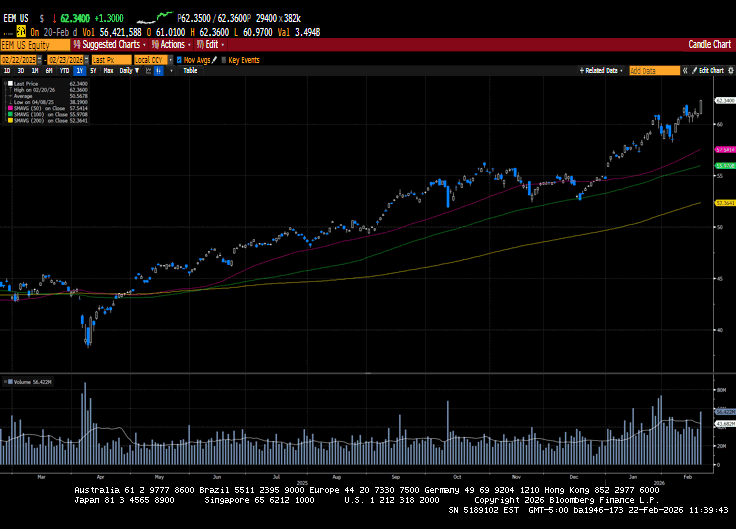
Weekly Market Commentary
The holiday-shortened week produced gains across US indices and saw an emerging market ETF break out to all-time highs. The start of the Chinese Lunar New Year and Ramadan tempered international trading volumes. The tail end of Q4 earnings continued to show constructive results, while tensions between the US and Iran increased as President Trump set a 10-15-day timeline for reaching a deal. The Supreme Court on Friday ruled against many of the tariffs President Trump imposed. The decision was widely expected, but the fallout will have several complex implications. Will the US Government have to repay the estimated $170 billion that has already been taken in? How this will be accomplished and who will receive the repayment are immediate questions. This has real potential to affect US Treasury markets, as more issuance will likely be needed. Trump immediately imposed global levies under sections 122, 232, and 301 of the Trade Act of 1974. The potential economic impact could include lower prices, be particularly beneficial to companies most affected by the tariffs, and even act as a stimulus to the global economy.

The S&P 500 gained 1.1%, the Dow rose by 0.3%, the NASDAQ added 1.5%, and the Russell 2000 increased by 0.7%. Walmart was a notable loser this week after the company announced better-than-expected comparable US sales and a more conservative outlook for the rest of 2026. Figma and Deer shares traded higher after their better-than-expected results. US Treasury yields rose across the curve, with shorter-duration issues taking the brunt of the sell-off. The 2-year yield increased by seven basis points to 3.48%, while the 10-year yield increased by three basis points to 4.09%. Of note, the $16 billion in 20-year Treasuries drew lackluster demand. Oil prices were volatile throughout the week amid what was initially seen as constructive dialogue between the US and Iran, only to be followed by a definitive timeline set for Iran to have a deal on the table. Oil prices increased by 5.8% or $3.64 to close at $66.49 a barrel. Gold prices increased by $33.80 to $5079.90 per ounce, while silver prices increased by 5.7% to $82.34 per ounce. Copper prices increased by four cents to $5.84 per Lb. Bitcoin’s price fell 2.36% to $68,150. The US Dollar index increased by 1% to 97.81.

S&P 500 2/20/2026
The economic calendar was stacked, featuring a stronger-than-expected PCE and a weaker-than-expected Q4 GDP first reading. The Fed’s preferred inflation measure came in at 0.4%, versus the consensus estimate of 0.3%. The headline number was up 2.9% year over year, up from 2.8% in November. The Core reading, which excludes food and energy, was up 0.4%, in line with estimates, but year over year rose to 3% from 2.8% in November. The hotter inflation read likely gives the Fed more reason to delay another rate cut. Personal Income came in line with estimates at 0.4%, while Personal Spending at 0.4% topped expectations of 0.2%. Q4 GDP came in at 1.4% versus the consensus estimate of 3%, with the government shutdown in the quarter likely the culprit for the decline in economic activity. Housing Starts, Building Permits, and New Home Sales all topped estimates; however, single-family starts and permits were materially lower than anticipated. Initial Claims fell by 23k to 206K, while Continuing Claims increased by 17k to 1869K. The final reading for February, the University of Michigan’s Consumer Sentiment, fell to 56.3 from 57.3.
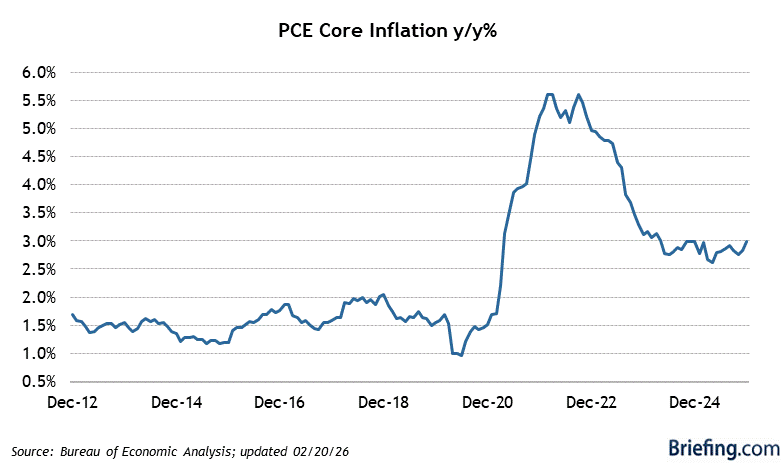
Investment advisory services offered through Foundations Investment Advisors, LLC (“FIA”), an SEC registered investment adviser. FIA’s Darren Leavitt authors this commentary which may include information and statistical data obtained from and/or prepared by third party sources that FIA deems reliable but in no way does FIA guarantee the accuracy or completeness. All such third party information and statistical data contained herein is subject to change without notice. Nothing herein constitutes legal, tax or investment advice or any recommendation that any security, portfolio of securities, or investment strategy is suitable for any specific person. Personal investment advice can only be rendered after the engagement of FIA for services, execution of required documentation, including receipt of required disclosures. All investments involve risk and past performance is no guarantee of future results. For registration information on FIA, please go to https://adviserinfo.sec.gov/ and search by our firm name or by our CRD #175083. Advisory services are only offered to clients or prospective clients where FIA and its representatives are properly licensed or exempted.

Personalized Retirement Strategy: A Plan Built Around You
Retirement isn’t one-size-fits-all. Two people can retire the same year with the same savings and still need completely different strategies—because income needs, taxes, risk tolerance, health care costs, and family priorities are never identical.
A personalized retirement strategy brings all the moving parts together into one organized, adaptable plan. The goal is simple: help you turn what you’ve saved into a reliable lifestyle—while managing risk and keeping taxes as efficient as possible.
Why “Generic” Retirement Planning Falls Short
Many retirement plans focus on a single number—“How much do I need?”—and stop there. But retirement success is less about one target and more about coordination:
Where your retirement income will come from
When you should claim Social Security
How to invest for growth while managing downside risk
How to withdraw funds in a tax-smart way
How to prepare for health care and long-term care costs
How to adapt when life changes
A personalized strategy is built to answer these questions clearly—and to adjust as circumstances shift.
Step 1: Organize Your Income Sources
Most retirees don’t have one “retirement paycheck.” They have multiple income sources that need to work together, such as:
Social Security
Pensions (if available)
IRA / 401(k) withdrawals
Brokerage accounts
Rental income
Part-time work or consulting
Annuities or other income tools (when appropriate)
A good plan maps out what comes from where, when it begins, and how dependable it is. This helps reduce guesswork and creates a clearer picture of monthly cash flow.
Step 2: Manage Risk in a Way That Matches Your Life
Risk isn’t just about the market going up and down. In retirement, you’re also managing:
Sequence-of-returns risk (market drops early in retirement can have a lasting impact)
Longevity risk (outliving your money)
Inflation risk (purchasing power erodes over time)
Health care and unexpected expense risk
A personalized retirement strategy aligns investments with your timeline and goals—often using a “bucket” approach or a blended allocation so you’re not forced to sell long-term investments at the wrong time.
Step 3: Align Withdrawals With a Tax Strategy
Taxes can be one of the biggest “silent expenses” in retirement. Your withdrawal plan can make a major difference in how long your money lasts.
A coordinated strategy may include:
Planning withdrawals across taxable, tax-deferred, and tax-free accounts
Identifying opportunities for Roth conversions (when they make sense)
Managing taxable income to potentially reduce Medicare-related surcharges
Timing withdrawals around Social Security and Required Minimum Distributions (RMDs)
The point isn’t to “avoid taxes” entirely—it’s to reduce unnecessary tax drag and improve long-term efficiency.
Step 4: Build a Retirement Plan That Evolves With You
Life changes. Your plan should, too.
A personalized retirement strategy is not a one-time event—it’s an ongoing process. We help clients update their strategy when:
They retire earlier or later than expected
They sell a home or business
They receive an inheritance
They lose a spouse or become a caregiver
Tax laws change
Markets shift or inflation rises
Health care needs increase
Regular reviews keep your strategy aligned with reality—not just a spreadsheet from years ago.
What a Personalized Retirement Strategy Can Deliver
A well-built, regularly updated plan can help you:
Create more predictable retirement income
Reduce surprises and financial stress
Make confident decisions around major life events
Improve tax efficiency over time
Stay invested with a strategy you understand and trust
Ready for a Retirement Strategy Built for You?
If you’re nearing retirement—or already retired—and want a plan that organizes your income, manages risk, and aligns taxes with your goals, we can help. The first step is a simple conversation to understand where you are today and what you want retirement to look like.
Schedule a consultation to start building a retirement strategy that fits your life—and stays current as life changes.
Conversions of Property and Conversions of Inherited IRA Funds: Today’s Slott Report Mailbag
By Andy Ives, CFP®, AIF®
IRA Analyst
A member of Ed Slott’s Elite Advisor Group℠ emailed us recently with a question about a minor child as beneficiary of her father’s IRA. The question was brief, and I think the expectation was that our reply would be of similar length. But our job is not to answer in the fewest words possible. Our responsibility is to fill in the blanks and make sure that member advisors are armed with all the pertinent details. Here is that communication. (Note: Some details have been changed for privacy.)
QUESTION:
Dad died leaving a $200,000 IRA to his daughter. He was not yet taking required minimum distributions (RMDs). Dad died in 2023. Daughter turned age 15 that year. When does her 10-year window begin?
OUR RESPONSE:
Here are the details in bullet points to keep it all straight:
- Dad died in 2023 prior to his required beginning date (RBD), so no lifetime required RMDs for Dad.
- Daughter is an eligible designated beneficiary (EDB) because she is a minor child of the IRA owner.
- As an EDB, and with death prior to the RBD, Daughter has a choice:
- 10-year rule with NO annual RMDs. The 10-year period would start in 2024 and end in 2033 when the entire account would need to be emptied.OR…
- Stretch RMDs starting in 2024 when Daughter was age 16 (at her birthday that year). The single life expectancy for a 16-year-old is 69.0. That would be Daughter’s starting factor in 2024, and she would subtract 1.0 from that number each year (i.e., 68.0 in 2025, 67.0 in 2026). Daughter would take RMDs each year until and including the year she turns age 21 (2029). At that point, the 10-year period kicks in (the year she reaches age 22). Daughter continues with the same RMD factor she was using, minus 1.0, for years 1–9. The account must be emptied by the end of the year (2039) in which Daughter turns age 31.
- If Daughter has not taken any RMDs in 2024 or 2025, and if she wants to leverage the EDB stretch + 10-year rule, then we have missed RMDs for 2024 and 2025. No worries. We follow the missed RMD penalty waiver request process.
- The process is: take the missed RMD, complete Form 5329, send the form and a letter to the IRS explaining what happened, that it has been corrected, and to please waive the missed RMD penalty. The IRS has shown that it is agreeable to work with proactive taxpayers.
- If Daughter wants to stick with just the 10-year rule and no EDB stretch, then no RMDs have been missed, and no penalty waiver request is needed.
- If Daughter goes with this 10-year/no RMD option, I suggest not waiting until the end of year 10 (2033) to deplete the account, because she could face an elevated “balloon” tax bill. A gradual drawdown over the next few years, being mindful of tax brackets, could be wise.
If you have technical questions you would like to have answered, be sure to submit them to mailbag@irahelp.com, to be answered on an upcoming Slott Report Mailbag, published every Thursday.
https://irahelp.com/real-life-scenario-minor-as-edb-beneficiary/
Real Life Scenario: Minor as EDB Beneficiary
By Andy Ives, CFP®, AIF®
IRA Analyst
A member of Ed Slott’s Elite Advisor Group℠ emailed us recently with a question about a minor child as beneficiary of her father’s IRA. The question was brief, and I think the expectation was that our reply would be of similar length. But our job is not to answer in the fewest words possible. Our responsibility is to fill in the blanks and make sure that member advisors are armed with all the pertinent details. Here is that communication. (Note: Some details have been changed for privacy.)
QUESTION:
Dad died leaving a $200,000 IRA to his daughter. He was not yet taking required minimum distributions (RMDs). Dad died in 2023. Daughter turned age 15 that year. When does her 10-year window begin?
OUR RESPONSE:
Here are the details in bullet points to keep it all straight:
- Dad died in 2023 prior to his required beginning date (RBD), so no lifetime required RMDs for Dad.
- Daughter is an eligible designated beneficiary (EDB) because she is a minor child of the IRA owner.
- As an EDB, and with death prior to the RBD, Daughter has a choice:
- 10-year rule with NO annual RMDs. The 10-year period would start in 2024 and end in 2033 when the entire account would need to be emptied.OR…
- Stretch RMDs starting in 2024 when Daughter was age 16 (at her birthday that year). The single life expectancy for a 16-year-old is 69.0. That would be Daughter’s starting factor in 2024, and she would subtract 1.0 from that number each year (i.e., 68.0 in 2025, 67.0 in 2026). Daughter would take RMDs each year until and including the year she turns age 21 (2029). At that point, the 10-year period kicks in (the year she reaches age 22). Daughter continues with the same RMD factor she was using, minus 1.0, for years 1–9. The account must be emptied by the end of the year (2039) in which Daughter turns age 31.
- If Daughter has not taken any RMDs in 2024 or 2025, and if she wants to leverage the EDB stretch + 10-year rule, then we have missed RMDs for 2024 and 2025. No worries. We follow the missed RMD penalty waiver request process.
- The process is: take the missed RMD, complete Form 5329, send the form and a letter to the IRS explaining what happened, that it has been corrected, and to please waive the missed RMD penalty. The IRS has shown that it is agreeable to work with proactive taxpayers.
- If Daughter wants to stick with just the 10-year rule and no EDB stretch, then no RMDs have been missed, and no penalty waiver request is needed.
- If Daughter goes with this 10-year/no RMD option, I suggest not waiting until the end of year 10 (2033) to deplete the account, because she could face an elevated “balloon” tax bill. A gradual drawdown over the next few years, being mindful of tax brackets, could be wise.
If you have technical questions you would like to have answered, be sure to submit them to mailbag@irahelp.com, to be answered on an upcoming Slott Report Mailbag, published every Thursday.
https://irahelp.com/real-life-scenario-minor-as-edb-beneficiary/
How In-Plan Roth Conversions Work
By Ian Berger, JD
IRA Analyst
In the January 5 edition of the Slott Report, we mentioned that the federal Thrift Savings Plan (for government workers and the military) started offering in-plan Roth conversions on January 28. This article will provide more information about in-plan Roth conversions generally – how they work, their availability, their tax consequences, and who can most benefit from them.
What is an in-plan Roth conversion? It’s a transfer of funds from your non-Roth 401(k) buckets (e.g., pre-tax elective deferrals, non-Roth after-tax contributions and employer matches) to a Roth account within the same plan. Besides active employees, in-plan conversions can be made by former spouses and surviving spouse beneficiaries with a plan account. Conversions cannot be done by non-spouse 401(k) beneficiaries.
In-plan Roth conversions are available to employees in 401(k), 403(b) and governmental 457(b) plans that permit them. (For the sake of simplicity, references in this article to “401(k) plans” mean 401(k), 403(b) and governmental 457(b) plans.)
In-plan Roth conversions are optional for plans. According to a recent report by the Plan Sponsor Council of America, 56% of surveyed plans allow in-plan conversions at any age, while 6% allow them only at age 59½ or older. So, be sure to check with your plan administrator or company HR to see if in-plan Roth conversions are allowed. By contrast, Roth IRA conversions are always available to traditional IRA owners. Roth IRA conversions are also available to inherited 401(k) beneficiaries, but not to inherited IRA beneficiaries.
When you convert funds in pre-tax 401(k) buckets, the conversion is fully taxable to you in the year you do the conversion. However, when you convert funds in a separate after-tax bucket, only part of the conversion is taxable. The conversion is taxable in the same proportion that after-tax earnings in your after-tax bucket bear to the total balance in that bucket. Note that Roth IRA conversions of after-tax amounts are taxed differently. All of your IRAs, including SEP and SIMPLE accounts, are considered in determining the taxable portion of the conversion.
It’s important to remember that once you do an in-plan Roth conversion, it cannot be undone. This means you must have the funds available to pay that year’s tax bill. You also may need to start making quarterly estimated payments to the IRS (or increase existing estimated taxes). Be sure to check with your financial advisor or CPA.
If you’re under 59½, working for a company with a 401(k) plan and want to boost your Roth savings, an in-plan Roth conversion may be an especially good idea. That’s because you normally can’t get access to your pre-tax plan savings in order to do a Roth IRA conversion while you are still employed. But if the plan allows, you can get those funds into a Roth 401(k) account through an in-plan conversion.
If you have technical questions you would like to have answered, be sure to submit them to mailbag@irahelp.com, to be answered on an upcoming Slott Report Mailbag, published every Thursday.
https://irahelp.com/how-in-plan-roth-conversions-work/
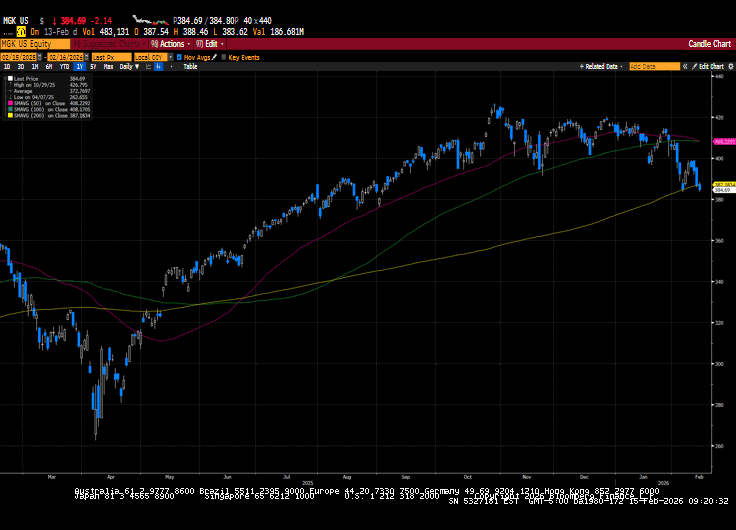
Weekly Market Commentary
US financial markets regressed in choppy trade. The narrative around the disruptive nature of AI continued to impact markets. Rotation away from growth and mega-cap issues continued while proceeds flowed to defensive sectors and small caps. Interest rate-sensitive sectors, such as the utilities and real estate, benefited from lower rates across the curve. Q4 earnings remained robust, but as we have seen in the last few weeks, better-than-expected results have often been met with selling the news.

The S&P 500 lost 1.4%, the Dow fell 1.2%, the NASDAQ gave back 2.1%, and the Russell 2000 shed 0.9%. US Treasury yields fell across the curve for the second week in a row. The 2-year yield fell by nine basis points to 3.41%, while the 10-year yield fell by fifteen basis points to 4.06%. West Texas Intermediate Crude prices fell by 1.1% to $62.85 per barrel. Gold prices increased by $64.10 or 1.3% to $5044.10 per ounce. Silver prices fell by 1.1% to $77.96 per ounce, while Copper prices fell by 1.8% to $5.80 per Lb. Bitcoin’s price fell 3% to $69,000. The US Dollar index fell 0.7% to 96.92.

S&P 500 2/13/2026
Economic data showed benign inflation and better-than-expected employment figures. Non-Farm Payrolls increased by 130k versus the consensus estimate of 68k. Private Payrolls increased by 172k versus an estimated 60k. The Unemployment Rate fell to 4.3% from 4.4%. Average Hourly Earnings increased by 0.4% versus the estimate of 0.3%. The Average Workweek increased to 34.3 hours from 34.2 hours in November. Headline CPI increased by 0.2% versus the consensus estimate of 0.3% and was up 2.4% year over year relative to 2.7% in December. Core CPI, which excludes food and energy, came in line with estimates at 0.3% and fell to 2.5% from 2.6% year over year. Retail Sales showed consumers backing away from purchases in December. Headline Retail sales were flat versus expectations for an increase of 0.4%. The Ex-Auto reading was also flat versus the consensus estimate of 0.4%. Initial Claims decreased by 5k to 227k, while Continuing Claims increased by 21k to 1.862k. Finally, the Employment Cost Index came in at 0.7%, slightly below the expected 0.8% increase.

Investment advisory services offered through Foundations Investment Advisors, LLC (“FIA”), an SEC registered investment adviser. FIA’s Darren Leavitt authors this commentary which may include information and statistical data obtained from and/or prepared by third party sources that FIA deems reliable but in no way does FIA guarantee the accuracy or completeness. All such third party information and statistical data contained herein is subject to change without notice. Nothing herein constitutes legal, tax or investment advice or any recommendation that any security, portfolio of securities, or investment strategy is suitable for any specific person. Personal investment advice can only be rendered after the engagement of FIA for services, execution of required documentation, including receipt of required disclosures. All investments involve risk and past performance is no guarantee of future results. For registration information on FIA, please go to https://adviserinfo.sec.gov/ and search by our firm name or by our CRD #175083. Advisory services are only offered to clients or prospective clients where FIA and its representatives are properly licensed or exempted.

Annuities: Why They Can Be a Smart Addition to Your Portfolio
When you think about building a strong retirement plan, most people focus on a mix of stocks, bonds, and cash. But for many retirees and pre-retirees, there’s another tool that can add stability, predictability, and confidence: annuities.
Annuities aren’t “one-size-fits-all,” and they’re not right for everyone. But when used appropriately, they can play an important role in a diversified financial strategy—especially for people who want to reduce income uncertainty in retirement.
What Is an Annuity?
An annuity is a contract with an insurance company designed to help you accumulate money and/or create a stream of income, often for retirement. Depending on the type of annuity, it may offer:
Income you can’t outlive (in some cases)
Protection from market losses (in certain products)
Tax-deferred growth
Optional benefits like income riders or legacy features
The key is matching the annuity’s purpose to your financial goals.
Why Some Investors Add Annuities to Their Portfolio
1) Predictable Retirement Income
One of the biggest concerns in retirement is:
“Will my money last?”
Certain annuities can provide guaranteed income you can rely on, helping to cover essential expenses like housing, utilities, food, and insurance. This can complement Social Security and pension income (if you have one), filling gaps and reducing stress.
Common fit: People who want a “paycheck” style retirement.
2) Protection From Market Volatility (When Designed That Way)
Many retirees don’t mind market swings as much when they’re still working. But once you’re withdrawing from your savings, volatility matters more.
Some annuity types can be structured to help reduce downside risk, which may help avoid selling investments at the wrong time during a market downturn.
Common fit: Investors who want growth potential but with guardrails.
3) Tax-Deferred Growth
Annuities typically grow tax-deferred, meaning you don’t pay taxes on gains each year like you might in a taxable brokerage account. This can be useful for people who have already maxed out other tax-advantaged options (like 401(k)s and IRAs) and are looking for additional ways to grow savings.
Note: Withdrawals are taxed based on how the annuity is funded (qualified vs. non-qualified), and early withdrawals may trigger penalties.
4) Longevity Risk Management
People are living longer—which is great—but it creates a real planning challenge. Retirement might last 25–35 years (or more).
Some annuities are designed specifically to address longevity risk, helping provide income even if you live well beyond average life expectancy.
Common fit: People worried about outliving their assets.
5) Portfolio Diversification Beyond Traditional Investments
Diversification isn’t just about owning different stocks or adding bonds. It can also mean diversifying income sources and risk types.
Annuities may provide benefits that are not tied directly to the stock market in the same way traditional investments are. That can help stabilize a plan—especially when paired thoughtfully with other assets.
Types of Annuities (Quick Overview)
There are several kinds, and the right one depends on your goals:
Fixed Annuities: Generally offer a set rate for a period of time.
Fixed Indexed Annuities (FIAs): Tie potential growth to a market index with rules (caps/participation rates), often with downside protection.
Variable Annuities: Invest in sub-accounts (market-based). Can offer higher potential but may include more risk and fees.
Immediate Annuities: Convert a lump sum into income that can begin right away.
Deferred Income Annuities / Longevity Annuities: Income starts later, often used to ensure against living a very long time.
When Annuities May Make Sense
An annuity may be worth considering if you:
Want more predictable retirement income
Prefer stability and risk management over maximum upside
Are close to retirement and concerned about sequence-of-returns risk
Want to supplement Social Security with another guaranteed income source
Have a conservative portion of your portfolio you want structured differently
Important Considerations Before Buying
Annuities can be valuable, but they’re also contracts—so details matter. Before purchasing, it’s smart to review:
Fees and costs (especially on variable annuities)
Surrender periods and liquidity options
Income rider details (how income is calculated, restrictions)
Insurer strength (claims-paying ability matters)
How it fits your overall plan (not just the product features)
The goal isn’t to “buy an annuity.” The goal is to solve a specific planning problem—like income certainty, risk reduction, or longevity protection.
Bottom Line: Annuities Are a Tool—Not a Strategy by Themselves
A well-designed retirement plan often blends growth, stability, and income. For the right person, an annuity can be a strong component of that plan—helping reduce uncertainty and create a more confident retirement.
If you’re curious whether an annuity could fit your situation, it may be worth a planning conversation to compare options, costs, and how it integrates with the investments you already own.
Want to see if an annuity makes sense for you?
A quick review can help determine whether adding guaranteed income or downside protection could strengthen your retirement plan. Reach out to schedule a consultation.
Health Savings Accounts and the “Still-Working” Exception: Today’s Slott Report Mailbag
Don’t Miss This Rule That Allows Smaller RMDs
By Sarah Brenner, JD
Director of Retirement Education
If you are age 73 or older in 2026, you will need to take a required minimum distribution (RMD) from your IRA. Usually, an RMD is calculated using the IRS Uniform Lifetime Table. However, if you are married to a spouse who is more than 10 years younger, and your spouse is the sole primary beneficiary of your IRA, there is a special rule that applies. You may calculate your RMD using the IRS Joint Life Expectancy Table instead.
What is the benefit? The RMD will be smaller. This can be an advantage for IRA owners who do not need the money and want to minimize taxable income.
Remember that your spouse must be your sole primary beneficiary for the entire year to use this special rule. If you have named multiple beneficiaries on your IRA, then you must use the Uniform Lifetime Table. Contingent beneficiaries are not considered when determining if your spouse is your sole beneficiary.
This opportunity to take a smaller RMD is often missed. Many IRA custodians default to the Uniform Lifetime Table when providing IRS RMD statements (which are required) to IRA owners. The RMD statement, therefore, may not give you the correct RMD amount if your spouse is your sole beneficiary and is more than 10 years younger than you.
If this is your situation, you may need to manually calculate and request the lower amount. You can find the Joint Life Expectancy Table in IRS Publication 590-B. To calculate the RMD, use the factor that corresponds to the ages that you and your spouse reach on your birthdays in 2026. Then divide that factor into your December 31, 2025, IRA balance. Example: Robert, age 76, is married to Maria, age 60. She is his sole IRA beneficiary. Because Maria is more than 10 years younger and the sole beneficiary, Robert can use the Joint Life Expectancy Table to determine the factor to calculate his RMD for 2026. If Robert and Maria look at the intersection of age 76 and age 60 on this table, the life expectancy factor is 28.2. For comparison purposes, the Uniform Lifetime Table’s factor for age 76 is 23.7, which would result in a larger RMD.
If you have technical questions you would like to have answered, be sure to submit them to mailbag@irahelp.com, to be answered on an upcoming Slott Report Mailbag, published every Thursday.
https://irahelp.com/dont-miss-this-rule-that-allows-smaller-rmds/
